June 9, 2026
Why the 3T Minerals Market Is Reshaping Global Supply Chain Thinking
The world's most sophisticated electronics, from the semiconductors powering artificial intelligence servers to the capacitors embedded in electric vehicle battery management systems, share a quiet dependency on three metals most investors have never heard of. Tin, tantalum, and tungsten, collectively referred to in the mining industry as 3T minerals, sit at the intersection of modern technology and geopolitical vulnerability. Unlike lithium or cobalt, which have attracted enormous mainstream attention, the 3T complex operates largely beneath the radar of retail investors, yet their supply concentration risks are arguably more acute.
Understanding why Aterian's Rwanda tin tantalum tungsten supply agreement matters requires first understanding the structural dynamics of the 3T market and what makes Rwanda such a strategically significant jurisdiction within it.
When big ASX news breaks, our subscribers know first
The Structural Case for 3T Minerals in 2026
Tantalum is an irreplaceable component in the miniaturised capacitors used across smartphones, laptops, and telecommunications equipment. Its high melting point and corrosion resistance make substitution technically and economically prohibitive in many applications. Tungsten's strategic importance extends to defence-grade armour-piercing munitions, industrial cutting tools, and radiation shielding, while tin remains foundational to the global electronics sector as the primary material in lead-free soldering.
What unites all three minerals is a supply picture characterised by significant geographic concentration and a growing push among Western technology manufacturers to diversify away from single-source dependencies. According to the U.S. Geological Survey, the Democratic Republic of Congo dominates global tantalum mine production, while China controls a commanding share of tungsten output. This concentration has prompted semiconductor manufacturers and defence contractors to actively seek alternative, traceable, conflict-free supply chains from politically stable jurisdictions.
Rwanda has emerged as one of the most compelling answers to that search. Furthermore, the broader critical minerals demand surge anticipated through 2025 and beyond only strengthens Rwanda's strategic position.
Rwanda's Unique Positioning in Global 3T Supply
Rwanda's significance in the 3T sector extends well beyond its geological endowment. The country has invested substantially in building the institutional and regulatory infrastructure required to meet the traceability standards demanded by international buyers. The iTSCi programme, a mineral supply chain traceability initiative operated across the Great Lakes region of Africa, functions as the backbone of Rwanda's responsible sourcing architecture, tagging mineralised bags at source and tracking them through every stage of the supply chain.
The Responsible Minerals Initiative (RMI), which operates the Responsible Minerals Assurance Process (RMAP), provides additional third-party audit infrastructure that Rwandan 3T exporters can access to achieve smelter-level certification. These frameworks are not merely compliance exercises. They have become genuine commercial prerequisites for accessing buyers in the United States, European Union, and Japan, where downstream manufacturers face regulatory pressure to demonstrate conflict-free sourcing.
Rwanda's political stability, functioning export infrastructure, and established relationships with certified smelters in Southeast Asia and Europe have made it one of the few African 3T jurisdictions capable of meeting the due diligence expectations of Tier 1 technology companies. This is the commercial environment into which Eastinco, Aterian's Rwanda-focused trading subsidiary, is expanding. Research into tantalum, tin, and tungsten production in Rwanda further underscores the country's growing importance in global supply chains.
What the Aterian Rwanda Tin Tantalum Tungsten Supply Agreement Actually Involves
Aterian plc, listed on the London Stock Exchange, has structured its business model around two complementary engines: an active exploration portfolio spanning Morocco, Botswana, and Rwanda, and a cash-generating trading operation run through Eastinco. The Aterian Rwanda tin tantalum tungsten supply agreement announced in June 2026 represents a meaningful acceleration of the trading engine.
The agreement establishes a long-term framework with an established Rwanda-based 3T producer and exporter, creating a structured mechanism for sourcing and supplying 3T concentrates into Eastinco's trading pipeline. Rather than committing to rigid fixed-volume offtake, the framework is designed to scale incrementally as supply volumes increase in line with operational targets and prevailing market demand.
Key provisions of the arrangement include:
- Responsible sourcing and traceability obligations embedded throughout the supply chain
- Operational collaboration between Eastinco and the counterparty producer
- Chain-of-custody controls and ongoing compliance oversight
- Supplier verification protocols aligned with international due diligence frameworks including the OECD Due Diligence Guidance for Responsible Supply Chains of Minerals from Conflict-Affected and High-Risk Areas
The confidential nature of the counterparty's identity is consistent with standard practice in competitive mineral trading environments, where supplier relationships represent proprietary commercial assets.
The 50% Revenue Uplift Target: Context and Caveats
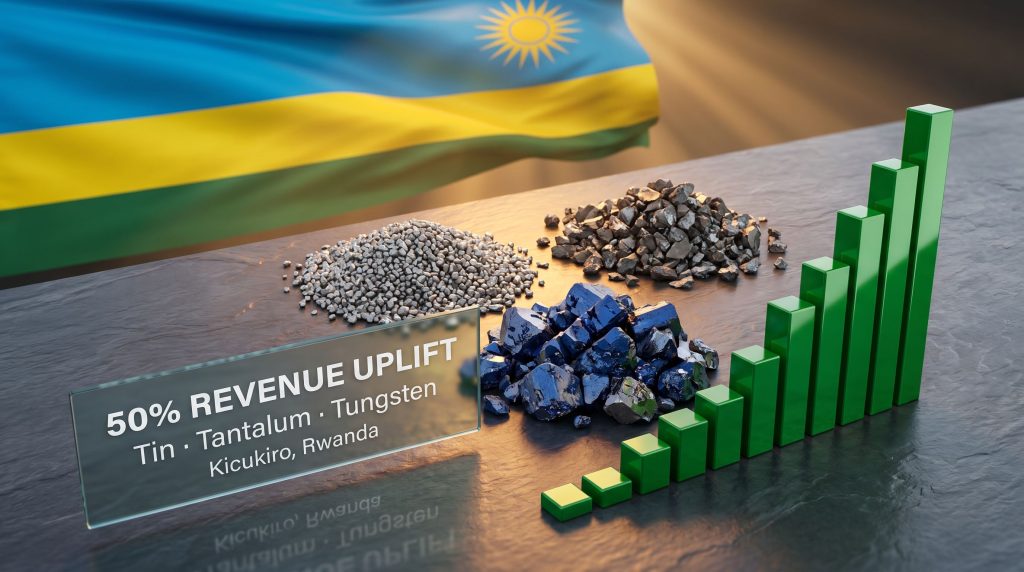
The agreement is anticipated to potentially increase Eastinco's targeted trading revenues by approximately 50% before the end of the current financial year. This projection carries meaningful significance for a trading platform still in its scaling phase, but investors should approach it with appropriate analytical rigour.
Investor Note: The 50% targeted revenue increase is contingent on supply volumes ramping in line with operational targets and prevailing 3T commodity pricing dynamics. It represents a targeted projection, not a guaranteed financial outcome. Readers should conduct independent due diligence and consider this figure within the broader context of early-stage trading platform risk.
The revenue uplift projection reflects the anticipated feedstock contribution from the new supply agreement layered on top of Eastinco's existing trading baseline. The pace at which this materialises will depend on the counterparty's production ramp, logistics throughput, and the trading conditions prevailing across tin, tantalum, and tungsten markets over the remainder of 2026. The supply agreement announcement provides further detail on the commercial terms supporting this growth trajectory.
Operational Infrastructure Supporting the Scale-Up
What distinguishes this announcement from a purely contractual development is the series of coordinated operational investments Aterian has made to prepare Eastinco for higher trading volumes.
The Kicukiro Warehouse: Physical Capacity Meets Strategic Intent
Eastinco has secured a new warehouse and operational facility in Kicukiro, Rwanda, covering approximately 500 square metres of dedicated storage, handling, and logistics space. The Kicukiro district sits within the greater Kigali area, Rwanda's commercial and administrative hub, providing proximity to the country's primary export logistics corridors.
In critical minerals trading, physical infrastructure is often underestimated by investors analysing early-stage companies. The ability to receive, sort, store, weigh, sample, and dispatch mineralised concentrates efficiently is a fundamental operational competency. A constrained warehouse footprint creates bottlenecks that suppress throughput regardless of how strong the commercial pipeline becomes. The Kicukiro facility directly addresses this constraint.
David Kayigire: Embedding Local Commercial Intelligence
The appointment of David Kayigire as local head of trading and director of Eastinco reflects a deliberate strategy of embedding senior expertise at the operational level within Rwanda rather than managing the trading business remotely from London.
Kayigire brings a professional background spanning mineral sourcing, supply chain oversight, traceability systems, and environmental studies within the Rwandan mineral sector. In a market where supplier relationships, local regulatory relationships, and community trust are genuine competitive differentiators, local leadership of this calibre is a material operational asset.
His mandate includes strengthening Eastinco's sourcing networks, deepening supplier relationships, and progressively increasing supply volumes while sustaining the responsible sourcing standards that underpin Eastinco's commercial credibility with international buyers.
The Dual-Engine Model: Why Trading and Exploration Belong Together
For junior mining companies, the conventional path to value creation involves raising equity capital to fund exploration, discovering a resource, completing feasibility studies, and eventually either selling the asset or attempting to finance mine development. This cycle is capital-intensive, dilutive, and heavily dependent on equity market sentiment.
Aterian's model challenges this convention by pairing exploration with an actively revenue-generating trading operation. The strategic logic is compelling:
| Strategic Benefit | What It Means for Shareholders |
|---|---|
| Reduced Dilution Risk | Trading revenues diminish reliance on repeated equity raises to fund exploration work programs |
| Internal Cash Flow Generation | A self-funding mechanism that reduces dependence on market conditions for capital access |
| Exploration Funding Source | Trading profits can be systematically recycled into drilling campaigns and resource development |
| Proprietary Market Intelligence | Active trading builds real-time pricing data and supply chain visibility unavailable to pure exploration companies |
| Strategic Counterparty Networks | Supplier relationships create long-term commercial optionality beyond simple trading margins |
| Asset Monetisation Flexibility | Established trading infrastructure can be leveraged in future asset transactions or joint venture structures |
The exploration portfolio itself spans three jurisdictions: Morocco, Botswana, and Rwanda. This geographic diversification reduces single-country political risk while maintaining a concentrated focus on minerals aligned with the energy transition and defence technology thematics. In addition, considerations around defence critical minerals supply chains are increasingly shaping how Western governments and technology companies approach sourcing strategy.
What the Management Realignment Signals
The restructuring of executive responsibilities announced alongside the supply agreement carries its own strategic signal. Chairperson Charles Bray is assuming direct strategic oversight of Eastinco's trading operations, while CEO Simon Rollason redirects his focus toward advancing the exploration portfolio.
Elevating trading oversight to chairperson level is not a routine administrative adjustment. It communicates that Aterian's board views Eastinco's trading platform as sufficiently mature and financially significant to warrant senior executive attention at the highest governance level. Aterian's management has indicated that the market has not yet fully recognised the strategic and financial value embedded within Eastinco's trading platform, positioning the current period as one in which the trading business is expected to close that valuation gap.
Responsible Sourcing as a Commercial Differentiator
One of the least appreciated dynamics in the global 3T market is the degree to which compliance infrastructure has shifted from being a cost centre to a revenue driver. As the EU Conflict Minerals Regulation came into full effect for all EU-based importers and the OECD Due Diligence Guidance continues to set the standard for global sourcing practices, the ability to demonstrate a fully auditable, conflict-free supply chain has become a genuine pricing premium driver.
Aterian's management has explicitly acknowledged this dynamic, noting that robust governance and traceability frameworks are becoming increasingly important competitive differentiators as demand for responsibly sourced critical minerals continues to expand globally. Furthermore, antimony in critical minerals markets illustrates a broader pattern in which previously overlooked metals are gaining strategic recognition as supply concentration risks become more apparent.
Eastinco's compliance architecture includes:
- Rigorous supplier verification procedures before any sourcing relationship is initiated
- Chain-of-custody controls tracking concentrate volumes from origin through to export
- Ongoing compliance oversight and internal audit processes
- Alignment with internationally recognised due diligence frameworks governing conflict-affected and high-risk area sourcing
This infrastructure is difficult and time-consuming to build. Companies that have already invested in it possess a structural advantage over new entrants seeking to access the same buyer relationships.
The next major ASX story will hit our subscribers first
Key Metrics at a Glance
| Factor | Detail |
|---|---|
| Agreement Structure | Long-term supply framework for 3T concentrates |
| Minerals Covered | Tin, tantalum, tungsten |
| Operating Jurisdiction | Rwanda, East Africa |
| New Facility | Approximately 500 m² warehouse in Kicukiro, Rwanda |
| Revenue Uplift Target | Approximately 50% increase in targeted trading revenues before year-end |
| New Local Appointment | David Kayigire, Head of Trading and Director, Eastinco |
| Management Realignment | Chairperson Charles Bray oversees trading; CEO Simon Rollason focuses on exploration |
| Compliance Framework | Responsible sourcing, traceability, chain-of-custody, supplier verification |
| Strategic Objective | Scalable, cash-generative critical minerals trading platform complementing exploration |
Frequently Asked Questions
What minerals does the Aterian Rwanda supply agreement cover?
The arrangement covers the three T minerals, specifically tin, tantalum, and tungsten, collectively processed as 3T concentrates, sourced from an established Rwanda-based producer and exporter.
Who is Eastinco Limited?
Eastinco is the Rwanda-focused critical minerals trading subsidiary of London-listed Aterian plc, functioning as the commercial trading arm of the broader group.
What is the expected financial impact?
The arrangement is anticipated to potentially increase Eastinco's targeted trading revenues by approximately 50% before the end of the current financial year, subject to supply ramp conditions and prevailing commodity pricing. This is a targeted projection and not a guaranteed financial outcome.
What responsible sourcing standards does Eastinco apply?
Eastinco applies comprehensive due diligence procedures including supplier verification, chain-of-custody controls, mineral traceability systems, and ongoing compliance oversight aligned with international responsible sourcing frameworks including the OECD Due Diligence Guidance.
What is the Kicukiro facility used for?
The approximately 500 m² facility in Kicukiro, Rwanda, serves as Eastinco's expanded warehouse and operational base, designed to improve storage capacity, logistics efficiency, and commodity throughput as trading volumes scale.
Why has the chairperson taken direct oversight of trading?
The realignment reflects the increasing strategic and financial significance of Eastinco's trading platform within Aterian's overall corporate model, with Chairperson Charles Bray assuming direct executive responsibility to support the next phase of the platform's development.
What This Means for East Africa's Critical Minerals Sector
Agreements of this nature are quietly redefining how junior companies operating in East Africa are valued. The traditional exploration-only model leaves companies almost entirely exposed to resource discovery risk, commodity pricing cycles, and equity market sentiment. A trading layer changes the risk profile materially.
Rwanda's 3T sector benefits from infrastructure that many comparable African mineral jurisdictions simply do not yet possess. Established smelter relationships, functional traceability systems, and a regulatory environment oriented toward responsible export create a commercial foundation that is genuinely difficult to replicate quickly. Consequently, critical minerals and energy security considerations are increasingly drawing institutional attention toward precisely the kind of jurisdiction-diversified, compliance-first model that Eastinco represents.
For companies like Eastinco that have already built operational presence and compliance credibility within that environment, the medium-term competitive position strengthens with each incremental expansion of the supplier network and trading volume. The Aterian Rwanda tin tantalum tungsten supply agreement represents one milestone within a longer-term strategy, but its combination of revenue impact, infrastructure investment, local leadership appointment, and management realignment suggests a business moving deliberately from early-stage into scaled operations.
This article is provided for informational purposes only and does not constitute financial or investment advice. Forward-looking statements, including revenue projections and operational targets, involve inherent uncertainty and should not be relied upon as guarantees of future performance. Readers should conduct independent due diligence before making any investment decisions.
Want to Track the Next Major Critical Minerals Discovery Before the Market Does?
Discovery Alert's proprietary Discovery IQ model instantly identifies significant ASX mineral discoveries across 30+ commodities — including critical minerals like tin, tantalum, and tungsten — delivering real-time alerts that turn complex data into actionable opportunities for both short-term traders and long-term investors. Explore how historic discoveries have generated substantial returns on Discovery Alert's dedicated discoveries page, and begin your 14-day free trial today to position yourself ahead of the broader market.