June 9, 2026
Why the Mining Industry's Electrification Challenge Is Bigger Than the Technology
The energy transition story told in consumer markets, where internal combustion engines give way to lithium-ion battery packs, barely scratches the surface of what industrial decarbonisation actually demands. In mining, a single haul truck can weigh more than 300 tonnes, consume thousands of litres of diesel per day, and operate across terrain that no public charging network was ever designed to serve. The forces reshaping passenger transport do not translate cleanly to this environment. What the mining industry faces is not a product substitution problem. It is a systemic redesign challenge, one that touches power infrastructure, equipment procurement cycles, workforce capability, and operational philosophy simultaneously.
This is the context in which ABB solving the electrification puzzle in mining has become one of the more closely watched engineering stories in the resources sector. The company's eMine framework represents a deliberate shift away from component-level thinking and toward coordinated system architecture, treating the transition to zero-emission operations as something that must be designed into a mine rather than bolted onto an existing one.
When big ASX news breaks, our subscribers know first
Diesel's Structural Grip on Mine Haulage
Surface and underground mining operations have been built around diesel for more than half a century. The fuel's energy density, infrastructure simplicity, and compatibility with heavy-load haulage made it the default choice long before decarbonisation entered the industry's vocabulary. Today, haul trucks account for the single largest share of direct emissions at most surface operations, and the diesel engine remains deeply embedded in both equipment design and operational planning assumptions.
The barriers to change are not simply technological. They include:
- Power infrastructure gaps at remote sites, where grid connections are often inadequate to support large electrified fleets without significant substation investment
- Equipment interoperability complexity, given that most large mines run multi-OEM fleets where no single manufacturer controls the full transition pathway
- Total cost of ownership uncertainty, particularly for operators who lack visibility over the full lifecycle economics of electric drivetrains in harsh mining conditions
- Capital lock-in risk, where long-lived diesel fleet purchases made today may become stranded assets as regulatory environments tighten
A simple swap from diesel to electric at industrial scale fails because it ignores these interdependencies. Placing an electric truck on a site without addressing grid capacity, charging infrastructure, and operational scheduling is the electrification equivalent of building a highway with no petrol stations. Furthermore, broader discussions around mining electrification and decarbonisation confirm that systemic thinking is increasingly recognised as the only viable path forward.
The Improving Economics of Mine Electrification
The cost-benefit equation has shifted materially over the past decade. Battery energy density improvements have expanded the operational range of electric equipment, while the declining cost of renewable energy generation has made on-site power sourcing more viable. In addition, the growing adoption of renewable energy in mining has further strengthened the financial case for transitioning away from diesel dependency.
At the same time, ESG commitments from major mining houses, the gradual expansion of carbon pricing mechanisms in key jurisdictions, and investor pressure around science-based emissions targets have raised the cost of inaction alongside the cost of transition. ABB's own position is that the trade-off for electrification is getting better, a view that reflects not just improving hardware economics but also the accumulating body of reference cases that reduce the perceived risk of early adoption.
What ABB's eMine Framework Actually Does
eMine is not a single product. It is an end-to-end electrification architecture that integrates multiple subsystems into a coherent operational framework, covering everything from power supply and overhead trolley infrastructure to high-power automated charging, battery-electric vehicle integration, and digital energy management.
The following table outlines the core components and their operational roles:
| eMine Component | Primary Function | Key Operational Benefit |
|---|---|---|
| Trolley Assist | External power via pantograph on haul trucks | Eliminates diesel combustion on high-consumption ramp sections |
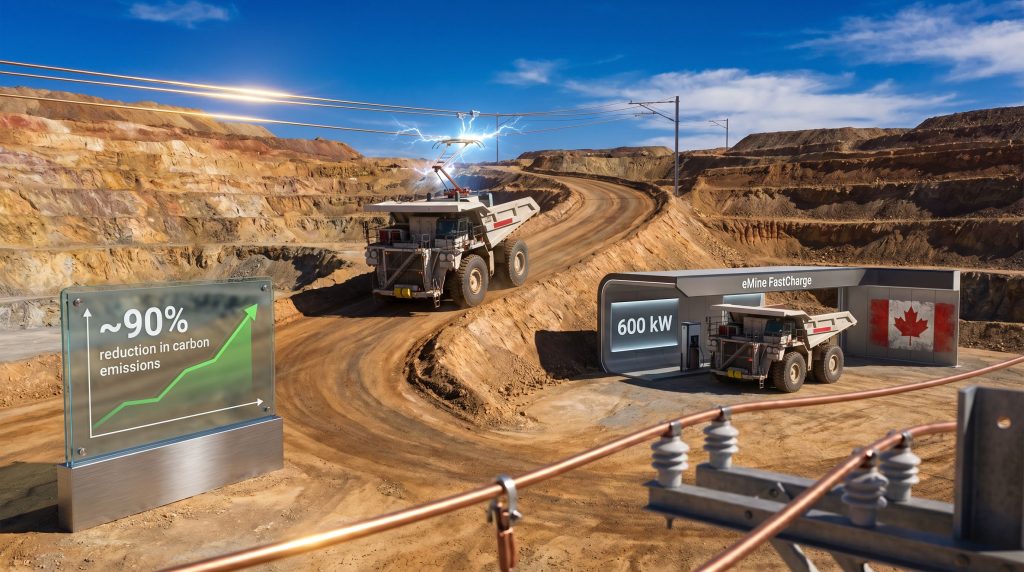
| eMine FastCharge | Automated charging up to 600 kW | Minimises fleet downtime between operating cycles |
| Battery-Electric Integration | Multi-OEM compatible vehicle electrification | Enables fleet-wide transition without single-vendor dependency |
| Digital Control and Monitoring | Real-time energy management and safety oversight | Full visibility across the mine's power system |
| Simulation and Early Engagement | Pre-procurement electrification design modelling | Reduces capital risk and prevents costly post-construction retrofitting |
The philosophy underpinning this architecture is sometimes described as pit-to-port electrification, meaning the intent is to address every stage of the material movement chain, not just the highest-visibility haulage segment. What makes this approach technically significant is its insistence on interoperability. Most large mines operate equipment from multiple manufacturers, and an electrification solution that only works with one OEM's trucks creates a ceiling on how far the transition can actually progress.
ABB's standardised interface approach is designed to remove that ceiling. By establishing open architecture protocols that any compliant vehicle can connect to, the framework gives mine operators the flexibility to manage fleet transitions on their own timelines without becoming captive to a single supply chain.
How Trolley Assist Delivers Near-Term Emissions Impact
Of all the components within the eMine system, trolley assist offers the most immediate and measurable emissions reduction for open-pit operations. The mechanism is straightforward: diesel-electric haul trucks are fitted with pantographs that connect to overhead electrified lines installed along the primary ramp sections of the pit. While connected, the trucks draw power directly from the grid to drive their electric motors, bypassing the diesel engine entirely.
This matters because the ramp is where a haul truck burns most of its fuel. Loaded trucks climbing out of deep open pits under full engine load represent the peak of the consumption and emissions curve. Removing diesel combustion from precisely this portion of the haul cycle delivers disproportionate impact relative to the proportion of total route distance covered by trolley infrastructure.
ABB's deployment at Copper Mountain in British Columbia, Canada, produced approximately a 90% reduction in carbon emissions on trolley-assisted haul routes compared with conventional diesel-only operation. Beyond emissions, the system also delivered productivity gains through increased haul speeds on ramp gradients, where trolley-powered trucks can climb faster than their diesel counterparts due to the superior torque characteristics of electric drive.
The infrastructure requirements for trolley systems include substation capacity upgrades, overhead line installation along the trolley corridor, and terrain-specific engineering to account for ramp geometry. These are non-trivial investments, but the emissions and productivity returns at sites like Copper Mountain have established a compelling reference case that other operators can model their own business cases against. For context, ABB's seven-step guide to electrifying the mining industry outlines precisely how operators can structure a transition program around proven infrastructure components like trolley assist.
Breaking Ground Underground: The Rävliden Milestone
While open-pit trolley deployments have accumulated a meaningful track record, the underground application of the same concept presented a different order of engineering complexity. Ventilation constraints, confined geometry, and the physical challenges of installing overhead infrastructure in underground drives created barriers that had previously prevented any commercial-scale underground trolley installation.
ABB collaborated with Epiroc to deliver the world's first underground trolley solution at Boliden's Rävliden mine in Sweden, which is designed as a fully electrified underground operation. The significance of this project extends well beyond Boliden's own operations. It established a technical precedent that had not previously existed at commercial scale, demonstrating that the same pantograph-based power delivery approach proven in open-pit environments can be adapted to the underground context.
Boliden has positioned Rävliden as part of a broader electrification strategy across its Swedish and Finnish mining portfolio, where access to low-carbon grid electricity makes the emissions case for electrification particularly strong. The project also highlighted a secondary benefit of underground electrification that is often underappreciated: reduced ventilation requirements. Diesel engines underground generate heat, exhaust gases, and particulate matter that require extensive ventilation infrastructure to manage. Electric equipment eliminates these outputs, allowing mine operators to reduce ventilation energy consumption, which itself represents a significant portion of underground mine operating costs.
The 600 kW Question: Why Charging Speed Is a Production Variable
For electrified fleets to function as production assets rather than experimental demonstrations, charging infrastructure must be fast enough to keep trucks in productive operation across full shift cycles. The eMine FastCharge system's 600 kW output is not an arbitrary specification. It reflects the energy requirements of large haul trucks and the operational tolerance for downtime that mine scheduling systems are built around.
The comparison with road transport charging standards illustrates the scale difference:
| Metric | Road EV Fast Charging | eMine FastCharge |
|---|---|---|
| Typical Power Output | 50 to 350 kW | Up to 600 kW |
| Vehicle Weight Class | Passenger and light commercial | Heavy mining trucks (100 to 300+ tonnes) |
| Automation Level | Manual plug-in | Highly automated connection |
| Operating Environment | Public infrastructure | Harsh mine site conditions |
| Downtime Sensitivity | Low | Extremely high (production-critical) |
The automated connection design of FastCharge is particularly relevant in mining environments where manual plug-in procedures would introduce safety risks and operational inefficiencies at scale. When multiple trucks are cycling through charging stations during shift changes or operational pauses, automation reduces the margin for human error and keeps the energy replenishment process integrated with the mine's broader production management systems.
Demand management also becomes critical when multiple large trucks charge simultaneously. Digital energy management systems within the eMine framework monitor aggregate grid load in real time, coordinating charging schedules to prevent demand spikes that could destabilise the mine's power supply. This kind of intelligent load management is a capability that simply does not exist in conventional diesel operations and represents one of the less-discussed operational advantages of electrified fleet management.
Building the Business Case: Total Cost of Ownership Over a Mine Life
Capital expenditure comparisons between diesel and electrified fleets routinely show higher upfront costs for electrification, a fact that has historically been the primary objection from mine operators. However, total cost of ownership analysis over a ten-year mine life increasingly reverses that conclusion.
The operating cost reductions from electrification accumulate across several dimensions:
- Fuel cost savings, which scale with diesel price volatility and are increasingly significant as carbon pricing adds to the effective cost of diesel combustion
- Reduced underground ventilation costs, where eliminating diesel exhaust can cut ventilation energy consumption by a material fraction
- Lower drivetrain maintenance costs, as electric motors have fewer moving parts and longer service intervals than diesel engines
- Productivity uplift from higher haul speeds on electrified ramp sections, which improves tonnes-per-hour throughput without adding trucks to the fleet
ABB's modelling indicates that electrifying haulage on trolley-assisted routes can reduce carbon emissions by up to 90% compared with diesel-only operation. For miners operating under science-based emissions targets, this figure carries direct financial implications through carbon credit value, ESG reporting improvements, and the avoidance of future carbon liability costs.
The risk calculus is also shifting. Operators who continue investing in long-lived diesel fleet assets today are accumulating stranded asset exposure as regulatory frameworks in major mining jurisdictions, including Australia, Canada, and the European Union, progressively tighten emissions standards. Early movers in electrification lock in infrastructure and operational knowledge that late adopters will need to acquire under greater time pressure and potentially higher cost conditions.
The next major ASX story will hit our subscribers first
Designing Electrification In, Not On: The Case for Early Engagement
One of the less visible but most consequential aspects of ABB's approach is its emphasis on engaging with mine operators at the feasibility stage rather than after construction decisions have been made. Electrification systems that are retrofitted onto operations designed around diesel require expensive compromises. Substations may need to be relocated, charging station footprints may conflict with existing infrastructure, and trolley corridor geometry may be suboptimal relative to the pit design.
The simulation-first methodology within eMine addresses this by modelling power demand profiles, charging cycle requirements, grid capacity constraints, and trolley network coverage before any procurement decisions are made. This approach transforms electrification planning from a reactive engineering exercise into a proactive design input, comparable in importance to geotechnical analysis or ventilation modelling in the mine planning process.
How an eMine Electrification Project Unfolds
A typical deployment follows a structured progression:
- Feasibility Assessment – Power demand modelling, grid capacity analysis, and scenario simulation across different electrification configurations
- System Architecture Design – Defining trolley network layout, charging station locations, substation specifications, and OEM interface requirements
- Interoperability Standardisation – Establishing the communication and power delivery protocols that allow equipment from multiple manufacturers to operate within the same electrification system
- Infrastructure Procurement and Installation – Substation upgrades, overhead line installation, and FastCharge station deployment
- Digital Integration – Connecting energy management systems, safety monitoring tools, and operational dashboards to the live mine environment
- Commissioning and Optimisation – Live performance benchmarking, system tuning, and ongoing monitoring to ensure design targets are achieved in operation
ABB has deployed eMine solutions across Sweden, Finland, Canada, Australia, and the United States, a geographic spread that reflects the framework's adaptability to different mine types, power grid conditions, and regulatory environments.
The Obstacles That Remain
No honest assessment of ABB solving the electrification puzzle in mining can ignore the barriers that still limit widespread adoption. Battery technology, despite significant improvement, still faces energy density constraints for the heaviest haul truck classes. Trucks in the 300-tonne payload category require energy storage systems that current battery chemistry cannot deliver with the same operational flexibility as diesel.
This does not prevent electrification of lighter equipment classes or trolley-assisted heavy trucks, but it does mean that fully battery-autonomous ultra-class haulage remains a future milestone rather than a current solution. Consequently, hydrogen-powered mine trucks are also attracting serious attention as a complementary pathway for the heaviest haulage applications where battery limitations persist.
Remote mine sites present another challenge. Where grid connections are weak or non-existent, the capital cost of establishing sufficient power infrastructure to support electrified fleets can shift the total cost of ownership comparison unfavourably. On-site renewable generation through solar, wind, and battery storage is increasingly being deployed to address this constraint, but integration complexity adds to the project development burden.
The workforce dimension is also frequently underestimated. Transitioning from diesel-centric operations to electrified ones requires skills in high-voltage electrical systems, digital energy management, and new maintenance disciplines that are not currently widespread in mining workforces. Training investment and change management capability are as important to a successful electrification program as the hardware itself.
It is also worth noting the current policy environment. Shifts in fossil fuel policy signals from major economies, particularly the United States under the current administration, create uncertainty for long-term capital planning. However, a notable trend among mine operators is the deliberate decoupling of electrification decisions from policy cycles. Increasingly, the business case is being anchored to operational economics, the fuel savings, maintenance reductions, and productivity gains, rather than regulatory compliance timelines. This makes the electrification trajectory more resilient to political headwinds than it might otherwise appear.
The Convergence of Electrification and Automation
One of the more strategically significant dimensions of ABB solving the electrification puzzle in mining is its relationship with autonomous haulage systems. Electric drivetrains generate richer, more granular operational data than diesel engines, and the digital integration required to manage a complex electrified fleet creates the data infrastructure that autonomous control systems depend on. In this regard, mining automation trends point clearly toward a future where electrification and autonomy are inseparable design partners.
This convergence means that the mines investing in electrification today are simultaneously building the foundation for autonomous operations. The two transitions, which might appear to be separate capital programs, are increasingly being treated as a unified transformation initiative by operators who understand the compounding returns available when electrification and automation are designed together rather than sequenced independently. Furthermore, data-driven mining operations are emerging as the connective tissue that makes this integrated approach genuinely viable at scale.
The downstream implications extend to Scope 3 emissions as well. Mining customers in steel production, battery manufacturing, and semiconductor supply chains are under their own pressure to reduce the embedded carbon intensity of their inputs. Mines that can demonstrate genuinely low-carbon production, through electrification paired with renewable power sources, are positioned to command a differentiation advantage in supply relationships that will only become more valuable as upstream emissions accounting matures.
This article is intended for informational purposes only and does not constitute financial or investment advice. References to emissions reduction figures, cost modelling outcomes, and project performance data reflect publicly reported results from specific deployments and should not be relied upon as guarantees of performance at other sites. Readers should conduct independent due diligence before making capital or operational decisions based on this content.
Want to Invest in the Companies Driving Mining's Next Transformation?
Discovery Alert's proprietary Discovery IQ model delivers real-time alerts on significant ASX mineral discoveries — turning complex data across 30+ commodities into clear, actionable insights for both short-term traders and long-term investors. Explore how historic mineral discoveries have generated substantial returns and begin your 14-day free trial today to position yourself ahead of the market.