June 8, 2026

The Rare Earth Bottleneck Nobody Is Talking About
The global energy transition has generated enormous focus on lithium, cobalt, and nickel — the headline battery metals that dominate critical minerals demand discourse. Yet the most acute supply chain vulnerability in clean energy manufacturing sits in a far less discussed category: heavy rare earth elements, specifically dysprosium and terbium. These two elements are non-substitutable in the high-performance permanent magnets that power electric vehicle traction motors and direct-drive wind turbines. Without them, the magnet either fails at operating temperature or loses the coercivity required for efficient energy conversion. There is no workaround, and there is no synthetic alternative. What exists instead is a near-total dependence on a single supplier nation.
China controls an estimated 85–90% of global heavy rare earth refining capacity, a dominance that reflects decades of deliberate industrial policy rather than simply geological good fortune. Beijing has demonstrated its willingness to weaponise this position, most visibly through the 2010 export restrictions that triggered a global price spike and forced Japan, Europe, and the United States to confront their structural exposure. Furthermore, China's export restrictions expanded to cover gallium and germanium in 2023, then broadened further to additional critical minerals in 2025 — a pattern of escalating leverage that signals rare earths could be next on the list.
It is within this context that the Aclara Chile rare earth project has attracted serious attention from investors, governments, and industrial buyers seeking to rebalance the global supply equation.
When big ASX news breaks, our subscribers know first
What Makes the Aclara Penco Module Different From Other Rare Earth Projects
Understanding Ionic Clay Deposits and Why They Matter
Not all rare earth deposits are created equal. The conventional image of rare earth mining involves hard rock extraction from mineral phases such as bastnäsite or monazite, which requires crushing, grinding, and complex beneficiation circuits to liberate the target elements. These processes generate significant volumes of radioactive thorium-bearing tailings and carry substantial environmental and community risk.
Ionic clay deposits represent a fundamentally different geological setting. In these deposits, rare earth elements exist in an exchangeable ionic form adsorbed onto the surface of clay minerals rather than locked within discrete crystalline structures. This characteristic, most commonly associated with weathered granitic terrains in southern China and parts of Latin America, enables an entirely different extraction approach — one that bypasses the crushing and flotation stages that generate conventional mining waste.
The Aclara Chile rare earth project targets precisely this deposit type. The Penco Module, located in the Biobío Region of Chile near Concepción, covers approximately 600 hectares of ionic clay terrain and represents the country's first serious attempt to develop a domestic heavy rare earth operation at commercial scale.
Project Snapshot: Key Attributes of the Penco Module
| Attribute | Detail |
|---|---|
| Project Name | Penco Module |
| Location | Penco, Biobío Region, Chile |
| Deposit Type | Heavy rare earths from ionic clay |
| Project Area | ~600 hectares |
| Target Annual Output | ~811 tonnes total rare earth oxides |
| Priority Elements | Dysprosium and terbium |
| Target Production Start | 2027–2028 (subject to permitting and financing) |
| Extraction Methodology | Circular Mineral Harvesting |
| Integrated Capital Target | US$1.5 billion (Latin America to US supply chain) |
Ownership Structure and Corporate Backing
Aclara Resources is partly owned by two significant institutional shareholders: the Hochschild Group, a diversified Latin American industrial and mining conglomerate with decades of regional operating experience, and CAP SA, one of Chile's largest steel and iron ore producers. This ownership structure provides the company with both operational credibility and regional political relationships that matter in navigating Chile's complex regulatory environment.
The partnership also provides a degree of financial resilience that distinguishes Aclara from the typical junior exploration company pursuing rare earth ambitions on a shoestring budget. Securing institutional backing at the project development stage is increasingly recognised as a prerequisite for attracting development finance institutions and offtake partners who require evidence of organisational capacity and balance sheet strength.
How Circular Mineral Harvesting Works: A Step-by-Step Breakdown
The Technical Logic Behind a Tailings-Free Rare Earth Process
Aclara's proprietary Circular Mineral Harvesting methodology is the technical centrepiece of the company's value proposition. Unlike conventional rare earth mining operations, this approach is designed to extract heavy rare earth elements from ionic clay without generating a tailings storage facility — historically one of the most environmentally damaging and community-sensitive aspects of rare earth operations globally.
The process operates through the following sequence:
-
In-situ or heap leaching using dilute reagent solutions that interact with the ionic clay matrix to displace adsorbed rare earth ions into solution — eliminating the need for blasting, bulk excavation, or grinding circuits
-
Engineered solution recovery through collection systems designed to capture pregnant leach solution while minimising surface disruption and groundwater interaction
-
Closed-loop reagent and water recycling that dramatically reduces per-tonne environmental footprint relative to conventional processing, with reagents reintroduced into the circuit rather than discharged
-
Absence of tailings storage infrastructure — the most significant differentiator from conventional rare earth operations, which often generate radioactively contaminated tailings requiring perpetual management
-
Integrated site rehabilitation built into the operational cycle, with disturbed areas progressively restored rather than left for post-closure remediation
How This Compares to Conventional Rare Earth Operations
| Feature | Conventional Rare Earth Mining | Aclara Circular Mineral Harvesting |
|---|---|---|
| Explosives required | Yes | No |
| Tailings storage facility | Yes (often radioactively contaminated) | No |
| Water consumption | High | Recycled and minimised |
| Surface disturbance | Significant footprint | Reduced operational area |
| Radioactive byproducts | Common (thorium, uranium bearing) | Significantly reduced |
| Community risk profile | High | Lower (as represented by company) |
| ESG capital market positioning | Challenging | Differentiated |
The absence of a tailings facility is not merely an environmental benefit — it is a commercial differentiator. ESG-sensitive institutional investors and development finance institutions increasingly apply tailings risk as a screening criterion, meaning Aclara's process design directly expands the pool of capital available to the project.
However, an important caveat is that ionic clay extraction operations do carry their own set of environmental considerations, including potential impacts on soil structure, hydrology, and vegetation cover that must be rigorously assessed through environmental impact processes. The company's claims about reduced environmental impact remain subject to verification through Chile's independent environmental evaluation framework. These rare earth processing challenges are not unique to Aclara — they are a consistent feature of scaling novel extraction methodologies to commercial production. For a broader perspective on rare earth processing challenges facing the industry, the technical and regulatory hurdles extend well beyond any single project.
Permitting Status: Where the Aclara Chile Project Stands
Chile's Environmental Evaluation System and Why It Is Uncompromising
Chile's environmental permitting framework, administered through the Sistema de Evaluación de Impacto Ambiental (SEIA), is widely regarded as one of Latin America's most rigorous regulatory systems. Large-scale mining projects must submit a comprehensive Environmental Impact Assessment (EIA) that addresses geology, hydrology, biodiversity, community impacts, and social licence considerations — with multiple rounds of addenda and technical responses typically required before a vote can be scheduled.
For the Aclara Chile rare earth project, this process has been neither linear nor straightforward. After its initial EIA submission encountered technical deficiencies — including concerns related to the presence of protected naranjillo tree species within the original project footprint — Aclara restructured its application to cover only the first six years of operations, deliberately designing around ecologically sensitive zones. This adaptive approach reflects sophisticated regulatory navigation rather than simple retreat, and is a recognised strategy within Chile's mining permitting landscape.
Permitting Timeline: Key Milestones
| Date | Milestone |
|---|---|
| June 2024 | Revised EIA submitted to Chilean environmental authorities |
| 2025 | Additional technical addenda filed in response to regulatory queries |
| March 2026 | Further supplementary addenda submitted |
| June 8, 2026 | Environmental Evaluation Commission vote scheduled |
| 2027–2028 | Targeted operational commencement (conditional on approval) |
The scheduled vote on June 8, 2026 represents a critical inflection point for the entire project timeline. Aclara's CEO Ramon Barua expressed optimism that regulators would approve the environmental application at that vote — though approval is never guaranteed in Chile's independent evaluation framework, and community opposition in the Biobío Region has been a documented feature of the project's development history.
Community engagement in Chile's mining sector has become an increasingly decisive factor in project outcomes. Opposition from local residents, indigenous communities, and environmental groups has delayed or permanently blocked several major mining projects over the past decade. Furthermore, the Penco Module's location in a populated agricultural and coastal region adds complexity to the social licence challenge that purely technical permitting assessments do not fully capture.
US Government Engagement: The DFC Factor Explained
What the US International Development Finance Corporation Actually Does
The US International Development Finance Corporation (DFC) functions as the United States government's primary development finance institution, providing loans, equity investments, guarantees, and political risk insurance to support private-sector projects in emerging and developing economies. Its mandate extends beyond commercial returns to encompass US foreign policy objectives — which in the current geopolitical environment increasingly means securing rare earth supply chains outside Chinese control.
A significant recent policy change expanded DFC eligibility criteria to include higher-income countries, a rule modification that directly opened the door for Chilean projects to access this financing channel. Chile's per capita income had previously placed it above the DFC's traditional country eligibility thresholds — meaning this regulatory adjustment is directly relevant to Aclara's financing strategy.
The Brazil Precedent and What It Signals for Chile
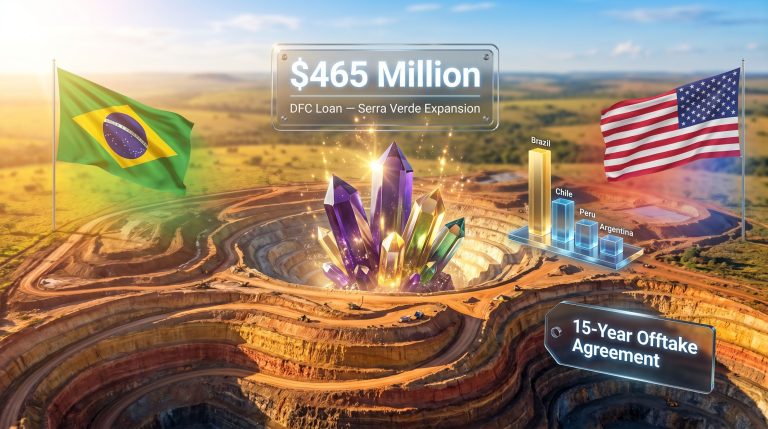
Aclara's engagement with the DFC is not without precedent within its own project portfolio. The company previously secured a $5 million DFC arrangement for its Brazilian rare earth project, structured as feasibility-stage support in exchange for an option allowing the DFC to invest at a later project stage. This model — where public development finance de-risks early-stage project development while preserving equity participation rights for later deployment — represents an increasingly standard template for government-backed critical mineral financing.
CEO Ramon Barua confirmed in June 2026 that a comparable arrangement had been proposed for the Chilean project and that the DFC had responded positively at a conceptual level. DFC chief policy officer Caroline Vik visited Santiago the week prior, meeting with government officials and private-sector representatives — including a business federation gathering attended by Aclara representatives — following the signing of a US-Chile critical minerals agreement in April 2026 that provides the bilateral diplomatic framework within which any DFC engagement would operate.
It is critical to note that no formal DFC commitment has been announced for the Chilean project as of mid-2026. The DFC declined to comment on any specific projects in its pipeline, citing commercial sensitivities. Any characterisation of US government support for this project beyond early-stage constructive discussions would be premature.
Why the Bilateral Framework Matters for Investors
The April 2026 US-Chile critical minerals agreement creates a diplomatic foundation that makes DFC engagement politically viable, but it does not guarantee project-level financing. Investors should distinguish between macro-level policy alignment — which is real and meaningful — and project-specific commitments, which have not yet been formalised. Consequently, the gap between diplomatic framework and capital deployment is often where project timelines slip.
Who Would Buy Rare Earths From the Penco Module?
Mapping the Downstream Demand Landscape
The commercial viability of the Aclara Chile rare earth project ultimately depends on securing binding offtake agreements with industrial buyers willing to commit to purchasing dysprosium and terbium output at agreed pricing terms. This is not a trivial challenge — rare earth offtake agreements require buyers to accept long-term price exposure and supply chain dependency on a project that has not yet demonstrated commercial production.
Aclara has confirmed that discussions with potential buyers of magnets manufactured from its rare earth output have accelerated as the company approaches its permitting milestone. The identified prospect base spans four major consuming regions:
-
United States: Driven by EV manufacturing reshoring initiatives and defence procurement requirements for domestic magnet supply chains, with growing regulatory pressure to reduce Chinese rare earth content in defence systems
-
Europe: Subject to increasingly stringent supply chain diversification obligations under the EU Critical Raw Materials Act, which creates compliance-driven demand for verified non-Chinese rare earth sources
-
Japan: Carries a longstanding acute awareness of rare earth supply vulnerability following China's 2010 export restrictions, which imposed severe economic costs on Japanese permanent magnet manufacturers and prompted sustained investment in supply diversification
-
South Korea: Expanding EV battery and motor manufacturing base requiring secure access to magnet-grade rare earth elements, with Korean automakers and chaebol electronics groups representing natural offtake counterparties
A critical insight that is often overlooked in rare earth project analysis is that offtake agreements and financing are often sequentially dependent but mutually conditional. Development finance institutions like the DFC typically require evidence of binding customer commitments before approving project financing, while industrial buyers are reluctant to sign binding offtake agreements for projects that lack confirmed financing. Breaking this circular dependency is one of the most challenging commercial problems facing early-stage rare earth projects.
The next major ASX story will hit our subscribers first
The $1.5 Billion Vision: An Integrated Western Hemisphere Supply Chain
From Chilean Clay to American Motor
Aclara's strategic ambition extends well beyond developing a single mine. The company's $1.5 billion integrated strategy envisions a vertically connected supply chain linking Latin American ionic clay extraction assets — including both the Chilean Penco Module and its Brazilian project — with US-based rare earth processing and magnet manufacturing capacity.
This positions Aclara as something conceptually different from a conventional junior miner. The company is attempting to function as a supply chain architect, assembling the multiple components required to deliver finished rare earth products to North American industrial buyers rather than simply selling ore or mixed rare earth concentrate at the earliest feasible point in the value chain. In this respect, the Americas rare earth supply chain ambitions that Aclara represents are significant — for context on Americas rare earth supply chain developments more broadly, the competitive landscape includes several other emerging producers, though none targeting heavy rare earths from ionic clay at this scale.
The most important insight from analysing Western rare earth supply chain failures is that building a mine is the easy part. The processing and separation infrastructure required to convert rare earth ore into separated oxides, and then into alloys and finished magnets, represents a far more technically demanding and capital-intensive challenge that new market entrants consistently underestimate.
How Aclara Compares to Other Emerging Non-Chinese Rare Earth Producers
| Project | Country | Key Elements | Stage | Notable Characteristics |
|---|---|---|---|---|
| Aclara Penco Module | Chile | Dy, Tb (heavy REEs) | Pre-production, permitting stage | Ionic clay, tailings-free methodology |
| Aclara Brazil Project | Brazil | Heavy REEs | Feasibility | DFC arrangement secured |
| MP Materials Mountain Pass | USA | Light REEs (Ce, La, Nd, Pr) | Operating | Limited heavy REE content |
| Lynas Rare Earths | Australia/Malaysia | Mixed REEs | Operating | Primary non-Chinese scaled producer |
A notable gap in the existing Western rare earth supply base is the near-total absence of meaningful heavy rare earth production outside China. MP Materials and Lynas both produce primarily light rare earth elements such as neodymium and praseodymium, leaving the dysprosium and terbium supply chain almost entirely dependent on Chinese output. This is the precise market gap the Aclara Chile rare earth project is designed to address.
Key Risks That Could Derail the Penco Module
A Multi-Dimensional Risk Assessment for Investors
No analysis of the Aclara Chile rare earth project would be complete without a rigorous examination of the risks that could prevent the project from reaching its stated objectives. Investors and industry observers should consider the following risk dimensions:
Permitting Risk: Chile's environmental evaluation process is independent and substantive. Community opposition in the Biobío Region, ecological sensitivities related to protected species, and the potential for legal challenges to any approval represent meaningful sources of delay. The restructured application covering only the first six years of operations addresses some concerns but does not eliminate the possibility of extended review or rejection.
Financing Risk: The project requires approximately US$1.5 billion in total investment across its integrated strategy. If DFC engagement does not formalise into a binding commitment, Aclara would need to identify alternative financing sources — potentially on less favourable terms and over longer timelines. Private capital markets for pre-production rare earth projects remain challenging, particularly for heavy rare earth projects without established comparable transactions.
Commodity Price Risk: Rare earth prices are highly volatile and subject to Chinese export policy decisions that can move markets rapidly in either direction. Notably, China could theoretically suppress rare earth prices to undermine the economics of competing projects in development, a strategy that has been employed in other commodity markets historically.
Community and Social Licence Risk: Operating in a populated coastal agricultural region near Concepción creates ongoing social licence obligations that extend beyond the formal permitting process. Community opposition that survives permitting approval can manifest through legal challenges, operational disruption, and reputational damage with ESG-sensitive investors and customers.
Beijing's historical deployment of rare earth export controls as a strategic lever — demonstrated through the 2010 restrictions that triggered a global price crisis, the 2023 gallium and germanium controls, and the 2025 expansion to additional critical minerals — indicates that China views its rare earth dominance as a geopolitical asset worth defending. Projects that directly challenge this dominance may encounter competitive responses including deliberate price suppression, which could erode project economics precisely when capital requirements are highest.
Technical and Execution Risk: Ionic clay rare earth extraction using Circular Mineral Harvesting methodology has not been demonstrated at commercial scale outside China. Scaling this technology through the feasibility, construction, and commissioning phases introduces technical execution risk that is difficult to fully quantify from publicly available information.
Three Scenarios for How This Project Unfolds by 2030
Scenario Analysis: Pathways From Here to Production
The ultimate trajectory of the Aclara Chile rare earth project will be shaped by how several critical variables resolve over the next three to four years. Three plausible scenarios frame the range of outcomes:
-
Base Case — Phased Development: The Environmental Evaluation Commission approves the application in 2026, enabling Aclara to progress toward financing close. DFC discussions advance into a formal feasibility support arrangement by mid-2027, unlocking the bilateral framework for broader capital raising. First production is achieved in late 2028 with initial offtake agreements in place with US and European industrial buyers, establishing Aclara as a meaningful but modest contributor to Western heavy rare earth supply by 2030.
-
Optimistic Case — Integrated Supply Chain Breakthrough: Rapid EIA approval triggers DFC commitment, which in turn catalyses binding offtake agreements from multiple automakers. The financing cascade enables simultaneous development of Latin American extraction assets and US processing capacity, positioning Aclara as the anchor of a genuinely integrated Western Hemisphere rare earth supply chain ahead of the 2030 mass EV adoption inflection point.
-
Downside Case — Prolonged Regulatory and Financing Delay: Extended EIA review, sustained community opposition, or failure to formalise DFC engagement pushes first production beyond 2029. The geopolitical window during which non-Chinese rare earth projects command premium attention from both governments and industrial buyers may partially close, reducing the urgency premium that currently supports Aclara's commercial discussions.
Frequently Asked Questions: Aclara Chile Rare Earth Project
What rare earth elements does the Penco Module produce?
The project targets heavy rare earth elements, with particular emphasis on dysprosium and terbium — the two elements most critical for high-performance permanent magnets used in EV traction motors and wind turbine generators operating at elevated temperatures.
Where is the Aclara Chile project located?
The Penco Module is located in the Biobío Region of Chile, near the city of Concepción, covering approximately 600 hectares of ionic clay terrain in the country's south-central zone.
When will production begin?
Aclara targets a start of operations in 2027–2028, though this timeline is conditional on securing environmental approval, binding financing commitments, and customer offtake agreements. External analysts have noted that 2028 represents a more conservative but realistic target given the permitting complexities involved.
What is Circular Mineral Harvesting?
Aclara's proprietary extraction approach processes rare earths from ionic clay without explosives, without a tailings storage facility, and with closed-loop water and reagent recycling systems. The methodology is designed to deliver a materially lower environmental footprint compared to conventional hard rock rare earth mining.
Has the US government formally committed to funding this project?
As of mid-2026, no formal commitment has been announced. Aclara's CEO has confirmed that early-stage discussions with the DFC have produced positive conceptual feedback, and the April 2026 US-Chile critical minerals agreement provides a supporting diplomatic framework. However, the DFC has declined to comment on specific projects, and no financing terms have been publicly disclosed.
What is the total scale of Aclara's investment strategy?
Aclara is pursuing a US$1.5 billion integrated strategy spanning Latin American rare earth extraction assets and US-based downstream processing and magnet supply chain infrastructure, with the Chilean and Brazilian projects representing the extraction component of this broader vision.
Disclaimer: This article is intended for informational purposes only and does not constitute financial or investment advice. Forecasts, scenario projections, and timeline estimates contained herein are speculative in nature and subject to material change based on regulatory, financing, technical, and geopolitical developments. Readers should conduct their own independent research and consult qualified financial advisers before making investment decisions related to any companies or projects discussed.
Want To Stay Ahead Of The Next Major Mineral Discovery On The ASX?
Discovery Alert's proprietary Discovery IQ model delivers real-time alerts on significant ASX mineral discoveries across rare earths and over 30 other commodities, turning complex mineral data into clear, actionable insights for investors at every level. Explore why historic discoveries have generated extraordinary returns and begin your 14-day free trial today to position yourself ahead of the broader market.