May 19, 2026
Advanced Bacterial Systems Drive Next-Generation Copper Recovery for AI Infrastructure
The digital transformation accelerating across global industries has created unprecedented demand for high-purity metals, particularly copper, as artificial intelligence and cloud computing infrastructure expand exponentially. Traditional pyrometallurgical approaches face mounting pressure from environmental regulations and escalating energy costs, while simultaneously struggling to extract value from increasingly complex ore bodies. This convergence of factors has catalyzed the emergence of biotechnological solutions that harness naturally occurring microorganisms to revolutionize metal extraction processes.
When big ASX news breaks, our subscribers know first
Biochemical Mechanisms Behind Microbial Copper Extraction
Bioleaching technology employs specialised acidophilic bacteria to catalyse the dissolution of copper-bearing sulfide minerals through oxidative processes that occur at ambient temperatures and pressures. This biotechnological approach fundamentally differs from conventional smelting by utilising biological catalysts rather than thermal energy to break down mineral matrices and liberate target metals.
The process centres on naturally occurring microorganisms, primarily acidophilic bacteria that thrive in highly acidic environments below pH 2.5. These microorganisms facilitate copper extraction through enzymatic oxidation reactions that convert insoluble copper sulfides into soluble copper sulfate solutions.
Operational Framework for Industrial-Scale Implementation
Modern bioleaching operations achieve 99.99% pure copper cathode production directly at mine sites, eliminating traditional concentrator, smelter, and refinery infrastructure requirements. This streamlined approach significantly reduces the mine-to-market supply chain complexity while maintaining exceptional product quality standards.
Key Process Advantages:
- Enables processing of primary sulfide ores previously considered waste material
- Facilitates faster scaling and customisation across different ore body compositions
- Operates continuously without thermal cycling limitations that constrain traditional processing
- Reduces infrastructure requirements compared to conventional concentration methods
- Maintains high purity standards while shortening production timelines
The modular nature of bioleaching systems allows rapid deployment and configuration adjustments based on specific ore characteristics, providing operational flexibility that traditional fixed infrastructure cannot match. Furthermore, these innovations align with broader mining innovation trends transforming the sector.
Environmental Performance Metrics Transforming Copper Production Standards
Commercial-scale bioleaching operations demonstrate substantially improved environmental performance compared to conventional copper processing routes, particularly in carbon emissions and water consumption metrics. Recent third-party life-cycle assessments have quantified these improvements, providing empirical data for sustainability comparisons.
Carbon Footprint Analysis
The Johnson Camp operation in Arizona, utilising Rio Tinto's Nuton bioleaching technology, has achieved certification as the lowest-carbon primary copper producer in the United States on a mine-to-refined-metal basis. Independent life-cycle assessment results indicate the facility produces copper with a full-scope carbon footprint of 2.82 kgCO₂e/kg of copper.
This performance metric compares favourably against global primary copper production, which ranges from approximately 1.5 kgCO₂e/kg to 8.0 kgCO₂e/kg depending on production method and technology employed. The Johnson Camp results position bioleaching technology within the lower quartile of global copper production carbon intensity.
Water Consumption Optimisation
| Production Method | Water Intensity (L/kg Cu) | Performance vs. Global Average |
|---|---|---|
| Global Industry Average | 130 L/kg | Baseline |
| Johnson Camp Bioleaching | 71 L/kg | 45% reduction |
The 71 litres per kilogram of copper water intensity achieved at Johnson Camp represents a significant improvement over the global industry average of approximately 130 litres per kilogram. This 45% reduction in water consumption addresses critical resource management challenges in arid mining regions.
Renewable Energy Integration
Bioleaching operations demonstrate enhanced compatibility with renewable energy systems due to their lower power density requirements compared to traditional smelting. The Johnson Camp facility achieves 100% renewable energy certificate matching through the purchase of 134,000 Green-e Energy certified renewable energy certificates, ensuring that all electricity consumption is backed by verified renewable sources.
Moreover, these sustainable practices complement mining reclamation innovation efforts across the industry.
Data Centre Infrastructure Driving Copper Demand Evolution
Modern data centres represent some of the most copper-intensive industrial facilities, utilising the metal across multiple critical applications including electrical distribution systems, cooling infrastructure, computing hardware, and backup power systems. The expansion of artificial intelligence workloads and hyperscale cloud computing has intensified copper demand beyond traditional data centre requirements.
Primary Copper Applications in Digital Infrastructure
Data centres are copper-intensive facilities, using the metal in applications such as:
- Electrical cabling and busbars for power distribution networks
- Transformer and motor windings in electrical equipment
- Printed circuit boards throughout computing systems
- Processor heat sinks for thermal management
- Cooling system heat exchangers and piping networks
- Uninterruptible power supply units and backup generator components
AI Infrastructure Copper Requirements
The proliferation of artificial intelligence workloads has created new categories of copper demand within data centre infrastructure. GPU clusters and high-performance computing arrays require enhanced cooling systems, higher power densities, and more robust electrical distribution networks, all of which increase copper consumption per unit of computing capacity.
Advanced liquid cooling systems, increasingly deployed for AI workloads, utilise copper piping networks and heat exchangers to manage thermal loads that exceed traditional air cooling capabilities. These systems represent a growing segment of data centre copper consumption as AI adoption accelerates across industries. Additionally, this growth impacts copper supply forecast models significantly.
Cloud Computing Optimisation of Bioleaching Operations
Advanced data analytics and cloud computing platforms are revolutionising bioleaching process control through real-time optimisation of operational parameters and predictive maintenance protocols. The integration of Amazon Web Services platforms at the Johnson Camp operation demonstrates how cloud technology enhances biotechnological mining processes.
Digital Analytics Integration
Bioleaching operations leverage Amazon Web Services platforms to simulate heap-leach performance and integrate advanced analytics into decision-making systems. This digital approach aims to optimise acid and water use while improving predictions for copper recovery rates across different ore compositions.
Cloud-Enabled Optimisation Capabilities:
- Real-time heap performance simulation modelling
- Predictive analytics for copper recovery forecasting
- Automated process parameter adjustment based on sensor data
- Integration of multiple data streams for comprehensive optimisation
- Advanced decision-making system support through machine learning algorithms
Operational Parameter Monitoring
The cloud-based analytics approach enables continuous monitoring and optimisation of critical process variables including temperature distribution, pH levels, moisture content, and airflow patterns throughout bioleaching heap structures. This comprehensive monitoring capability supports enhanced process control compared to traditional manual oversight methods.
Consequently, these technological advances represent a significant evolution in data-driven mining operations across the industry.
Modular Technology Architecture Enabling Rapid Deployment
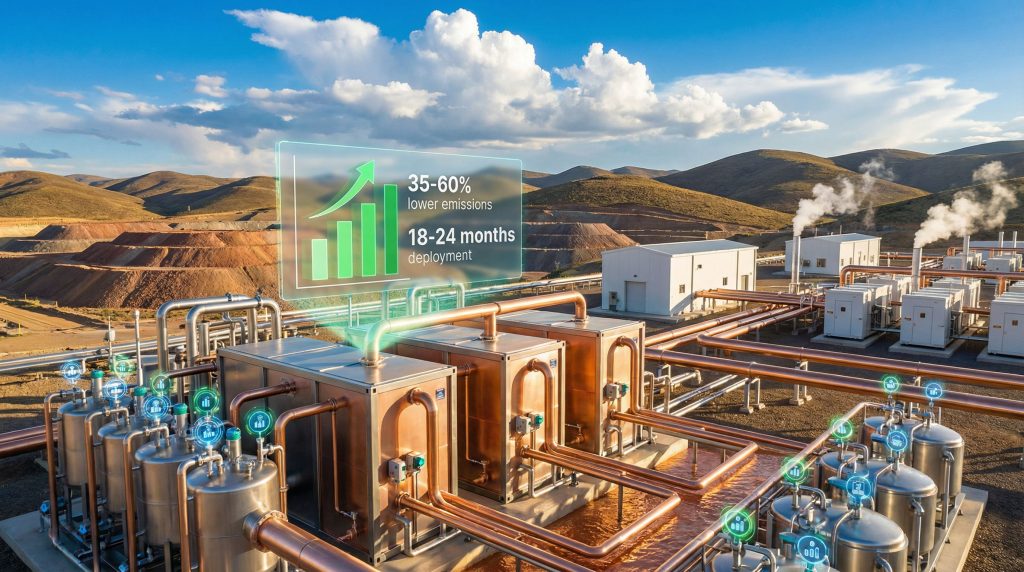
Modular bioleaching systems utilise standardised processing units that can be rapidly configured for different ore types and production scales, significantly reducing capital deployment timelines compared to traditional copper processing infrastructure. This approach provides operational flexibility while minimising initial capital requirements.
Scalability and Timeline Advantages
The Johnson Camp operation is targeting production of approximately 30,000 tons of refined copper over a four-year period, representing about 7,500 metric tons of refined copper annually. This production level demonstrates commercial viability for modular bioleaching systems at industrial scale.
Deployment Benefits:
- Reduced infrastructure complexity compared to traditional smelting operations
- Faster scaling and customisation across different ore body compositions
- Lower initial capital requirements for mine development
- Enhanced operational flexibility through modular system design
- Ability to process previously uneconomical ore grades
The modular approach enables phased capacity expansion as ore reserves are developed and market conditions evolve, providing risk mitigation compared to large fixed infrastructure investments required for conventional processing facilities.
The next major ASX story will hit our subscribers first
Supply Chain Resilience Through Domestic Production Capacity
Bioleaching technology enables economical processing of previously marginal copper resources, potentially enhancing domestic production capacity and reducing import dependencies for critical materials. This capability addresses strategic resource security concerns while providing economic benefits to regional economies.
Strategic Material Security
The Amazon and Rio Tinto Nuton bioleached copper partnership demonstrates how advanced processing technologies can strengthen domestic supply chain resilience for critical materials. By bringing Nuton copper into AWS's US data centre supply chain, the collaboration helps secure critical materials closer to where they are consumed.
Domestic Production Advantages:
- Reduced transportation costs through shorter supply chains
- Lower geopolitical risk through decreased foreign dependency
- Faster response times due to proximity to end-use markets
- Enhanced quality assurance through direct production oversight
- Improved supply chain reliability for strategic materials
Economic Impact on Regional Development
Bioleaching operations can unlock value from ore bodies previously classified as waste, expanding the economic resource base for existing mining regions. This capability provides opportunities for extending mine life and supporting regional economic development in established mining communities.
The technology's ability to process lower-grade ores economically may enable development of domestic copper resources that were previously uneconomical using conventional processing methods, potentially reducing reliance on imported copper concentrates. Furthermore, this approach complements strategic investments in copper and uranium investments globally.
Financial Performance Metrics for Bioleaching Investment
Economic modelling demonstrates favourable investment returns for bioleaching technology, particularly when processing lower-grade ore bodies or developing brownfield sites where existing infrastructure can be leveraged. The reduced capital intensity compared to traditional smelting operations provides enhanced financial flexibility.
Capital Efficiency Analysis
Bioleaching operations typically require lower initial capital investments compared to traditional concentrator-smelter-refinery processing routes. This capital efficiency stems from the elimination of high-temperature processing equipment, simplified infrastructure requirements, and modular system design.
Investment Characteristics:
- Lower upfront capital requirements compared to smelting operations
- Reduced infrastructure complexity and construction timelines
- Enhanced operational flexibility through modular system architecture
- Ability to generate revenue from previously waste material
- Scalable capacity expansion as ore reserves are developed
The technology's capability to produce 99.99% pure copper cathode directly at mine sites eliminates the need for separate refining facilities, reducing both capital and operating costs throughout the production chain.
Technological Innovation Pathways for Enhanced Efficiency
Ongoing research in biotechnology, process optimisation, and automation systems promises to further improve bioleaching performance and economic viability. Industrial innovation combined with cloud technology demonstrates potential for delivering cleaner, lower-carbon materials at commercial scale.
Advanced Process Control Systems
The integration of cloud-based data analytics with bioleaching operations represents a significant advancement in process control capabilities. These systems enable real-time optimisation of operational parameters while providing predictive capabilities for maintenance and performance management.
Emerging Technology Applications:
- Advanced heap performance modelling and simulation
- Predictive analytics for bacterial population optimisation
- Automated process parameter adjustment based on real-time data
- Integration of multiple sensor systems for comprehensive monitoring
- Machine learning algorithms for continuous process improvement
Biotechnology Advancement Opportunities
Future developments in synthetic biology and microbial engineering may enhance bacterial performance characteristics, potentially improving copper recovery rates and expanding the range of ore types suitable for bioleaching treatment. These advances could further improve the economic competitiveness of biological processing methods.
Research into process intensification techniques, including enhanced bacterial cultivation methods and optimised heap construction approaches, may reduce processing timelines and improve overall system efficiency.
Strategic Implications for Critical Materials Supply Chains
The successful deployment of industrial-scale bioleaching technology represents a significant milestone in the evolution of sustainable mining practices. The collaboration between Amazon and Rio Tinto Nuton bioleached copper demonstrates how digital technology partnerships can accelerate the adoption of environmentally advantaged production methods.
This partnership exemplifies how industrial innovation and cloud technology can combine to deliver cleaner, lower-carbon materials at scale while strengthening domestic resilience for critical materials supply chains. The achievement of commercial-scale production with superior environmental performance metrics validates the viability of biotechnological approaches to metal extraction.
As AI infrastructure expansion continues driving copper demand growth, bioleaching technology provides a pathway for meeting increased requirements while achieving carbon footprint reduction and water conservation objectives. The technology's ability to process previously waste material and operate with renewable energy systems positions it as a key component in sustainable materials supply chain development.
The success of the Johnson Camp operation in achieving the lowest-carbon primary copper production in the United States demonstrates that biotechnological mining methods can deliver both environmental and economic advantages at commercial scale, providing a model for future critical materials production strategies.
Ready to Capitalise on Next-Generation Mining Technologies?
Discovery Alert's proprietary Discovery IQ model delivers instant notifications on significant mineral discoveries from innovative companies deploying cutting-edge extraction technologies like bioleaching across ASX markets. Access Discovery Alert's dedicated discoveries page to understand how breakthrough mining technologies can lead to exceptional market returns, and begin your 30-day free trial today to position yourself ahead of rapid technological developments transforming the mining sector.