May 24, 2026
Advanced Catalyst Engineering Transforms Hydrogen Economics
The global hydrogen economy stands at a critical inflection point where new platinum development lowering hydrogen cost represents a fundamental transformation of production economics. Recent materials science innovations have demonstrated that strategic manipulation of platinum catalyst architectures can achieve dramatic efficiency improvements while simultaneously reducing precious metal consumption requirements. These developments represent a convergence of nanotechnology, electrochemistry, and industrial engineering that addresses one of the most significant barriers to widespread hydrogen adoption.
The economic viability of hydrogen as an energy carrier has historically been constrained by the substantial platinum loadings required in proton exchange membrane (PEM) electrolysis systems. Traditional catalyst configurations demand significant quantities of precious metals, creating cost barriers that have limited deployment to specialized applications. However, emerging catalyst design methodologies are demonstrating that fundamental changes to atomic-level structures can deliver equivalent performance with drastically reduced material requirements.
When big ASX news breaks, our subscribers know first
Revolutionary Catalyst Architecture Design
Single-Atom Dispersion Technology
Materials scientists have achieved unprecedented efficiency gains through single-atom catalyst architectures that maximise the utilisation of individual platinum atoms. This approach involves dispersing platinum atoms individually across graphitic nanosheet supports, with each atom bonded to nitrogen atoms to create isolated catalytic sites. The technique represents a fundamental departure from traditional bulk catalyst designs that rely on platinum nanoparticles.
Key Performance Metrics:
• Atom utilisation: Nearly 100% of platinum atoms serve as active sites
• Loading reduction: Decreases platinum requirements by 60-80%
• Activity enhancement: Delivers 13-fold higher mass activity compared to conventional catalysts
• Durability: Maintains 65% activity retention after 50,000 operational cycles
The single-atom approach fundamentally alters the economics of hydrogen production by ensuring that virtually every platinum atom contributes to the catalytic process. Traditional nanoparticle catalysts often have significant portions of platinum atoms buried within particle structures where they cannot participate in surface reactions, representing substantial material waste from both cost and efficiency perspectives.
Multi-Metal Hybrid Formulations
Alternative catalyst engineering strategies focus on substituting portions of platinum with more abundant transition metals while maintaining catalytic performance. These hybrid systems typically incorporate nickel and cobalt mounted on carbon nanosphere supports, creating active sites that can perform hydrogen evolution reactions at efficiency levels comparable to pure platinum catalysts.
| Catalyst Configuration | Platinum Content | Performance Ratio | Cost Reduction |
|---|---|---|---|
| Traditional bulk | 20% by weight | 1.0x baseline | – |
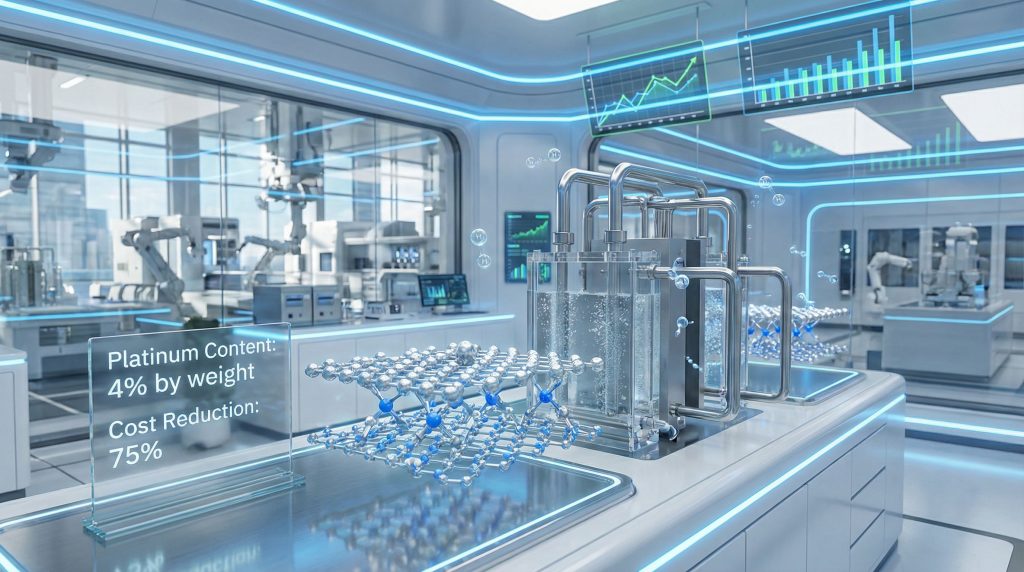
| Hybrid multi-metal | 4% by weight | 1.0x equivalent | 75% |
| Single-atom dispersed | <1% by weight | 1.2x enhanced | 80% |
The multi-metal approach addresses supply chain vulnerabilities by reducing dependence on platinum while leveraging the catalytic properties of more abundant elements. Furthermore, cobalt and nickel, when properly engineered into catalyst structures, can provide electronic properties that complement platinum's hydrogen evolution capabilities, creating synergistic effects that maintain overall system performance.
Manufacturing Process Innovations
Nanosheet Flattening Methodologies
Advanced manufacturing techniques have transformed conventional granular platinum catalysts into flattened sheet structures through controlled processing environments. These methods involve precise temperature and pressure conditions that encourage platinum particles to adopt two-dimensional configurations rather than three-dimensional clusters.
The flattening process increases the surface-to-volume ratio of platinum catalysts, exposing more atoms to reactant molecules and improving mass transfer characteristics. Experimental results demonstrate that flattened platinum nanosheets achieve 60% material reduction while delivering 2.3x improved fuel cell performance compared to conventional particle-based catalysts.
Palladium Alternative Development
Research efforts have identified palladium-based catalyst systems as potential alternatives that can match platinum performance characteristics while offering different supply chain dynamics. Palladium catalyst innovations demonstrate overpotential performance of 34 millivolts compared to platinum's 35 millivolts, indicating essentially equivalent catalytic efficiency.
The palladium approach provides strategic diversification opportunities for catalyst supply chains, as palladium and platinum have different mining geographies and market dynamics. This diversification can help mitigate supply risks associated with the geographical concentration of platinum production in South Africa and Russia.
Economic Impact Analysis
Cost Target Achievement
These catalyst innovations have successfully achieved production costs below the $2 per kilogram threshold established by the US Department of Energy for 2026. This cost target represents a critical milestone for hydrogen competitiveness with conventional fossil fuel alternatives across multiple applications.
The cost reduction stems from several factors:
• Material efficiency: Reduced platinum requirements decrease raw material costs
• Manufacturing optimisation: Simplified catalyst synthesis processes
• Performance enhancement: Higher activity levels reduce system sizing requirements
• Durability improvements: Extended catalyst lifespans reduce replacement frequency
Supply Chain Economics
Global platinum production faces significant constraints that create vulnerability for hydrogen economy scaling. Annual platinum mine production approximates 6 million ounces, with the majority concentrated in South Africa's Bushveld Complex and Russia's Norilsk region. This geographical concentration creates risks related to geopolitical mineral supply security.
Reduced platinum loading requirements fundamentally alter the supply-demand dynamics for hydrogen applications. In addition, if widespread hydrogen deployment required traditional catalyst loadings, the platinum supply would become a limiting factor for industry growth. The new platinum development lowering hydrogen cost essentially decouples hydrogen scaling from platinum supply constraints.
Technical Implementation Challenges
Manufacturing Scalability
While laboratory demonstrations show promising results, commercial deployment requires addressing complex synthesis challenges. Single-atom catalyst production involves multi-step processes that must maintain atomic-level precision across large-scale manufacturing operations.
Critical scalability factors include:
• Quality control protocols: Ensuring consistent atomic dispersion across production batches
• Process automation: Developing manufacturing systems capable of atomic-level precision
• Cost optimisation: Reducing synthesis complexity while maintaining performance
• Supply chain integration: Establishing reliable feedstock sources for advanced materials
System Integration Requirements
The advanced catalysts must integrate with existing PEM electrolysis infrastructure to enable retrofitting of current installations. This compatibility requirement influences catalyst design parameters and constrains the range of architectural modifications that can be implemented.
Integration considerations encompass membrane compatibility, operating temperature ranges, pressure requirements, and electrical interface specifications. However, catalyst modifications must maintain compatibility with these system parameters while delivering performance improvements.
Market Deployment Dynamics
Commercial Readiness Assessment
Current catalyst developments exist primarily in research and demonstration phases, with commercial deployment requiring validation of long-term stability under industrial operating conditions. The transition from laboratory-scale synthesis to commercial production represents a significant scaling challenge that must be addressed before widespread adoption.
Industry experts emphasise that while the fundamental science demonstrates clear advantages, commercial viability depends on proving synthesis repeatability. Moreover, establishing quality control methodologies and demonstrating economic competitiveness at scale remain critical factors.
Application Versatility
The catalyst engineering approaches show adaptability across multiple platinum group metals, including ruthenium, palladium, and iridium. This versatility provides opportunities for application-specific optimisation and enables catalyst selection based on cost, performance, and supply considerations for different deployment scenarios.
The next major ASX story will hit our subscribers first
Global Hydrogen Economy Implications
Regional Production Economics
Enhanced catalyst efficiency enables economically viable hydrogen production across diverse geographical regions, reducing dependence on centralised production facilities. This distributed production capability supports energy security objectives and enables local hydrogen economies to develop based on regional renewable energy resources.
The cost reductions make hydrogen competitive with conventional fuels in applications that were previously economically prohibitive. This expanded economic window enables hydrogen adoption across transportation, industrial heating, chemical processing, and energy storage sectors. Consequently, these developments align with broader energy transition materials requirements.
Infrastructure Development Acceleration
Lower production costs accelerate hydrogen infrastructure deployment by improving project economics and reducing investment risks. This economic improvement enables financing of hydrogen projects that previously failed to meet investment return requirements.
The catalyst developments complement broader infrastructure investments in hydrogen storage, distribution networks, and end-use applications. South Korea currently operates over 200 hydrogen refuelling stations, demonstrating the infrastructure deployment pace possible when economic conditions support investment.
Future Technology Pathways
Research Pipeline Developments
Ongoing investigations focus on extending catalyst durability beyond current performance levels and developing synthesis procedures suitable for industrial-scale production. Research priorities include alternative precious metal formulations that further reduce dependency on constrained supply sources.
Future developments may incorporate machine learning optimisation of catalyst structures, enabling rapid screening of material combinations and processing conditions. These advances complement broader mining innovation trends that are reshaping resource extraction methodologies.
Industry Integration Strategies
The catalyst advances complement broader hydrogen technology developments including improved storage systems, enhanced distribution infrastructure, and expanded end-use applications. Integration of these technological improvements creates synergistic effects that accelerate overall hydrogen economy development.
Furthermore, these innovations align with mineral exploration insights that inform strategic resource development. The reduced dependence on traditional platinum sources creates opportunities for alternative supply chains and enables greater economic flexibility.
Environmental and Economic Benefits
Decarbonisation Impact
The new platinum development lowering hydrogen cost directly contributes to environmental objectives by making clean hydrogen more economically viable. Lower production costs accelerate the displacement of fossil fuel-based hydrogen production methods, which currently account for approximately 95% of global hydrogen supply.
These catalyst improvements support decarbonisation benefits across multiple industrial sectors by enabling cost-effective hydrogen adoption. The technology creates pathways for reducing industrial carbon emissions while maintaining economic competitiveness.
Resource Efficiency Gains
Advanced catalyst architectures represent a fundamental shift towards resource efficiency in hydrogen production. By maximising the utilisation of precious metals, these technologies address both economic and environmental concerns associated with mining intensive operations.
The efficiency improvements reduce the environmental footprint of hydrogen production while creating more sustainable supply chains. This approach aligns with circular economy principles that prioritise resource optimisation and waste reduction.
Disclaimer: This analysis contains forward-looking assessments of catalyst technology development and market deployment that involve uncertainties and assumptions. Actual commercial outcomes may differ significantly from projections discussed. Readers should conduct independent research and consult with technical experts before making investment or deployment decisions based on emerging catalyst technologies.
The convergence of materials science innovation and economic necessity is reshaping hydrogen production fundamentals in ways that address long-standing cost barriers. These catalyst engineering breakthroughs position hydrogen as an increasingly competitive energy carrier while reducing dependence on constrained precious metal supplies, creating conditions for accelerated adoption across multiple industrial applications.
Looking to Capitalise on the Critical Minerals Driving Clean Energy Innovation?
Discovery Alert's proprietary Discovery IQ model delivers real-time alerts on significant platinum and critical mineral discoveries across the ASX, instantly empowering subscribers to identify actionable opportunities ahead of the broader market as the hydrogen economy accelerates. Begin your 30-day free trial today and secure your market-leading advantage in the clean energy transition.