May 23, 2026
The Logistics Bottleneck That Shapes Global Mineral Markets
Every tonne of copper extracted from the landlocked heart of central Africa faces a challenge that has nothing to do with geology or grade: getting to a port. The continent holds some of the world's most significant concentrations of transition-critical minerals, yet for decades the absence of reliable, cost-effective transport infrastructure has acted as a ceiling on how much of that wealth could reach global markets efficiently. Road haulage across thousands of kilometres of deteriorating highways carries costs that, in some cases, approach the commercial value of the cargo itself. This economic paradox has quietly shaped commodity pricing, investment decisions, and supply chain strategies far beyond Africa's borders.
The solution that investors, governments, and mining companies are now converging on is not a new road network. It is rail, and specifically the integrated Africa mining rail corridors that link extraction zones in the DRC, Zambia, and Mozambique to deepwater ports on both the Atlantic and Indian Ocean coastlines.
When big ASX news breaks, our subscribers know first
The Infrastructure Gap at the Heart of Africa's Mining Potential
Why Landlocked Mineral Wealth Requires a Rail Solution
The geography of Africa's most valuable mineral deposits creates a structural logistics problem that has no easy workaround. The copper and cobalt reserves of the DRC's Copperbelt sit roughly 2,000 kilometres from the nearest major port. Mozambique's Moatize coal basin is separated from the Indian Ocean by mountainous terrain and limited road capacity. In both cases, the economics of road transport erode margins to the point where project viability itself becomes questionable for lower-grade or higher-volume operations.
A mining rail corridor addresses this problem not simply by replacing trucks with trains, but by creating an integrated logistics system. These corridors typically encompass:
- Dedicated rail lines capable of handling heavy-haul bulk freight
- Border crossing infrastructure with documented transit agreements between nations
- Customs and documentation processing systems that reduce dwell time at crossings
- Port connectivity, including dedicated mineral handling terminals at the corridor's seaward end
The distinction matters because the cost advantage of rail over road for bulk minerals is not marginal. For cargo volumes typical of a producing copper mine, rail transport per tonne-kilometre runs at a fraction of road costs, and the efficiency differential compounds over the distances involved in southern Africa's mining geography.
How Rail Infrastructure Transforms Resource Economics
Ivanhoe Mines' 2023 trial shipment via the Lobito Corridor provided a real-world validation of the economic case. That shipment demonstrated that the corridor reduced the effective port route distance by approximately two-thirds compared with the traditional trucking alternatives previously used by DRC-based producers. The transit time saving of up to 20 days for cargo destined for European and North American markets translates directly into reduced working capital requirements, lower insurance exposure during transit, and improved supply reliability for buyers.
Beyond pure logistics, these corridors function simultaneously as mineral export channels, regional trade arteries, and potential anchors for industrial development. The infrastructure built to move copper to port can also move fertiliser, manufactured goods, and agricultural products in the opposite direction, creating economic multiplier effects that extend well beyond the mining sector. Furthermore, the critical minerals demand driving these investments continues to accelerate as the global energy transition intensifies.
"Africa's rail corridors are not simply transport upgrades. They represent a fundamental restructuring of how landlocked mineral economies connect to global supply chains, with implications extending well beyond mining into regional trade, employment, and industrial development."
Mapping the Four Corridors That Anchor Southern Africa's Mining Logistics Network
Corridor Performance Comparison at a Glance
| Corridor | Total Length | Primary Commodity | Key Port | Estimated Investment |
|---|---|---|---|---|
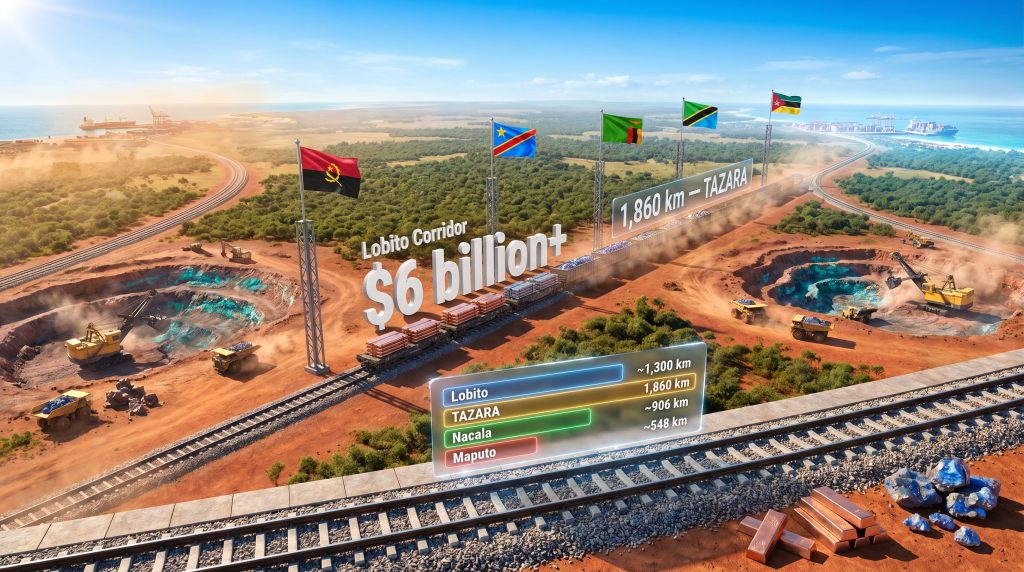
| Lobito | ~1,300 km (up to 1,739 km with branches) | Copper, Cobalt | Lobito, Angola (Atlantic) | $6 billion+ |
| TAZARA | 1,860 km | Copper | Dar es Salaam, Tanzania (Indian Ocean) | $1.4 billion (rehabilitation) |
| Nacala | ~906 km (up to 1,020 km with branches) | Coal | Nacala, Mozambique (Indian Ocean) | $7 billion (expansion) |
| Maputo | ~548 km total (88 km Mozambique + ~460 km South Africa) | Industrial freight | Maputo, Mozambique (Indian Ocean) | Ongoing (AfDB-supported) |
The Lobito Corridor: Africa's Most Strategically Contested Rail Route
Route Architecture and Geographic Footprint
The Lobito Corridor traces one of the most ambitious transport alignments on the continent. Starting at the Angolan Atlantic port of Lobito, the route moves inland through five Angolan provinces: Benguela, Huambo, Bié, Moxico, and Moxico Leste. It then crosses into the DRC's Lualaba and Haut-Katanga provinces before extending into Zambia's Copperbelt and North-West regions.
This geography gives the corridor a dual commercial function. On one axis, it is a mineral export route designed to bring copper and cobalt from some of the world's richest deposits to an Atlantic-facing port. On another, it represents a potential backbone for cross-border regional economic integration across three nations with significantly different infrastructure endowments.
The Atlantic orientation is a structural differentiator. While TAZARA and Nacala deliver cargo to Indian Ocean ports, Lobito's Atlantic access positions it uniquely for trade flows destined for Europe and North America, cutting transit times by up to 20 days compared with road-dependent routes. According to the European Union's Lobito Corridor programme, the initiative is designed specifically to support sustainable development and regional integration across the three host nations.
Ownership, Concession Structure, and the Open-Access Model
The corridor operates under a 30-year concession held by Lobito Atlantic Railway, a joint venture formed by Trafigura, Mota-Engil, and Vecturis. The concession structure includes approximately 350 miles of new rail line under construction in Zambia, hundreds of miles of associated feeder roads, and a comprehensive renovation programme for the Benguela Railway, which was originally constructed over 120 years ago.
One of the Lobito Corridor's most commercially significant characteristics is its designation as Africa's first open-access rail system. Unlike concessions structured around a single vertically integrated operator, the open-access model permits multiple mining companies and logistics providers to utilise the corridor independently. This distinction has significant implications for pricing, competition, and the corridor's long-term commercial viability.
Who Is Funding the $6 Billion Modernisation Programme?
The funding architecture behind the Lobito Corridor modernisation reflects a deliberate multilateral strategy. Key financing institutions include:
- The U.S. International Development Finance Corporation
- The European Union
- The African Development Bank
- The Africa Finance Corporation
A notable financing milestone arrived at COP29 in November 2024, when a $553 million loan approval was confirmed, adding to the cumulative investment commitment that now exceeds $6 billion. The involvement of Western multilateral institutions in this project is not incidental. It reflects a conscious strategic decision to fund infrastructure that can reduce dependence on Chinese-controlled mineral supply chains, particularly as the Congo-US minerals partnership continues to develop at pace.
"The Lobito Corridor's open-access model and multilateral financing structure represent a deliberate alternative to the state-directed, single-operator concession models that have historically characterised Chinese-financed African rail projects."
TAZARA: A Cold War-Era Railway Facing a 21st-Century Reinvention
Historical Origins and Strategic Legacy
The TAZARA Railway carries a legacy that extends well beyond freight logistics. Built during the era of African independence movements, its original purpose was to provide Zambia with sovereign sea access that bypassed the apartheid-era transport networks of southern Africa. At 1,860 kilometres, it remains Africa's longest active mining rail corridor, connecting the Tanzanian port of Dar es Salaam to Kapiri Mposhi in Zambia via the border crossings at Tunduma (Tanzania) and Nakonde (Zambia).
The railway's political origins shaped its operational model in ways that persist today. As a state-operated entity jointly managed by Tanzania and Zambia, TAZARA has historically prioritised sovereign transport access over commercial efficiency, a dynamic that partly explains its current infrastructure constraints.
Infrastructure Constraints and the $1.4 Billion Rehabilitation Programme
Decades of deferred maintenance have left TAZARA operating well below its design capacity. The core challenges include:
- Ageing rolling stock with limited carrying capacity per train
- Track infrastructure that restricts operating speeds and axle loads
- Capacity bottlenecks at key staging points along the route
- Cross-border processing delays that reduce effective throughput
A rehabilitation programme estimated at $1.4 billion, financed by China Civil Engineering Construction Corporation, is currently under preparation. The programme includes conversion to standard gauge, which would bring TAZARA into alignment with the gauge standards being adopted across East Africa's broader rail development agenda. Consequently, funders have also committed $1.3 billion to Zambia for related critical minerals rail investment, underscoring the scale of external interest in the region's transport infrastructure.
The Chinese financing of TAZARA rehabilitation carries geopolitical significance. China's involvement in this project sits within its broader Belt and Road Initiative infrastructure positioning across East Africa, a pattern that Western nations have observed with increasing attention.
TAZARA vs. Lobito: Competing Corridors for the Same Copperbelt Output
| Dimension | TAZARA | Lobito Corridor |
|---|---|---|
| Ocean Access | Indian Ocean (Dar es Salaam) | Atlantic Ocean (Lobito) |
| Primary Backer | China (CCEC) | USA / EU / AfDB |
| Operational Status | Active but constrained | Under modernisation |
| Length | 1,860 km | ~1,300 km |
| Gauge Conversion | Planned (standard gauge) | Already underway |
| Access Model | State-operated | Open-access concession |
The Nacala Corridor: Coal-Focused Integration Across Three Nations
Cross-Border Design and the Moatize Coal Basin Connection
The Nacala Corridor's defining engineering achievement is its integrated cross-border architecture. Stretching between 900 and 1,020 kilometres depending on branch lines, it connects Mozambique's Moatize coal basin to the deep-water port of Nacala, routing through Malawi to achieve this connection. This three-nation alignment reduces the number of intermediate transfer points that cargo encounters between mine gate and vessel, and the African Development Bank has cited transit time savings of three to seven days compared with road transport alternatives.
Vale and Mitsui and Co. co-financed the corridor's existing infrastructure, reflecting the close alignment between major mining companies and transport corridor investment in Africa. This model, where mining producers take direct equity stakes in the logistics infrastructure their operations depend on, represents a different investment logic from the multilateral-funded, open-access approach being applied at Lobito.
Where the Nacala Corridor Has Fallen Short
Despite its engineering ambitions, the Nacala Corridor has not fully delivered on its original design targets. The most significant gap is the incomplete extension toward Zambian mining areas, which would have expanded the corridor's catchment zone beyond Mozambican coal into the broader Copperbelt copper production network. Without this extension, Zambian producers lack direct Nacala access and must rely on alternative routes.
Recognising this shortfall, Japan, the African Development Bank, and additional partners announced plans to mobilise $7 billion to construct the missing corridor sections. Japan's involvement in Nacala expansion is worth examining as a strategic signal in its own right.
Japan's Strategic Entry Into African Mining Logistics
Japanese investment in the Nacala Corridor extension reflects industrial supply chain security calculations that mirror, in their own way, the motivations driving U.S. and EU involvement in Lobito. Japan's industrial base has significant critical mineral dependencies, particularly for battery and electronics manufacturing, and securing reliable logistics access to African mineral output serves long-term supply resilience objectives.
The pattern emerging across these corridors is therefore one of competing major economies each seeking to anchor African mineral export infrastructure within their respective supply chain ecosystems:
- United States and EU: Lobito Corridor, Atlantic access, open-access model
- Japan: Nacala Corridor expansion, Indian Ocean access, coal and future mineral flows
- China: TAZARA rehabilitation, Indian Ocean access, state-operated model
In addition, the broader European critical minerals strategy is increasingly positioning African corridor investment as a central element of supply chain diversification away from single-source dependencies.
The next major ASX story will hit our subscribers first
The Maputo Corridor: High-Frequency Industrial Trade Over Long-Distance Mining
Route Profile and Freight Volumes
The Maputo Corridor operates on a different commercial logic from the other three. Its geographic footprint is compact, with the 88-kilometre Ressano Garcia line on the Mozambican side connecting to approximately 460 kilometres of South African network operated by Transnet between Komatipoort and Pretoria. Yet despite its relatively short combined length, the African Development Bank reports annual freight throughput of approximately 30 million tonnes, placing it among the most heavily utilised corridors in sub-Saharan Africa.
This utilisation intensity reflects the corridor's fundamentally different commodity profile. Rather than serving as a primary extraction route for a single mineral commodity, Maputo functions as a high-frequency industrial trade artery between South Africa's Gauteng manufacturing hub and the Indian Ocean port of Maputo. The freight mix includes manufactured goods, bulk agricultural products, and industrial inputs moving in both directions.
Modernisation Trajectory and Transnet's Broader Rail Overhaul
African Development Bank financing is supporting rehabilitation of the Ressano Garcia section on the Mozambican side, while South Africa's Transnet is planning a broader overhaul of its national rail network that will affect the South African portion of the corridor. The combined effect of these programmes, if executed on schedule, could meaningfully expand the corridor's capacity and reliability for cross-border industrial trade.
Who Controls What? The Geopolitical Architecture Behind Africa's Mining Rail Corridors
China's Structural Advantage in the DRC Mining-Transport Nexus
Understanding the competitive dynamics of Africa mining rail corridors requires acknowledging a fundamental asymmetry. Chinese firms are reported to control an estimated 15 of the 19 major mines in the DRC, the primary source of copper and cobalt flowing through these corridors. This concentration of upstream mineral control gives Chinese interests a structural position that rail corridor ownership alone cannot replicate.
The situation at Lobito illustrates this layered complexity clearly. Chinese interests hold 20-year operating rights for the port of Lobito itself, even as a Western-backed consortium operates the rail concession that runs to the same port. This arrangement means that cargo moving along a Western-financed open-access rail corridor arrives at a port terminal with Chinese operational oversight, creating competitive dynamics that extend well beyond transport infrastructure.
The Western Counter-Strategy: Open Access, Multilateral Financing, and Supply Chain Diversification
The strategic logic driving U.S. and EU investment in African rail infrastructure rests on reducing exposure to Chinese-controlled critical mineral supply chains. Copper and cobalt from Zambia and the DRC are central to this calculation, given their role in electrical grid infrastructure, EV manufacturing, and lithium-ion battery production. Efficient, reliably accessible corridor infrastructure is a prerequisite for translating African mineral reserves into stable supply for Western industrial buyers.
The open-access design of the Lobito Corridor functions as a structural tool within this strategy. By preventing any single operator from controlling corridor access, it reduces the risk that Chinese-affiliated logistics operators could effectively gate Western buyers' access to Copperbelt mineral output. However, the shifting geopolitical landscape for metals and mining in 2025 suggests these dynamics will continue to evolve rapidly.
"The competition over Africa's rail corridors is not primarily about transport infrastructure. It is a proxy contest for long-term control over the critical mineral supply chains that will underpin the global energy transition."
What This Means for African Nations: Sovereignty, Leverage, and Industrial Policy
The most underexamined dimension of Africa's rail corridor debate is what these investments mean for the host nations themselves. External financing, whether from Western multilateral institutions or Chinese state-directed entities, carries conditions and strategic alignments that do not always align with domestic industrial development priorities.
Emerging national strategies in Tanzania, Zambia, and the DRC increasingly seek to condition corridor usage on local mineral processing and value-addition objectives. The tension is between corridors optimised purely for raw material export efficiency, which serves foreign industrial interests, and corridors integrated into domestic industrialisation strategies that could allow African nations to capture significantly more value from their mineral endowments.
Beyond the Big Four: Africa's Wider Network of Mining-Dedicated Rail Lines
Regional Breakdown of Mining Rail Infrastructure Across the Continent
| Region | Corridor / Network | Primary Mineral | Key Feature |
|---|---|---|---|
| North Africa | Gara Djebilet (Algeria) | Iron Ore | Under development |
| North Africa | Zouerate Network (Mauritania) | Iron Ore | Active export line |
| North Africa | Phosphate Lines (Morocco, Tunisia) | Phosphate | Established export infrastructure |
| West Africa | Simandou Corridor (Guinea) | Iron Ore | ~650 km, under construction |
| West Africa | Yekepa-Buchanan Line (Liberia) | Iron Ore | Active export line |
| Central Africa | Setrag Network (Gabon) | Manganese | Active, operated by Setrag |
Why Fragmentation Limits Continental Economic Integration
Africa's mining rail network beyond the four main southern corridors is characterised by a structural weakness that limits its economic impact: the lines were built for single-commodity, single-destination export rather than interconnected regional logistics. Each line serves its own mine or basin and terminates at its own port, with no designed interoperability with adjacent national networks.
The absence of gauge standardisation across national networks compounds this problem. Trains operating on one country's network cannot continue seamlessly onto a neighbouring country's infrastructure without gauge-specific modifications, eliminating the network effects that would otherwise emerge from geographic proximity.
The Simandou corridor in Guinea, approximately 650 kilometres of new infrastructure currently under construction to serve what is expected to be one of the world's largest iron ore developments, represents the most significant near-term addition to West Africa's mining rail landscape. Whether it becomes an integrated regional corridor or simply another single-commodity export line will depend on planning and investment decisions being made now.
What Do Africa's Rail Corridors Actually Deliver for Global Supply Chains?
Copper, Cobalt, and Coal: The Commodity Flows Driving Corridor Economics
The commodity hierarchy across Africa's main mining corridors reflects the global energy transition's mineral priorities. Copper and cobalt from Zambia and the DRC dominate utilisation across the Lobito and TAZARA routes, with coal from Mozambique's Moatize basin anchoring Nacala. These are not interchangeable commodities from a supply chain perspective.
Copper's role in electrical grid infrastructure and EV manufacturing makes consistent, cost-efficient corridor performance a direct input into the economics of energy transition projects globally. Cobalt's concentration in the DRC, which accounts for an estimated 70 percent of global production, means that corridor disruptions in central Africa have immediate implications for battery manufacturing supply chains worldwide. Furthermore, the critical minerals energy transition agenda is intensifying pressure on all corridor stakeholders to improve reliability and throughput.
Transit Time, Cost Reduction, and Logistics Performance Benchmarks
The logistics efficiency case for rail over road on these routes is compelling when examined at scale:
- Transit time reductions of 3 to 20 days depending on corridor and commodity type
- Cost-per-tonne advantages that compound significantly over 1,000-plus kilometre distances
- Reduced cargo damage rates compared with road transport over rough terrain
- Lower carbon intensity per tonne-kilometre, increasingly relevant to corporate supply chain sustainability commitments
Modern corridor operators are also moving beyond simple transport provision toward full logistic solutions that integrate rail movement, border processing, documentation management, and port-side handling into a single contracted service. This bundled model reduces the transaction costs that historically made African logistics unpredictable for international mining companies and their customers.
Frequently Asked Questions: Africa Mining Rail Corridors
What is the longest mining rail corridor in Africa?
The TAZARA Railway, at 1,860 kilometres, connecting Zambia's Copperbelt to the port of Dar es Salaam in Tanzania, is the longest dedicated mining rail corridor currently operating on the continent.
Which corridor is most important for copper and cobalt exports?
The Lobito Corridor currently represents the highest-profile route for copper and cobalt from the DRC and Zambia, given its Atlantic access and significant Western-backed modernisation investment exceeding $6 billion.
How does the Lobito Corridor's open-access model differ from other African rail concessions?
Unlike traditional single-operator rail concessions, the Lobito Corridor operates as an open-access system. Multiple mining companies and logistics operators can utilise the infrastructure without being tied to a single freight operator, promoting competition and reducing the risk of capacity lock-in.
Why are Western governments investing in African rail infrastructure?
The primary driver is critical mineral supply chain security. As demand for copper, cobalt, and other transition minerals accelerates, the United States, European Union, and Japan are each working to ensure reliable, non-Chinese-controlled access to African mineral output for their domestic industrial bases.
What is the current status of the TAZARA rehabilitation programme?
A $1.4 billion rehabilitation and standard gauge conversion programme financed by China Civil Engineering Construction Corporation is currently under preparation, targeting decades of deferred maintenance and addressing capacity constraints across the 1,860-kilometre route.
How much freight does the Maputo Corridor move annually?
According to the African Development Bank, the Maputo Corridor handles approximately 30 million tonnes of freight per year, making it one of the most heavily utilised corridors in sub-Saharan Africa despite its relatively compact geographic footprint.
The Road Ahead: Can Africa's Rail Corridors Deliver More Than Export Pipelines?
From Raw Material Channels to Industrial Development Enablers
The most important question surrounding Africa mining rail corridors is not which one is fastest or cheapest, but whether they can serve a broader economic purpose than moving unprocessed minerals to foreign factories. The infrastructure prerequisites for this shift are significant. Downstream mineral processing requires reliable power supply, water access, skilled labour markets, and regulatory frameworks that incentivise value-addition, none of which corridor investment alone provides.
National industrialisation strategies in Tanzania, Zambia, and the DRC are beginning to articulate frameworks for aligning corridor usage with local processing ambitions. Whether these frameworks have sufficient leverage over external infrastructure financiers to shape corridor operating conditions remains an open question with significant long-term consequences for African economic development.
Key Conditions for Long-Term Corridor Success
For Africa's rail corridors to fulfil their potential as development enablers rather than simply export pipelines, several structural conditions must be met:
- Alignment with national mineral processing strategies rather than pure export volume optimisation
- Gauge standardisation and cross-border interoperability to enable network effects across the currently fragmented African rail landscape
- Governance frameworks that balance external financing interests with host nation economic sovereignty
- Diversification of corridor revenue beyond single-commodity dependency to improve financial resilience
- Integration of passenger and community transport services to expand the social dividend from corridor infrastructure investment
The TAZARA corridor's historical passenger services offer a useful precedent for socially integrated rail management, demonstrating that mining rail infrastructure need not be purely extractive in its social footprint. How the next generation of corridor investments balances commercial efficiency with community development will shape both their long-term political viability and their broader contribution to Africa's economic trajectory.
Readers seeking ongoing coverage of African infrastructure investment and critical mineral supply chains can find relevant reporting through Ecofin Agency's rail corridors and mining economy coverage at ecofinagency.com.
Want to Position Yourself Ahead of the Next Major Mineral Discovery?
Africa's rail corridor buildout is unlocking critical mineral supply chains that could reshape commodity markets for decades — and the ASX-listed companies best placed to benefit won't stay undiscovered for long. Discovery Alert's proprietary Discovery IQ model scans ASX announcements in real time, delivering instant alerts on significant mineral discoveries so subscribers can act before the broader market catches on — explore historic discovery returns to understand what's at stake, then begin a 14-day free trial at Discovery Alert to secure your market-leading edge.