May 22, 2026
Africa's Strategic Position in Global Critical Mineral Markets
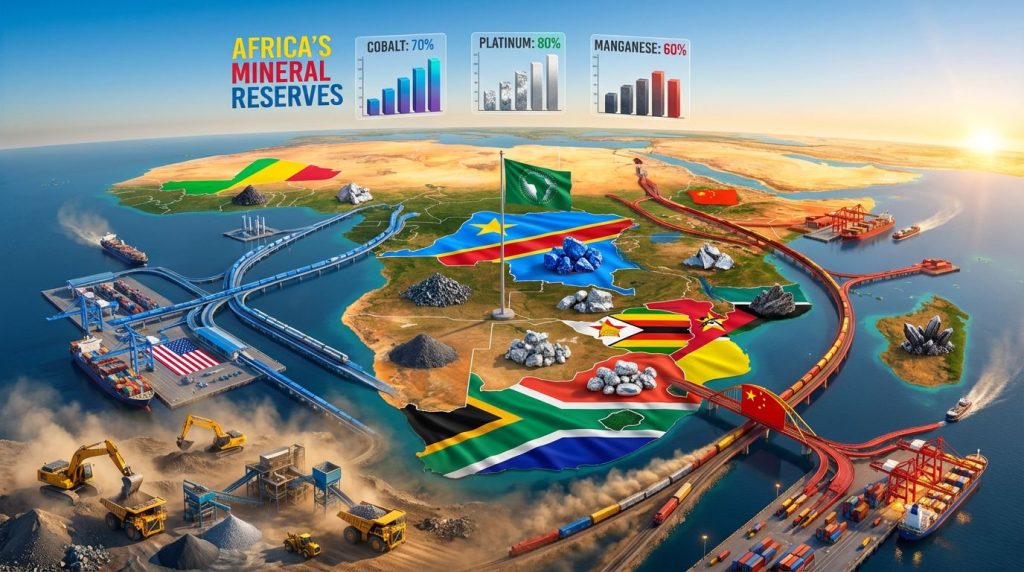
Africa's geological endowment positions the continent at the center of global mineral security discussions, particularly amid intensifying China-US mineral rivalry in Africa. The Democratic Republic of Congo controls approximately 73% of global cobalt mine production, making it the world's dominant cobalt supplier according to the United States Geological Survey Mineral Commodity Summaries 2024. This concentration extends beyond cobalt to encompass multiple critical materials essential for modern technology and energy systems.
Furthermore, South Africa holds the world's largest manganese reserves at approximately 350 million tonnes, representing roughly 45-50% of global reserves according to World Bank Commodity Markets Outlook 2024. Combined with Zimbabwe, the region controls approximately 88% of known platinum reserves globally, creating significant supply concentration risks for automotive and industrial applications.
Continental Resource Concentration Creates Geopolitical Leverage
The intersection of geological fortune and geopolitical positioning creates unique dynamics that influence green transition dynamics across multiple industrial sectors. Consequently, African nations find themselves at the centre of major power competition seeking reliable access to these essential materials.
| Mineral | African Share | Primary Locations | Global Significance |
|---|---|---|---|
| Cobalt | 73% production | DRC | EV battery critical component |
| Manganese | 45-50% reserves | South Africa, Gabon, Ghana | Steel production, battery materials |
| Platinum Group Metals | 88% reserves | South Africa, Zimbabwe | Automotive catalysts, hydrogen fuel cells |
| Chromium | 47% reserves | South Africa | Stainless steel production |
| Graphite | 21-25% reserves | Madagascar, Mozambique | Battery anodes, industrial applications |
Why Does Energy Transition Amplify Resource Demand?
The International Energy Agency projects substantial increases in critical mineral demand through the 2030s to meet net-zero energy transition goals. Electric vehicle batteries require approximately 8 kg of lithium carbonate equivalent per vehicle, with global lithium demand potentially reaching 1.2 million tonnes by 2030 according to the IEA Global EV Outlook 2024.
Moreover, each electric vehicle battery contains approximately 10-20 kg of cobalt, while utility-scale wind turbines require approximately 400 kg of rare earth elements for permanent magnet generators. This creates multiplicative demand pressure as renewable energy deployment accelerates globally.
Critical mineral demand is expected to increase substantially by 2040, with lithium, cobalt, and nickel requirements growing significantly to support energy transition objectives according to multiple industry assessments.
Additionally, Sub-Saharan Africa holds approximately 30% of the world's proven critical mineral reserves according to World Bank assessments. This positions the continent as a fundamental supplier for global energy transition security requirements, creating strategic leverage that African nations can potentially employ in negotiations with major powers.
When big ASX news breaks, our subscribers know first
China's Comprehensive African Mineral Strategy
Infrastructure-Linked Resource Acquisition Model
Chinese entities invested approximately $3.37 billion in Africa's mining sector during 2024, targeting South Africa, Mozambique, Niger, Algeria, and Mauritius. This investment extends beyond simple mining concessions to encompass comprehensive infrastructure development linking extraction sites to export facilities.
The Sicomines copper mining project in the Democratic Republic of Congo exemplifies this integrated approach. Chinese entities hold a 68% equity stake in the venture, with multiple Chinese state-owned enterprises coordinating this strategic resource development representing state-level resource planning rather than purely commercial ventures.
Furthermore, Chinese railway and port facility development creates long-term operational advantages by reducing extraction-to-export bottlenecks. This infrastructure integration differs fundamentally from Western resource models that typically emphasise single-concession development without comprehensive logistics network construction.
Processing Dominance Creates Value Capture Advantages
China controls refining capacity for 19 of 20 strategic minerals identified by the U.S. Department of Interior as critical to national security. This processing dominance enables value capture beyond simple resource extraction, as approximately 77% of Africa's raw mineral materials are processed in Chinese facilities after export according to industry assessments.
However, recent battery recycling breakthrough developments indicate potential shifts in this processing landscape. Chinese rare earth processing facilities handle approximately 90% of global rare earth elements, with refining concentrated in Inner Mongolia and Guangdong Province according to USGS Mineral Commodity Summaries 2024.
The vertical integration model encompasses:
- Mining Rights Acquisition through bilateral government agreements
- Infrastructure Development financed through Chinese development banks
- Raw Material Export via Chinese-controlled logistics networks
- Downstream Processing in Chinese refining facilities
- Manufacturing Integration for global export market supply
State-Owned Enterprise Financial Advantages
Chinese state-owned enterprises operate under fundamentally different financial constraints compared to Western private capital providers. SOEs demonstrate tolerance for extended pre-revenue periods and lower immediate return-on-investment expectations compared to publicly-traded Western mining companies subject to quarterly earnings pressures.
Consequently, Chinese SOEs can maintain operations in regions with political uncertainty where Western private investment faces institutional barriers. These include pension fund restrictions, ESG-related capital constraints, and shareholder litigation risk, enabling Chinese entities to secure concessions in challenging operating environments.
United States Strategic Response Framework
National Security Integration Replaces Market-Based Approach
The United States imported 100% of its supplies for 15 mineral commodities as of 2024, with China supplying substantial proportions according to U.S. Geological Survey assessments. This complete import dependency encompasses:
- Graphite: 100% import dependency (primarily from China, Madagascar, and Brazil)
- Manganese: Near 100% import dependency with China and South Africa as primary sources
- Cobalt: Approximately 75% import dependency, with significant Chinese involvement in DRC processing
- Rare Earth Elements: Approximately 80-85% import dependency, primarily from China
In response, recent US critical minerals order initiatives aim to address these vulnerabilities. The Defence Production Act grants the U.S. Executive Branch authority to accelerate development of critical mineral processing facilities through expedited permitting and financing.
Infrastructure Competition Through Alternative Corridor Development
The Lobito Corridor railway project linking Angola, Zambia, and the Democratic Republic of Congo represents infrastructure development supporting mineral export diversification away from China-controlled transportation routes. Initial phases commenced 2021-2022 with ongoing development extending through 2025 and beyond.
Furthermore, this infrastructure initiative directly competes with Chinese Belt and Road Initiative projects by providing alternative export routes. The corridor enables mineral exports through Atlantic ports rather than Chinese-financed facilities, reducing African dependence on Chinese logistics networks.
Minerals Security Partnership Multilateral Coordination
Established in 2022, the Minerals Security Partnership coordinates approximately 14 member countries around environmental, social, and governance standards integration with mineral supply chain development. Member countries include the United States, European Union member states, United Kingdom, Canada, Australia, Japan, and South Korea.
The partnership emphasises:
- Responsible sourcing standards limiting conflict mineral procurement
- Community benefit-sharing requirements for local population involvement
- Environmental impact assessments and remediation standards
- Worker safety and labour practice requirements exceeding baseline regulatory compliance
Financial Mechanisms for Supply Chain Diversification
The U.S. Export-Import Bank provided $160 million in financing support to Pensana Rare Earths and Chemicals for rare earth element processing facility development in Angola. This project targets 2027 for initial production, positioning Angola as an alternative rare earth processing hub.
Additionally, the "mine to magnet" supply chain development model aims to reduce reliance on Chinese refining and manufacturing intermediates. This approach supports integrated value chains from mineral extraction through processing to permanent magnet motor manufacturing within allied nation networks.
African Nation Strategic Positioning Options
Resource Leverage Through Competitive Bidding
Multiple African nations hold significant strategic leverage through their mineral endowments, enabling competitive bidding between major powers for access rights. Zimbabwe's lithium deposits, Mali's emerging mineral potential, and Mozambique's graphite resources create opportunities for favourable negotiation terms.
However, the Democratic Republic of Congo's cobalt dominance provides particular leverage given global electric vehicle growth projections. DRC's position as supplier of 70% of global cobalt production creates supply security vulnerabilities for any major power lacking reliable access to Congolese resources.
Moreover, South Africa's established mining infrastructure combined with platinum group metal dominance offers advantages in attracting processing facility investment rather than simple raw material extraction agreements. This positioning reflects broader strategic reserves insights relevant to resource-rich nations.
Value Addition Through Domestic Processing Development
Current patterns show 77% of Africa's mineral resources exported in raw material form, representing significant value transfer to foreign processing facilities. Domestic processing facility development could capture substantially higher revenues per unit of mineral extracted.
Processing facility development requirements include:
- Smelting and refining infrastructure investment estimated in hundreds of millions per facility
- Technology transfer agreements with experienced processing operators
- Skilled workforce development for technical processing operations
- Environmental management systems meeting international standards
- Export logistics adaptation for processed rather than raw material shipments
African Continental Free Trade Area Integration
The African Continental Free Trade Area, launched in 2021, provides frameworks for increased intra-African trade and regional beneficiation strategies. Regional mineral processing hubs could serve multiple African suppliers while reducing dependence on external processing facilities.
Furthermore, collective bargaining potential exists through coordinated African approaches to major power negotiations. Resource cartel formation possibilities, similar to OPEC petroleum coordination, could strengthen African negotiating positions with competing powers.
Supply Chain Vulnerability Analysis
Single-Source Dependencies Create Strategic Risks
Approximately 95% of global gallium production occurs in China according to USGS assessments, creating critical vulnerability for semiconductor applications essential to electric vehicle power electronics. Similar concentration patterns exist across multiple critical materials where single countries control dominant market shares.
Consequently, transportation route security considerations extend beyond mining locations to encompass shipping lanes, port facilities, and processing plant security. Research indicates that the U.S. and China are racing for critical minerals in Africa, with both powers seeking to establish secure supply chains through strategic partnerships.
| Chokepoint Type | Location | Minerals Affected | Disruption Impact |
|---|---|---|---|
| Processing Facilities | China (Inner Mongolia) | Rare Earth Elements | 90% global capacity |
| Transportation Routes | Strait of Malacca | Multiple minerals | Asian-Pacific shipping |
| Mining Regions | DRC (Katanga Province) | Cobalt | 70% global production |
| Port Facilities | Chinese-operated ports | Various African minerals | Export capacity bottlenecks |
Export Control Weaponisation Precedents
China has implemented temporary rare earth export restrictions and established germanium and gallium export controls, demonstrating how mineral supply access can be utilised as geopolitical leverage. These precedents indicate potential for supply disruption during international tensions.
Moreover, Western governments increasingly recognise mineral supply security as national security imperative rather than purely commercial consideration. This leads to strategic reserves planning and supply chain resilience investments extending beyond market-based procurement approaches.
Technology Disruption and Future Demand Scenarios
Battery Chemistry Evolution Reducing Dependency Patterns
Lithium iron phosphate (LFP) battery technology development reduces cobalt dependence in electric vehicle applications, potentially diminishing the strategic importance of cobalt-rich African resources. Similarly, solid-state battery development could alter mineral demand patterns significantly.
Furthermore, recycling technology advancement creates alternative supply sources for critical materials. Battery recycling facilities could recover substantial proportions of lithium, cobalt, and nickel from end-of-life electric vehicles, reducing primary mining dependence over extended timeframes.
Climate Policy Acceleration Effects
Net-zero emissions commitments by major economies drive mineral demand acceleration beyond current projection levels. Carbon border adjustment mechanisms could affect African mineral exports by incorporating carbon content assessments into trade frameworks.
Additionally, renewable energy deployment acceleration increases demand for wind turbine rare earth elements, solar panel silver and silicon, and grid storage battery materials simultaneously across multiple technology sectors.
The next major ASX story will hit our subscribers first
Geopolitical Realignment Possibilities
Regional Power Competition Beyond China-US Rivalry
India, Saudi Arabia, Russia, and other emerging powers increasingly compete for African mineral access, creating additional negotiation opportunities for African governments beyond bilateral China-US competition frameworks. As highlighted by experts, African countries need to establish rules for this mineral competition.
Furthermore, European Union coordination through critical raw materials policy initiatives represents additional competitive pressure on traditional China-US mineral rivalry in Africa dynamics in African mineral markets.
African Union Collective Action Potential
Continental coordination through African Union frameworks could strengthen negotiating positions with external powers seeking mineral access. Collective bargaining approaches similar to OPEC petroleum coordination models offer possibilities for enhanced revenue capture.
Consequently, regional power bloc formation scenarios could emerge through economic integration initiatives linking mineral-rich African nations with shared negotiation strategies and infrastructure development coordination.
Optimisation Strategies for African Resource Management
Revenue Multiplication Through Processing Integration
Domestic processing facility development could multiply export revenues significantly compared to raw material sales. Refined mineral exports typically generate 3-5 times higher revenues per unit compared to raw material equivalents, representing substantial economic development opportunities.
Furthermore, technology transfer requirements in processing facility agreements ensure knowledge transfer and skill development beyond simple employment creation. These capabilities create long-term competitive advantages for sustained economic development.
Environmental and Social Governance as Competitive Advantage
International standard compliance creates competitive differentiation for African mineral suppliers seeking Western market access. ESG-compliant operations command premium pricing and preferential access to Western financing sources.
Moreover, community development integration requirements ensure local population benefits from mineral extraction activities. Benefit-sharing agreements create political stability advantages that support long-term investment sustainability.
Success metrics for African resource strategy should encompass revenue capture improvement targets, local employment and skills development goals, and environmental protection standard achievement rather than simple extraction volume maximisation.
The current window of geopolitical competition between major powers creates unprecedented opportunities for African nations to negotiate favourable terms for mineral resource development. However, capitalising on China-US mineral rivalry in Africa requires sophisticated negotiation strategies, domestic capacity building, and regional coordination mechanisms that extend beyond traditional resource extraction models toward comprehensive economic development frameworks.
Want to Capitalise on Emerging Mineral Opportunities?
Africa's strategic mineral dominance creates significant investment opportunities as global powers compete for critical resource access. Discovery Alert's proprietary Discovery IQ model delivers real-time alerts on significant ASX mineral discoveries, instantly identifying actionable opportunities in mining companies positioned to benefit from this geopolitical mineral race. Begin your 30-day free trial today to position yourself ahead of the market with immediate access to Discovery Alert.