June 9, 2026
The Nuclear Fuel Landscape Is Changing Faster Than Most Investors Realise
For most of the past seven decades, nuclear energy has been synonymous with uranium. The entire global infrastructure of reactor design, fuel fabrication, enrichment, and waste management was built around a single elemental feedstock. Yet the rise of advanced microreactor development is quietly forcing a reassessment of that assumption. As compact, factory-built reactor systems push into new deployment environments, including remote industrial sites, naval vessels, forward military bases, and AI-hungry data centres, the question of what those reactors will actually run on has become commercially urgent. Thorium, long dismissed as a curiosity or a processing byproduct, is re-entering the conversation with genuine momentum.
The emergence of Ampera thorium microreactor fuel from Australia as a structured supply chain strategy illustrates exactly how this shift is unfolding at the corporate level, and why the gap between geological potential and commercial reality deserves careful scrutiny from investors and industry observers alike.
When big ASX news breaks, our subscribers know first
Understanding Thorium's Elemental Position in the Nuclear Fuel Hierarchy
Thorium occupies an unusual space in nuclear physics. It is not fissile in the way that uranium-235 is, meaning it cannot sustain a self-reinforcing chain reaction on its own. Instead, it is classified as a fertile material. When thorium-232 absorbs a neutron, it undergoes a two-step decay sequence that ultimately produces uranium-233, which is fissile and capable of sustaining a nuclear reaction.
This distinction matters enormously for reactor design. A thorium-fuelled system requires an external neutron source to initiate and maintain the conversion process. Ampera's subcritical microreactor design addresses this through proprietary neutron-source technology integrated into its architecture. The approach sidesteps the need for a self-sustaining chain reaction entirely, which has significant implications for both safety engineering and regulatory positioning.
Why Thorium's Abundance Is Both an Asset and a Complication
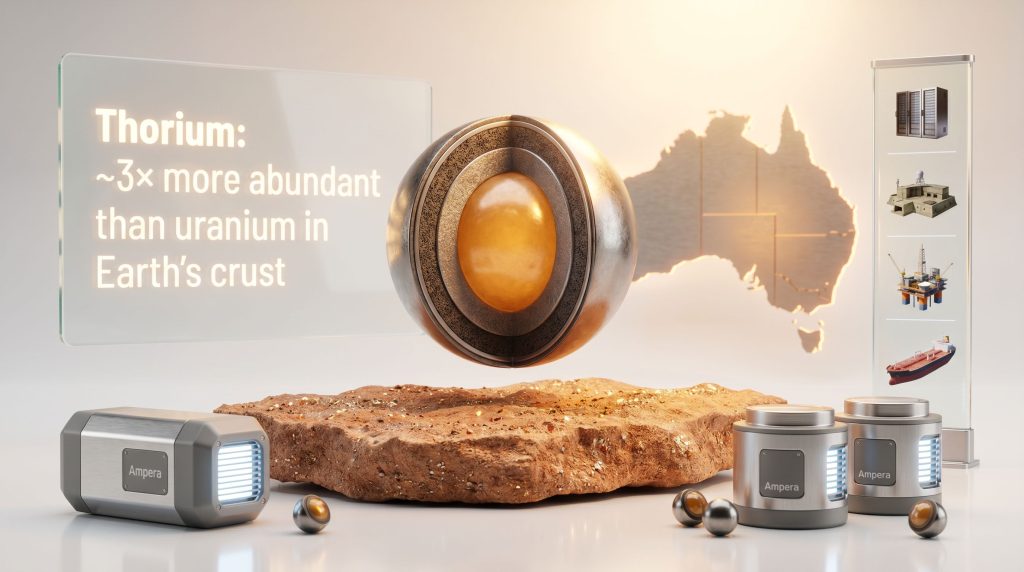
Thorium is estimated to be more than three times as abundant in Earth's crust as uranium, according to the World Nuclear Association. Australia holds substantial identified thorium resources, primarily co-located with rare earth mineral deposits and heavy mineral sands in regions such as Western Australia and Queensland. However, abundance in the ground does not translate directly into available commercial supply.
Geoscience Australia's assessments have consistently noted that large-scale commercial thorium production is unlikely within the near term. The reason is structural: thorium has historically been extracted as an unwanted byproduct during rare earth and monazite processing, then stockpiled or disposed of due to the absence of any established demand market. There is currently no active commercial thorium mining operation in Australia, and no established global market for thorium as a traded fuel commodity.
Furthermore, when examining global thorium reserves, it becomes clear that while the geological foundation exists, transforming that potential into commercial supply requires deliberate strategic investment and bilateral cooperation.
This is a critical framing point for investors. Ampera's Australian thorium strategy is not procurement from an existing supply chain. It is an effort to construct that supply chain from the ground up, using Australia's resource base as the geological foundation and a bilateral diplomatic framework as the enabling mechanism.
TRISO Fuel Technology: The Engineering Bridge Between Thorium and Deployable Power
The commercial pathway for thorium as a microreactor fuel depends heavily on one manufacturing innovation: TRISO fuel kernels. Tri-structural isotropic fuel encapsulates fissile or fertile material within multiple concentric layers of ceramic and carbon-based coatings, creating a particle-level containment system that can withstand extreme temperatures and physical stress.
Each TRISO kernel functions, in essence, as its own miniature containment vessel. The layered structure, typically comprising a porous carbon buffer, a dense inner pyrolytic carbon layer, a silicon carbide layer, and an outer pyrolytic carbon layer, prevents the release of radioactive fission products under conditions that would compromise conventional fuel rod cladding.
What Makes Ampera's TRISO Approach Distinctive
Ampera's fuel platform is built on a portfolio of more than 60 patents covering nuclear fuel manufacturing processes, including a proprietary jetting technology used to produce TRISO kernels. The jetting approach relates to advanced additive manufacturing methods for forming the initial fuel kernel geometry before coating, a process step that directly influences particle sphericity, density uniformity, and ultimately fuel performance.
Key characteristics of Ampera's TRISO-based fuel strategy include:
- Proprietary jetting technology for kernel formation, providing manufacturing process control not replicable through standard methods
- In-house production planned at a Florida facility, enabling supply chain ownership from raw thorium import through finished fuel kernel
- Trade secret protections layered alongside patent coverage, creating dual-layer IP defence
- TRISO architecture specifically selected for compatibility with high-temperature, compact reactor environments
- Safety profile suited to deployment in non-grid-connected environments where external emergency response is limited or unavailable
The significance of producing TRISO thorium kernels domestically in the United States cannot be overstated from a supply security perspective. It means Ampera is not dependent on any third-party fuel fabricator, a structural vulnerability that has historically exposed reactor operators to both cost volatility and geopolitical supply risk.
How the US-Australia Critical Minerals Framework Enables the Strategy
In October 2025, the governments of the United States and Australia announced a bilateral framework for securing supply chains in critical minerals and rare earth processing. This intergovernmental agreement created the diplomatic and regulatory foundation that made cross-border thorium procurement between allied nations a viable corporate planning assumption.
Ampera moved quickly to operationalise this framework. In February 2026, the company established Ampera Australia Pty Ltd, a dedicated subsidiary structured specifically to manage the procurement and import of thorium material from Australia to the United States. The timing is deliberate: forming the corporate infrastructure before a commercial thorium supply chain exists positions Ampera to shape the terms of that market rather than participate in it as a price-taking buyer.
It is worth being precise about what this framework does and does not represent. The bilateral agreement is a government-to-government policy instrument covering critical minerals supply security broadly. It does not constitute project-specific government support, funding, or designation for Ampera's operations. Rather, it establishes the conditions within which a private company can legally and practically execute a cross-border thorium procurement strategy.
Consequently, the broader critical minerals demand environment has made such bilateral frameworks increasingly common between allied nations seeking to reduce dependency on potentially adversarial supply sources. In addition, shifting rare earth supply chains towards allied-nation partnerships reflects the same strategic logic underpinning Ampera's Australian subsidiary structure.
The Vertical Integration Model: Four Stages From Ground to Grid
Ampera's commercial architecture follows a vertically integrated logic that spans the entire fuel value chain. Understanding how each stage connects is essential for evaluating the strategy's execution risk.
| Stage | Activity | Entity |
|---|---|---|
| 1 | Identifying and securing thorium-bearing mineral sources in Australia | Ampera Australia Pty Ltd |
| 2 | Importing raw thorium material to the United States | Ampera Australia Pty Ltd as procurement vehicle |
| 3 | Converting imported thorium into TRISO fuel kernels at Florida facility | Ampera (US operations) |
| 4 | Integrating proprietary fuel into factory-built containerised microreactor systems | Ampera (US operations) |
This structure mirrors the vertical integration strategies employed by battery metals companies and rare earth processors, where control over upstream mineral supply is treated as a strategic asset rather than a commodity purchasing function. In nuclear fuel markets, this approach is unusual. Most reactor operators source fuel from established commercial fabricators operating within the existing uranium supply chain.
Target Markets: Where Thorium Microreactors Compete
Ampera's addressable market spans four structurally distinct sectors, each sharing a common requirement for reliable, high-density, emission-free power in locations where grid connectivity is impractical or strategically undesirable.
Data Centres: The exponential growth of AI-driven computing infrastructure has created acute power demand pressure on grid operators globally. Hyperscale data centres increasingly require gigawatt-scale power commitments that conventional grid connections cannot guarantee. Compact nuclear microreactors offer an off-grid baseload solution with zero direct emissions, a combination no other current technology can match at equivalent energy density.
Defence and Military Operations: Containerised, rapidly deployable power systems address a long-standing logistical vulnerability in military operations. Fuel supply lines are among the most exposed and costly elements of forward operating base maintenance. A self-contained nuclear microreactor that operates without refuelling fundamentally changes the energy logistics equation for defence planners.
Industrial Applications: Remote mining operations, off-grid processing facilities, and industrial sites facing decarbonisation mandates represent a large and underserved power market. These operations typically rely on diesel generation, which carries both high fuel cost volatility and growing regulatory carbon exposure.
Maritime and Shipping: In April 2026, Ampera announced a strategic collaboration with Monaco-based Scorpio Tankers Inc to jointly develop microreactors for marine and shipping applications. The maritime sector faces some of the most demanding decarbonisation targets of any heavy industry, with the International Maritime Organization targeting net-zero greenhouse gas emissions from international shipping by or around 2050.
The next major ASX story will hit our subscribers first
Regulatory Position and Development Timeline
Key Milestones: 2025 to Mid-2026
| Date | Development |
|---|---|
| October 2025 | US-Australia critical minerals bilateral framework announced |
| February 2026 | Ampera Australia Pty Ltd established |
| February 2026 | Formal pre-application letter submitted to US Nuclear Regulatory Commission |
| April 2026 | Strategic collaboration with Scorpio Tankers Inc announced |
| April 2026 | Global headquarters opened in Florida, USA |
| June 2026 | Australian thorium fuel sourcing strategy publicly announced |
The NRC pre-application process is precisely what its name implies: the earliest formal engagement stage between a developer and the regulator, occurring well before any licence application is submitted. This phase involves technical exchanges, identification of novel regulatory questions, and early safety review planning. It does not represent approval, licensing, or even formal review of a completed design.
For novel reactor concepts using non-conventional fuel cycles, the path from pre-application engagement to design certification has historically taken well over a decade. Investors should calibrate expectations accordingly.
Thorium vs. Uranium: A Technical Comparison for Microreactor Contexts
| Dimension | Thorium | Uranium |
|---|---|---|
| Crustal abundance | Approximately 3x more abundant | Less abundant |
| Fissile status | Fertile (converts to U-233 via neutron absorption) | Fissile (U-235 directly usable) |
| Weapons proliferation risk | Generally considered lower | Higher concern with enriched forms |
| Long-lived waste production | Reduced actinide generation in some cycles | Produces long-lived transuranics |
| Commercial maturity | Early-stage and developmental globally | Fully commercialised across all markets |
| Existing supply chain | No established commercial market | Deep global infrastructure |
| TRISO fuel compatibility | Under active development by Ampera | Proven in existing advanced reactor designs |
One technically significant but underappreciated aspect of the thorium fuel cycle is the proliferation resistance argument. Uranium-233 produced from thorium breeding does contain a contaminant isotope, uranium-232, whose decay chain produces highly penetrating gamma radiation. This characteristic makes U-233 significantly more difficult and hazardous to handle covertly for weapons purposes than weapons-grade enriched uranium, though it is not absolutely proliferation-proof under all technical scenarios.
However, it is important to note that shifting uranium market dynamics — including supply disruptions and the Russian uranium import ban — have further strengthened the case for diversifying nuclear fuel feedstocks into alternatives such as thorium.
Assessing Commercial Viability: Supporting Factors and Execution Risks
Any balanced analysis of Ampera's strategy must hold both dimensions simultaneously.
Factors supporting long-term viability:
- A bilateral government framework providing diplomatic enablement for cross-border thorium trade between allied nations
- A proprietary IP portfolio exceeding 60 patents, creating defensible competitive positioning in fuel manufacturing
- Vertical integration architecture that, if successfully executed, eliminates third-party fuel cost exposure
- Multi-sector addressable market with structural tailwinds in energy security, decarbonisation, and AI infrastructure
- The Scorpio Tankers partnership providing a concrete commercial pathway in maritime, one of the largest decarbonisation challenges globally
Execution risks that warrant investor caution:
- Australia has no active commercial thorium production as of mid-2026. The supply chain Ampera needs does not yet exist.
- Geoscience Australia has assessed large-scale thorium production as unlikely in the near term, meaning supply ramp-up timelines are uncertain.
- TRISO thorium kernel production at commercial scale has not been demonstrated anywhere in the world.
- The broader thorium fuel cycle remains developmental globally, with no operational commercial precedent.
- NRC pre-application engagement represents the very beginning of a multi-year, potentially multi-decade regulatory process.
The honest characterisation of Ampera's current position is this: a well-capitalised, IP-rich technology developer with a coherent long-term strategy, operating at the earliest stages of both supply chain development and regulatory approval. The distance between the announced intention and commercial operation is measured in years, not months.
What Ampera's Strategy Signals for the Broader Nuclear Fuel Sector
The structural significance of what Ampera is attempting extends well beyond a single company's commercial plan. If a vertically integrated thorium fuel supply chain can be successfully constructed between Australia and the United States, it would represent the first time thorium has transitioned from a processing byproduct into a purpose-built commercial nuclear fuel commodity.
That transition would have cascading implications. Australia could emerge as a thorium exporter within a broader critical minerals framework, adding a new category to its already significant rare earth and mineral sand export profile. Reactor developers globally, who have historically avoided thorium fuel cycles due to the absence of commercial infrastructure, might find the calculus beginning to change.
The deeper pattern here reflects a broader shift in how energy-critical supply chains are being structured. The era of assuming open, liquid global commodity markets for fuel inputs is giving way to an era of allied-nation sourcing, bilateral frameworks, and vertical integration. Thorium, precisely because it has no existing commercial market, may be easier to structure within this new paradigm than uranium, which carries decades of existing contractual and geopolitical complexity.
For investors and industry observers tracking advanced nuclear development, the story of Ampera thorium microreactor fuel from Australia represents an early and instructive example of how the next generation of nuclear fuel supply chains may be assembled: not by plugging into existing markets, but by building entirely new ones. For those seeking further context on thorium as a nuclear fuel, independent technical resources provide valuable grounding for evaluating competing claims about its commercial potential.
This article contains forward-looking analysis and references to development-stage technologies and strategies. It does not constitute financial advice. Investors should conduct independent due diligence before making any investment decisions. All regulatory timelines referenced reflect historical precedent and publicly available information and are subject to change.
Want to Track the Next Major Mineral Discovery Before the Broader Market Does?
Discovery Alert's proprietary Discovery IQ model delivers real-time alerts on significant ASX mineral discoveries — instantly turning complex data across 30+ commodities into actionable insights for both short-term traders and long-term investors. Explore historic discoveries and the substantial returns they generated, then begin your 14-day free trial at Discovery Alert to position yourself ahead of the market.