May 23, 2026
The Arctic Mineral Maze: Why Geography and Geology Shape Critical Resource Markets
Global supply chain vulnerabilities in critical minerals have exposed fundamental weaknesses in how nations approach resource security. Furthermore, understanding the critical minerals energy security implications requires examining the complex interdependencies between geological characteristics, processing technologies, regulatory frameworks, and geopolitical positioning that determine market access and pricing power.
Arctic mineral deposits represent a fascinating paradox: vast theoretical reserves constrained by practical extraction realities. This dynamic extends beyond simple economics into the realm of technological feasibility, environmental considerations, and strategic positioning in an increasingly multipolar resource landscape.
Greenland's Geological Complexity: Understanding Eudialyte Processing Challenges
The Arctic island's mineral wealth centres around eudialyte-hosted deposits, presenting unique metallurgical challenges that have confounded international extraction efforts for decades. Unlike traditional rare earth element (REE) deposits found in carbonatites or ion-adsorption clays, eudialyte requires entirely different processing approaches that remain largely theoretical despite substantial research investments.
However, evaluating these deposits requires understanding the mineral deposit tiers guide framework that classifies resources based on processing complexity. Greenland rare earth minerals fall into the most challenging category due to their unique mineralogy.
Technical Processing Barriers:
- Complex sodium-calcium-zirconium silicate matrix requiring multi-stage acid leaching
- High fluorine content creating environmental and equipment corrosion challenges
- Radioactive thorium and uranium co-occurrence complicating separation processes
- Energy-intensive beneficiation requiring specialised crushing and flotation techniques
Industry specialists have documented repeated failures across multiple international attempts to commercialise eudialyte processing. For instance, German engineering firms, Finnish metallurgical research institutes, Chinese state-owned enterprises, and Russian mining conglomerates have all encountered similar technical bottlenecks that prevent economic extraction at commercial scales.
Table: Eudialyte vs. Traditional REE Deposits Processing Comparison
| Processing Stage | Eudialyte Deposits | Traditional REE Deposits | Complexity Factor |
|---|---|---|---|
| Ore Preparation | Multi-stage crushing, magnetic separation | Standard crushing, flotation | 3x more complex |
| Leaching | Sulphuric/hydrochloric acid at high temperatures | Sulphuric acid standard conditions | 2x more intensive |
| Separation | Novel solvent extraction required | Established precipitation methods | 5x more challenging |
| Purification | Radioactive element removal mandatory | Standard rare earth separation | 4x additional steps |
Strategic Geography: Arctic Infrastructure Investment Requirements
Greenland's remote location creates infrastructure demands that dwarf typical mining development costs. Consequently, the absence of existing transportation networks, power generation capacity, and processing facilities means any serious extraction operation must build complete industrial ecosystems from ground zero.
Critical Infrastructure Components:
- Deep-water port facilities capable of year-round operation
- Heavy-lift transportation networks connecting inland deposits to coastal access points
- On-site power generation systems sized for energy-intensive mineral processing
- Specialised housing and life support systems for international workforce requirements
- Environmental monitoring and waste management facilities meeting Arctic standards
According to industry experts examining Greenland's geological complexity, the total capital expenditure for establishing commercial-scale rare earth operations in Greenland's Arctic environment typically exceeds five billion dollars before any mineral production begins, creating financing challenges that extend development timelines by decades rather than years.
Deposit Quality Assessment: Kvanefjeld and Tanbreez Project Analysis
Despite processing challenges, Greenland rare earth minerals contain significant heavy rare earth element concentrations that command premium pricing in global markets. In addition, the Kvanefjeld project, now suspended due to regulatory changes, contained some of the world's highest-grade heavy REE mineralisation outside of Chinese deposits.
Kvanefjeld Deposit Specifications:
- Total rare earth oxide (TREO) grade: 1.43%
- Heavy rare earth elements: 370,000 metric tonnes contained
- Dysprosium content: Premium concentrations exceeding 0.1%
- Terbium reserves: Significant quantities of this critical permanent magnet component
The Tanbreez project represents a more realistic near-term development scenario, with lower radioactive content and potentially simpler processing requirements. However, even this operation faces substantial technical and economic hurdles that have delayed commercial production beyond initial projections.
Table: Greenland REE Projects Development Status
| Project Name | TREO Grade | Heavy REE % | Development Stage | Key Constraints |
|---|---|---|---|---|
| Kvanefjeld | 1.43% | 25% | Suspended | Uranium content, political opposition |
| Tanbreez | 0.5% | 30% | Pilot phase | Processing technology, financing |
| Kringlerne | 1.1% | 20% | Exploration | Remote location, no infrastructure |
| Kangerluluk | 0.8% | 22% | Early exploration | Limited geological data |
Market Dynamics: China's Processing Monopoly vs. Raw Material Availability
Understanding global rare earth markets requires distinguishing between mining and processing capabilities. Furthermore, the critical minerals demand surge has intensified competition for processing capacity, while China's dominance stems from integrated refining and separation infrastructure developed over decades of strategic investment.
Global REE Value Chain Control Points:
- Mining operations: Distributed globally with China, Australia, United States leading
- Ore concentration: Limited facilities outside China for complex processing
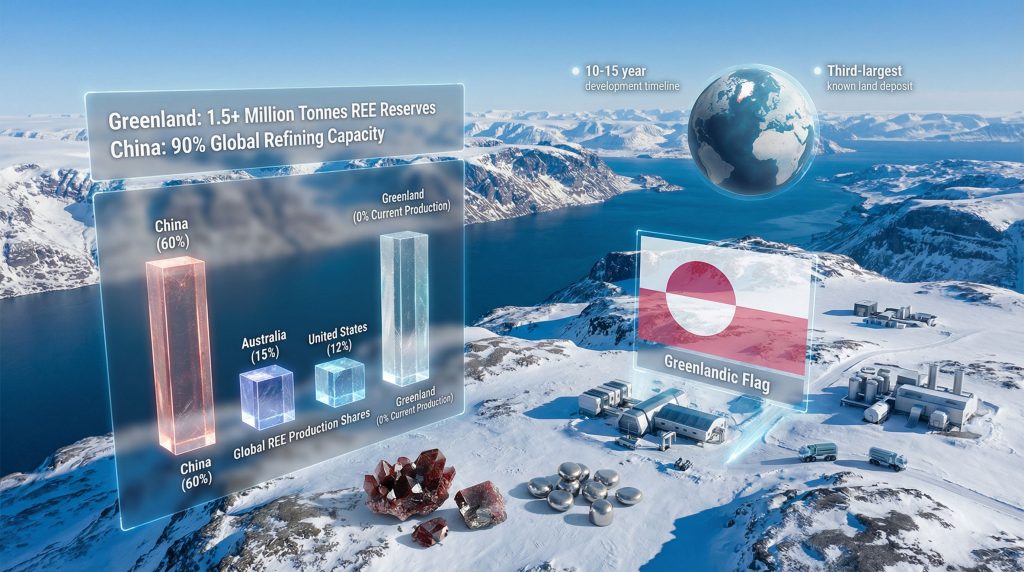
- Chemical separation: 90% controlled by Chinese facilities
- Alloy and magnet production: Concentrated in East Asian manufacturing hubs
This processing bottleneck means that even successful development of Greenland rare earth minerals would require either shipping concentrate to Chinese facilities or building entirely new separation infrastructure in Western markets. The technical knowledge and industrial capacity for rare earth processing represents decades of accumulated expertise that cannot be rapidly replicated.
Regulatory Evolution: Environmental Policy vs. Strategic Mineral Access
Greenland's political landscape regarding mining has shifted dramatically over recent years, creating additional uncertainty for potential developers. For example, the 2021 decision to ban uranium mining effectively eliminated the Kvanefjeld project despite its significant rare earth potential, demonstrating how environmental concerns can override strategic mineral considerations.
Key Regulatory Developments:
- 2021 uranium mining prohibition affecting multiple REE projects with radioactive co-occurrence
- Environmental impact assessment requirements specific to Arctic ecosystems
- Indigenous consultation processes extending permitting timelines
- Climate change adaptation requirements for long-term mining operations
Recent electoral changes have introduced new variables into Greenland's mining policy framework. Pro-development parties gained influence in 2025 elections, potentially reopening discussions about previously banned projects, but implementation timelines remain highly uncertain.
Technology Pathways: Innovation Requirements for Arctic REE Extraction
Breakthrough processing technologies specifically designed for eudialyte deposits could theoretically unlock Greenland's mineral potential. Moreover, AI in mining innovation offers promising solutions for optimising extraction processes in harsh Arctic conditions. Research initiatives focus on several promising approaches, though commercial viability remains unproven at industrial scales.
Emerging Processing Technologies:
- High-temperature pressure leaching using novel acid combinations
- Microwave-assisted ore preparation reducing energy requirements
- Selective flotation techniques separating rare earth minerals from gangue materials
- Biohydrometallurgy approaches using specialised bacterial cultures
Investment Risk Considerations:
- Technology development risks with unproven commercial applications
- Regulatory approval uncertainties in evolving political environments
- Infrastructure capital requirements exceeding traditional mining projects
- Market timing risks given long development cycles vs. demand fluctuations
Supply Chain Diversification: Strategic Implications for Global Markets
Even successful development of Greenland rare earth minerals would require 10-15 year timelines for meaningful production volumes. Consequently, this extended development period limits near-term supply diversification benefits while creating opportunities for alternative strategies and competing projects.
The critical minerals supply chain vulnerabilities extend beyond Arctic resources. Additionally, comprehensive analysis from the Centre for Strategic and International Studies highlights the strategic implications of Greenland's mineral potential for Arctic security frameworks.
Alternative Diversification Strategies:
- Recycling infrastructure development for permanent magnet materials
- Substitution research reducing critical element dependencies
- Strategic stockpiling programmes maintaining supply security buffers
- International cooperation agreements spreading development risks
The geopolitical dimensions of critical mineral supply chains extend beyond simple supplier diversification into broader questions of technological sovereignty and industrial capacity building. Nations seeking reduced dependence on Chinese processing capacity must simultaneously develop mining, refining, and manufacturing capabilities across the entire value chain.
Investment Framework: Evaluating Arctic Mineral Opportunities
Professional investors approaching Greenland's rare earth sector require sophisticated risk assessment frameworks accounting for multiple uncertainty layers. Furthermore, traditional mining investment models prove inadequate for Arctic operations involving novel processing technologies and evolving regulatory environments.
Due Diligence Components:
- Metallurgical test work validation using representative ore samples
- Environmental baseline studies meeting Arctic regulatory standards
- Infrastructure cost modelling including climate change adaptations
- Political risk assessment covering electoral cycles and policy continuity
- Technology development monitoring for processing breakthrough potential
Table: Investment Timeline vs. Risk Probability Matrix
| Development Phase | Timeline | Technical Risk | Regulatory Risk | Commercial Risk |
|---|---|---|---|---|
| Exploration | 2-5 years | Medium | Low | Low |
| Feasibility | 3-7 years | High | Medium | Medium |
| Permitting | 2-5 years | Low | High | Medium |
| Construction | 5-8 years | Medium | Medium | High |
| Operations | 20+ years | Low | Medium | High |
Long-term Market Evolution: Scenarios for REE Supply Chain Transformation
The ultimate impact of Greenland's rare earth resources depends on broader technological and geopolitical developments that extend well beyond Arctic mining operations. In addition, multiple scenario pathways could fundamentally alter global supply chain dynamics over the next decade.
Scenario Analysis:
- Technology breakthrough scenario: Successful eudialyte processing enables large-scale Arctic production
- Substitution scenario: Alternative materials reduce rare earth element dependencies
- Recycling expansion scenario: Urban mining provides significant secondary supply sources
- Geopolitical fragmentation scenario: Trade restrictions accelerate regional supply chain development
Market participants must consider these interconnected possibilities when evaluating investment opportunities and strategic positioning within the critical minerals sector. The complexity of Arctic resource development means that success requires not just geological and technical factors aligning, but also sustained political support, technological innovation, and favourable market conditions persisting over extended timeframes.
Understanding Greenland rare earth minerals within this broader context reveals both the potential significance and practical limitations of Arctic resources in reshaping global supply chains. While geological endowments provide the foundation for potential development, the path from mineral occurrence to market supply involves navigating numerous technical, regulatory, and economic challenges that continue to constrain commercial viability despite decades of international interest and investment.
Ready to Capitalise on Critical Mineral Market Shifts?
Discovery Alert's proprietary Discovery IQ model delivers real-time alerts on significant mineral discoveries across the ASX, instantly empowering subscribers to identify actionable opportunities in the evolving critical minerals landscape. Begin your 14-day free trial today and secure your market-leading advantage in this rapidly transforming sector.