June 9, 2026
The Upstream Advantage: Why West African Bauxite Is Reshaping Indian Mining Economics
The global aluminium supply chain has long been shaped by a fundamental geographic reality: the world's most accessible, highest-quality bauxite reserves are concentrated in a handful of countries, and Guinea sits at the top of that list. For mining companies agile enough to secure early-mover positions in West Africa, the structural rewards are now becoming impossible to ignore. The financial results emerging from India's bauxite sector in FY2026 offer a compelling illustration of how upstream resource positioning translates into downstream earnings power over time.
Ashapura Minechem Guinea bauxite profit is one of the clearest examples yet of how a strategically concentrated bet on Guinea bauxite can compress a company's timeline from mid-tier operator to a structurally significant participant in global raw material flows. Understanding what drove this transformation, and what it signals for the years ahead, requires examining not just the headline numbers but the operational architecture sitting beneath them.
When big ASX news breaks, our subscribers know first
The Revenue Architecture: What Near-Doubling Sales Actually Means
It is rare for a mining company of meaningful scale to nearly double its revenue in a single fiscal year without a major acquisition. When organic volume growth and operational execution are the primary drivers, it signals something more durable than a commodity price spike.
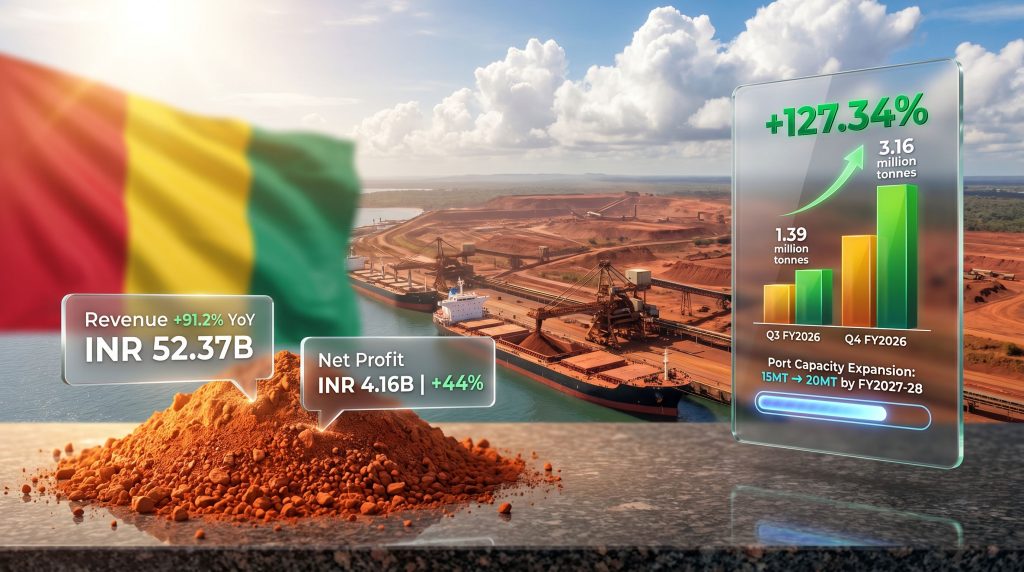
Furthermore, the bauxite and alumina market context surrounding this performance makes the result even more significant. Ashapura Minechem's FY2026 story is built on exactly this foundation. Revenue from operations reached INR 52.37 billion (USD 548.15 million), a 91.2% increase year-on-year from INR 27.39 billion (USD 286.67 million) in FY2025. Total consolidated income for the year came in at INR 53.56 billion (USD 560.58 million).
The profitability picture is equally instructive, though it requires a more nuanced reading than the top-line figure alone.
| Financial Metric | FY2025 | FY2026 | YoY Change |
|---|---|---|---|
| Revenue from Operations | INR 27.39B (USD 286.67M) | INR 52.37B (USD 548.15M) | +91.2% |
| Total Consolidated Income | – | INR 53.56B (USD 560.58M) | – |
| Net Profit (Consolidated) | INR 2.89B (USD 30.26M) | INR 4.16B (USD 43.59M) | +44% |
| Basic EPS | INR 31.46 | INR 42.02 | +33.57% |
| Final Dividend Per Share | INR 1.00 | INR 2.00 | +100% |
A common investor reflex is to question why net profit growth of 44% lagged revenue growth of 91.2%. The answer is actually reassuring rather than alarming. When a mining company rapidly scales export volumes, it absorbs proportionally higher logistics, fuel, and port handling costs in the near term. The cost base temporarily expands faster than margin can consolidate.
This is the natural mechanics of a volume ramp, not evidence of structural margin erosion. As volumes stabilise at higher levels and infrastructure capacity catches up, per-unit costs normalise and profit growth tends to accelerate relative to revenue growth. The earnings quality here is sound.
Basic EPS improved 33.57% year-on-year to INR 42.02, and the board's decision to double the final dividend to INR 2.00 per share further confirms management's conviction that this earnings level is sustainable, not a one-cycle anomaly.
Guinea's Operational Scale: The Asset Base That Makes This Possible
Numbers at the consolidated level only make sense when viewed against the physical reality of what is being operated on the ground. Ashapura's Guinea asset base covers approximately 872 square kilometres of mining concessions, holding an estimated reserve base exceeding 830 million tonnes of bauxite. This is not a boutique operation or an exploration-stage holding. It is a large-scale, export-oriented mining platform with infrastructure purpose-built for volume throughput.
Guinea's bauxite is globally recognised for its quality characteristics. The country's deposits typically feature gibbsite-dominant mineralogy, which means lower energy requirements during the refinery digestion process compared with boehmite or diaspore-bearing ores found in some other global deposits. This distinction matters to alumina refineries selecting feed material on the basis of processing cost and output efficiency.
It is one reason Guinea bauxite commands consistently strong demand across Asian and European refinery networks. In addition, China commodity demand trends continue to place significant weight on Guinea as a primary feed source, reinforcing long-term structural demand for operators with established concessions.
The Guinea division generated divisional turnover of approximately INR 42 billion (USD 439.6 million) during FY2026, representing roughly 79.3% of group revenue. This level of concentration is deliberate. It reflects years of capital allocation decisions prioritising the highest-return asset over a more diversified, but less focused, operational model.
The Q4 Volume Surge: Understanding the 127.34% Sequential Jump
Perhaps the most operationally significant data point in the full-year results is the Q4 export volume figure.
- Q3 FY2026 export volumes from Guinea: 1.39 million tonnes
- Q4 FY2026 export volumes from Guinea: 3.16 million tonnes
- Sequential quarter-on-quarter increase: +127.34%
This kind of sequential acceleration rarely happens by accident. In Guinea's bauxite export context, several intersecting factors typically drive Q4 surges. Dry season logistics improvements in the Guinea interior allow mining and haulage operations to reach peak throughput in the December to March window. Refinery customers managing annual procurement targets also tend to finalise large shipment schedules in the final calendar quarter. Port scheduling concentrations further amplify volume in short windows.
However, this volume surge came with a cost trade-off. Q4 profitability faced pressure from elevated ocean freight rates and fuel costs, conditions directly linked to geopolitical disruption in the Middle East affecting major shipping corridors. The inverse relationship between high-volume quarters and per-unit margin is well understood in bulk commodity logistics. When vessels are in high demand and fuel surcharges are elevated, the cost to move each tonne rises, compressing net realisation even as gross shipment volumes reach record levels. This is a cyclical headwind, not a structural problem.
H1 FY2026: Where the Inflection Point First Became Visible
The full-year strength did not emerge in isolation. The first half of FY2026 already signalled that something structurally different was unfolding in the Guinea business.
| H1 FY2026 Metric | Value |
|---|---|
| Income from Operations | INR 2,308 crore (~USD 276M) |
| EBITDA | INR 319.9 crore |
| Profit Before Tax | INR 213.05 crore |
| Guinea Bauxite Export Volumes | 3.38 million tonnes |
| Net Profit Growth (YoY) | +136% |
A 136% net profit surge in the first half alone is not a rounding error. It reflects genuine operating leverage: a cost structure that, beyond a certain volume threshold, does not scale linearly with production. Fixed costs across mining infrastructure, port access, and management overhead are largely absorbed at base volumes. Every incremental tonne shipped above that threshold carries meaningfully higher margins.
Q1 FY2026 standalone figures reinforced this, with revenue of INR 1,355 crore and profit before tax of INR 131.84 crore demonstrating the consistency of the underlying earnings engine. According to recent reporting, the Q1 revenue surge of 89.8% was driven almost entirely by Guinea bauxite operations, confirming that the earnings momentum is concentrated in a single, high-performing asset.
Guinea's Regulatory Shift: Why an Export Cap Could Be a Tailwind
One of the more counterintuitive dynamics emerging from Guinea's evolving regulatory environment deserves careful analysis. Guinea is advancing a framework to cap national bauxite export volumes, a policy designed to slow resource depletion, support local processing development, and manage freight market dynamics.
For most commodity-dependent economies, export restrictions typically raise concerns among investors in producing companies. In this case, the logic runs in the opposite direction for established, licensed exporters.
A reduction in Guinea's total national export volumes under a cap framework tightens global bauxite supply. With fewer tonnes competing for the same refinery demand, pricing power shifts toward sellers. Simultaneously, reduced vessel call frequency at Guinea ports creates less congestion and lowers freight rate pressure over time, improving net realisations for exporters who retain their licences and volume allocations.
This dynamic particularly benefits operators with established concessions, functioning port infrastructure, and existing refinery customer relationships. New entrants face the highest barriers under a constrained export environment, as licence allocation, berth access, and customer trust all take years to develop. Ashapura's existing footprint positions it to retain and potentially expand its proportional share of a smaller overall export pool, improving per-unit economics even if absolute volume growth moderates.
Guinea holds an estimated 7.4 billion tonnes of bauxite reserves, representing approximately one-quarter of the world's known bauxite endowment according to the US Geological Survey. The country's export trajectory has grown dramatically over the past decade, making it one of the global bauxite mine leaders by volume. Any policy action that deliberately constrains this flow has material implications for global alumina supply chains, particularly for Chinese alumina refineries that have become heavily reliant on Guinean feed material. China currently imports more than half of its bauxite needs from Guinea, a dependency that amplifies the downstream price sensitivity to any supply reduction.
Capital Allocation: Building the Infrastructure for the Next Growth Phase
Management's capital deployment decisions reveal where future earnings growth is expected to come from.
For India-based operations, approximately INR 1.5 billion (USD 15.7 million) in capital expenditure has been earmarked to modernise plant infrastructure and expand the domestic product portfolio. This investment is aimed at reducing concentration risk and building a more diversified domestic earnings base over the medium term.
For Guinea, the more strategically significant investment is port capacity expansion. Current throughput capacity stands at 15 million tonnes per annum. The target is to lift this to 20 million tonnes per annum by the end of FY2027-28, representing a 33% capacity increase.
This expansion is designed as a pre-emptive move, positioning operational capacity ahead of anticipated volume requirements rather than reacting to demand after bottlenecks emerge. In mining logistics, port capacity constraints are frequently the binding constraint on growth, not ore availability or mining capability. By investing in throughput capacity now, management is removing the infrastructure ceiling that would otherwise cap upside in FY2028 and beyond.
An additional near-term earnings quality factor is the ongoing tax holiday on Guinea operations. Management has indicated this holiday is likely to remain in effect for at least the next one to two years as capital investments are recovered. From an investor analysis perspective, a tax holiday effectively means that reported pre-tax profits flow through to net profit at a higher conversion rate than the headline tax rate would suggest, creating an earnings quality premium not fully visible in standard profitability ratios.
The next major ASX story will hit our subscribers first
Guinea's Place in the Global Bauxite-to-Aluminium Chain
Understanding why this business model works requires appreciating where bauxite sits in the broader aluminium value chain. Bauxite is the raw ore from which alumina (aluminium oxide) is extracted through the Bayer process. Alumina is then smelted into primary aluminium metal via electrolytic reduction. This means every tonne of bauxite exported from Guinea is an essential upstream input for a global industry producing roughly 70 million tonnes of aluminium per year.
Consequently, resource export challenges faced by competing origins such as Australia further concentrate global refinery attention on Guinea as a reliable, cost-effective feed source. The value chain from mine to finished aluminium product can be summarised as:
- Bauxite mining (Guinea, Australia, Brazil, Jamaica)
- Alumina refining via the Bayer process, requiring approximately 4-5 tonnes of bauxite per tonne of alumina
- Primary aluminium smelting via the Hall-Heroult process, requiring approximately 2 tonnes of alumina per tonne of aluminium
- Downstream fabrication into rolled, extruded, or cast products for end-use industries
Bauxite exporters like Ashapura operate at the furthest upstream point of this chain. Margins at this stage are driven by volume, ore quality, logistics efficiency, and the differential between extraction costs and FOB (free-on-board) selling prices. Guinea's combination of surface-mineable deposits, high available alumina content in the ore, and proximity to deep-water port access makes it one of the lowest-cost bauxite origins globally. Among the bauxite production leaders worldwide, Guinea's structural cost advantages remain largely unmatched.
Scenario Analysis: What FY2027 Could Look Like
Investors evaluating the Ashapura Minechem Guinea bauxite profit trajectory into FY2027 should consider three distinct scenarios depending on how key variables evolve.
| Scenario | Key Assumptions | Revenue and Margin Implications |
|---|---|---|
| Base Case | Stable volumes, gradual freight normalisation, tax holiday continues | Moderate revenue growth from FY2026 base, improving margins as per-unit costs ease |
| Bull Case | Export cap tightens Guinea supply, realisations improve materially, port expansion on schedule | Significant margin expansion even on similar or slightly lower volumes; earnings per tonne rises sharply |
| Bear Case | Freight rates remain structurally elevated, export cap implementation delayed, India capex absorbs cash | Volume-driven revenue growth continues but margin compression limits profit upside |
The bull case rests on a supply-side mechanism rather than demand speculation, which gives it credibility as a scenario rather than mere optimism. If Guinea's export cap reduces national volumes meaningfully, the market clearing price for bauxite cargoes rises and shipping economics improve simultaneously. This double tailwind would disproportionately benefit operators with scale, infrastructure, and existing customer relationships.
The bear case, while plausible, is largely a timing risk rather than a structural threat. Freight cost normalisation historically follows geopolitical de-escalation, and Middle East-driven shipping disruption has shown cyclical rather than permanent characteristics in prior episodes.
Frequently Asked Questions: Ashapura Minechem Guinea Bauxite Profit
What drove Ashapura Minechem's 44% profit increase in FY2026?
The primary driver was a near-doubling of revenue from the Guinea mining division, which handles bauxite and iron ore exports. Higher export volumes, particularly in Q4, combined with the operating leverage inherent in a scaling mining platform pushed net profit up 44% year-on-year to INR 4.16 billion (USD 43.59 million).
How much does Guinea bauxite contribute to Ashapura Minechem's total revenue?
The Guinea division generated approximately INR 42 billion (USD 439.6 million) in divisional turnover during FY2026, representing roughly 79.3% of group revenue from operations.
What is the size of Ashapura's bauxite reserve base in Guinea?
Ashapura holds approximately 872 square kilometres of mining concessions in Guinea with an estimated resource base exceeding 830 million tonnes of bauxite, providing a multi-decade production runway at current throughput rates.
How will Guinea's bauxite export cap affect Ashapura Minechem?
Management views the anticipated export cap as a net positive for established exporters. A reduction in Guinea's total export volumes is expected to tighten global bauxite supply, improve per-tonne realisations, and ease freight market congestion, all of which benefit existing licensed operators with functioning infrastructure. Ashapura's dominant position in Guinea's bauxite tussle reinforces why the company is particularly well-placed to benefit from this regulatory shift.
What is Ashapura Minechem's port expansion plan in Guinea?
The company is expanding Guinea port throughput capacity from 15 million tonnes per annum to 20 million tonnes per annum, with completion targeted by the end of FY2027-28. Furthermore, Ashapura's Guinea operations outline how the company's long-standing presence underpins the credibility of these expansion targets.
Why did Q4 FY2026 margins face pressure despite record export volumes?
Elevated ocean freight rates and fuel costs, driven by geopolitical tensions affecting Middle East shipping routes, increased per-tonne logistics costs during Q4. This created an inverse relationship between record shipment volumes and per-unit profitability, a cyclical rather than structural headwind.
What dividend did Ashapura Minechem declare for FY2026?
The board recommended a final dividend of INR 2.00 per equity share, double the prior year's final dividend of INR 1.00, subject to shareholder approval.
Key Takeaways
- Guinea bauxite operations generated approximately INR 42 billion in divisional turnover in FY2026, representing the dominant share of group revenue at roughly 79.3%
- Full-year consolidated net profit reached INR 4.16 billion, up 44% year-on-year, while H1 alone delivered a 136% net profit surge versus the prior corresponding period
- Q4 export volumes of 3.16 million tonnes represented a 127.34% sequential increase from Q3, demonstrating accelerating operational momentum in the Guinea business
- Port capacity expansion targeting 20 million tonnes per annum by FY2027-28 removes the infrastructure ceiling on future volume growth and signals management's long-term conviction in Guinea demand
- Guinea's anticipated bauxite export cap is assessed by management as a net positive for established exporters, with supply tightening expected to support both realisations and freight economics
- An ongoing tax holiday on Guinea operations provides near-term earnings quality advantages, as capital investment recovery periods allow pre-tax profits to flow through at a higher net conversion rate than standard corporate tax rates would otherwise permit
- Guinea's gibbsite-dominant bauxite mineralogy delivers a processing cost advantage to refinery customers, supporting consistent demand for Ashapura's cargoes across Asian and European alumina refinery networks
Disclaimer: This article contains forward-looking statements, scenario projections, and financial analysis based on publicly reported data. These do not constitute investment advice. Past financial performance is not a guarantee of future results. Readers should conduct independent research and consult qualified financial advisers before making investment decisions. Commodity prices, freight rates, regulatory outcomes, and geopolitical conditions involve inherent uncertainty.
Want to Track the Next Major Mineral Discovery Before the Broader Market Does?
Discovery Alert's proprietary Discovery IQ model scans ASX announcements in real time, instantly converting complex mineral data across 30+ commodities into clear, actionable insights — explore historic discoveries and their returns to understand the scale of opportunity, then begin your 14-day free trial at Discovery Alert to position yourself ahead of the market.