May 25, 2026
When Geography Alone Cannot Win the Investment Race
Every decade or so, global energy markets undergo a structural realignment that reshapes which exporters thrive and which stagnate. The LNG sector is currently in the middle of one such realignment, triggered not by technological change or demand collapse, but by a sudden and severe geopolitical rupture in the world's most strategically sensitive energy corridor. The closure of the Strait of Hormuz following the Iran conflict has removed a substantial portion of Qatari LNG from global supply chains, creating a supply vacuum that will take years to fill. The question facing Australia LNG policy uncertainty is deceptively simple: does it have the policy architecture to convert its geographic and geological advantages into durable investment and expanded export capacity?
The answer, based on the accumulated evidence from industry surveys, executive commentary, and capital flow patterns, is that Australia's policy environment is actively working against that outcome even as the global opportunity expands.
When big ASX news breaks, our subscribers know first
The Global LNG Supply Shock and What It Means for Pacific Basin Producers
The disruption of Qatari LNG infrastructure through Iranian missile strikes and the effective closure of the Strait of Hormuz have done something that no regulatory document or market forecast had anticipated: they have fundamentally restructured global LNG trade routes almost overnight. Qatar had been one of the world's two or three most dominant LNG exporters, and the removal of significant volumes from the market has created an acute, multi-year supply deficit.
The International Energy Agency has warned that tight global gas markets are expected to persist through at least 2030, meaning this is not a temporary price spike but a structural reconfiguration of supply and demand balances that will shape long-term contracting decisions across Asia and Europe alike. The LNG supply outlook for Pacific Basin producers, consequently, has rarely looked more strategically significant.
For Australia, positioned as the world's third-largest LNG exporter with established infrastructure and proximity to the fastest-growing gas import markets in Asia, the theoretical opportunity is considerable:
- Global LNG spot prices have surged as buyers compete for available volumes
- Japan, South Korea, and emerging Southeast Asian economies are actively seeking long-term supply agreements with non-Middle Eastern producers
- New South Wales launched its first natural gas exploration tender in a decade in late April 2026, acknowledging the opportunity at the state level
- The federal government ruled out LNG export controls for the third quarter of 2026, providing short-term reassurance to global buyers
Yet the structural question remains unanswered: can Australia offer buyers the supply certainty they need? That certainty depends not on geology but on whether new investment in production capacity can be sanctioned, permitted, and developed within commercially viable timeframes.
Australia LNG Policy Uncertainty: The Core Investment Problem
Why Capital Allocation Decisions Are Moving Away From Australia
The term Australia LNG policy uncertainty has become something of an industry shorthand for a cluster of interconnected risks that, taken together, have fundamentally altered how global capital allocators view the country. LNG projects are not comparable to conventional infrastructure investments. They require 20 to 30 year investment horizons, multi-billion dollar upfront capital commitments, and long-term revenue certainty through supply contracts.
Even moderate ambiguity around fiscal terms, approval timelines, or export obligations is sufficient to tip capital toward more predictable jurisdictions. Furthermore, Australia's export challenges compound this issue, as the country must simultaneously address both its domestic policy environment and intensifying international competition for long-term supply contracts.
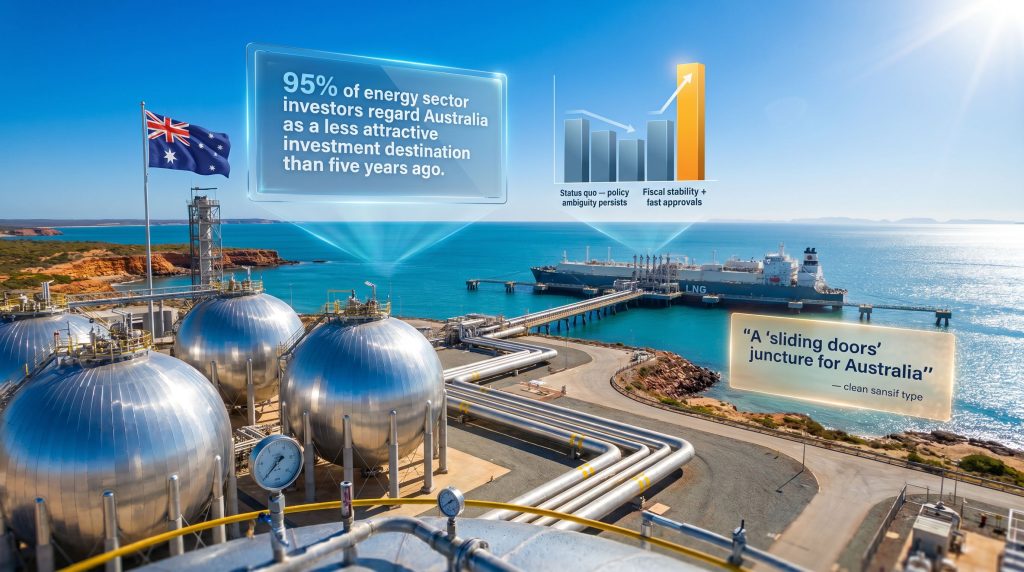
The scale of the investor confidence problem is striking. According to research on Australia's natural gas investment competitiveness, approximately 95% of surveyed energy sector respondents regard Australia as a less attractive investment destination today compared to five years ago, with more than 95% reporting that policy and regulatory changes have directly influenced their capital allocation decisions. This is not a marginal erosion at the edges of the investor base. It represents a near-consensus view that Australia's policy environment has become a material risk factor for energy sector capital.
| Investment Barrier | Impact Level | Primary Investor Concern |
|---|---|---|
| Regulatory approval delays | High | Extended project timelines |
| Environmental review complexity | High | Legal challenge exposure |
| Gas conservation policy ambiguity | Very High | Capital allocation uncertainty |
| Potential new taxation frameworks | High | Return-on-investment risk |
| Domestic gas reservation debates | Medium-High | Export volume uncertainty |
The Taxation and Gas Conservation Policy Overhang
Australia is expected to introduce a gas conservation policy framework from 2027 onward. The precise design of this framework, including any export limitation mechanisms or expanded domestic reservation requirements, remains unresolved. For producers who must make capital allocation decisions years in advance of first gas, this ambiguity is not an abstract policy concern. It is a concrete financial risk that affects project economics modelling, financing structures, and ultimately whether a final investment decision is made at all.
Santos chief executive Kevin Gallagher articulated the stakes at the Australian Energy Producers Conference, framing the current moment as a critical juncture at which Australia either demonstrates that it is a predictable, long-term destination for global capital, or watches that capital migrate to more stable jurisdictions over a timeframe measured in decades rather than electoral cycles. Gallagher's warning was specifically directed at the dual risks of escalating taxation debates and unresolved gas conservation policy, both of which he identified as active deterrents to new investment.
Cecile Wake, Chair of the Australian Energy Producers association, reinforced this perspective by emphasising that increasing new supply is the mechanism through which both domestic affordability and thriving export volumes can be achieved simultaneously. The framing is significant because it directly challenges the assumption underlying some domestic policy debates: that restricting exports is a pathway to cheaper domestic gas. Without the commercial incentive that export revenues provide, the underlying production investment needed to serve domestic markets may not materialise at all.
The Competitive Landscape: How the US and Qatar Are Pulling Ahead
United States: Structural Advantages Compounding
While Australia's policy framework creates friction for new investment, the United States is rapidly consolidating its position as the backbone of global LNG supply growth. Several structural factors make the US Gulf Coast an increasingly formidable competitor:
- Feedgas cost advantage: Associated gas production from the Permian Basin provides low-cost feedstock that materially reduces liquefaction economics compared to Australian developments
- Permitting environment: Recent US federal policy settings have delivered streamlined project approvals for LNG export facilities, reducing development lead times
- Project bankability: The combination of competitive capital costs and stable fiscal terms makes US Gulf Coast projects easier to finance on long-term supply contracts
- Scale of expansion: Multiple US liquefaction projects are in various stages of construction or final investment decision, adding substantial new capacity through the late 2020s
Qatar: Capital-Efficient and Sovereignly Backed
Despite the current disruption to Qatari infrastructure from the Iran conflict, Qatar's long-term competitive position remains formidable. The North Field expansion program, even if temporarily disrupted, represents some of the most capital-efficient LNG development in the world. Sovereign backing provides investment certainty and project continuity that private-sector-led Australian developments cannot replicate.
Australia's Compounding Structural Disadvantages
Against these competitors, Australia faces a set of layered challenges that go beyond policy uncertainty alone:
- Higher capital costs for both greenfield and brownfield LNG expansion relative to US Gulf Coast benchmarks
- Domestic gas reservation obligations that reduce export flexibility and complicate project economics
- Declining output from legacy Bass Strait and Northwest Shelf fields without confirmed replacement volumes at sufficient scale
- Greater regulatory complexity and legal challenge exposure than competing jurisdictions
The Long-Term Contract Expiry Risk: An Underappreciated Vulnerability
One of the least discussed but most consequential risks facing Australian LNG is the approaching expiry of long-term supply contracts signed during the construction boom of the 2000s and 2010s. As these agreements roll off through the 2030s, Australian producers will need to compete for contract renewals against a global supply landscape that will look materially different from the one in which those original agreements were signed.
Without new investment in production capacity to offset declining legacy field output, Australia's export volumes are projected to decline through the 2030s, progressively eroding the country's share of Asian LNG import markets.
Buyers in Japan, South Korea, and increasingly Southeast Asia will have more options available when renegotiating supply terms. However, if Australia cannot offer competitive pricing, supply reliability backed by new production investment, and political stability equivalent to alternatives, volume may redirect toward US Atlantic Basin suppliers or toward a post-recovery Qatar. The consequences would extend beyond commercial outcomes into strategic ones: Australia's long-standing role as a cornerstone energy security partner to Japan and South Korea depends on its ability to deliver contracted volumes reliably over multi-decade timeframes.
What the Industry Needs: The Three Pillars of Investment Confidence
The Australian energy sector's requirements from government are well-defined and internally consistent. They can be understood through three interconnected pillars:
1. Fiscal Stability and Internationally Competitive Taxation
- Long-term certainty on royalty structures and corporate taxation frameworks applicable to the LNG sector
- Explicit commitment to avoid retrospective changes to fiscal terms for projects that have already reached final investment decision
- Benchmarking of Australian fiscal settings against US, Canadian, and Qatari equivalents to ensure competitiveness
2. Streamlined and Predictable Project Approvals
- Defined statutory timelines for environmental impact assessments with clear decision points
- Elimination of duplicative overlap between state and federal approval processes that extends development lead times unnecessarily
- Legal frameworks that provide greater certainty around the scope of third-party litigation against approved projects
3. Policy Clarity on Domestic Gas Obligations and Export Settings
- Resolution of the gas conservation policy design ahead of its expected 2027 implementation date
- Transparent, rules-based criteria for any future export limitation mechanisms that provide advance notice to capital allocators
- Certainty that domestic gas reservation obligations will not be expanded in ways that fundamentally alter the export economics underpinning long-term supply contracts
The next major ASX story will hit our subscribers first
Scenario Analysis: Investment Outcomes Under Different Policy Paths
| Policy Scenario | Investment Outcome | Export Volume Trajectory | Strategic Position by 2035 |
|---|---|---|---|
| Fiscal stability and fast approvals | New projects sanctioned, volumes grow | Expanding through 2030s | Competitive with US and Qatar |
| Status quo policy ambiguity persists | Brownfield maintenance only | Flat to declining | Losing relative market share |
| Higher taxation and export controls introduced | Capital flight, project cancellations | Declining materially | Marginalised exporter |
| Streamlined approvals with stable fiscal terms | Selective new investment proceeds | Modest but sustained growth | Niche reliable supplier role |
The scenario analysis reveals an asymmetric risk profile. The downside of policy deterioration is severe and potentially irreversible within a planning horizon relevant to infrastructure investment. The upside of policy improvement, in contrast, is meaningful but requires sustained, credible commitment rather than short-term gestures.
The East Coast Domestic Supply Dimension
Australia's internal LNG debate cannot be cleanly separated from the domestic gas supply outlook, particularly on the East Coast. Legacy Bass Strait fields operated by major producers are in structural decline, and the new supply sources needed to replace those volumes face their own development and approval challenges. In addition, global trade disruptions are further complicating the commercial environment for producers attempting to secure long-term Asian supply contracts.
A counterintuitive but important insight from the industry's analysis is that a thriving LNG export sector and a well-supplied domestic market are complementary rather than competing outcomes. The commercial incentive created by export revenues is what drives investment in new gas field development. That new development simultaneously adds volumes to both domestic supply and export capacity. Policies that restrict exports without addressing the underlying production investment equation risk tightening domestic supply rather than alleviating it.
New South Wales' decision to launch its first gas exploration tender in a decade reflects at least partial recognition of this dynamic at the state level. The challenge is whether that recognition translates into the sustained, coordinated federal and state policy architecture that major capital decisions require. Furthermore, the commodity price impacts flowing from sustained LNG price volatility add another layer of complexity to investment planning across the sector.
Frequently Asked Questions: Australia LNG Policy and Investment
Why does policy uncertainty have such an outsized effect on LNG investment compared to other industries?
LNG projects involve capital commitments typically ranging from several billion to tens of billions of dollars, with payback periods extending 20 to 30 years. Revenue models depend on long-term supply contracts that buyers will only sign if they have confidence in the producer's ability to deliver. Any material uncertainty around taxation, export obligations, or approval timelines introduces risks that make those contracts harder to underwrite and projects harder to finance.
Has Australia concretely lost LNG investment to overseas competitors?
Industry survey data indicates that policy and regulatory changes have directly influenced capital allocation decisions for more than 95% of respondents, with the same proportion identifying Australia as a less attractive investment destination than five years ago. Some projects have been cancelled or redirected offshore as a direct result. The DCCEEW gas market review further underscores the structural pressures contributing to this investment divergence.
What is the gas conservation policy and why does it matter so much to producers?
The gas conservation policy framework expected from 2027 would establish rules governing how gas resources are managed between domestic use and export. The concern is not the principle of the policy but its unresolved design. Producers cannot model project economics without knowing whether export volumes may be capped, what criteria would trigger restrictions, and how domestic reservation obligations might change. That uncertainty is equivalent to an investment veto for many capital allocators.
How does Australia's proximity to Asia factor into its competitive position?
Australia's geographic position translates into a material freight cost advantage over Atlantic Basin suppliers, including the United States, when serving Japanese, Korean, and Southeast Asian import terminals. That advantage is real but not decisive on its own. Buyers weigh freight economics against supply certainty, price competitiveness, and counterparty reliability. Australia's proximity helps, but it cannot compensate for policy-driven investment shortfalls that reduce production capacity and supply reliability over time.
Key Takeaways
- Australia holds genuine geographic and geological advantages as the world's third-largest LNG exporter, but those advantages are being structurally undermined by Australia LNG policy uncertainty across taxation, approvals, and export frameworks
- Approximately 95% of energy sector investors regard Australia as a less attractive investment destination than five years ago, with policy changes directly driving capital allocation decisions
- The disruption of Qatari LNG exports in 2026 has created a significant near-term export opportunity that Australia is currently unable to fully capitalise on due to its investment climate challenges
- The US and Qatar are the primary beneficiaries of the next wave of global LNG investment, while Australia risks losing relative market share through the 2030s
- Long-term contract expiries create a structural vulnerability that can only be addressed through new production investment, which in turn requires the policy certainty the industry is currently calling for
- The industry's core ask of government encompasses fiscal stability, streamlined approvals, and policy clarity on domestic gas obligations: the minimum threshold needed to restore investor confidence and attract the capital that both export growth and domestic supply security depend upon
This article is analytical and informational in nature. It does not constitute financial or investment advice. Forecasts and scenario projections involve inherent uncertainty and should not be relied upon as the sole basis for investment decisions.
Want to Spot the Next Major ASX Mineral Discovery Before the Market Does?
While Australia's LNG policy landscape shapes the broader energy investment environment, significant mineral discoveries continue to emerge across the ASX — and Discovery Alert's proprietary Discovery IQ model delivers real-time alerts the moment they are announced, turning complex geological data into actionable insights for investors at every experience level. Explore the historic returns major discoveries have generated and begin your 14-day free trial today to position yourself ahead of the market.