May 22, 2026
Mining exploration accelerators represent a fundamental shift in how the industry approaches innovation and technology adoption. Traditional mineral discovery methods, while historically successful, face mounting pressure to deliver faster results amid growing global demand for critical minerals essential to energy transition infrastructure. The emergence of collaborative innovation platforms signals recognition that breakthrough discoveries increasingly require integration of diverse technical expertise rather than relying solely on internal corporate research capabilities. The BHP Xplor program exemplifies this evolution through its distinctive equity-free funding approach.
Understanding BHP's Strategic Innovation Framework
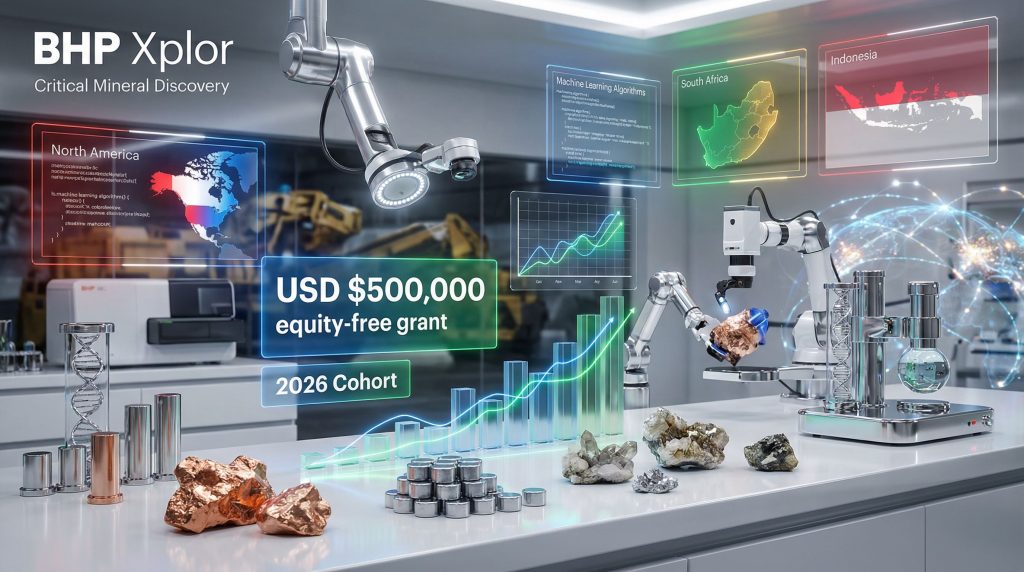
The BHP Xplor program operates as a distinctive funding mechanism within the mining sector, providing selected participants with USD $500,000 in equity-free grants alongside comprehensive technical mentorship. This non-dilutive structure distinguishes it from conventional venture capital models by allowing emerging companies to retain complete ownership whilst accessing BHP's extensive global operational network.
The program framework encompasses multiple integrated components designed to accelerate participant development. Financial support includes unrestricted cash grants enabling participants to advance their concepts without equity conversion requirements. Technical mentorship provides access to BHP specialists across exploration operations, technology development, and commercial strategy functions. Furthermore, network access connects participants with suppliers, service providers, and industry experts spanning BHP's global footprint.
| Component | Description | Duration |
|---|---|---|
| Financial Support | USD $500,000 equity-free grant | 6-9 months |
| Technical Mentorship | Access to BHP specialists across exploration, technology, and commercial functions | Full program |
| Network Access | Global connections with suppliers, service providers, and industry experts | Ongoing |
| Structured Learning | Bootcamps, masterclasses, and coaching sessions | Throughout program |
According to BHP's February 2026 announcement, Group Exploration Officer Tim O'Connor emphasised that exploration methodologies are evolving rapidly through integration of enhanced tools, improved data infrastructure, and innovative working approaches that fundamentally alter early-stage concept validation processes. The program enables collaborative learning opportunities for BHP to understand emerging discovery paradigms whilst supporting participant development through mining innovation trends.
Program Head Marley Palin characterised the 2026 intake as demonstrating the expansive and dynamic nature of contemporary early-stage discovery ecosystems, noting that innovative concepts emerge simultaneously across exploration, data analytics, and technology domains.
When big ASX news breaks, our subscribers know first
Strategic Expansion Through the 2026 Cohort Architecture
The 2026 cohort represents the largest participant group since program inception, featuring 10 companies spanning multiple continents and commodity focuses. This expansion reflects BHP's strategic recognition that breakthrough discoveries increasingly emerge from collaborative efforts between established operators and specialised innovators operating across diverse geological environments.
Geographic distribution demonstrates deliberate diversification strategy:
North American participants (4 companies):
- FrontierX: Canadian uranium exploration advancing preliminary geological concepts
- Mineural: Canadian deep-tech company utilising AI platform IRIS for copper exploration
- Utah Geological Survey: Regional mineral systems analysis across eastern Great Basin
- Discovery Genomics: DNA sequencing technology applied to copper exploration
International expansion (6 companies):
- Litchfield Minerals: Australian copper, zinc, lead, silver, and gold opportunities in Northern Territory
- Orion Minerals: South African copper-zinc development using modern data analytics
- Otrera Resources: South American sediment-hosted copper systems
- PT GeoFix: Indonesian porphyry copper-gold concepts in Sunda-Banda Arc
- RadiXplore: AI analysis of historical exploration records
- VectOres Science: Water and isotope chemistry platform for mineral system identification
Commodity focus distribution analysis:
- Copper: 5 direct references representing primary strategic emphasis
- Multi-commodity: Litchfield Minerals advancing diversified portfolio
- Uranium: 2 participants reflecting nuclear energy reassessment trends
- Technology platforms: 4 companies developing cross-commodity applications
The cohort composition indicates the BHP Xplor program's commitment to integrating advanced technologies across exploration value chains. In addition, AI in mining operations include machine learning platforms combining algorithmic analysis with geological expertise, legacy dataset reinterpretation systems, and genomics platforms utilising DNA sequencing as novel exploration methodology. Advanced analytics encompass water and isotope chemistry platforms for early mineral system identification, proprietary prospectivity tools, and modern geochemical approaches.
Litchfield Minerals exemplifies mineral systems approaches applied to established Australian provinces, focusing on the Oongalabi project within the Arunta region. This represents testing of contemporary discovery methodologies in mature geological settings where historical exploration provides substantial baseline data for comparative analysis.
PT GeoFix demonstrates regional expertise application through proprietary prospectivity tools tested in Indonesia's Sunda-Banda Arc porphyry environment. Porphyry deposits constitute primary global copper sources, with this geological province maintaining established production histories providing geological context for exploration concept validation.
Selection Methodology and Strategic Alignment Criteria
BHP's participant selection methodology reveals critical insights into major mining companies' evaluation frameworks for emerging opportunities within increasingly competitive critical mineral discovery markets. The selection process prioritises companies demonstrating technical excellence, strategic alignment, and scalability potential through data-driven mining operations.
Technical excellence requirements include:
- Geological innovation through novel mineral systems understanding approaches
- Technical capability demonstrating proven expertise in advanced methodology application
- Scalability potential indicating concepts expandable beyond initial proof-of-concept phases
Strategic alignment factors encompass:
- Future-facing commodity requirements addressing energy transition essentials
- Operational capability complementarity with BHP's existing infrastructure
- Long-term supply chain contribution potential
According to program documentation, participants were selected based on conceptual strength, technical capability, and potential to contribute to long-term supply of future-facing commodities. This framework indicates evaluation of methodological innovation rather than incremental refinement of established techniques.
The 2026 cohort demonstrates this evaluation spectrum through diverse technical approaches:
- Discovery Genomics: Novel application domain utilising DNA sequencing for mineral detection
- RadiXplore: Advanced algorithmic application to legacy datasets through AI reinterpretation
- PT GeoFix: Regional methodology adaptation using proprietary prospectivity tools
- VectOres Science: Real-time geochemical analysis through water and isotope chemistry platforms
Selection criteria require demonstration that concepts can be expanded beyond initial proof-of-concept phases, indicating the BHP Xplor program's interest in technologies with replicable application across multiple geographies, deposit types, or commodity targets rather than site-specific solutions.
Comparative Analysis: Accelerator vs Traditional Investment Models
The BHP Xplor program represents a fundamental departure from conventional mining industry investment approaches, offering unique advantages for both participants and corporate sponsors through its distinctive operational structure. However, traditional investment models maintain certain characteristics that differ substantially from accelerator frameworks.
| Aspect | Traditional Investment | Xplor Accelerator |
|---|---|---|
| Equity Requirements | Significant ownership stakes demanded | Equity-free participation maintained |
| Timeline | Extended due diligence periods | Streamlined 6-9 month programs |
| Support Structure | Primarily financial focus | Comprehensive mentorship ecosystem |
| Risk Distribution | Concentrated investor exposure | Diversified cohort approach |
| Innovation Access | Limited to invested companies | Broad technology screening capability |
Strategic benefits for major mining corporations:
- Early-stage innovation exposure: Access to breakthrough technologies before widespread industry adoption
- Risk mitigation: Portfolio approach reduces individual project failure impact
- Talent pipeline development: Relationships with emerging industry leaders and technical experts
- Competitive intelligence: Insights into evolving exploration methodologies and market trends
The equity-free structure differentiates the program from traditional venture capital investment mechanisms. Unlike equity-based funding where investors receive ownership stakes proportional to capital contributed, the Xplor model provides unrestricted cash grants without equity conversion rights. This enables BHP to function as both financial supporter and strategic advisor whilst preserving participants' intellectual property ownership and exit flexibility.
Participant advantages include:
- Complete ownership retention throughout program duration
- Access to global industry networks typically reserved for major corporate partners
- Technical guidance from operational specialists with decades of field experience
- Reduced capital dilution compared to venture funding alternatives
How Does the Accelerator Model Compare to Venture Capital?
The accelerator model differs significantly from venture capital through its non-dilutive funding structure and comprehensive support ecosystem. Venture capital typically requires equity stakes ranging from 15-25% in exchange for funding, whilst accelerators provide grants without ownership requirements. Furthermore, AI-powered mining efficiency benefits demonstrate how participants can leverage corporate expertise without surrendering intellectual property rights.
Critical Mineral Supply Chain Impact Assessment
The diverse composition of the 2026 cohort positions participants to address multiple bottlenecks in critical mineral supply chains essential for renewable energy infrastructure and advanced manufacturing applications. This strategic focus reflects growing recognition that energy transition goals require substantial increases in mineral production capacity.
Copper supply chain enhancement initiatives:
Several cohort companies focus specifically on copper exploration and development through varied technical approaches:
- Advanced mineral systems thinking: Applied to established mining regions for discovery potential expansion
- Modern data analytics: Identifying new discoveries in mature districts with extensive historical datasets
- AI-powered exploration: Combining machine learning algorithms with geological expertise for target generation
Mineural's IRIS platform exemplifies technology scalability through AI-driven copper exploration combining machine learning with BHP's geological expertise. This integration approach enables platform adaptation across BHP's diverse copper portfolio spanning multiple jurisdictions and deposit styles without requiring fundamental algorithm restructuring.
Uranium market development considerations:
The inclusion of FrontierX for Canadian uranium exploration reflects growing recognition of nuclear energy's role in clean energy transitions, particularly as governments reassess nuclear power's contribution to carbon reduction goals. This strategic positioning anticipates potential uranium demand increases driven by nuclear capacity expansion policies. In addition, mineral discovery alerts help identify emerging opportunities in uranium exploration across various jurisdictions.
Technology transfer multiplication effects:
The program's emphasis on technology companies suggests potential for broader industry adoption of innovations developed within the Xplor framework, creating multiplier effects extending beyond individual participant success. RadiXplore's AI platform for historical exploration record analysis demonstrates globally applicable methodology, as all major mining regions contain substantial legacy datasets suitable for algorithmic reinterpretation.
Regional geological targeting rationale:
Participant geographic distribution reflects strategic targeting of specific geological provinces with established mineralisation histories and remaining prospectivity potential:
- Eastern Great Basin: Utah Geological Survey's regional mineral systems analysis targets a province with documented mineral occurrences and systematic exploration gaps
- Sunda-Banda Arc: PT GeoFix's porphyry copper-gold focus leverages a region with established deposit types and exploration infrastructure
- Northern Cape: Orion Minerals' application of modern analytics to historical exploration data in a region with known copper-zinc mineralisation
Investment Implications and Performance Evaluation Framework
For investors analysing BHP's strategic direction, the BHP Xplor program provides valuable insights into the company's long-term positioning, innovation priorities, and approach to external technology integration. The program's evolution offers indicators of broader structural changes affecting global mining industry dynamics.
Positive investment signals:
- Expanded cohort size: Indicates successful program validation and increased resource allocation
- Geographic diversification: Suggests global opportunity recognition and risk distribution
- Technology integration emphasis: Demonstrates commitment to operational efficiency enhancement
Risk considerations for evaluation:
- Equity-free model limitations: Restricts direct financial returns from successful participant companies
- Early-stage focus inherent risks: High failure rates typical of exploration and technology development
- Competitive advantage temporality: Other major mining companies developing similar innovation programs
Key performance metrics for monitoring:
- Participant progression rates to commercial development phases
- Technology adoption rates within BHP's operational framework
- Alumni company funding success in subsequent investment rounds
- Patent and intellectual property development from collaborative projects
The non-dilutive funding structure presents both advantages and limitations from an investment perspective. Whilst BHP gains exposure to emerging technologies without equity commitments, successful participants retain full ownership of valuable intellectual property and discoveries, limiting BHP's direct financial participation in breakthrough outcomes.
What Are the Long-Term Strategic Benefits?
The market psychology indicators reveal that the program reflects mining industry recognition that traditional exploration approaches face efficiency constraints requiring technological augmentation. Consequently, this shift indicates institutional acceptance that competitive advantage increasingly derives from technology integration rather than purely geological expertise or capital deployment capacity.
The next major ASX story will hit our subscribers first
Future Industry Trends and Structural Implications
The BHP Xplor program evolution provides insights into broader structural changes affecting the global mining industry and critical mineral markets, revealing emerging patterns in corporate innovation strategy and technology adoption approaches.
Collaboration over competition paradigms:
The accelerator model suggests industry recognition that complex geological and technological challenges require collaborative approaches rather than purely competitive strategies. This shift reflects acknowledgement that no single organisation possesses all capabilities necessary for addressing energy transition mineral supply requirements.
Speed-to-market imperatives:
Accelerated program timelines reflect growing pressure to reduce discovery-to-production cycles for critical minerals essential to energy transition goal achievement. Traditional exploration timelines, often spanning decades, conflict with renewable energy deployment schedules requiring mineral supply capacity expansion within years rather than decades.
Technology integration acceleration indicators:
The emphasis on artificial intelligence, genomics, and advanced analytics indicates that digital transformation in mining exploration is transitioning from experimental to operational implementation phases. This technological integration suggests the industry is moving beyond pilot project stages toward systematic deployment of advanced analytical capabilities.
Regulatory environment implications:
Whilst not explicitly addressed in program documentation, the focus on critical minerals and energy transition commodities reflects anticipated regulatory support for projects addressing government policy objectives. This alignment suggests participants may benefit from favourable permitting environments and potential policy incentives.
Investment landscape evolution:
The success of equity-free accelerator models may influence how other major mining companies structure innovation partnerships, potentially reducing reliance on traditional venture capital mechanisms for early-stage technology development. This could create new funding categories specifically designed for mining technology companies. For instance, BHP Xplor continues to expand its innovative approach to supporting breakthrough technologies in exploration.
Knowledge transfer implications:
The program's mentorship components suggest recognition that technology transfer requires systematic knowledge sharing rather than purely financial investment. This approach indicates that successful innovation in mining requires integration of operational experience with technological capability, rather than independent technology development.
This analysis is based on publicly available information about BHP's Xplor program and industry trends in mining innovation and critical mineral development.
Ready to Discover the Next Major Mining Breakthrough?
Discovery Alert's proprietary Discovery IQ model delivers instant notifications on significant ASX mineral discoveries, transforming complex exploration announcements into actionable investment opportunities. With mining accelerators like BHP Xplor highlighting the rapid evolution of discovery technologies, staying ahead of breakthrough mineral discoveries has never been more crucial for maintaining your competitive advantage in Australia's dynamic mining sector.