June 9, 2026
When Supply Fear Meets Demand Reality: The Forces Compressing Crude Oil in Mid-2026
Energy markets rarely move in straight lines, and the period surrounding any major geopolitical inflection point is perhaps the best illustration of that truth. The prevailing assumption among traders entering June 2026 was straightforward: escalating Middle East conflict equals higher crude. What unfolded instead was a demonstration of how competing forces can neutralise each other, leaving prices suspended in a narrow band with neither bulls nor bears able to claim decisive control. The dynamic driving this stalemate is precisely what makes the current environment so instructive for anyone tracking the ceasefire caps oil rally as China demand weakens thesis playing out across global energy markets.
When big ASX news breaks, our subscribers know first
The Geopolitical Risk Premium: What It Is and How It Unravels
Every barrel of crude that trades during periods of elevated conflict carries more than its physical value. Embedded in the price is a geopolitical risk premium, an additional amount that reflects the market's probabilistic assessment of supply disruption. This premium forms rapidly when conflict escalates near critical infrastructure, and it can dissipate with equal speed when diplomatic developments reduce the perceived probability of a catastrophic outcome.
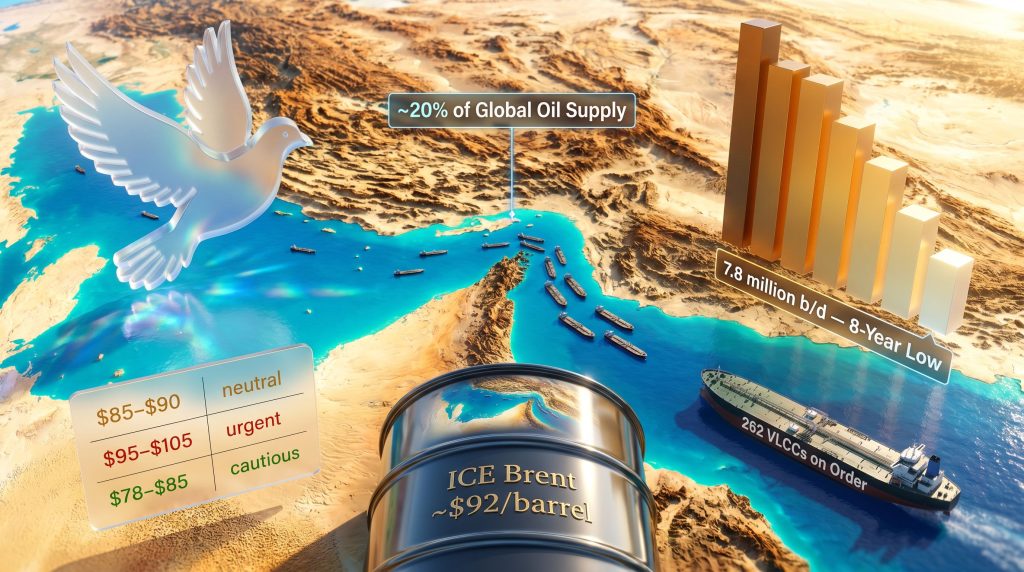
The Strait of Hormuz represents the most concentrated chokepoint in global energy logistics. Roughly 20% of the world's oil supply passes through this narrow passage, making any disruption there a systemic rather than localised event. When Israeli and Iranian missile exchanges intensified and then gave way to a Trump-brokered temporary cessation of hostilities, crude traders faced a classic dilemma: hold risk premium positions based on conflict continuation, or begin unwinding them on the assumption that de-escalation signals a durable change.
The market's answer was a partial unwind. ICE Brent lingered near $92 per barrel rather than collapsing toward pre-conflict levels, reflecting the market's collective judgement that this ceasefire represents a pause rather than a resolution. US Energy Secretary Chris Wright indicated that vessel traffic through Hormuz was recovering in a meaningful way, and Kuwait's decision to offer 4 million barrels of crude for delivery outside the Gulf region added to the normalisation narrative. Yet traders remain acutely aware that a fragile diplomatic halt is structurally different from a settled conflict.
Understanding the broader crude oil geopolitics at play helps contextualise why markets are behaving with such caution in the face of apparent de-escalation signals.
The distinction between a temporary ceasefire and genuine de-escalation is not semantic. In oil markets, pricing a conflict resolution that does not materialise is far more costly than maintaining partial risk premium on a ceasefire that holds.
Historical precedent supports the cautious approach. Prior de-escalation events in the region have triggered rapid premium unwinds followed by sharp re-pricing when hostilities resumed. The asymmetry of outcomes, where a ceasefire breakdown could push Brent materially above $94-$105 per barrel while a confirmed resolution might only bring modest downside, creates an environment where traders rationally maintain a buffer. For context, recent Reuters analysis of similar prior episodes shows how quickly sentiment can shift when diplomatic signals change.
China's Import Collapse: The Data Telling a Different Story
While the geopolitical risk premium was unwinding at the top of the price structure, a separate and arguably more concerning force was building from beneath: genuine demand destruction emanating from China, the world's largest crude importer.
Chinese customs data for May 2026 revealed crude imports of approximately 7.8 million barrels per day, the lowest reading since October 2017. To contextualise that figure, it represents a decline of nearly 4 million b/d compared to the same period a year earlier, a staggering contraction by any measure.
| Metric | Current Reading | Comparative Benchmark |
|---|---|---|
| China crude imports (May 2026) | ~7.8 million b/d | Lowest since October 2017 |
| Year-on-year decline | ~4 million b/d lower | 8-year import low |
| Saudi Aramco OSP cut to Asia (July) | -$6/barrel | Arab Light at +$9.50 above Oman/Dubai |
| China refinery capacity delayed | 500,000 b/d | Saudi Aramco Panjin pushed to October |
The mechanism behind this contraction involves several overlapping factors. Chinese refiners have been substituting seaborne crude purchases with inventory drawdowns, effectively consuming stored barrels rather than sourcing new ones from international markets. Simultaneously, the Hormuz disruption triggered project delays across China's downstream sector, with Saudi Aramco's 300,000 b/d Panjin refinery having its startup pushed back from June to early October, and CNPC's Dalian expansion facing similar timeline extensions.
These delays reduced immediate crude intake requirements, compounding the demand signal. The timing matters enormously, as summer months traditionally represent peak demand across Asia. The fact that Chinese imports are hitting multi-year lows during what should be a seasonal demand peak suggests structural softness rather than a simple timing anomaly.
What Saudi Arabia's Pricing Decisions Reveal
Official Selling Prices (OSPs) set by Saudi Aramco function as one of the most reliable real-time indicators of actual demand conditions in Asian crude markets. When Aramco slashed its July-loading formula prices to Asia by $6 per barrel, setting Arab Light at $9.50 per barrel above the Oman/Dubai benchmark, the signal was unambiguous: regional buyers were not competing aggressively for barrels, and the seller needed to attract purchases through price concession.
This same demand weakness was visible in the Iranian crude market, where prices were also cut to attract Chinese buyers. When both the dominant Gulf producer and a price-sensitive sanctioned seller are simultaneously reducing prices to win Chinese demand, the underlying demand environment is clearly deteriorating rather than recovering. The broader oil price shock dynamics affecting producer strategies throughout 2025 and into 2026 have only reinforced this pattern of competitive price concessions.
The VLCC Orderbook Surge: Maritime Markets Rewriting Long-Term Trade Architecture
One of the less discussed but structurally significant consequences of the Hormuz disruption is the transformation underway in global supertanker markets. The crisis has, furthermore, triggered a shipbuilding boom of historic proportions.
| Indicator | Current Data | Historical Context |
|---|---|---|
| VLCCs on global order books | 262 vessels | Surpasses September 2008 record of 254 |
| New orders placed since January 2026 | +99 VLCCs | Largest single-year surge on record |
| Second-hand VLCC price (10-year-old) | $115 million | Highest valuation since 2008 |
| VLCCs locked in Persian Gulf | ~10% of non-sanctioned fleet | Wary of transiting Hormuz |
| Average VLCC fleet age | 14.1 years | Rejuvenation underway |
With approximately 10% of the world's non-sanctioned VLCC fleet currently stationary in the Persian Gulf due to Hormuz transit risk, shippers face a near-term capacity squeeze. The response has been to race toward shipyard orderbook positions, locking in delivery slots for 2029 to 2030. The 262 VLCCs currently on order globally have surpassed the previous record of 254 set in September 2008, with 99 new orders placed in the first five months of 2026 alone.
This creates a layered risk dynamic that is not widely appreciated. In the near term, the capacity squeeze is supportive of freight rates and tanker valuations, with second-hand 10-year-old VLCCs now commanding $115 million, the highest since 2008. However, when this wave of newbuild capacity begins entering service around 2029-2030, the resulting supply glut in the tanker market could create significant freight rate compression for years. Investors in tanker stocks who are currently benefiting from elevated rates should be aware of this medium-term structural headwind.
Separately, the Port of Vancouver is launching dredging works to allow Aframax tankers using the Trans Mountain Expansion's Westridge Marine Terminal to achieve full 700,000-barrel loadings, compared to the current depth-constrained maximum of 550,000 to 600,000 barrels. This infrastructure improvement will meaningfully expand Canada's export capacity once completed.
OPEC+ and the Strategic Contradiction of Hiking Into Weakness
The seven participating members of OPEC+ approved an additional 188,000 b/d production increase for July, marking the fourth consecutive monthly output hike. Understanding the full scope of OPEC market influence helps explain why this decision appears counterintuitive given that Hormuz-related disruptions have already removed approximately 10 million b/d from Gulf member output.
The apparent contradiction reflects a critical nuance in how OPEC+ quota management operates. Announced production increases do not necessarily translate into actual additional barrels if the infrastructure to deliver those barrels is compromised. Consequently, OPEC+ may be signalling long-term market share intent while knowing near-term physical delivery constraints will absorb the announced volume increases without materially softening prices.
The OPEC production impact of these consecutive monthly hikes is therefore substantially muted by real-world logistical constraints, a distinction that markets are only partially pricing in at present.
Capital Deployment: Where the Industry Is Placing Long-Term Bets
Despite the near-term price uncertainty, upstream capital allocation decisions reveal where major players see structural opportunity:
- Vaca Muerta, Argentina: Chevron has applied for RIGI tax incentive status for its $13.8 billion El Trapial unconventional project, which could rank among the largest single energy investments in Argentina's history.
- West Africa: ENI signed an offshore exploration agreement for Gambia's Block A1, five years after a prior operator's pandemic-era withdrawal. Petrobras secured rights to develop eight ultra-deepwater blocks offshore Côte d'Ivoire.
- Alaska ANWR: The June 5 federal lease sale yielded only five leases and $3.7 million in winning bids, a dramatic underperformance that significantly undermines the near-term drilling outlook for the region.
- Alaska LNG: Developer Glenfarne revised cost estimates upward from $44 billion to $55 billion, with the liquefaction terminal alone assessed at $24-28 billion, raising serious questions about project economics.
- Latin America distribution: Trading house Mercuria acquired Raizen Argentina's downstream business for $1.42 billion, securing Latin America's second-largest fuel distribution network in one transaction.
The next major ASX story will hit our subscribers first
LNG, Aluminium, and the Collateral Damage Spreading Across Commodity Markets
The Hormuz disruption is propagating through adjacent commodity markets in ways that extend well beyond crude oil pricing. In addition, the ceasefire caps oil rally as China demand weakens narrative is being reinforced by these broader commodity ripple effects.
Morgan Stanley has projected Asian LNG prices rising to a 3.5-year high, with China's LNG imports reaching their highest level since the Iran conflict began. This substitution dynamic, where LNG fills gaps left by disrupted pipeline and crude-linked gas supply, is reshaping Northeast Asian energy security calculations. The evolving LNG supply outlook suggests these substitution patterns may persist well beyond any near-term diplomatic resolution.
In Australia, INPEX sought intervention from the country's workplace tribunal to prevent planned strike action at the Ichthys LNG facility, with industrial action initially scheduled for June 11. Any supply interruption at a major Australian LNG export terminal would compound Asian supply tightness at a moment of heightened demand.
Gulf primary aluminium production tells a particularly striking story about regional energy cost impacts. Output fell to just 330,000 tonnes in May, a 35% year-on-year decline and the lowest level in more than a decade. Chinese aluminium exports surged to 632,000 tonnes in May as Gulf supply gaps created export arbitrage opportunities, demonstrating how energy disruptions cascade into industrial metals markets. Franklin Templeton's assessment of the ceasefire dynamics similarly characterises the current situation as a relief rally rather than a structural all-clear for commodity markets.
Three Scenarios for Crude Over the Next 90 Days
| Scenario | Key Trigger | Brent Price Range |
|---|---|---|
| Ceasefire holds, China demand stabilises | Diplomatic progress + inventory rebuild | $85-$90/barrel |
| Ceasefire fractures, Hormuz re-disrupted | Renewed missile exchanges | $95-$105/barrel |
| Ceasefire holds, China demand deteriorates further | Refinery delays extend, run cuts deepen | $78-$85/barrel |
For traders and investors monitoring this environment, the key variables to track include:
- Weekly Chinese customs import data
- Hormuz transit vessel counts
- OPEC+ compliance rates against announced quotas
- Saudi Aramco's August-loading OSP adjustments, which will serve as the next real-time read on whether Asian demand is stabilising or deteriorating further
The scenario in which the ceasefire caps oil rally as China demand weakens most decisively is the third: a diplomatically stable but economically stagnant environment where reduced supply fear and reduced demand confidence both suppress the price simultaneously.
The current price environment reflects a market caught between two forces pulling in the same bearish direction: reduced supply fear and reduced demand confidence. Until one of these resolves decisively, crude is likely to remain range-bound rather than trending strongly in either direction.
This article is for informational and educational purposes only and does not constitute financial, investment, or trading advice. Commodity price forecasts and scenario projections involve inherent uncertainty and should not be relied upon as predictions of future market outcomes. Readers should conduct independent research before making any investment decisions.
Want to Stay Ahead of the Next Major Commodity Discovery?
While crude oil markets navigate the tension between geopolitical risk premiums and softening Chinese demand, the real alpha in resource investing often emerges from significant mineral discoveries — and Discovery Alert's proprietary Discovery IQ model scans ASX announcements in real time, instantly alerting subscribers to high-potential opportunities across 30+ commodities. Explore historic discoveries and their exceptional returns, then begin your 14-day free trial at Discovery Alert to position yourself ahead of the broader market.