June 9, 2026
The Invisible Barrier Between Copper in the Ground and Capital in the Bank
Global copper demand forecasts paint an optimistic picture for resource-rich nations. The energy transition, electrification megatrends, and tightening supply projections have collectively elevated copper's strategic profile to levels not seen in decades. Yet for investors and developers operating inside Chile, the world's single largest copper-producing nation, the path from geological discovery to bankable project has grown considerably more complex than the commodity narrative alone would suggest.
Project execution speed and access to capital in Chile mining are now equally decisive variables as ore grade when determining whether a project reaches production. Understanding why requires moving beyond the resource inventory and examining the institutional architecture through which that inventory must pass.
When big ASX news breaks, our subscribers know first
When Geology Becomes a Necessary But Insufficient Condition
Chile holds approximately 23% of global copper reserves, a geological inheritance that no competing jurisdiction can match at scale. The Atacama and Antofagasta regions contain porphyry copper systems of extraordinary size, and the country's established mining corridors have delivered consistent production for over a century. However, a structurally important shift has taken place in how sophisticated capital allocators evaluate Chilean assets.
The traditional investment thesis, anchored almost entirely in resource size and grade, is being systematically tested by two variables that ore reports cannot capture: how long it takes to get a project approved, and whether the financing architecture exists to sustain a developer through that approval window. The Chile copper price outlook adds further context, given how price expectations shape the economics of new project development.
Copper grades across Chile's major producing deposits have declined measurably over the past two decades. The average ore grade processed by Chilean copper operations dropped from approximately 1.5% Cu in the mid-2000s to closer to 0.7% Cu in more recent years, according to COCHILCO data. This grade deterioration increases processing costs, raises water and energy intensity per tonne of copper produced, and compresses the economic margins that justify the upfront capital commitments required to develop new assets.
When lower grades combine with extended permitting timelines, the internal rate of return calculations for greenfield projects in Chile begin to look structurally challenged relative to competing jurisdictions where the institutional pathway is faster and more predictable.
Two Structural Bottlenecks Defining Project Outcomes
The Permitting Time Burden: Institutional Risk, Not Geological Risk
Chile's mining development constraint is, at its core, institutional rather than geological. This distinction carries significant implications for how risk is priced and how capital is deployed. As noted in recent analysis of Chile's mine permitting landscape, the regulatory architecture itself has become one of the most scrutinised aspects of the country's investment environment.
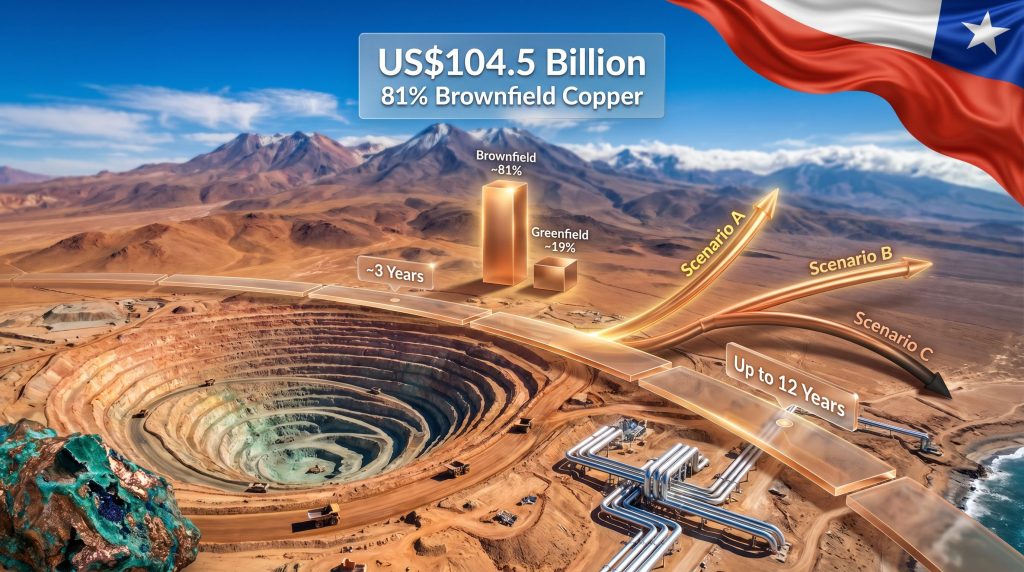
Environmental assessment processes for new mining projects in Chile have averaged close to three years under standard circumstances. Complex projects, particularly those involving new water infrastructure, multi-jurisdictional land use, or proximity to protected zones, have documented timelines extending to 12 years before receiving construction approval. That is not a statistical outlier — it is a structural characteristic of the system as currently designed.
What amplifies this risk is not just the duration but the unpredictability of the duration. Investors can underwrite a known three-year permitting timeline with reasonable confidence. They struggle to price a timeline that could resolve in three years or twelve. The optionality value of capital deployed into a project with an indeterminate approval horizon is fundamentally different from one with a defined regulatory pathway, and that difference is reflected in the discount rates lenders and equity sponsors apply to early-stage Chilean assets.
Water Scarcity and the Infrastructure Cost Multiplier
Northern Chile's hyper-arid environment introduces a second structural bottleneck that compounds both capital requirements and permitting complexity. The Atacama Desert, which hosts much of the country's highest-grade undeveloped copper mineralisation, receives less than 15 millimetres of rainfall annually in many zones. That constraint is not engineering-solvable without significant capital and without navigating additional regulatory layers.
Desalination has become the de facto water supply solution for new northern Chilean mining projects. Facilities capable of supplying a major mine typically require capital investment in the range of US$300 million to over US$1 billion depending on capacity, pipeline distance, and pumping elevation. The energy cost of pumping desalinated water from coastal facilities to mine sites at elevations exceeding 3,000 metres above sea level materially affects long-term operating cost structures.
Critically, water infrastructure triggers its own permitting requirements, effectively layering a second regulatory process on top of the primary environmental assessment. For new entrants without existing water rights or established coastal infrastructure, this creates a compounding delay and cost burden that is not always visible in high-level project feasibility summaries.
Decoding Chile's US$104.5 Billion Mining Investment Pipeline
COCHILCO, Chile's copper commission, has projected a total mining investment pipeline of US$104.549 billion through to 2034. The headline figure reads as a vote of confidence in Chilean mining's future, and in aggregate terms, it is. However, the composition of that number tells a more nuanced story about where risk appetite is actually concentrated.
Approximately 81% of that projected investment is allocated to brownfield copper projects, covering expansions of operating mines and capital required to sustain existing production levels. Only the remaining ~19% is directed toward greenfield development, early-stage projects, and non-copper minerals.
| Investment Category | Share of US$104.5B Pipeline | Implied Risk Profile |
|---|---|---|
| Brownfield copper (expansions, continuity capex) | ~81% | Lower: established permits, existing infrastructure |
| Greenfield and early-stage development | ~19% | Higher: full permitting cycle, infrastructure build-out |
Of the total pipeline, US$83.2 billion represents projects considered to be under active execution for the 2024–2033 window. The gap between the full pipeline value and the execution-stage value reflects the volume of capital that remains contingent on permitting outcomes, financing close, and regulatory approvals.
Strategic insight: The 81% brownfield concentration is not a coincidence or a reflection of resource limitation. It is a rational capital allocation response to a permitting environment that makes greenfield timelines difficult to underwrite with standard project finance structures.
Chile has maintained its position as the leading recipient of foreign direct investment among Latin American nations in the mining sector since 2022. That status reflects genuine geological advantage and an established mining services ecosystem. It does not, however, suggest that all categories of mining investment face equivalent conditions. Furthermore, the emerging copper supply crunch adds urgency to resolving these institutional bottlenecks before demand outpaces available supply.
The Reform Agenda: What Environmental Evaluation 2.0 Proposes
The Chilean government and industry have both acknowledged that permitting reform is necessary to unlock the next wave of investment, particularly in greenfield copper and critical minerals. The Environmental Evaluation 2.0 framework represents the primary legislative vehicle for this reform agenda.
The stated objectives include:
- Streamlining initial project assessment timelines across all major permit categories
- Reducing processing times for project modification approvals, which currently create secondary bottlenecks for operating mines seeking to expand
- Introducing clearer procedural timelines that reduce the unpredictability of the permitting environment, not just its average duration
- Targeted reforms aiming at a 30–70% reduction in sectoral permit processing times across key regulatory categories
The practical impact of these reforms, if fully delivered, would be material. Projects that currently require eight to twelve years from submission to approval could theoretically move through the system in three to five years, fundamentally changing the risk-adjusted return profile for greenfield developers and junior operators.
However, the investment community has historically applied a credibility discount to regulatory reform commitments until demonstrated outcomes emerge. Announced reform and delivered reform are different variables in a capital allocation model, and sophisticated investors model Chilean project timelines based on current system performance rather than projected reform trajectories.
Three Scenario Pathways for Reform Outcomes
Scenario A: Full Reform Delivery
Permitting timelines compress toward international benchmarks. Greenfield project economics improve materially. Junior and mid-tier operators gain access to development windows previously dominated by majors with the internal resources to absorb extended regulatory timelines.
Scenario B: Partial Implementation
Processing times improve modestly but unpredictability persists. Large operators with dedicated regulatory teams absorb the friction. Smaller entrants remain structurally disadvantaged. Capital continues to favour brownfield assets.
Scenario C: Reform Stagnation
Institutional bottlenecks deepen relative to competing jurisdictions including Peru, the Democratic Republic of Congo, and Canada. Chile's geological endowment advantage erodes as a competitive differentiator for exploration-stage capital. Foreign direct investment narrows further toward brownfield copper held by existing majors.
Most informed observers currently position Chile between Scenarios A and B, with the trajectory dependent on legislative execution over the next two to three years.
The Capital Access Hierarchy: Who Gets Funded and Who Doesn't
Project execution speed and access to capital in Chile mining are not uniform challenges distributed equally across all operator types. The financing environment is tiered in ways that systematically advantage established operators and create compounding difficulties for new entrants.
Tier 1: Major operators on brownfield assets retain the strongest access to both project debt and equity financing. Established environmental track records reduce lender risk premiums. Existing permits and infrastructure eliminate the most capital-intensive early-stage development costs. Relationships with multilateral lending institutions, export credit agencies, and major commercial banks provide financing optionality unavailable to smaller operators.
Tier 2: Mid-tier developers on advanced-stage projects face a more conditional financing environment. Project finance access depends heavily on feasibility study quality, permitting status, and the presence of offtake arrangements with creditworthy counterparties. In addition, completing a definitive feasibility study to a bankable standard has become an increasingly important threshold for unlocking lender engagement at this tier.
Streaming and royalty financing structures have become increasingly common alternatives to traditional project debt for this tier, offering capital at higher effective cost but with fewer covenant restrictions during the construction and commissioning period.
Tier 3: Junior explorers and early-stage entrants face the most structurally challenging environment. Consider the typical financial profile:
- Exploration timelines of two to eight years before any production decision can be made
- Pre-production capital requirements for copper exploration projects ranging from US$500,000 to US$15 million
- Global junior equity market liquidity conditions that have been consistently weaker since the 2022 rate tightening cycle
- Permitting timelines that extend the period during which capital is at risk without generating any return
Warning for investors: The financing gap for junior operators in Chile is not solely a function of market conditions. The structural interaction between extended permitting timelines and the time-value of committed capital creates a compounding deterrent for risk-sensitive investors, independent of the commodity price environment.
The next major ASX story will hit our subscribers first
Jurisdiction Comparison: How Chile Stacks Against Competing Copper Geographies
| Dimension | Chile | Peru | DRC | Canada |
|---|---|---|---|---|
| Geological endowment | World-leading | Very strong | Strong (cobalt-copper) | Strong (varied) |
| Permitting speed | 3–12 years (reform underway) | Variable, improving | Opaque, faster in practice | 3–7 years |
| Infrastructure maturity | High in corridors, constrained in new zones | Moderate | Low | High |
| Capital market access | Deep for majors, shallow for juniors | Moderate | Limited | Deep across tiers |
| Water availability | Severe constraint in north | Moderate constraint | Low constraint | Generally available |
This comparative framework highlights that Chile's competitive position is strongest in geological endowment and infrastructure maturity within established corridors. Its relative weakness in permitting predictability and junior capital access creates an opening for competing jurisdictions to attract exploration-stage investment that might otherwise naturally flow to Chilean assets.
Strategic Positioning for Operators and Investors
For Large and Mid-Tier Mining Companies
- Prioritise brownfield expansion pipelines where partial permitting pathways are already established, reducing the institutional risk component of project underwriting
- Build dedicated regulatory engagement capability as a permanent organisational function rather than a project-specific cost line
- Apply conservative permitting timeline assumptions in feasibility models, calibrated to Scenario B outcomes unless reform delivery is evidenced by completed approvals
- Structure water supply solutions early in project development, as late-stage desalination permitting creates secondary delays that are often underestimated in project schedules
For Junior Explorers and Early-Stage Developers
- Raise capital to fund through permitting uncertainty rather than to the next technical milestone, acknowledging that the institutional timeline may exceed initial projections
- Pursue strategic partnerships with established operators as a mechanism for accessing infrastructure, regulatory relationships, and balance sheet support
- Evaluate royalty and streaming arrangements as capital-efficient alternatives during the pre-production phase when traditional project debt is inaccessible
- Consider the full regulatory stack, not just the primary environmental assessment, when modelling time-to-production for northern Chilean assets requiring water infrastructure
For Institutional and Financial Investors
- Apply a differentiated jurisdictional risk premium that separately accounts for institutional delay risk and geological uncertainty, treating them as independent variables rather than a single country risk factor
- Monitor Environmental Evaluation 2.0 reform progress as a leading indicator of conditions for greenfield capital deployment
- Maintain a structural preference for brownfield copper exposure during the period when reform delivery remains undemonstrated, rotating toward greenfield and junior exposure as institutional risk empirically declines
- Explore copper investment strategies calibrated to Chile's tiered financing environment, particularly those that differentiate between brownfield and greenfield risk profiles
Frequently Asked Questions
What makes project execution speed so critical in Chilean copper mining?
Extended timelines between discovery, permitting, and production directly affect the internal rate of return of mining projects. Every additional year of pre-production delay increases the cumulative capital at risk without generating returns, compresses the net present value of future cash flows, and creates exposure to commodity price cycles that may shift the project's economics during the approval window.
Why does brownfield investment dominate Chile's US$104.5 billion pipeline?
Brownfield assets carry materially lower institutional risk. Established permits, existing infrastructure, and documented environmental and social track records reduce both the time and cost required to expand production relative to building a new mine from scratch. In an environment where greenfield permitting timelines are uncertain and can extend to twelve years, capital naturally concentrates where execution risk is manageable. The role of mining private equity in selectively backing brownfield assets over greenfield exploration reflects precisely this dynamic.
How does ore grade decline affect financing conditions for Chilean projects?
Lower grades increase the capital and operating cost intensity per unit of copper produced, which narrows the margin of safety in project finance models. Lenders and equity investors applying standard financial covenants to lower-grade projects require either higher commodity price assumptions, lower cost structures, or larger scale to achieve acceptable coverage ratios — all of which raise the bar for project bankability.
What role do streaming and royalty structures play for Chilean mining developers?
These instruments have become increasingly important as alternatives to traditional project debt for developers who cannot yet access senior secured financing. A streaming arrangement, where a financial investor provides upfront capital in exchange for the right to purchase a portion of future metal production at below-market prices, allows a developer to fund construction without the covenant-heavy structure of a project finance facility. The cost is higher in effective terms, but the flexibility can be decisive for mid-tier developers navigating multi-year permitting cycles. Indeed, as research into capital access in mining consistently shows, project execution speed and access to capital in Chile mining are intrinsically linked — one cannot be resolved without addressing the other.
Disclaimer: This article contains forward-looking analysis, scenario modelling, and projections based on publicly available data and industry reporting. It does not constitute financial advice. Investment decisions involving mining projects in any jurisdiction should be made in consultation with qualified financial, legal, and technical advisors. Pipeline and investment figures cited are sourced from COCHILCO reporting and are subject to revision as project timelines and capital plans evolve.
Want To Identify The Next Major Copper Discovery Before The Market Does?
Discovery Alert's proprietary Discovery IQ model scans ASX announcements in real time, instantly converting complex mineral data across 30+ commodities into clear, actionable insights — so investors can capitalise on significant copper and critical mineral discoveries the moment they are announced. Explore how historic ASX mineral discoveries have generated exceptional returns, then start your 14-day free trial at Discovery Alert to position yourself ahead of the broader market.