June 8, 2026
The Battery Age Has Created a New Geography of Power
The transition to electric mobility has quietly redrawn the world's economic map. As nations race to decarbonise transportation, the minerals that make batteries function have become as strategically significant as oil was in the twentieth century. Among these, lithium occupies a singular position, sitting at the heart of every lithium-ion battery pack powering electric vehicles from Shanghai to Stuttgart.
What makes the current moment so consequential is not simply that demand is rising — it is where the supply is coming from, and who controls it. Africa has emerged as one of the fastest-growing lithium-producing regions on the planet, and the entity shaping that growth more than any other is China.
Understanding the mechanics of China in Africa's lithium industry requires moving beyond headlines. It demands a close examination of corporate structure, processing economics, host-country policy, and the geopolitical contest now unfolding across the continent's resource corridors.
When big ASX news breaks, our subscribers know first
Africa's Ascent in Global Lithium Supply
From Marginal Player to Structural Contributor
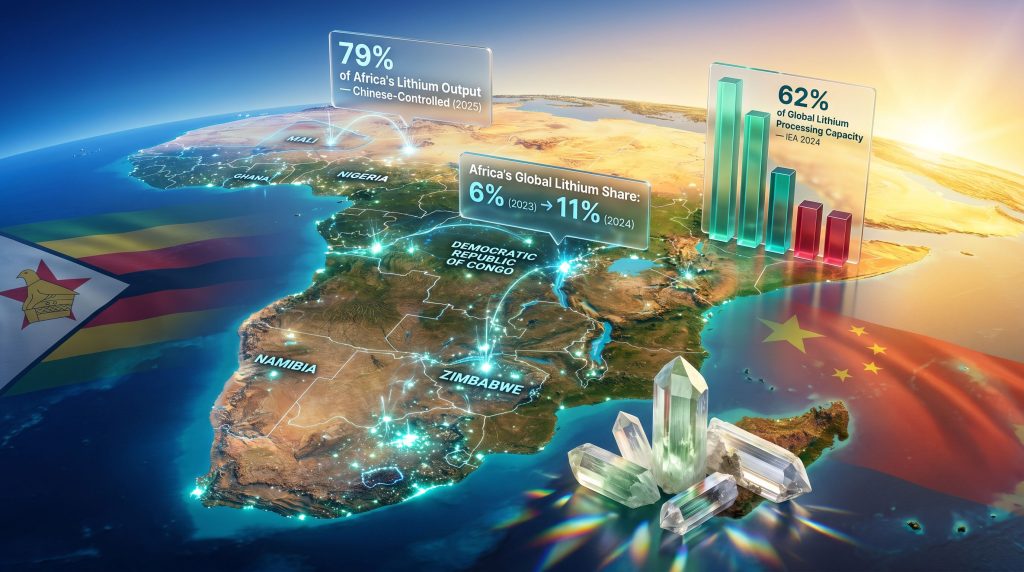
The numbers tell a striking story. According to the International Energy Agency, Africa's share of the global lithium market climbed from 6% in 2023 to 11% in 2024, representing one of the sharpest single-year shifts in the mineral's supply geography in recent memory. That trajectory is not accidental. It reflects deliberate capital deployment, largely from Chinese industrial groups, into a continent that holds some of the world's most significant undeveloped lithium reserves.
The IEA has also estimated that approximately 55 new lithium mines must reach production globally by 2035 to meet anticipated demand from the EV sector and grid-scale energy storage. Africa, with its combination of geological endowment, relatively lower development costs, and growing regulatory frameworks around mineral processing, sits at the centre of that equation.
What is less commonly understood is the nature of African lithium geology. Much of the continent's lithium is hosted in spodumene pegmatite deposits — hard-rock formations that require crushing and flotation to produce a lithium concentrate. Understanding spodumene extraction is essential here, as concentrates typically grade between 5% and 6% lithium oxide (Li₂O). This concentrate must then be chemically converted into lithium compounds suitable for battery manufacturing, a processing step that is technically demanding and capital-intensive.
Why Lithium's Value Chain Architecture Matters
Most people think of lithium as a single commodity. In practice, it moves through several distinct value stages before reaching a battery cell. Furthermore, understanding how lithium mining works clarifies why the location of processing determines which party captures the majority of value:
- Mining and concentration — Ore is extracted and processed into spodumene concentrate (typically 6% Li₂O)
- Chemical conversion — Concentrate is converted into lithium sulfate, an intermediate compound
- Refining — Lithium sulfate is further refined into battery-grade lithium carbonate or lithium hydroxide
- Cell manufacturing — Refined lithium compounds are incorporated into cathode active materials and battery cells
Each step up this chain adds substantial value. A tonne of spodumene concentrate might sell for a fraction of the price commanded by an equivalent quantity of battery-grade lithium carbonate. The country or company controlling the refining steps captures a disproportionate share of the overall economic surplus. This is precisely why the question of where processing happens in Africa is not a technical detail — it is the central economic and geopolitical contest of the continent's lithium decade.
How Chinese Capital Engineered Africa's Lithium Boom
The Industrial Logic Behind Overseas Acquisition
China's engagement in African lithium follows a logic that is both coherent and formidable. The country's battery manufacturing ecosystem — the world's largest by a considerable margin — requires continuous, cost-competitive lithium feedstock. Domestic Chinese lithium production, while significant, cannot satisfy the scale of demand generated by its own gigafactory buildout. The result has been a convergence of state industrial policy and corporate strategy around a model of overseas resource acquisition paired with domestic refining control.
According to IEA data, China accounts for approximately 62% of global lithium processing capacity as of 2024. This midstream dominance gives Chinese firms a structural incentive to secure upstream supply wherever it can be found at competitive cost. According to Benchmark Minerals, China is set to dominate African lithium production throughout this decade, reinforcing the integrated nature of its strategy across the continent.
The relationship between China's upstream acquisition strategy in Africa and its downstream refining monopoly is not coincidental. It represents an integrated industrial policy designed to maintain feedstock security for the world's most consequential battery manufacturing base.
A Country-by-Country Picture of Chinese Lithium Control
The geographic spread of Chinese lithium investment across Africa is broader than most observers appreciate:
| Country | Key Projects | Principal Chinese Operators | Status |
|---|---|---|---|
| Zimbabwe | Arcadia, Bikita, Kamativi, Sabi Star, Gwanda | Zhejiang Huayou, Sinomine Resources, Sichuan Yahua, Chengxin Lithium, Tsingshan | Active production |
| Mali | Goulamina, Morila Lithium | Ganfeng Lithium, Hainan Mining | Active production |
| DRC | Manono | Zijin Mining | Advanced development |
| Ghana | Ewoyaa | Zhejiang Huayou (acquisition pursuit) | Exploration and acquisition phase |
| Namibia | Downstream processing assets | Various Chinese-backed entities | Processing development |
Zimbabwe: The Continent's Most Advanced Case Study
Zimbabwe has been transformed by Chinese lithium investment more completely than any other African nation. Five major Chinese corporate groups now collectively operate the country's principal lithium assets — a concentration built through a wave of acquisitions and greenfield developments executed in the early 2020s.
Zhejiang Huayou's Arcadia operation achieved a continental milestone in April 2025, recording Africa's first export of lithium sulfate, the intermediate compound that sits between raw concentrate and battery-grade material. The company has since announced plans to advance Arcadia toward full battery-grade lithium carbonate production, a move that would place a Chinese-operated African mine at the doorstep of battery-ready chemistry for the first time.
This matters for a reason that is rarely articulated clearly. Lithium carbonate and lithium hydroxide — the battery-grade end products — command prices that can be several multiples of spodumene concentrate. By producing these compounds inside Zimbabwe, Zhejiang Huayou would be capturing value that previously accrued exclusively to Chinese refineries. Whether Zimbabwe's government captures a proportionate share of that incremental value through royalties and taxation is a separate and politically significant question.
Quantifying Chinese Dominance: The Ownership Numbers
How Concentrated Is Control?
Industry estimates suggest that Chinese-owned or Chinese-controlled operations could account for approximately 79% of African lithium production in 2025. That figure is projected to moderate to around 65% by 2035 as new entrants establish positions and host-country policy interventions reshape the competitive landscape.
Even the lower projected figure would leave Chinese entities as the overwhelmingly dominant force in African lithium a full decade from now. For context, no single national corporate bloc exercises comparable control over any other major globally traded commodity at this scale.
| Metric | Figure | Source |
|---|---|---|
| Africa's global lithium share (2023) | 6% | IEA |
| Africa's global lithium share (2024) | 11% | IEA |
| China's share of global lithium processing (2024) | 62% | IEA |
| New mines required globally by 2035 | ~55 | IEA |
| Estimated Chinese share of African lithium output (2025) | ~79% | Industry forecast |
| Projected Chinese share of African lithium output (2035) | ~65% | Industry forecast |
The Structural Risks of Single-Ecosystem Concentration
Concentration of this magnitude creates specific vulnerabilities for African producer countries that are often underappreciated in public debate:
- Pricing leverage erosion: When the dominant buyer of a country's mineral output is also the dominant processor globally, the seller's ability to negotiate open-market pricing is structurally compromised
- Limited competitive tension: A single-investor-ecosystem environment reduces the pressure on operators to accelerate community investment, infrastructure development, or employment localisation
- Royalty and tax negotiation asymmetry: Host-country governments negotiating with technically sophisticated, vertically integrated Chinese groups often lack equivalent technical capacity and market intelligence
- Policy dependency: Changes in Chinese industrial policy can have immediate consequences for African producing nations with little advance warning
The Processing Pivot: China Builds Refineries Inside Africa
A Strategic Shift With Long-Term Implications
Perhaps the most consequential and least discussed development in China in Africa's lithium industry is the decision by Chinese operators to construct processing infrastructure within host countries rather than exporting raw concentrate exclusively to China. Advances in direct lithium extraction technology are, furthermore, making in-country processing increasingly viable. This shift is partly a response to evolving African government policy, but it also reflects a forward-looking competitive strategy.
By establishing in-country refining capacity now, Chinese companies are positioning themselves to remain indispensable to African lithium economies even as local content requirements tighten. Key processing developments currently underway include:
- Zhejiang Huayou at Arcadia (Zimbabwe): lithium sulfate production operational, advancing toward lithium carbonate
- Sinomine Resources (Zimbabwe): developing dedicated lithium sulfate processing infrastructure
- Sichuan Yahua (Zimbabwe): constructing processing facilities integrated with its mining operations
- Zijin Mining (DRC, Manono): planning integrated processing as a core component of project development
Zimbabwe's 2027 Export Ban: Unintended Consequences
Zimbabwe's announced ban on raw lithium concentrate exports, scheduled to take effect in 2027, is designed to force value-addition within the country and increase government revenue from its mineral base. The policy intent is sound. The execution risk, however, is significant and rarely discussed.
A resource nationalism policy that mandates in-country processing can paradoxically entrench the dominance of investors who have already built processing infrastructure, while effectively excluding competitors who have not yet committed capital to the country. Zimbabwe's 2027 export ban may produce exactly this outcome.
Chinese companies, already investing in Zimbabwean lithium sulfate and carbonate facilities, are uniquely positioned to comply with the new rules. Western mining companies and alternative investors, constrained by longer due diligence cycles and more demanding ESG approval processes, have not established comparable processing presence. The export ban may therefore function less as a diversification catalyst and more as a barrier to entry for non-Chinese capital.
The Value Capture Question: Is Africa Getting Its Share?
What Host Countries Are Actually Receiving
The gap between the scale of lithium extraction and the visible economic transformation in host communities remains one of the most persistent criticisms of the current model. Investigations into Chinese-operated projects across Africa have raised concerns in several areas:
- Inadequate environmental impact management at certain mine sites
- Weak enforcement of local employment and procurement commitments in some jurisdictions
- Limited transparency in revenue-sharing arrangements between operators and governments
- Allegations of governance irregularities in project approval processes, particularly in Namibia
- Compressed timelines for environmental and social due diligence driven by Chinese investment speed
It is important to note that these concerns are not uniformly applicable across all Chinese operators. Some projects have delivered measurable local benefits. However, the pattern has attracted scrutiny from civil society organisations and international development institutions. Global Witness has documented how a rush for lithium across the continent risks fuelling corruption and failing citizens if governance frameworks are not adequately strengthened.
The Countervailing Forces: African Governments Fight Back
Several African governments are actively working to renegotiate the terms of their lithium relationship with Chinese capital. In addition, the Manono lithium project in the DRC represents one of the most closely watched test cases for how these negotiations play out at scale:
- Zimbabwe's Kuvimba Mining (state-owned) is advancing the Sandawana lithium project to build a domestically controlled presence in the sector
- The European Investment Bank has committed financing for Namibia's Uis lithium project, offering an alternative investment model aligned with Western sustainability standards
- KoBold Metals, backed by U.S. investors, has secured exploration licences in the vicinity of the Manono project in the DRC, introducing competitive tension into a previously Chinese-dominated corridor
- Multiple African governments are evaluating joint venture mandates, local content thresholds, and escalating royalty frameworks tied to commodity prices
The Emerging Geopolitical Contest
| Investor Bloc | Primary Strategic Tool | Key African Presence |
|---|---|---|
| China | Direct corporate investment, processing infrastructure, state-backed financing | Zimbabwe, Mali, DRC, Ghana |
| United States | Exploration investment, bilateral mineral agreements, development finance | DRC surrounds, broader critical minerals diplomacy |
| European Union and EIB | Multilateral development financing, sustainability-linked structures | Namibia (Uis project) |
| African State Entities | State-owned mining vehicles, local content legislation | Zimbabwe (Kuvimba), broader resource nationalism trend |
The next major ASX story will hit our subscribers first
Three Scenarios for China's African Lithium Position by 2035
The trajectory of China in Africa's lithium industry over the next decade is not predetermined. Three distinct pathways are plausible, each with materially different implications for African economies and global supply chains.
Scenario 1: Consolidation of Dominance
Chinese companies successfully navigate host-country processing mandates, deepen their refining footprint, and sustain approximately 65% production control. Western and multilateral investors fail to deploy capital at sufficient speed or scale to alter the competitive balance. African governments lack the negotiating leverage to force structural change.
Scenario 2: Managed Diversification
African governments successfully leverage competing geopolitical interest from the U.S., EU, and Gulf capital to renegotiate investment terms. Chinese market share declines to 50 to 55% as a more pluralistic investment landscape emerges. Processing value is more equitably distributed between Chinese operators and host-country entities.
Scenario 3: Disruption Through Technology or Policy
Advances in alternative battery chemistries — particularly sodium-ion or solid-state architectures — reduce lithium's centrality to energy storage. African governments implement aggressive resource nationalism that disrupts existing project economics. Chinese investment partially retreats or restructures, creating openings for alternative capital at reduced entry costs.
The most likely near-term outcome sits closer to Scenario 1, though the growing involvement of KoBold Metals in the DRC and the EIB's Namibian financing signal that Scenario 2 is not merely aspirational.
Frequently Asked Questions
Which African country currently produces the most lithium?
Zimbabwe is Africa's largest lithium-producing nation, a position largely constructed through Chinese corporate investment in the Arcadia, Bikita, Kamativi, Sabi Star, and Gwanda operations during the early 2020s.
What is lithium sulfate and why does its production in Africa matter?
Lithium sulfate is an intermediate processed lithium compound, representing a step up the value chain from raw spodumene concentrate but below battery-grade lithium carbonate or hydroxide. Africa's first production of lithium sulfate at Zhejiang Huayou's Arcadia mine signals a structural shift toward in-country processing rather than raw material export, with meaningful implications for where value is captured along the supply chain.
Why has Western investment in African lithium been so limited?
Western mining companies and investment institutions face longer capital deployment cycles, more demanding ESG approval frameworks, and higher risk-adjusted return requirements than Chinese state-backed industrial groups. This structural asymmetry has allowed Chinese firms to move faster, commit capital earlier, and establish operational positions before Western competitors have completed due diligence.
What is Zimbabwe's lithium export ban and when does it take effect?
Zimbabwe has announced a policy prohibiting exports of unprocessed lithium concentrate, scheduled to take effect in 2027. The measure is intended to compel investors to carry out processing within Zimbabwe's borders, retaining a larger share of the value generated from the country's lithium resources.
The Decade That Will Define Africa's Lithium Future
Africa stands at a genuinely consequential inflection point. The continent holds a growing share of the lithium reserves the world needs to electrify transport and store renewable energy at scale. China holds the capital, processing technology, and supply chain integration to convert those reserves into battery-ready materials at speed.
The next ten years will determine whether Africa transitions from a raw material supplier into an integrated participant in the global battery economy, or whether its lithium wealth replicates the enclave extraction patterns that defined previous commodity cycles. That outcome will depend on the quality of African regulatory design, the coherence of host-country negotiating strategies, the pace at which alternative investors build genuine commitments, and whether resource nationalism policies are architected with enough sophistication to diversify rather than inadvertently consolidate Chinese control.
This article contains forward-looking analysis, scenario projections, and market forecasts. These represent analytical perspectives and should not be construed as financial advice. Production figures, ownership estimates, and capacity projections are subject to change as projects develop and market conditions evolve.
Want to Track the Next Major Mineral Discovery Before the Market Does?
Discovery Alert's proprietary Discovery IQ model delivers real-time ASX alerts on significant mineral discoveries — including critical battery metals like lithium — turning complex geological and market data into actionable investment opportunities the moment they are announced. Explore historic discoveries and their extraordinary returns to understand what early positioning can mean, then begin your 14-day free trial to stay ahead of the market.