June 10, 2026
The Hidden Architecture of a Global Aluminum Supply Crisis
Most commodity disruptions unfold gradually, giving markets time to adjust. The aluminum market in 2026 has not been granted that luxury. China aluminum exports surged in May as the Iran war keeps supply tight, compressing what would normally be a multi-year supply adjustment into a matter of weeks. Understanding how this crisis is reshaping global trade flows requires looking beyond headline production numbers and into the structural mechanics of how aluminum actually moves through the global economy.
When big ASX news breaks, our subscribers know first
Why Gulf Aluminum Was Never Just a Regional Story
The Gulf region's contribution to global primary aluminum output sits at roughly 8 to 9% of total world production — a figure that sounds modest until you consider how tightly balanced aluminum supply and demand typically are. In commodity markets where annual supply growth rarely exceeds 2 to 3%, removing even a fraction of physically deliverable metal from trade flows can trigger disproportionate price responses.
Before the current conflict, Gulf producers occupied a strategically important position in the global supply chain. Their aluminum was competitive on price, logistically accessible via established maritime routes, and available in consistent volumes that buyers in Europe, South Asia, and Southeast Asia could plan around. These were not marginal suppliers filling gaps. They were foundational to the procurement strategies of industrial consumers across multiple continents.
The energy intensity of aluminum smelting makes the Gulf's production profile particularly difficult to replicate elsewhere on short notice. The Gulf's access to low-cost energy, combined with its capital infrastructure, created a production cost structure that took decades to build. Damage to that infrastructure cannot be undone in quarters. Furthermore, China commodity demand dynamics have added another layer of complexity to an already strained global market.
The Anatomy of the Supply Shock: What the Data Actually Shows
The Iran conflict inflicted damage on two of the largest aluminum smelting facilities in the Gulf region, extracting significant capacity from an already tightly supplied global market. The secondary effect — the effective closure of the Strait of Hormuz — compounded the damage by severing the maritime corridor through which both aluminum and alumina (the feedstock required to produce aluminum) had previously flowed.
The combined impact registered with unusual clarity in International Aluminium Institute production data:
- Gulf region primary aluminum output collapsed to approximately 330,000 metric tons in April 2026, the weakest monthly reading in more than a decade
- This represented a 35% year-on-year decline versus April 2025, a contraction rate that is exceptional for a capital-intensive heavy industry
- Global primary aluminum production fell 2.1% year-on-year to 5.92 million metric tons in April 2026
- Chinese primary aluminum production, by contrast, expanded an estimated 1.5% year-on-year to 3.68 million metric tons
The distinction between headline output decline and deliverability decline matters enormously here. Some aluminum production that technically continues cannot be physically exported due to shipping route closure. The tradeable supply shortfall is larger than the raw production figures suggest.
This deliverability gap is a concept that often escapes headline-level analysis. A smelter that continues producing but cannot export its output because of port closures or shipping route restrictions contributes to domestic inventory buildup but does nothing to relieve international supply tightness. For buyers outside the affected region, the metal effectively does not exist. Consequently, global supply chain disruption of this scale has few modern precedents in the aluminum industry.
China Aluminum Exports Surged in May: The Numbers Behind the Surge
Against this backdrop of tightening global supply, China's aluminium exports surged in May in a manner that reflects both opportunistic trade repositioning and deeper structural shifts in how the global aluminum market is being served.
Monthly and Cumulative Export Performance
| Metric | Value | Period |
|---|---|---|
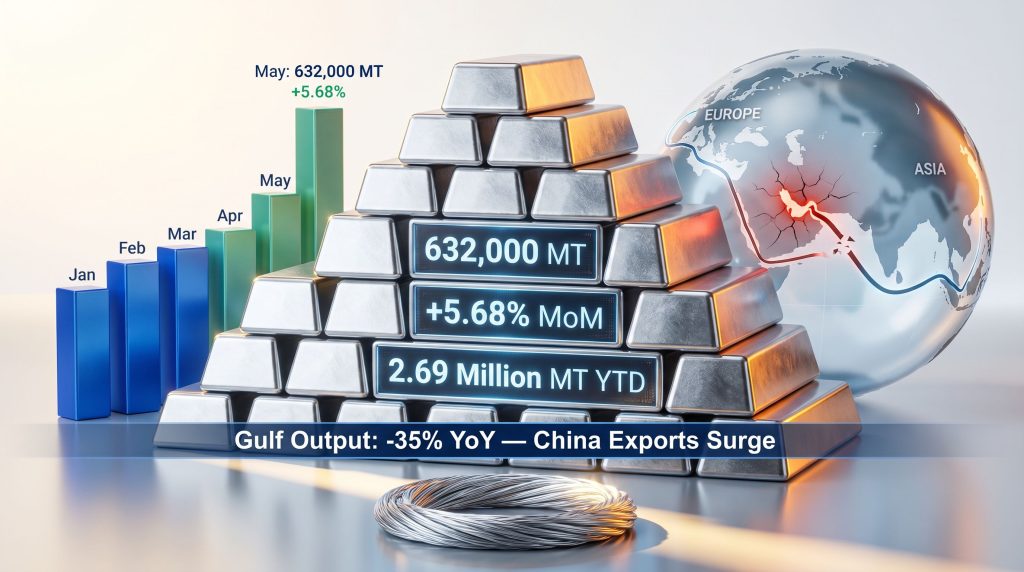
| Unwrought aluminum and product exports | 632,000 metric tons | May 2026 |
| Month-on-month growth | +5.68% | May vs. April 2026 |
| April 2026 exports | ~598,000 metric tons | April 2026 |
| April characterisation | Highest in at least a year | April 2026 |
| Cumulative exports (Jan to May) | 2.69 million metric tons | YTD 2026 |
| YTD cumulative growth | +10.4% | Jan to May 2026 |
The sequential nature of this acceleration is significant. April was already the strongest single-month export reading in over a year. May exceeded it. A two-month consecutive surge of this magnitude in a market under structural supply stress is not noise. It reflects a deliberate and financially incentivised reorientation of Chinese aluminum toward export markets.
The Price Arbitrage Mechanism Driving Chinese Export Economics
The export surge is not occurring in a vacuum. It is being driven by a specific and measurable financial dynamic: the widening spread between Chinese domestic aluminum prices and elevated international benchmark prices.
When international buyers face constrained supply from traditional Gulf sources, they compete more aggressively for available metal, pushing international prices higher. Chinese domestic prices, insulated from direct Gulf disruption, have remained comparatively stable. The resulting price differential makes exporting aluminum from China materially more profitable than selling domestically.
This arbitrage mechanism operates with considerable precision in commodity markets. Traders and producers respond quickly to price signals. When the spread widens beyond the cost of logistics and export duties, export volumes accelerate. The May 2026 data confirms that the spread has been wide enough, and sustained long enough, to drive consecutive months of elevated export activity. In addition, shifts in aluminum and alumina markets have reinforced the financial logic underpinning this surge.
Aluminum Stranded Wire: An Unconventional Arbitrage Signal
One of the more technically revealing aspects of the current export surge involves aluminum stranded wire, a product normally classified in a separate customs category from standard unwrought aluminum and aluminum products. Stranded wire is primarily used in power transmission and distribution infrastructure, serving as conductor cable in electrical grids.
In April 2026, exports of aluminum stranded wire recorded a notable jump as traders sought to access additional aluminum export volumes through this alternative category. The logic is straightforward: if the financial incentive to export aluminum is strong enough, market participants will identify and utilise every available customs classification to maximise volumes.
When industrial inputs designed for power grid infrastructure begin being repurposed as vehicles for commodity arbitrage, it is a reliable signal that the underlying price dislocation is not marginal. It suggests the gap between domestic and international aluminum prices has reached a threshold where unconventional strategies become economically rational.
This kind of behaviour is historically significant as a leading indicator. It typically precedes either a further escalation of export volumes or a policy response from domestic authorities seeking to redirect supply back toward domestic consumption.
Aluminum Semis: The Supply Shift Extends Across the Value Chain
The export acceleration is not limited to primary metal. China's semi-fabricated aluminum products, collectively referred to in industry terminology as semis, have also seen export growth rebound into 2026. Semis encompass a wide range of downstream aluminum forms including rolled products, extruded profiles, foil, and wire rod used across automotive, construction, packaging, and electrical applications.
The expansion of semis exports alongside primary aluminum exports indicates that the trade flow shift is occurring at multiple points along the aluminum processing chain. Buyers who might previously have sourced both raw aluminum and processed forms from Gulf or other international producers are increasingly turning to Chinese suppliers across the full product spectrum.
This is strategically important for Chinese aluminum producers. Semis carry higher value-added margins than primary metal. If the current supply disruption accelerates buyer migration toward Chinese semis, the commercial benefit to Chinese producers extends well beyond the immediate export volume gains. However, the response from top aluminium producers outside China will be closely watched as competition for displaced demand intensifies.
Trade Flow Realignment: Who Bears the Long-Term Risk?
Buyer Dependency and Supply Chain Vulnerability
The buyers most affected by Gulf supply disruption are those in regions that historically relied on it as a primary source. European industrial consumers, South Asian manufacturers, and buyers across Southeast Asia now face a near-term structural dependency on Chinese aluminum that few would have planned for or preferred.
This dependency shift carries consequences that extend beyond price. Supply chain resilience, geopolitical risk diversification, and long-term procurement strategy are all affected when a significant share of global aluminum supply concentrates more heavily through a single origin. Portfolio theory applied to supply chains suggests that concentration risk of this kind warrants a premium or a diversification response over time.
Risks That Could Close China's Export Window
Several factors could curtail the duration of China's export advantage:
- Domestic policy intervention — China's government retains the ability to restrict aluminum exports through taxation adjustments, quota imposition, or strategic reserve allocation. If domestic infrastructure spending accelerates, policy priorities could redirect aluminum toward internal use.
- Trade defence responses — A prolonged period of elevated Chinese aluminum exports increases the probability of anti-dumping investigations or tariff actions. The imposition of aluminum and steel tariffs has already demonstrated how swiftly trade policy can reshape commodity flows.
- Gulf recovery trajectory — Even partial facility restarts at damaged Gulf smelters would begin compressing the international price premium, reducing the financial incentive for Chinese exports.
- Energy cost normalisation — If Gulf instability resolves and global energy costs moderate, the cost floor for non-Chinese aluminum production falls, improving the competitiveness of alternative suppliers.
Gulf Infrastructure Recovery: Why It Takes Longer Than Expected
Heavy industrial infrastructure, particularly aluminum smelters, has long recovery timelines following significant damage. Smelting facilities operate with large capital structures including electrolytic cells, bus bar systems, and high-voltage power infrastructure that require specialised engineering, materials, and expertise to restore.
Historical precedent from conflict-affected industrial zones suggests reconstruction timelines of 12 to 36 months for heavy industrial assets, even when political conditions allow work to begin immediately. This timeline means the supply gap opened by the Iran conflict could remain partially unfilled well into 2027, sustaining the conditions that have made China aluminum exports surged in May the defining trade story of 2026's commodity markets.
The next major ASX story will hit our subscribers first
Secondary Market Effects: Energy Costs and the Global Production Cost Floor
A dimension of the supply shock that receives less analytical attention is its impact on global aluminum production economics outside both the Gulf and China. The Gulf conflict has contributed to elevated energy costs across global markets. Since aluminum smelting is one of the most energy-intensive industrial processes in existence, consuming roughly 13 to 15 megawatt-hours of electricity per metric ton of aluminum produced, energy cost increases translate directly into higher production costs.
This cost floor elevation affects smelters in Europe, North America, and parts of Asia that were already operating near their margin thresholds. Higher energy costs reduce the production economics for these facilities, making some capacity uneconomic and potentially accelerating production curtailments. The net effect is that the supply tightness caused by direct Gulf disruption is being amplified by cost-driven curtailments in other regions.
Key Market Dynamics at a Glance
| Supply and Demand Factor | Current Status | Market Impact |
|---|---|---|
| Gulf smelter infrastructure | Damaged, recovery timeline uncertain | Strongly bearish supply |
| Strait of Hormuz shipping | Active disruption, constrained access | Reduces deliverable supply |
| Global primary output growth | Negative at -2.1% year-on-year | Tightens available metal |
| Chinese primary production | Positive at +1.5% year-on-year | Partial supply offset |
| International aluminum prices | Elevated versus Chinese domestic | Sustains export arbitrage |
| Buyer stockpiling behaviour | Active accumulation | Amplifies apparent demand |
| Global energy costs | Elevated due to Gulf instability | Raises non-Chinese cost floor |
| Chinese semis export growth | Rebounding through 2026 | Extends value chain advantage |
Frequently Asked Questions
Why did China aluminum exports surge in May 2026 specifically?
May 2026 exports reached 632,000 metric tons, rising 5.68% over April's already elevated levels. The primary driver was the gap in international aluminum supply created by Gulf region production falling 35% year-on-year and the Strait of Hormuz restricting maritime access. International buyers competed aggressively for available metal, pushing prices above Chinese domestic levels and creating a financially compelling incentive for Chinese producers and traders to redirect supply toward export markets.
What is alumina and why does the Strait of Hormuz closure matter for it?
Alumina is the refined intermediate product derived from bauxite ore that serves as the direct feedstock for aluminum smelting. Approximately two tonnes of alumina are required to produce one tonne of primary aluminum. The Strait of Hormuz is a critical shipping corridor for alumina and aluminum trade flows serving the Gulf region. Its disruption affects not only finished aluminum exports but also the feedstock supply chains that sustain smelting operations.
How does the stranded wire arbitrage actually work?
Aluminum stranded wire sits in a separate customs classification from unwrought aluminum and standard aluminum products. When the financial incentive to export aluminum is exceptionally high, traders identify alternative product categories that can be exported to capture the same underlying price arbitrage. By exporting stranded wire, they effectively access aluminum export volumes beyond what standard category quotas or tax structures might otherwise allow, exploiting the price gap between domestic and international markets through an unconventional but legal trade mechanism.
Could this supply disruption become permanent?
The likelihood of a permanent realignment depends on whether Gulf producers can reconstruct damaged infrastructure and whether the Strait of Hormuz returns to full operational status. Historical data on heavy industrial reconstruction following conflict damage suggests 12 to 36 months as a realistic recovery window, meaning the current supply conditions have a meaningful probability of persisting through much of 2027. Whether that constitutes a permanent shift depends on subsequent geopolitical developments that remain highly uncertain.
This article is intended for informational purposes only and does not constitute financial, investment, or commodity trading advice. Forecasts, timelines, and market projections referenced herein involve significant uncertainty. Readers should conduct independent research and consult qualified advisors before making any investment or procurement decisions. Production data sourced from the International Aluminium Institute. Trade data sourced from Chinese customs authorities as reported by Reuters.
Want to Stay Ahead of the Next Major Commodity Disruption?
Discovery Alert's proprietary Discovery IQ model scans ASX announcements in real time, instantly identifying significant mineral discoveries across aluminium, bauxite, and more than 30 other commodities — turning complex market shifts into actionable investment opportunities before the broader market catches on. Explore how historic mineral discoveries have generated substantial returns and begin your 14-day free trial today to position yourself ahead of the next major market move.