May 23, 2026
Underground Coal Mining's Most Persistent Killer: Why Gas Explosions Keep Claiming Lives
Methane does not announce itself. Colourless, odourless, and lighter than air, it seeps silently from fractured coal seams into the enclosed roadways of underground mines, accumulating in roof cavities and poorly ventilated dead-ends until a single ignition source transforms it into a pressure wave travelling faster than sound. This is the technical reality that underpins every major coal mine gas explosion in recorded history, and it is the same mechanism that turned a Friday evening shift in northern China into the country's deadliest mining catastrophe in more than sixteen years. The China coal mine disaster in Shanxi is a case that demands careful, systematic analysis.
The Liushenyu coal mine disaster in Shanxi Province is not simply a news event. It is a diagnostic moment for an industry that has made genuine, measurable progress on worker safety over two decades, yet still carries structural vulnerabilities that no amount of regulatory paperwork can fully neutralise. Understanding what happened, why it happened, and what it reveals about the persistent gap between compliance frameworks and operational reality requires looking well beyond the headline death toll.
When big ASX news breaks, our subscribers know first
The Liushenyu Disaster: Scale, Sequence, and Key Facts
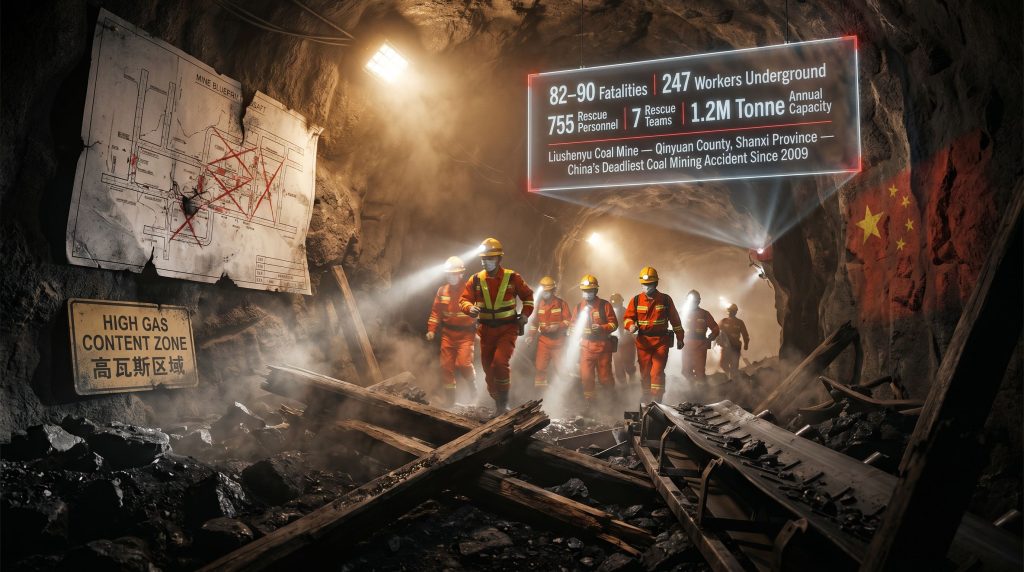
The explosion occurred late on a Friday evening at the Liushenyu coal mine located in Qinyuan County, Shanxi Province. At the time of the blast, 247 workers were underground. The immediate aftermath produced casualty figures that shifted as rescue operations progressed: authorities initially reported 90 fatalities, before revising that figure downward to 82 confirmed deaths at an official briefing the following day. More than 120 workers were hospitalised, and two individuals remained unaccounted for at the time of initial reporting.
The scale of the emergency response was equally significant:
- 755 rescue and medical personnel were deployed to the site
- Personnel were organised across 7 specialist teams
- Teams were dispatched by Shanxi provincial emergency management authorities
- Operations were complicated almost immediately by a critical discovery
That discovery was the blueprint discrepancy. The actual underground layout of the Liushenyu mine did not correspond to its official documented maps. For rescue teams attempting to navigate branching tunnel systems under conditions of poor visibility, compromised air quality, and potential afterblast instability, this mismatch was not a bureaucratic technicality. It was a life-or-death operational obstacle, much like the challenges observed in cases involving tunnel collapse impact in other parts of the world.
Key Statistics at a Glance
| Metric | Figure |
|---|---|
| Workers underground at time of blast | 247 |
| Confirmed fatalities (revised) | 82 |
| Initial fatality estimate | 90 |
| Workers hospitalised | 120+ |
| Workers missing | 2 |
| Rescue personnel deployed | 755 |
| Rescue teams | 7 |
| Mine annual production capacity | 1.2 million tonnes |
| Operating entity established | 2010 |
How This Disaster Compares to China's Coal Mining History
To appreciate the significance of the Liushenyu explosion, it is worth placing it within the longer arc of Chinese mining fatality data. In the early 2000s, China was recording thousands of coal mining deaths annually, a scale that prompted international scrutiny and drove fundamental regulatory reform. The trajectory since then has been one of real, sustained improvement. However, significant incidents continue to expose persistent systemic weaknesses.
| Incident | Year | Province | Fatalities | Primary Cause |
|---|---|---|---|---|
| Heilongjiang mine disaster | 2009 | Heilongjiang | 108 | Coal and gas outburst |
| Shanxi mine explosion | 2009 | Shanxi | 74 | Explosion |
| Liushenyu coal mine explosion | 2026 | Shanxi | 82 (revised) | Gas explosion |
The Heilongjiang disaster of 2009, which killed 108 workers and injured 133, is widely regarded as the event that accelerated China's most significant post-reform push on underground safety standards. The Liushenyu explosion surpasses the death toll of the 2009 Shanxi incident and places itself as the deadliest China coal mine disaster in Shanxi or anywhere else in the country since that Heilongjiang event.
This does not necessarily indicate that China's long-term safety trajectory has reversed. What it does indicate is that progress, however genuine, has not eliminated the conditions under which mass-casualty gas explosions can occur. The gap between regulatory intent and operational compliance in high-gas-content mines remains a live risk.
The Geology of Danger: Why Shanxi's Coal Seams Are Inherently High-Risk
Shanxi Province is China's dominant coal-producing region, and its geological profile is inseparable from its risk profile. The province's coal seams are characterised by high gas content, a geological condition that reflects the thermal maturity and structural history of the coal-bearing strata. As coal matures over geological time, it releases methane as a byproduct. In deeply buried, structurally complex seams, this methane becomes trapped under pressure within the coal matrix and surrounding rock.
When mining operations advance into these seams, the pressure differential created by excavation causes methane to desorb and migrate rapidly into the mine atmosphere. In mines classified as high-gas facilities, the rate of methane emission can overwhelm ventilation systems during periods of elevated production, equipment failure, or ventilation circuit disruption. The Liushenyu mine had been formally classified as a disaster-prone facility prior to the explosion, meaning its high-gas characteristics were documented and known to regulators.
This classification carries specific obligations under Chinese mining law, including mandatory gas drainage systems, continuous atmospheric monitoring, and pre-shift safety inspections focused on methane concentration levels. The confirmation of serious regulatory violations by authorities raises the question of which of these obligations were not met, and why. Furthermore, effective mine fire response and safety protocols in comparable underground environments demonstrate just how critical these pre-established frameworks are when emergencies unfold.
What Methane Concentration Thresholds Mean in Practice
Underground coal mine safety protocols globally use methane concentration thresholds as trigger points for operational decisions:
- Below 1.0% methane by volume: normal operations permitted in most jurisdictions
- Between 1.0% and 1.5%: warning zone requiring increased ventilation and monitoring
- Above 1.5%: mandatory production halt and worker withdrawal in Chinese mining regulations
- 5% to 15% methane by volume: the explosive range within which ignition produces a detonation
A gas explosion occurs when methane accumulates within this explosive band and encounters an ignition source, which can be electrical equipment, friction from cutting machinery, or even spontaneous combustion in coal dust. The enclosed geometry of underground roadways concentrates the blast pressure, making survival rates among workers in the vicinity of the ignition point extremely low.
The Blueprint Problem: A Systemic Risk Hiding in Plain Sight
Of all the factors associated with the Liushenyu disaster, the discrepancy between the mine's official blueprints and its actual underground configuration may be the most institutionally significant. This is not a rare phenomenon in Chinese coal mining, particularly in operations that have undergone informal expansion, ownership changes, or incremental development over many years without corresponding updates to documented plans.
Blueprint and mine map accuracy is one of the most underappreciated safety variables in underground mining. In a surface facility, a layout discrepancy is an inconvenience. Underground, during an active rescue operation with compromised communications and deteriorating air quality, it can mean the difference between reaching trapped workers in time and arriving too late.
The practical consequences of map inaccuracies during rescue operations include:
- Rescue teams entering dead-ends or collapsed sections not shown on plans
- Ventilation reversal strategies based on incorrect airflow circuit assumptions
- Delays in identifying the most probable locations of survivor pockets
- Incorrect assessment of secondary explosion risk zones
- Miscommunication between surface command and underground teams
International best practice, as outlined by bodies including the International Labour Organization and the Mine Safety and Health Administration (MSHA), treats mine map accuracy as a non-negotiable baseline standard, not an aspirational target. The Liushenyu case will likely reinforce calls for mandatory independent re-surveying of underground infrastructure across China's coal sector, particularly in mines that have undergone capacity expansion since their original approval. This concern is closely tied to broader mining permitting realities that affect how operational changes are documented and approved across the industry.
The Government Response: Speed, Authority, and Accountability
The official response to the China coal mine disaster in Shanxi moved quickly across multiple levels of government, reflecting the political sensitivity of large-scale industrial fatalities and China's evolving approach to public accountability in crisis situations.
| Action | Authority | Details |
|---|---|---|
| Presidential directive | Xi Jinping | Ordered maximum effort on rescue and full legal accountability |
| Premier's instruction | Li Qiang | Called for transparent and timely public information disclosure |
| State Council investigation | Central government | Formal probe dispatched to determine causation and accountability |
| Executive detentions | Local authorities | Mine company executives taken into custody |
| Emergency deployment | Shanxi provincial authorities | 755 personnel across seven teams |
The involvement of a State Council investigation team is particularly significant. State Council-level inquiries carry the highest administrative authority within China's governmental hierarchy. Outcomes from such investigations can include criminal prosecution, permanent licence revocation for the operating entity, and binding sector-wide regulatory reforms. The precedent set by the post-2009 investigations, which resulted in sweeping changes to gas management requirements and inspection regimes, suggests that the Liushenyu inquiry could produce similarly consequential policy outcomes.
The operator, Shanxi Tongzhou Group Liushenyu Coal Industry, is a subsidiary of Shanxi Tongzhou Coal Coking Group. Established in 2010 with an annual production capacity of 1.2 million tonnes, the entity was operating a facility already flagged as disaster-prone when the explosion occurred. The detention of its executives signals that authorities are treating the confirmed serious violations as a matter for criminal rather than purely administrative accountability.
The next major ASX story will hit our subscribers first
What Drove Safety Improvements, and What Is Now Being Tested
China's reduction in coal mine fatalities between the early 2000s and the mid-2020s was not accidental. It was the product of deliberate, sustained policy intervention across several dimensions.
Factors behind the long-term decline in mining fatalities:
- Mandatory installation of gas drainage boreholes in all high-gas-rated mines
- Sector consolidation that replaced thousands of small informal operations with larger, better-resourced entities subject to stronger oversight
- Real-time atmospheric monitoring systems with automatic production cutoff triggers
- Substantially increased penalties for safety violations, including criminal liability for executives
- Enhanced pre-shift inspection protocols with documented sign-off requirements
Factors that persistently undermine compliance:
- Production pressure during periods of elevated energy demand, which can incentivise shortcuts on gas drainage timelines
- The administrative complexity of enforcing standards across a geographically dispersed sector with thousands of active operations
- Blueprint and documentation irregularities that accumulate over time in operations that expand without corresponding regulatory updates
- Gaps between the technical sophistication required to operate modern safety systems and the training levels of front-line supervisory staff
The tension embedded in this list is structural. China remains the world's largest producer and consumer of coal, with the fuel underpinning a substantial share of national electricity generation and steel production. Production continuity is an energy security imperative. Yet the enforcement of the most stringent gas management standards can materially reduce short-term output, creating an incentive environment that even well-designed regulatory frameworks struggle to fully neutralise.
Downstream Industry Implications
The immediate operational consequences of the Liushenyu disaster extend beyond the mine itself. Heightened inspection activity across Shanxi's coal operations is a near-certain short-term outcome, and some high-gas-content mines in the province may face temporary production suspensions pending safety audits. Given Shanxi's central role in supplying coal to Chinese steel mills and power generators, even modest disruptions to provincial output can transmit through to downstream sectors.
Longer-term, the disaster is likely to accelerate several regulatory conversations that were already underway. Consequently, the industry will need to look seriously at comprehensive mining risk management solutions to address the structural vulnerabilities this event has exposed. Specifically, the anticipated regulatory focus includes:
- Mandatory re-surveying and independent verification of underground mine maps across the national portfolio of operating mines
- Accelerated timelines for methane pre-drainage requirements in disaster-prone facilities
- Renewed scrutiny of mid-tier operators whose safety management systems may not have kept pace with their production growth
- Potential reforms to the way China categorises and monitors high-gas mines, including more frequent third-party audits
For international mining safety professionals and regulators, the Liushenyu disaster reinforces a principle that the sector's own data consistently supports: the most dangerous moment in a high-gas underground mine is not when safety systems are absent, but when they are present on paper and absent in practice. The Moranbah North mine fire in Australia, whilst different in its specifics, similarly underscored how operational compliance gaps can rapidly transform a manageable situation into a crisis. However, the China coal mine disaster in Shanxi represents a sobering reminder that scale and consequence can differ profoundly depending on the regulatory environment, geological conditions, and enforcement culture in which a mine operates.
Disclaimer: This article is intended for informational and analytical purposes only. Casualty figures and investigation details are based on reporting available at the time of writing and may be subject to revision as official inquiries progress. Readers seeking the most current figures should consult updates from Xinhua, Reuters, and official Chinese government communications.
Want to Stay Ahead of Significant ASX Mineral Discoveries as They Happen?
Discovery Alert's proprietary Discovery IQ model delivers real-time alerts on significant ASX mineral discoveries, turning complex data across more than 30 commodities into clear, actionable insights for both short-term traders and long-term investors. Explore how historic discoveries have generated substantial returns on Discovery Alert's dedicated discoveries page, and begin your 14-day free trial today to position yourself ahead of the broader market.