June 10, 2026
The Hidden Cost of Linear Metal Systems and the Case for Circularity
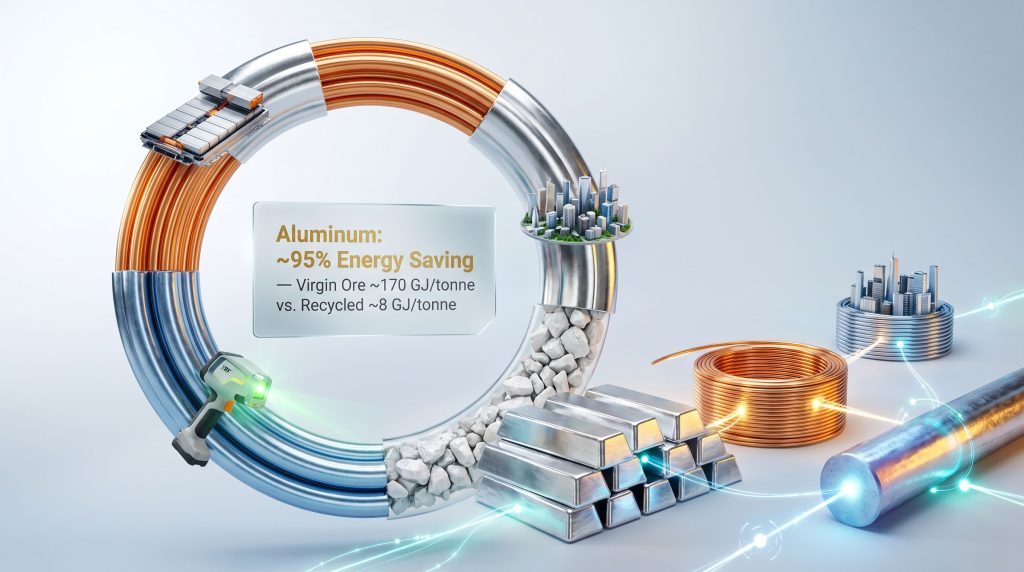
Every tonne of primary aluminum produced from bauxite ore consumes roughly 170 gigajoules of energy. Produce that same tonne from recycled scrap, and the energy requirement collapses to approximately 8 gigajoules — a reduction of around 95%. This single data point encapsulates why the circular economy in metal supply chains is not a fringe concept or regulatory checkbox. It is one of the most consequential efficiency opportunities available to industrial civilisation, and the gap between current practice and theoretical potential remains enormous.
The linear model — extract ore, manufacture product, discard at end of life — made sense when mineral reserves appeared inexhaustible and environmental externalities were unpriced. Neither condition holds today. Demand for critical minerals is accelerating in parallel with the clean energy transition, while ore grades at many established mining operations are declining, pushing extraction costs upward and energy intensity higher. The structural mismatch between finite supply and compounding demand is not a future risk. It is an active constraint reshaping supply chain economics right now.
When big ASX news breaks, our subscribers know first
What Circular Economy in Metal Supply Chains Actually Means
The phrase gets used loosely, so precision matters. A circular metal supply chain is not simply a recycling programme. It is a systems-level redesign that keeps metals in productive use for as long as technically and economically possible, capturing value at every stage rather than allowing it to leak out at disposal.
The operational architecture rests on five interconnected pillars:
| Pillar | Description | Example Application |
|---|---|---|
| Design for Circularity | Products engineered for disassembly and modular replacement | Modular EV battery packs |
| Secondary Material Integration | Increasing recycled content in new production | High-scrap electric arc furnaces |
| Closed-Loop Recovery | End-of-life scrap reintroduced into production cycles | Steel mill closed-loop scrap systems |
| Traceability and Transparency | Data-driven tracking of material origin and composition | Digital product passports |
| Waste Valorisation | Converting industrial by-products into usable inputs | Slag repurposed in construction |
Critically, circularity differs from sustainability as a supply chain strategy. Sustainability often focuses on reducing harm within an existing system. Circularity restructures the system itself, eliminating the concept of waste as a terminal outcome. The Ellen MacArthur Foundation's overview of critical minerals provides a compelling framework for understanding how this systemic redesign applies specifically to metal-intensive industries.
How Different Metals Fit the Circular Model
Not all metals are equally positioned for circular recovery. Steel and aluminum benefit from mature scrap infrastructure and high intrinsic recovery value. Copper demonstrates strong secondary market economics given its price point. Critical minerals including lithium, cobalt, and rare earth elements present a different challenge entirely: their circular systems are early-stage, yet they carry the highest strategic urgency because of their indispensable role in battery technology and clean energy hardware.
A less commonly understood dimension is the alloy contamination problem in aluminum recycling. Wrought and cast aluminum alloys cannot be freely interchanged during remelting without degrading material properties. As end-of-life products increasingly mix different alloy families, the secondary aluminum stream faces a quality ceiling that precision sorting technology must overcome before circular economics can fully mature.
Technologies Driving Precision Recovery
Sorting, Identification, and Stream Purity
The quality of secondary metal is only as high as the precision of the separation process that precedes it. X-ray fluorescence (XRF) technology enables rapid, non-destructive elemental analysis of metal scrap, allowing alloy-grade identification without destroying the material being assessed. Furthermore, x-ray transmissive sorting combined with AI-driven robotic systems enables modern recovery facilities to process complex mixed waste streams at throughput rates that manual sorting cannot approach.
The commercial logic is straightforward: higher purity secondary streams command premium pricing and reduce downstream reprocessing costs. A facility recovering aerospace-grade aluminum alloy as a distinct stream rather than blending it into lower-grade mixed scrap captures substantially more value from the same feedstock.
Traceability Infrastructure: From Opaque Chains to Verifiable Flows
Blockchain-enabled material passports create tamper-proof records of metal origin, processing history, and recycled content across multi-tier supply chains. The EU's developing digital product passport framework signals that traceability will transition from a voluntary differentiator to a regulatory requirement in major markets, with significant implications for cross-border secondary material trade.
The critical bottleneck is not the technology itself but data interoperability across supply chain participants. Incompatible traceability systems between ore producers, processors, manufacturers, and recyclers prevent reliable provenance verification at scale. Solving this integration challenge is arguably more important than advancing any individual tracking technology.
Emerging Recovery Processes Beyond Conventional Smelting
The comparison between recovery methods reveals why investment in process innovation is intensifying:
| Method | Energy Intensity | Emission Profile | Suitable Metals | Scalability |
|---|---|---|---|---|
| Pyrometallurgy | High | High CO₂ | Steel, copper, aluminum | Mature |
| Hydrometallurgy | Medium | Lower emissions | Cobalt, lithium, nickel | Scaling |
| Bioleaching | Low | Minimal | Copper, gold, rare earths | Early-stage |
| Direct Recycling | Very Low | Near-zero | Battery cathode materials | Emerging |
Bioleaching deserves particular attention as an underappreciated development pathway. Microbial-assisted metal recovery leverages bacterial and fungal organisms to extract metals from low-grade or complex waste streams at ambient temperatures. Innovations such as flash Joule heating are also emerging as transformative methods for processing battery black mass and complex scrap with dramatically lower energy input, though commercial scalability remains under active development.
Direct recycling of battery cathode materials represents a step further — recovering cathode active material without breaking it down to elemental metals, preserving the crystalline structure and reducing processing steps. If scaled successfully, direct recycling could dramatically improve the economics of lithium-ion battery circularity. In addition, China's battery recycling process demonstrates how state-coordinated approaches can accelerate the scaling of these emerging recovery methods.
Design for Circularity: Moving the Burden Upstream
Design for Circularity (DfC) shifts responsibility for end-of-life outcomes from waste managers back to product architects. Standardised fastening systems, material labelling, and modular component design reduce disassembly time and improve secondary stream purity. Estimates within the EV battery sector suggest that DfC-optimised battery pack architectures can reduce disassembly time by approximately 60% compared to conventional designs, materially improving the economics of downstream recovery operations.
Reverse Logistics: The Infrastructure Gap That Limits the Whole System
Technical innovation in sorting and processing means little if end-of-life metal cannot be efficiently collected and transported to recovery facilities. Reverse logistics infrastructure remains the most underdeveloped layer of circular metal systems globally, particularly in lower-income markets where metal-containing products are increasingly consumed but recovery networks are sparse.
Urban mining addresses part of this gap by reframing the built environment as a managed secondary ore reserve. The metal concentrations found in discarded electronics frequently exceed those in conventional mining deposits for certain critical minerals. Printed circuit boards, for instance, can contain gold at concentrations orders of magnitude higher than the ore grades that make primary gold mines economically viable. The policy and infrastructure conditions required to systematically capture this value at scale remain underdeveloped in most jurisdictions.
Policy Frameworks Shaping Circular Metal Supply Chains
Regulatory architecture increasingly determines circular investment economics. The comparison across major regions illustrates divergent but converging approaches:
| Region | Key Policy Instrument | Circular Economy Focus | Enforcement Mechanism |
|---|---|---|---|
| European Union | Circular Economy Action Plan + CRMA | Recycled content mandates, digital product passports | Regulatory compliance and market access |
| United States | Inflation Reduction Act (domestic content provisions) | Critical mineral recovery | Tax credit incentives |
| China | National Circular Economy Promotion Law | Industrial symbiosis, scrap quotas | State-directed industrial policy |
| Japan | Sound Material-Cycle Society Act | End-of-life vehicle and appliance recovery | Producer take-back obligations |
The EU Critical Raw Materials Act sets domestic recycling capacity targets alongside sourcing diversification goals, creating a direct regulatory link between circular economy performance and strategic autonomy objectives. Extended Producer Responsibility (EPR) schemes embedded in EU legislation push design-stage decisions by making manufacturers financially accountable for end-of-life collection and processing.
What the table above also reveals is the international harmonisation gap. Divergent definitions of what constitutes waste versus secondary raw material across jurisdictions create trade barriers that fragment global circular material flows and discourage investment in recovery infrastructure in markets where regulatory clarity is weakest.
Business Model Implications for Metal-Intensive Industries
The Energy Economics of Secondary Production
The financial case for circular sourcing is anchored in energy cost differentials that are not marginal but structural:
| Metal | Energy to Produce from Virgin Ore | Energy to Produce from Recycled Material | Energy Saving |
|---|---|---|---|
| Aluminum | ~170 GJ/tonne | ~8 GJ/tonne | ~95% |
| Steel | ~20 GJ/tonne | ~6 GJ/tonne | ~70% |
| Copper | ~35 GJ/tonne | ~7 GJ/tonne | ~80% |
| Lithium | Variable | Early-stage recovery | Under development |
The energy differential between primary and secondary aluminum production alone represents one of the most compelling economic arguments for circular supply chain investment across any industrial sector — and at current energy prices, that differential translates directly into cost competitiveness for producers who successfully scale secondary sourcing.
Supply Security as a Competitive Asset
Firms with diversified secondary material sourcing demonstrate measurably lower input cost volatility compared to those dependent on primary commodity markets. Domestic scrap recovery systems function as a structural hedge against the combination of export restrictions, geopolitical supply disruptions, and commodity price swings that have periodically destabilised critical mineral supply chains. This resilience premium is increasingly being priced into strategic procurement decisions by manufacturers with long-term input cost exposure.
Servitisation models add another dimension. In metal leasing and performance-based contract structures, material ownership is retained by producers throughout the product lifecycle, creating a direct financial incentive to design for recoverability and durability rather than planned obsolescence. Furthermore, Glencore's approach to critical minerals recycling illustrates how major industry players are integrating these principles into their long-term transition strategies.
The next major ASX story will hit our subscribers first
Key Barriers to Scaling Circular Metal Systems
A structured assessment of systemic obstacles reveals that the barriers are institutional and economic as much as they are technical:
- Collection infrastructure gaps: Insufficient reverse logistics density in developing markets restricts feedstock availability for secondary processors
- Alloy contamination in recycled streams: Mixed-material product designs reduce the quality ceiling achievable from secondary metal, limiting premium market access
- Data interoperability failures: Incompatible traceability systems across supply chain tiers prevent reliable material provenance verification, undermining confidence in recycled content claims
- Capital investment shortfalls: Advanced recycling facilities require significant upfront capital with long payback periods, deterring private investment in the absence of stable secondary pricing signals
- Regulatory fragmentation: Inconsistent waste versus secondary raw material classifications across jurisdictions create compliance complexity that raises transaction costs for cross-border circular flows
- Workforce and knowledge gaps: Specialised technical expertise required to operate hydrometallurgical and bioleaching facilities at commercial scale remains globally scarce
A practical illustration of how these barriers interact: a technically capable battery recycler deploying proven hydrometallurgical technology may simultaneously face inconsistent battery chemistry disclosure from original equipment manufacturers limiting sorting efficiency, Basel Convention classification constraints on cross-border waste shipments, and financing challenges driven by uncertain secondary lithium pricing. Technical readiness is necessary but not sufficient. Aligned policy, data infrastructure, and market design must advance in parallel. The ICMM's circular economy research provides valuable context for understanding how industry-wide coordination can help address these systemic challenges.
Five Structural Shifts Defining the Circular Metal Economy to 2035
- AI-optimised material flow management will dynamically route secondary materials to highest-value recovery pathways in real time, improving system-wide resource efficiency beyond what static routing allows
- Mandatory digital product passports will embed material traceability into every metal-containing product sold in major regulated markets, transforming provenance verification from voluntary to obligatory
- Scaled urban mining operations will formalise the built environment as a managed secondary ore reserve in high-income economies, bringing discipline and scale to what has historically been fragmented informal activity
- Service-based metal business models will accelerate across automotive, aerospace, and construction sectors as regulatory pressure and circular economics align producer incentives with material stewardship
- Secondary market price maturation will reduce circular investment risk as recycled metal volumes grow, quality standards converge, and buyers gain confidence in secondary stream specifications
The intersection with decarbonisation strategy reinforces all five trajectories. The circular economy in metal supply chains directly reduces Scope 3 emissions for downstream manufacturers, making circular economy investment and net-zero capital allocation increasingly inseparable decisions. Green steel produced via electric arc furnaces powered by renewables, and low-carbon secondary aluminum, are not sustainability initiatives layered onto existing business models. They are the business models that regulators and major industrial customers are actively selecting for.
Frequently Asked Questions: Circular Economy in Metal Supply Chains
What is the circular economy in metal supply chains?
A circular metal supply chain replaces the traditional linear extraction-to-disposal model with a closed-loop system where metals are continuously recovered, reprocessed, and reintroduced into production, preserving material value across multiple use cycles rather than dissipating it at the point of disposal.
Which metals are most suited to circular supply chain models?
Steel and aluminum have the most mature circular infrastructure due to established scrap markets, high intrinsic value, and substantial energy savings from secondary production. Copper demonstrates strong recovery economics at current price levels. Critical minerals such as lithium, cobalt, and rare earth elements are at an earlier stage of circular development but represent the highest strategic priority given their essential role in clean energy technology.
What technologies enable circular metal supply chains?
Key enabling technologies include AI-assisted robotic sorting, XRF alloy identification, blockchain-based material passports, hydrometallurgical and bioleaching recovery processes, digital product passports, and IoT-enabled real-time material flow monitoring across multi-tier networks.
What is urban mining and why does it matter?
Urban mining refers to the systematic recovery of metals from end-of-life products, infrastructure, and electronic waste embedded in the built environment. It matters because certain e-waste streams contain metal concentrations exceeding conventional ore grades, making them economically compelling secondary sources, particularly for critical minerals where primary supply chains carry significant geopolitical and logistical risk.
What are the primary barriers to circular metal supply chains?
The main barriers include inadequate reverse logistics infrastructure, contamination in mixed-material waste streams, incompatible data systems across supply chain tiers, regulatory fragmentation between jurisdictions, insufficient capital for advanced recycling facilities, and limited specialised workforce capacity.
How do circular supply chains improve supply security for critical minerals?
Developing domestic scrap recovery and secondary processing capacity reduces dependence on primary mining operations and import supply chains, providing a more stable, geopolitically resilient input source for manufacturers exposed to critical mineral price and supply volatility.
Circularity as an Operational and Strategic Imperative
The convergence of resource constraints, tightening environmental regulation, decarbonisation commitments from major industrial buyers, and supply security concerns driven by geopolitical fragmentation has moved the circular economy in metal supply chains from strategic aspiration to operational necessity. The firms and jurisdictions that build circular infrastructure earliest gain a combination of lower input cost structures, resilient secondary sourcing, regulatory compliance positioning, and credible ESG profiles that late movers will struggle to replicate at equivalent cost.
The investment case is not speculative. The energy economics alone justify it. The regulatory trajectory reinforces it. And the alternative — continuing to depend on a linear model designed for an era of abundant cheap ore in a geopolitically stable world — carries risks that are becoming increasingly difficult to hedge.
Disclaimer: This article is intended for informational purposes only and does not constitute financial, investment, or professional advice. Projections, forecasts, and scenario analyses presented herein involve inherent uncertainty and should not be relied upon as predictions of future outcomes. Readers should conduct independent research and consult qualified advisors before making any business or investment decisions.
Want to Identify ASX Mineral Discoveries Before the Broader Market Does?
Discovery Alert's proprietary Discovery IQ model delivers real-time alerts on significant ASX mineral discoveries — instantly translating complex mineral data into actionable investment insights for both short-term traders and long-term investors. Explore how historic discoveries have generated substantial returns and begin your 14-day free trial at Discovery Alert to position yourself ahead of the market.