June 10, 2026
When Energy Policy Becomes Economic Destiny
Resource-dependent economies occupy a uniquely precarious position in the global energy transition. Unlike diversified industrial economies that can absorb the disruption of fossil fuel phase-down across multiple sectors, nations whose fiscal architecture rests on hydrocarbon revenues face an existential tension: decarbonise too fast and the budget collapses; move too slowly and long-term competitiveness erodes.
Few countries illustrate this dilemma more acutely than Colombia, where the 2026 presidential election has become, at its core, a referendum on whether hydrocarbons remain the backbone of the national economy or are systematically wound down in favour of an alternative model.
The stakes extend well beyond campaign rhetoric. The Colombia oil industry election dynamic is fundamentally a stress test of whether a middle-income, resource-dependent Latin American economy can engineer an energy transition without triggering a fiscal and social crisis in the process.
When big ASX news breaks, our subscribers know first
The Numbers Behind the Crisis: Colombia's Hydrocarbon Output in Freefall
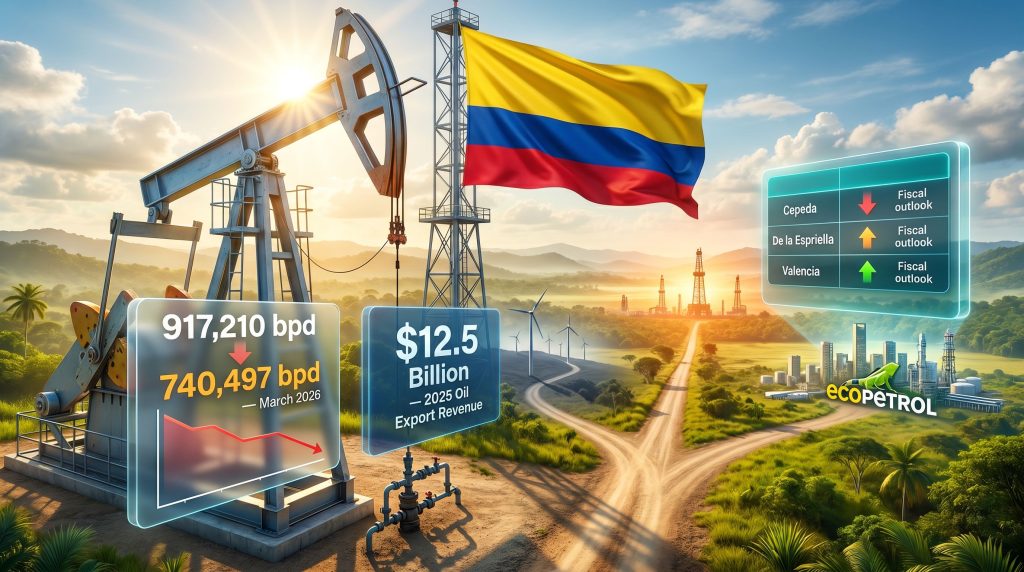
Understanding the severity of Colombia's energy predicament requires looking past political narratives and directly at production data. According to Colombia's National Hydrocarbon Agency (ANH), the country produced 740,497 barrels of oil per day in March 2026. That figure sits roughly 19.3% below the 917,210 barrels per day recorded during the same month a decade earlier.
| Metric | 2016 Level | March 2026 Level | Change |
|---|---|---|---|
| Oil Production (bpd) | ~917,210 | 740,497 | -19.3% |
| Natural Gas Output | Higher historical levels | ~700 million cubic feet/day | Near multi-decade lows |
| LNG Import Dependence | Minimal | >20% of domestic consumption | Structural shift |
| Oil Export Revenue | Higher baseline | $12.5 billion (2025) | Declining trend |
Source: Colombia's National Hydrocarbon Agency (ANH) and national trade statistics (DANE)
Natural gas paints an equally troubling picture. ANH data confirms that March 2026 domestic gas output of approximately 700 million cubic feet per day sits at the lowest levels recorded in decades. What is particularly striking is that this figure arrived despite a marginal month-on-month uptick, suggesting the underlying decline curve remains firmly intact.
Hydrocarbons remain Colombia's single largest export category, generating $12.5 billion in revenue during 2025 according to national trade data from DANE. This is not a peripheral industry facing a managed wind-down. It is the primary engine of foreign exchange earnings in a fiscally fragile, debt-laden economy where annualised inflation reached 5.68% in April 2026. The convergence of declining production, rising import costs, and domestic price pressure creates a compounding vulnerability that the 2026 election must directly address.
How a Series of Policy Decisions Dismantled a Production Base
The Regulatory Architecture of Decline
The production decline visible in ANH statistics is not a geological inevitability. It is, to a significant degree, the product of deliberate regulatory choices made after 2022. Three policy interventions stand out as primary drivers:
-
A moratorium on new exploration and production contracts removed the primary mechanism through which Colombia's reserve base is refreshed. Without new acreage entering the development pipeline, existing fields decline and no new supply enters the queue.
-
Significant increases in hydrocarbon taxation eroded the marginal economics of many producing fields, particularly smaller and mid-tier assets that require stable fiscal terms to justify continued capital expenditure.
-
Legislative and judicial efforts to prohibit hydraulic fracturing closed off access to Colombia's unconventional resource base, including potentially significant deposits in the Magdalena Medio basin that many industry analysts regard as the most credible pathway to long-term reserve replacement.
The cumulative effect of these measures accelerated the withdrawal of international energy companies from Colombia's upstream sector. The departure of major operators removed not just capital but institutional knowledge, technical capacity, and the exploration discipline that historically underpinned Colombia's production growth cycles.
The Natural Gas Emergency
Within the broader hydrocarbon decline, the natural gas situation carries the most immediate risk to Colombia's economic stability and energy security.
A decade ago, Colombia operated with a comfortable degree of gas self-sufficiency, with domestic production broadly matching national demand. That balance began deteriorating as output fell and demand grew, forcing Bogotá to begin importing liquefied natural gas in December 2016, according to ANH records. What started as a supplemental supply measure has evolved into structural dependence: imported LNG now accounts for more than one-fifth of total national gas consumption.
With proven natural gas reserves standing at approximately one trillion cubic feet, the trajectory of domestic supply looks challenging without significant new exploration and development activity. The reserves-to-production ratio implied by these figures provides limited runway at current consumption levels.
Colombia's deepening reliance on imported LNG transforms what was once a manageable domestic supply challenge into a live geopolitical vulnerability. Any sustained disruption to international LNG supply routes, including scenarios involving the Strait of Hormuz, carries direct implications for Colombia's electricity grid stability and industrial output.
The Hormuz dimension is not theoretical. Global LNG markets are already navigating significant supply chain volatility, and the LNG supply outlook for 2025 and beyond signals continued pressure. Colombia's growing import dependency means that disruptions affecting major LNG exporters now transmit directly into Colombian energy costs and grid reliability.
Three Electoral Scenarios for Colombia's Oil Industry
Scenario One: Policy Continuity Under Iván Cepeda
Cepeda, the candidate most closely associated with the ideological continuity of the current administration, has articulated a vision centred on deepening Colombia's energy transition rather than reversing it. At a campaign rally held in Barrancabermeja in April 2026, a city that sits at the symbolic heart of Colombia's petroleum industry, Cepeda communicated that Colombia's energy future should involve diversifying away from hydrocarbon dependence.
He has also indicated that an agricultural transformation, rather than resource extraction, represents the economic model he intends to pursue. In public statements made in early May 2025, Cepeda characterised extractive industries as a model that has run its course and outlined his intention to reposition agriculture as Colombia's principal economic engine.
Projected outcomes under Scenario One:
- Oil and gas production continues its multi-year structural decline
- Foreign direct investment in the upstream sector remains suppressed or falls further
- LNG import dependency deepens, increasing Colombia's exposure to global commodity price volatility
- Remaining international operators reduce capital expenditure or exit entirely
- Renewable energy development accelerates, but cannot compensate for near-term hydrocarbon revenue losses at the pace required to stabilise fiscal accounts
Scenario Two: Pro-Extraction Realignment Under Abelardo de la Espriella
De la Espriella, currently polling in second place, has positioned energy sovereignty as a core national security and economic priority. His platform explicitly includes the resumption of new exploration and production contract awards, the direct inversion of the moratorium that has constrained Colombia's upstream development pipeline since 2022.
He also supports the legalisation and commercial deployment of hydraulic fracturing, a position that places him in direct conflict with a moratorium upheld by Colombia's highest court. Overcoming this barrier would require navigating significant judicial and legislative processes regardless of executive intent. His broader economic ambitions include 7% annual GDP growth, with a revitalised energy sector serving as a key structural contributor.
De la Espriella's security agenda is equally relevant to the energy sector. Plans to militarise conflict-affected regions and end the current peace negotiation framework with non-state armed groups carry direct implications for upstream operators whose facilities are located in remote areas historically subject to disruption. According to analysts at S&P Global, a right-wing presidential win could meaningfully unlock Colombia's oil and gas sector.
Projected outcomes under Scenario Two:
- Near-term improvement in investor sentiment and potential re-engagement from international energy companies
- New exploration contracts could begin reversing long-term decline, though with a multi-year production lag
- Fracking expansion remains subject to significant legal and community consultation barriers
- Improved security conditions reduce operational risk across the upstream sector
Scenario Three: Centre-Right Restoration Under Paloma Valencia
Valencia represents the most direct continuity with the regulatory and investment framework that characterised Colombia's most productive hydrocarbon era. It was during the presidency of Álvaro Uribe between 2002 and 2010 that Ecopetrol was restructured and listed on the New York Stock Exchange, a transformation that catalysed a sustained period of production growth and attracted significant foreign capital into Colombia's upstream sector.
Valencia has set an explicit production target of one million barrels per day, a threshold long identified by fiscal analysts as the volume at which Colombia's hydrocarbon revenues can support a balanced national budget. She supports hydraulic fracturing conducted within an environmentally responsible framework, and her vice-presidential candidate Juan Daniel Oviedo has publicly committed to reactivating fossil fuel exploitation while pursuing fracking with both environmental responsibility and technological innovation, according to an interview published by El País.
Her security commitments mirror De la Espriella's in scale, with plans for 30,000 additional police officers and 30,000 new military personnel specifically oriented toward securing the remote regions where energy infrastructure operates.
Projected outcomes under Scenario Three:
- Restoration of a stable, predictable regulatory environment most capable of attracting sustained foreign direct investment
- A credible medium-term pathway toward the one million bpd production target
- Ecopetrol positioned for renewed strategic investment
- Energy security improvements enabling Colombia to pursue electricity-intensive economic opportunities, including data centre development and AI infrastructure
- Gradual reduction in LNG import dependency as domestic gas production stabilises
Fiscal Risk: Why Production Volume Is a Budget Issue, Not Just an Energy Issue
The connection between Colombia's hydrocarbon production levels and its fiscal stability is not indirect. It is structural. The national budget has historically been calibrated around oil and gas export revenues, making production volumes a direct determinant of fiscal capacity.
| Scenario | Production Trajectory | Fiscal Revenue Outlook | LNG Import Cost Trend | Investment Climate |
|---|---|---|---|---|
| Cepeda (Continuity) | Continued decline | Deteriorating | Worsening | Suppressed |
| De la Espriella (Pro-Extraction) | Recovery potential | Improving (medium-term) | Stabilising | Improving |
| Valencia (Centre-Right Restoration) | Recovery targeting 1M bpd | Strengthening | Improving | Most favourable |
The gap between current output of approximately 740,000 bpd and the one million bpd fiscal breakeven represents a revenue shortfall that constrains public spending across every policy domain. For a debt-laden economy already contending with 5.68% annualised inflation, the margin for further revenue compression without triggering a broader fiscal crisis is narrow. Furthermore, broader global recession risks could amplify these pressures if global recession risks materialise alongside falling commodity prices.
The Fracking Question: More Than a Technical Debate
Hydraulic fracturing has become a proxy battle in Colombia's energy debate that transcends the technical question of extraction methodology. The regulatory, judicial, and social dimensions of the fracking issue reveal the deeper tensions between different visions of Colombia's economic development trajectory.
Colombia's constitutional court has maintained a moratorium on fracking, meaning that even under a strongly pro-fracking administration, the pathway to commercial operations involves multiple sequential barriers:
- Legislative reform or executive action to challenge the existing moratorium
- Judicial review and potential Supreme Court consideration
- Community consultation processes mandated under Colombian constitutional law
- Environmental impact assessment and permitting procedures
- Infrastructure development and operator procurement
Industry analysis suggests that even under optimistic regulatory conditions, the minimum timeline from policy change to first commercial fracking output is three to five years. This lag is critical for investors and policymakers evaluating medium-term production scenarios.
Colombia's unconventional resource base, particularly in the Magdalena Medio basin, is considered by many upstream analysts to hold material potential for extending the country's hydrocarbon production horizon beyond what conventional field development alone can deliver. The question is whether the political and judicial conditions for unlocking those resources can be created within a timeframe that is relevant to Colombia's current fiscal pressures.
The next major ASX story will hit our subscribers first
Colombia in Regional Context: Argentina, Venezuela, and the Latin American Lesson
Colombia's energy crossroads reflects a broader regional tension between transition ambitions and fiscal necessity. Two regional case studies are instructive.
Argentina's Vaca Muerta development demonstrates that a supportive regulatory framework, combined with sustained foreign investment and unconventional extraction technology, can deliver significant production growth and export revenue even from a starting position of fiscal difficulty. The Argentina resource investment trends further illustrate how pro-investment regulatory environments can reshape a country's energy and commodity trajectory.
Venezuela's energy crisis, driven by policy mismanagement and investment withdrawal over multiple decades, provides the counterpoint. A resource-dependent economy that allows its hydrocarbon sector to deteriorate beyond a recovery threshold faces generational economic consequences that no transition agenda can quickly reverse.
Colombia sits at a decision point between these two trajectories. The Colombia oil industry election will determine which pathway the country begins to travel down, with consequences that will extend well beyond a single presidential term. Consequently, the geopolitical mining landscape across Latin America could also shift depending on which governance model Colombia ultimately adopts, as outlined in analyses of the broader geopolitical mining landscape.
FAQ: Colombia Oil Industry and the 2026 Election
What is Colombia's current oil production level?
As of March 2026, Colombia was producing approximately 740,497 barrels of oil per day, according to ANH data, compared to roughly 917,210 barrels per day recorded in the same month a decade earlier.
Why has Colombia's oil production declined so significantly?
The decline reflects a combination of a moratorium on new exploration and production contracts, substantial increases in hydrocarbon taxation, legal restrictions on fracking, and the resulting withdrawal of international investment from the upstream sector. As OilPrice.com reports, the Colombia oil industry election in 2026 represents a defining moment for the sector's long-term direction.
How dependent is Colombia on LNG imports?
Colombia began importing LNG in December 2016 and now relies on imports for more than 20% of its natural gas consumption. Proven reserves stand at approximately one trillion cubic feet, highlighting the urgency of new exploration activity.
What is the significance of the one million barrels per day target?
One million barrels per day is widely identified as Colombia's fiscal breakeven production threshold, the volume at which hydrocarbon export revenues can support a balanced national budget. Current production at approximately 740,000 bpd represents a material shortfall from this target.
Could fracking actually be deployed quickly under a pro-extraction government?
Even under a supportive administration, commercial fracking in Colombia would require overcoming a constitutional court moratorium, legislative reform, judicial review, community consultation, and environmental permitting. Most industry assessments suggest a minimum of three to five years from policy change to first production output.
Disclaimer: This article is for informational purposes only and does not constitute financial or investment advice. Projections and scenario analyses represent analytical frameworks based on publicly available data and are subject to change. Investors should conduct independent research before making any investment decisions.
Want to Stay Ahead of the Next Major Resource Discovery?
While Colombia's energy future hangs in the balance of its 2026 election, Discovery Alert's proprietary Discovery IQ model scans ASX announcements in real time, instantly identifying significant mineral discoveries across more than 30 commodities and delivering actionable alerts directly to subscribers — explore historic discovery returns on the Discovery Alert discoveries page to see why being first matters, then begin your 14-day free trial at Discovery Alert to secure your edge in the market.