May 23, 2026
Constitutional Framework Strengthens State Lithium Control
Mexico's Supreme Court validates lithium reform through decisive constitutional validation, rejecting five separate legal challenges and establishing clear precedent for state resource control. The March 25, 2026 ruling upheld Articles 1, 5 bis, and 10 of Mexico's Mining Law, which reserve lithium exploration, exploitation, processing, and utilisation exclusively to state entities while prohibiting private concessions entirely.
The constitutional challenge, filed by a minority coalition of legislators, argued that the reform violated established mining frameworks, undermined legal certainty principles, and failed to meet indigenous consultation requirements. However, the Supreme Court determined that prior consultation with indigenous and Afro-Mexican communities was not constitutionally required for general legislative reforms, distinguishing between broad policy changes and project-specific implementations that directly impact community rights.
| Constitutional Article | Legal Function | Operational Impact |
|---|---|---|
| Article 1 Reform | Establishes lithium strategic classification | Enables exclusive state control framework |
| Article 5 bis Implementation | Prohibits private concessions | Eliminates foreign direct investment pathways |
| Article 10 Enforcement | Creates mining reserve designation | Centralises development through LitioMx |
The justices affirmed that lithium's strategic mineral classification complies with constitutional legality and certainty principles, provided implementation follows established Mining Law procedures requiring technical justification and Mexican Geological Survey validation. This regulatory framework creates structured pathways for project approval while maintaining centralised state authority over critical mineral resources.
Regional Resource Sovereignty Models
Mexico's constitutional approach parallels broader Latin American resource nationalism trends, though implementation strategies vary significantly across jurisdictions. Bolivia maintains full state control through Yacimientos de Litio Bolivianos since 2008, despite experiencing substantial development delays and limited commercial production. Furthermore, Chile operates mixed public-private partnerships through CORFO participation alongside private operators like SQM and Antofagasta Minerals, balancing state involvement with operational efficiency.
Indonesia's 2014 nickel export ban demonstrates how constitutional strategic classification can reshape global supply chains, forcing downstream processing investments while securing domestic value addition. Similar approaches across copper in Chile and cobalt in the Democratic Republic of Congo indicate accelerating governmental priority for resource sovereignty over export revenue maximisation. These trends align with the broader critical minerals energy transition movement globally.
When big ASX news breaks, our subscribers know first
LitioMx Budget Constraints Limit Operational Capacity
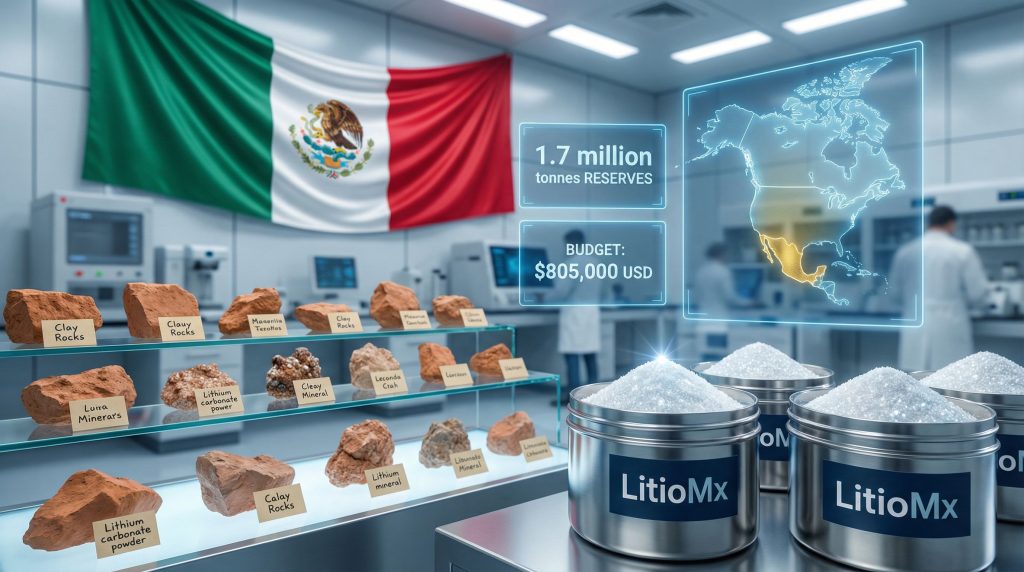
Mexico's state lithium entity faces significant financial limitations despite legal framework validation. LitioMx's 2026 budget allocation of MX$13.9 million (US$805,000) represents a 7.7% increase from 2025's MX$12.9 million allocation, yet covers only operational expenses without including exploration capital, pilot facility development, or commercial production infrastructure.
The budget progression reveals concerning resource constraints: 2024 received MX$9.8 million, followed by 27.3% growth to 2025 levels, then moderate expansion to current allocations. Industry experts highlight fundamental disconnects between budget availability and typical lithium project development requirements, which often demand multi-million dollar investments across exploration, resource estimation, technical validation, and pilot operations phases.
Mexico's Lithium Resource Distribution:
- Total identified reserves: 1.7 million tonnes lithium carbonate equivalent
- Geographic distribution: 82 deposits across 18 Mexican states
- Leading regions: Sonora (13 deposits), Puebla (12 deposits), Oaxaca (9 deposits)
- Deposit characteristics: Predominantly clay-hosted lithium requiring advanced processing
| Country | 2026 Production Estimate | Development Model | Market Position |
|---|---|---|---|
| Australia | 180,000t LCE | Private concessions | Global leader |
| Chile | 160,000t LCE | Mixed partnerships | Established player |
| China | 140,000t LCE | State-dominated processing | Supply chain control |
| Mexico | <5,000t LCE | Exclusive state control | Pre-commercial |
Current global lithium market dynamics intensify pressure on Mexico's development timeline. S&P Global Energy CERA projects 2026 consumption rising 13.5% to 1.48 million tonnes LCE while production increases only 9.9% to 1.58 million tonnes LCE. This supply-demand convergence reduces projected surplus from 141,000 tonnes in 2025 to 109,000 tonnes in 2026, creating tighter market conditions that favour established producers over emerging participants.
Industry Expertise Challenges
Rubén del Pozo, President of AIMMGM (Mexican Mining Association), emphasises that lithium development requires sequential investment phases extending beyond initial exploration. Modern lithium projects demand comprehensive geological assessment, detailed resource estimation, metallurgical testing, pilot facility construction, and commercial production scaling across multi-year timelines with cumulative capital requirements typically exceeding hundreds of millions of dollars.
Clay-hosted lithium deposits present additional technical complexity compared to conventional brine or hard-rock operations. President Claudia Sheinbaum acknowledges these challenges, noting that Mexican lithium exists primarily in clay form requiring sophisticated processing technology and significantly higher capital intensity than traditional extraction methods. This complexity contrasts sharply with insights from Argentina lithium insights where brine operations dominate.
Clay Processing Technology Requirements
Mexican lithium deposits demand specialised extraction technologies due to their clay-hosted geological characteristics. Unlike conventional brine operations utilising evaporation ponds or hard-rock spodumene processing, clay lithium extraction requires advanced chemical separation, beneficiation processes, and higher energy inputs throughout the production cycle.
Clay Lithium Processing Methodology:
- Stage 1: Flotation or acid leaching for mineral concentration
- Stage 2: Chemical separation through sulphuric acid treatment
- Stage 3: Purification and crystallisation for product specification
- Stage 4: Quality control and logistics for market delivery
Current commercial deployment of clay lithium technology remains limited globally, with pilot facilities operating in Argentina and exploratory projects elsewhere. Cost structures for clay processing can exceed $15,000 per tonne lithium carbonate equivalent compared to $5,000-8,000 for traditional brine operations, creating fundamental economic challenges for state-funded development models prioritising domestic resource control over profit optimisation.
PEMEX Collaboration Opportunities
Mexico's national petroleum company explores lithium extraction from oilfield brines as part of its 2025-2030 Strategic Plan, potentially creating synergies with LitioMx operations. PEMEX CEO Victor Rodríguez disclosed lithium concentrations comparable to Bolivian deposits across drilling sites in five Mexican states, suggesting viable co-production opportunities integrating existing petroleum infrastructure.
"Petrolithium" Development Concept:
- Utilisation of existing wellheads and collection systems
- Integration with petroleum operations for cost efficiency
- Potential PEMEX Lithium subsidiary establishment
- Collaboration framework with LitioMx for technology sharing
Direct lithium extraction technologies offer accelerated deployment pathways compared to traditional evaporation methods. DLE systems utilise sorbent-based or membrane-based separation technologies, reducing water consumption, land requirements, and extraction timelines while maintaining modular scalability for varied production volumes.
| Technology Type | Advantages | Implementation Challenges | Cost Structure |
|---|---|---|---|
| Sorbent-based DLE | Reduced water use | Technology maturity gaps | High capital intensity |
| Membrane DLE | Faster extraction | Energy requirements | 20-30% lower operational costs |
| Traditional evaporation | Proven technology | Water intensive | Lower capital, higher operational |
Global Supply Chain Integration Challenges
Mexico's lithium strategy unfolds within tightening global supply conditions driven by accelerating energy transition demand. Battery energy storage system installations are projected to expand 7.7% in 2026, reaching 301 GWh of new capacity, while global plug-in hybrid electric vehicle sales target 22.77 million units representing 16.8% growth from 2025 levels.
Heavy-duty electric truck adoption demonstrates rapid market transformation, with Chinese sales increasing 190.6% through November 2025 and global new energy heavy truck market share expected to exceed 30% by 2026. These demand drivers create sustained pressure on lithium supply chains, particularly impacting countries unable to rapidly scale production capacity.
Critical Supply Chain Dependencies:
- China controls majority of processed lithium and lithium chemicals
- Australia, Chile, and Argentina supply approximately 94% of battery-grade lithium
- Processing capacity concentration creates supply chain vulnerability
- Geographic diversification becomes strategic priority for consuming nations
Mexico's position within the USMCA trade framework offers potential advantages for North American supply chain integration, particularly as governments prioritise critical mineral security and domestic processing capabilities. However, current production timelines and technical challenges limit immediate contribution to regional supply chain resilience. This context reflects broader patterns in the mining industry evolution toward strategic resource control.
Investment Pattern Transformation
Constitutional validation creates distinct investment landscape changes affecting both domestic and international capital allocation strategies. Traditional mining concession models become unavailable, while technology licensing, equipment supply, and downstream processing partnerships emerge as alternative engagement mechanisms.
Restricted Investment Categories:
- Private lithium exploration and extraction concessions
- Foreign direct investment in primary production
- Traditional joint venture mining partnerships
- Export-oriented extraction operations
Emerging Opportunity Frameworks:
- Technology transfer agreements for clay processing
- Infrastructure and equipment supply contracts
- Downstream battery manufacturing collaborations
- Research and development partnerships with Mexican institutions
Market Psychology and Resource Nationalism
Global investment sentiment increasingly reflects concerns over critical mineral access and supply chain security. Supreme Court validates lithium reform decisions align with broader governmental trends prioritising resource sovereignty over foreign investment attraction, potentially influencing similar policy decisions across other mineral-rich jurisdictions.
Armando Alatorre, Vice President of CIMMGM, emphasises competitive timing pressures facing Mexico's development strategy. International automotive manufacturers increasingly secure direct supply agreements with established lithium producers, potentially leaving Mexico outside primary supply chain considerations during critical market expansion phases.
Strategic Consideration: While Mexico focuses on establishing state control frameworks, global automotive and battery industries advance supply chain integration with existing producers, creating potential market access challenges for delayed entrants regardless of resource quality or quantity.
Risk Assessment Matrix:
| Risk Factor | Probability | Impact Severity | Mitigation Options |
|---|---|---|---|
| Execution delays | High | Medium | International partnerships |
| Budget limitations | Very High | High | Private technology collaboration |
| Technical challenges | High | High | External expertise integration |
| Market timing | Medium | High | USMCA preference utilisation |
Geopolitical Context and Trade Implications
Rising protectionism and critical mineral security initiatives provide strategic backdrop for Mexico's nationalisation decision. United States critical mineral policies, European Union raw materials strategies, and Chinese export controls create complex trade environment favouring domestic resource development and regional supply chain integration.
President Sheinbaum frames lithium access within broader critical mineral criticality, emphasising renewable energy technology dependencies across batteries, wind turbines, photovoltaic panels, and electric vehicles. This perspective aligns with international strategic mineral classification trends as governments recognise resource access as fundamental to energy transition and economic competitiveness. Meanwhile, recent European regulatory challenges highlight the complexity of balancing legal frameworks with development objectives.
Regional Trade Advantage Potential:
- USMCA preferential treatment for Mexican lithium
- Reduced dependence on Asian processing networks
- Enhanced North American supply chain resilience
- Potential leverage in international trade negotiations
Development Timeline Scenarios and Production Projections
Multiple pathway scenarios exist for Mexican lithium sector development, each characterised by distinct timelines, investment requirements, and production potential. Scenario modelling reveals critical decision points affecting long-term sector viability and international competitiveness.
Accelerated Development Pathway (2027-2030):
- International technology partnerships established by 2027
- PEMEX brine extraction operations commence 2028
- First commercial clay processing facility operational 2029
- Annual production target: 15,000-25,000 tonnes LCE by 2030
Moderate Development Pathway (2028-2032):
- Gradual capacity building without extensive international collaboration
- Limited private sector technology integration
- Domestic market prioritisation over export development
- Annual production estimate: 5,000-15,000 tonnes LCE by 2032
Constrained Development Pathway (2030+):
- Persistent budget limitations restrict project advancement
- Technical challenges remain unresolved without external expertise
- Minimal commercial production achievement
- Annual production ceiling: <5,000 tonnes LCE beyond 2030
Indigenous Community Consultation Framework
While the Supreme Court validates lithium reform and determined that general legislative consultation was not constitutionally required, project-specific lithium development will likely require comprehensive community engagement protocols. The ruling specified inclusion of Afro-Mexican communities alongside indigenous groups, establishing broader consultation requirements for future extraction operations.
Community Engagement Requirements:
- Project-level consultation for specific extraction sites
- Human rights impact assessment protocols
- Environmental protection standards coordination
- Social licence to operate establishment across 18 affected states
Implementation considerations include multiple community jurisdictions across identified deposit locations, coordination between federal and state authorities, and integration of environmental assessment procedures with social consultation requirements.
The next major ASX story will hit our subscribers first
Energy Transition and Critical Mineral Security
Mexico's constitutional lithium strategy represents broader themes connecting resource sovereignty, energy transition financing, and supply chain security. The decision's global significance extends beyond immediate production implications to influence policy frameworks in other resource-rich nations evaluating state control versus private investment trade-offs.
Global Energy Transition Implications:
- North American battery supply chain integration potential
- Electric vehicle manufacturing cost structure effects
- Renewable energy storage capacity planning
- Critical mineral availability for decarbonisation targets
Resource Governance Model Testing:
- State efficiency versus private sector optimisation
- Environmental protection integration with production targets
- Indigenous rights incorporation within development frameworks
- International cooperation balance with domestic prioritisation
The constitutional validation establishes Mexico as a test case for state-led critical mineral development within accelerating global energy transition demands. Success or failure in achieving commercial production targets will influence similar policy decisions across other mineral-rich jurisdictions evaluating resource nationalism strategies. This development occurs alongside broader changes in battery metals investment patterns globally.
This strategic positioning creates both opportunities and constraints for international investors, technology providers, and consuming nations seeking supply chain diversification. Mexico's execution of state-controlled lithium development over the next decade will provide valuable insights into alternative models for critical mineral security in an increasingly competitive global landscape.
Disclaimer: This analysis contains forward-looking projections and market assessments based on current information. Lithium market dynamics, technological developments, and policy changes may significantly affect actual outcomes. Investors should conduct independent due diligence before making investment decisions related to Mexican lithium sector developments or related supply chain opportunities.
Ready to Capitalise on Critical Mineral Market Shifts?
Discovery Alert's proprietary Discovery IQ model delivers instant notifications on significant ASX mineral discoveries across lithium, copper, and other critical commodities, empowering investors to identify actionable opportunities ahead of broader market awareness. Explore how major mineral discoveries can generate substantial returns by visiting Discovery Alert's discoveries page and begin your 14-day free trial today to position yourself strategically as global resource dynamics continue evolving.