
May 23, 2026
The Global Shift Toward Critical Mineral Security and African Phosphate Production
The global agricultural system faces unprecedented pressure from converging forces: population growth demanding increased food production, climate change disrupting traditional farming patterns, and supply chain vulnerabilities exposed by geopolitical tensions. Within this complex landscape, phosphate rock emerges as a critical component of modern agriculture, essential for phosphorus-based fertilizers that sustain global food security. Understanding how emerging African phosphate operations achieve production milestones provides insight into broader trends reshaping international commodity markets and resource security strategies.
When big ASX news breaks, our subscribers know first
Strategic Context of Phosphate Production Records
Why Monthly Production Milestones Matter in Critical Mineral Markets
Monthly production records in phosphate concentrate manufacturing serve as crucial indicators of operational maturity and technical risk mitigation. When mining operations achieve successive production milestones during trial phases, they demonstrate several critical capabilities that institutional investors and industry analysts monitor closely.
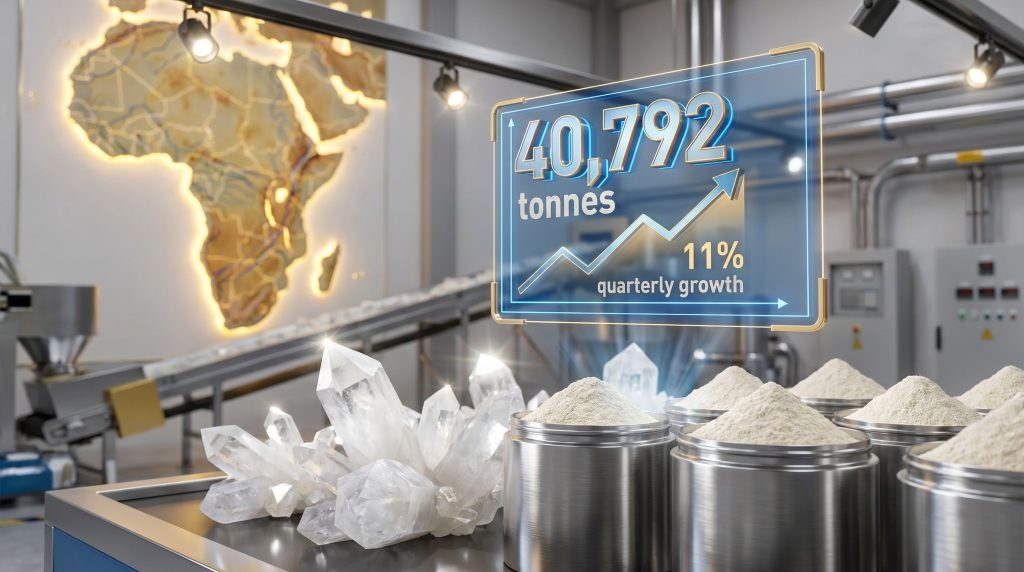
The consistency of output reveals process optimisation effectiveness. Kropz's South African project monthly production record of 40,792 tonnes in March 2026 represents more than just operational achievement. This figure, representing a 19.8% increase from the September 2025 baseline of 34,070 tonnes, indicates systematic improvement in production processes over a six-month period.
Key Performance Indicators for Phosphate Operations:
• Equipment uptime and utilisation rates
• Beneficiation circuit recovery efficiency (typically 60-85% for phosphate concentrate)
• Concentrate grade consistency (P₂O₅ content usually 30-32% for market specifications)
• Throughput optimisation measuring tonnes processed per operational day
• Product quality compliance with customer specifications
Trial production phases typically span 12-24 months in phosphate mining operations. During this period, operators focus on process parameter optimisation, equipment commissioning validation, and workforce competency development. The achievement of five consecutive monthly records during the final six months of a financial year suggests successful transition from development uncertainty toward commercial viability.
Furthermore, operational risk assessment reveals that production consistency during trial phases reduces technical risk premiums in project valuations. Successive monthly records demonstrate that engineering designs function at scale and that process assumptions translate into practical operations.
Global Phosphate Market Dynamics and Supply Security
The international phosphate market exhibits significant geographic concentration that creates strategic vulnerabilities for importing nations. According to the U.S. Geological Survey's 2024 Mineral Commodity Summaries, global phosphate rock production reached 212 million tonnes in 2023, with Morocco controlling approximately 35% of global output.
Global Phosphate Production Distribution:
| Country/Region | Production Share | Strategic Considerations |
|---|---|---|
| Morocco | ~35% | Concentrated in disputed Western Sahara territory |
| China | ~14% | Domestic consumption priority, export restrictions |
| United States | ~6% | Declining reserve base, increasing imports |
| Russia | ~5% | Geopolitical supply chain risks |
| Sub-Saharan Africa | <5% | Emerging production potential |
This concentration pattern creates supply chain vulnerabilities, particularly given that Morocco's largest operations occur in the disputed Western Sahara territory under complex international legal frameworks. In addition, China, the second-largest producer, increasingly prioritises domestic consumption over exports, implementing periodic export restrictions to secure domestic fertilizer supplies.
African phosphate development outside North Africa offers geographic diversification benefits. South African operations like the Elandsfontein project provide politically stable alternatives within established mining jurisdictions. However, the global mining landscape demonstrates that Congo-Brazzaville's potential, despite technical challenges, represents additional supply chain resilience opportunities.
The fertilizer supply chain complexity extends beyond primary phosphate rock extraction. Downstream processing requires phosphoric acid production facilities, typically located near deepwater ports for efficient bulk commodity logistics. Consequently, African producers must consider not only mining operations but also processing infrastructure and export capability development.
Production Performance Analysis and Industry Benchmarking
Benchmarking 40,792 Tonnes Against Industry Standards
The March 2026 production achievement at Kropz's Elandsfontein project provides quantitative data for assessing operational performance within industry context. The 40,792-tonne monthly output translates to an annualised run-rate of approximately 490,000 tonnes, positioning the operation within the mid-scale producer category.
Elandsfontein Production Trajectory Analysis:
| Period | Monthly Output (tonnes) | Growth Rate | Operational Phase |
|---|---|---|---|
| September 2025 | 34,070 | Baseline record | Trial production |
| Q4 FY2026 Average | 38,562 | 13.2% increase | Trial production |
| March 2026 Peak | 40,792 | 19.8% vs baseline | Trial production |
| Q4 Sales Volume | 104,900 | 104.9% of production | Revenue generation |
The quarterly production total of 115,686 tonnes represents an 11% increase from the previous quarter, demonstrating sustained operational improvement rather than isolated monthly performance. This growth pattern during trial production suggests systematic process optimisation and equipment performance stabilisation.
Sales volumes of 104,900 tonnes during Q4 FY2026 indicate strong market demand absorption and successful product quality compliance. The sales-to-production ratio of approximately 91% reflects typical industry patterns where some production remains in inventory for quality assurance and logistics optimisation.
Operational Excellence Indicators:
• Consistency: Five production records achieved in final six months demonstrates process reliability
• Growth Trajectory: Month-over-month improvements indicate ongoing optimisation effectiveness
• Market Access: Sales volumes matching production levels confirm product acceptance
• Scalability: Trial phase performance suggests commercial operation readiness
Technical Factors Driving Production Optimisation
Phosphate concentrate production optimisation involves multiple technical systems working in coordination. The beneficiation process typically includes comminution (crushing and grinding), flotation separation, and dewatering to achieve marketable concentrate specifications.
Process Optimisation Components:
-
Comminution Circuit Efficiency
- Optimal crusher feed size distribution
- Grinding media management and wear monitoring
- Energy consumption per tonne optimisation
-
Beneficiation Performance
- Flotation reagent dosing optimisation
- Recovery rate maximisation (target 75-85% phosphate recovery)
- Grade consistency achieving P₂O₅ specifications
-
Quality Assurance Systems
- Real-time grade monitoring and process control
- Impurity management (silica, iron, acid insoluble content)
- Product blending for specification compliance
The iterative improvement demonstrated at Elandsfontein—from 34,070 tonnes in September 2025 to 40,792 tonnes in March 2026—typically reflects systematic equipment parameter adjustment, operator skill development, and process control enhancement. Such improvements during trial production validate engineering design assumptions and demonstrate operational team competency.
Water management represents a critical technical factor, particularly relevant given the challenges addressed at Kropz's Congo project. Comprehensive stress testing and optimisation initiatives significantly reduced water-related risks, transforming what management previously considered material constraints into manageable operational parameters.
Investment Implications and Market Valuation Dynamics
Market Valuation Implications of Operational Milestones
Production record achievement during trial phases provides institutional investors with quantifiable risk reduction metrics. For instance, Kropz, listed on the AIM (Alternative Investment Market) of the London Stock Exchange, operational milestones serve multiple valuation functions.
Risk Assessment Framework:
• Technical Risk Mitigation: Demonstrated production consistency reduces engineering execution uncertainty
• Operational Capability Validation: Process optimisation success indicates management competency
• Financial Performance Indicators: Sales volumes provide cash flow generation visibility
• Commercial Viability Confirmation: Market acceptance validates product quality and demand assumptions
AIM-listed mining companies typically experience enhanced institutional interest following production milestone achievement. The reduction in technical risk premium allows for more favourable debt financing terms and potentially improved equity valuations as operations transition from development toward commercial production phases.
Comparative Analysis: Trial Production vs Commercial Operations
The distinction between trial and commercial production phases carries significant implications for investors, regulators, and market participants. Understanding this transition provides context for evaluating operational achievements and future performance expectations.
Phase Comparison Matrix:
| Operational Aspect | Trial Production | Commercial Operations |
|---|---|---|
| Regulatory Status | Pilot permits with limited scope | Full production authorisation |
| Production Targets | Variable (20-100% nameplate) | Sustained nameplate capacity |
| Revenue Recognition | May be restricted or provisional | Full profit and loss impact |
| Capital Investment | Optimisation and commissioning | Maintenance and expansion focus |
| Market Perception | De-risking advancement | Operational maturity indicator |
| Timeline Duration | 12-36 months typical | Ongoing production lifecycle |
Trial production success typically requires demonstration of sustained output at 75% or higher of nameplate capacity, consistent product quality compliance, and environmental management system effectiveness. Commercial operation transition involves regulatory approval processes and often triggers covenant compliance requirements for project financing.
Economic Implications for Food Security and Regional Development
Food Security and Agricultural Input Supply Chains
Phosphate production capacity directly impacts global food security through fertiliser availability and pricing. The Food and Agriculture Organisation estimates that fertilisers contribute to approximately 40-60% of crop yield increases achieved since the mid-20th century, with phosphorus being non-substitutable in biological processes.
African Agricultural Development Context:
• Sub-Saharan Africa imports approximately 70% of its fertiliser requirements
• Transport costs add 25-50% to fertiliser prices in landlocked African nations
• Local phosphate production offers import substitution benefits
• Regional processing facilities could serve multiple African markets
The development of African phosphate production capacity, exemplified by operations like Elandsfontein, contributes to regional food security through reduced dependence on concentrated international suppliers. Furthermore, critical minerals energy security considerations highlight how geographic diversification of phosphate supply sources enhances global agricultural resilience against geopolitical disruptions.
Regional value chain development opportunities extend beyond primary phosphate concentrate production. Downstream processing facilities for phosphoric acid and compound fertiliser manufacturing could capture additional value while serving regional agricultural markets. This integration potential makes successful trial production particularly significant for long-term economic development.
Infrastructure and Logistics Considerations
Bulk commodity operations require substantial infrastructure investment and coordination. Phosphate concentrate transport typically involves rail networks, port facilities, and specialised handling equipment designed for consistent product quality maintenance.
Critical Infrastructure Requirements:
| Infrastructure Component | Operational Requirements | Strategic Importance |
|---|---|---|
| Rail Connectivity | Heavy haul capability for bulk transport | Cost-effective inland transport |
| Port Facilities | Deep water berths, bulk handling equipment | International market access |
| Power Supply | Reliable electricity for continuous processing | Operational consistency |
| Water Management | Process water, environmental compliance | Sustainable operations |
| Skilled Workforce | Technical expertise, safety training | Operational effectiveness |
South Africa's existing mining infrastructure provides advantages for operations like Elandsfontein, including established rail networks to deepwater ports and existing mining services sectors. Congo-Brazzaville's Hinda project faces different infrastructure challenges, requiring potentially greater capital investment for logistics capability development.
The successful optimisation of water management systems at Hinda demonstrates how technical solutions can address infrastructure constraints. Transforming material operational risks into manageable parameters through engineering solutions enhances project economics and reduces operational uncertainty.
Water Management Solutions and Project Viability Enhancement
Technical Risk Mitigation in Complex Geological Environments
Water management represents one of the most critical technical challenges in phosphate mining operations. Underground water control, surface water management, and process water optimisation require integrated engineering solutions tailored to specific geological conditions.
Water Management Technical Components:
-
Surface Water Control
- Rainfall diversion and collection systems
- Sediment control and water treatment
- Environmental compliance monitoring
-
Underground Water Management
- Dewatering system design and operation
- Groundwater monitoring and protection
- Mine water treatment and disposal
-
Process Water Optimisation
- Water recycling and recovery systems
- Quality control for beneficiation circuits
- Waste water treatment and discharge
The comprehensive stress testing conducted at Kropz's Hinda project in Congo-Brazzaville resulted in significant risk reduction for both surface and underground water challenges. This technical achievement transforms project economics by reducing both capital and operational expenditure requirements while enhancing environmental compliance capability.
Project Economics and Profitability Optimisation
Water management optimisation contributes to project profitability through multiple mechanisms. Capital cost reduction occurs when engineering solutions eliminate the need for more expensive water control infrastructure. Operational cost benefits result from improved process efficiency and reduced regulatory compliance complexity.
Economic Impact Assessment:
• Capital Efficiency: Optimised water management reduces infrastructure investment requirements
• Operating Cost Reduction: Process efficiency improvements lower unit production costs
• Risk Mitigation: Environmental compliance reduces regulatory and legal risk exposure
• Production Reliability: Consistent water supply enables sustained operational performance
The transformation of water-related challenges from material constraints to manageable operational parameters represents substantial value creation. This engineering achievement enhances overall project profitability and reduces execution risk for potential investors and financing partners.
The next major ASX story will hit our subscribers first
Future African Mining Development and Strategic Implications
Regional Mining Sector Development Trends
African mining industry evolution exhibits increasing sophistication in technical execution, environmental management, and international market integration. The success demonstrated at operations like Elandsfontein provides templates for broader sector advancement.
Development Pattern Indicators:
• Technology transfer from established mining jurisdictions
• Local workforce capability development and training
• Environmental management system advancement
• Integration with international supply chains and markets
• Regulatory framework development supporting investment
The technical solutions implemented across projects like Elandsfontein and Hinda demonstrate how African operations increasingly address complex geological and engineering challenges. This capability development enhances the continent's position within global mining supply chains and attracts international investment.
Regional mining service sector development accompanies successful operations, creating multiplier effects for local economies. Technical expertise, specialised equipment, and support services developed for one operation often transfer to other projects, building regional capability clusters.
Strategic Implications for Critical Mineral Security
The development of African critical mineral production capacity contributes to global supply chain resilience and strategic resource security. Phosphate production diversification reduces dependence on geographically concentrated sources and enhances supply chain stability.
Strategic Security Assessment:
| Factor | Current Status | Future Potential | Timeline |
|---|---|---|---|
| Supply Diversification | Limited African capacity | Multiple projects advancing | 3-7 years |
| Processing Integration | Concentrate export focus | Regional value-added potential | 5-10 years |
| Infrastructure Development | Project-specific solutions | Regional corridor development | 7-15 years |
| Technology Capability | International expertise dependent | Local capacity building | 5-12 years |
African governments increasingly recognise critical mineral production as strategic economic development opportunity. Policy frameworks supporting mining investment, infrastructure development, and value chain integration create enabling environments for sector expansion.
The success of operations achieving production records during trial phases demonstrates that African mining projects can execute complex technical challenges while maintaining international quality standards. This operational competency enhances Africa's position within global critical mineral supply chains.
Investment Analysis and Market Outlook
Key Considerations for Stakeholders
The achievement of Kropz South African project monthly production record provides multiple stakeholder groups with valuable risk assessment information. For instance, investors benefit from operational consistency that demonstrates technical execution capability and reduces project development risk perceptions.
Stakeholder Impact Analysis:
• Equity Investors: Production milestones validate investment thesis and reduce technical risk premium
• Debt Providers: Operational track records improve covenant compliance confidence
• Offtake Partners: Product quality and delivery reliability reduce supply chain risks
• Regulatory Authorities: Successful trial production demonstrates operational competency
• Local Communities: Economic development benefits and employment generation
Market positioning within global phosphate supply chains requires consistent operational performance, product quality compliance, and reliable delivery capability. The demonstration of these characteristics during trial production phases establishes foundations for long-term commercial success.
Forward-Looking Market Dynamics
Global phosphate market development reflects broader trends toward supply chain diversification, regional processing capability development, and strategic resource security enhancement. However, the Ammaroo Phosphate Project and similar African producers achieving operational milestones participate in these structural market changes.
Market Evolution Indicators:
• Geographic diversification of phosphate supply sources
• Regional value chain development and processing integration
• Technology advancement in mining and beneficiation processes
• Environmental management system enhancement and sustainability focus
• Infrastructure development supporting bulk commodity logistics
The transition from trial to commercial production represents critical milestone achievement for African phosphate development. Successful operations like Elandsfontein provide demonstration effects that enhance investor confidence in broader African mining sector potential.
Long-term success requires sustained operational excellence, market development, and continuous technical improvement. Furthermore, mining sustainability transformation initiatives ensure that the foundation established through trial production achievement creates platforms for expanded capacity, regional market development, and value chain integration.
Disclaimer: This analysis contains forward-looking statements and projections based on current market conditions and publicly available information. Actual results may vary significantly due to market volatility, regulatory changes, operational challenges, and other risk factors. Readers should conduct independent research and seek professional advice before making investment decisions.
Ready to Invest in Africa's Critical Mineral Revolution?
Discovery Alert's proprietary Discovery IQ model delivers real-time alerts on significant mineral discoveries across emerging markets, including Africa's rapidly developing phosphate and critical mineral sectors. Subscribers gain instant access to actionable opportunities as companies achieve crucial production milestones and operational breakthroughs that often precede major market movements. Begin your 14-day free trial today to position yourself ahead of the market in this transformative sector.