
May 24, 2026
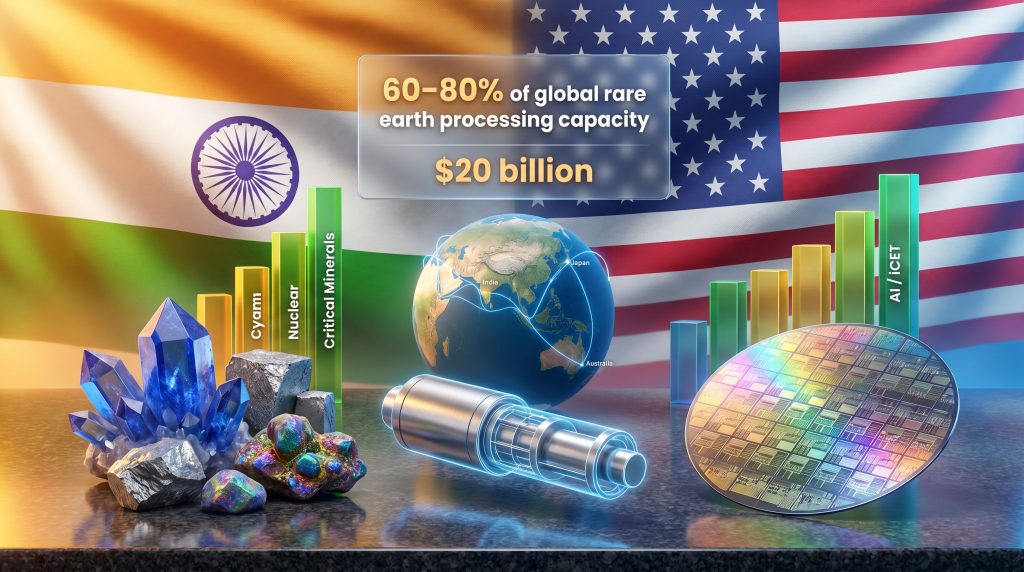
The Geopolitical Architecture Behind Critical Minerals, AI, and Nuclear Energy in the India-US Partnership
Across the global economy, a quiet but consequential competition is reshaping how nations think about industrial power. The ability to manufacture advanced semiconductors, deploy next-generation energy systems, and build sovereign AI infrastructure no longer depends solely on capital or labour. It depends, fundamentally, on access to a narrow category of geological resources that most economies cannot produce at scale without international cooperation. This structural reality sits at the heart of why the Jaishankar Rubio India-US talks on critical minerals, AI, and nuclear energy have attracted attention far beyond the usual diplomatic circles.
When big ASX news breaks, our subscribers know first
Why Critical Minerals Have Become the Defining Resource Conflict of the 21st Century
The phrase "critical minerals" covers a broad spectrum of elements and compounds, including lithium, cobalt, graphite, gallium, germanium, rare earth elements, and titanium, all of which share a common characteristic: they are essential inputs to high-technology systems and cannot be easily substituted. Their strategic importance has grown in direct proportion to the electrification of transport, the scaling of renewable energy, and the acceleration of digital infrastructure globally.
What makes the current moment particularly acute is the concentration of processing capacity in a single geography. China controls an estimated 60 to 80 percent of global rare earth element processing, and its dominance extends across the refining stages of multiple other critical minerals. This is not merely a trade statistic. It represents a structural leverage point over Western industrial capacity, one that has been made visible through China's export controls on gallium, germanium, and other processed minerals as instruments of economic statecraft.
The weaponisation of market access and resource supply chains has become a primary concern for allied economies, shifting critical minerals from a commodities conversation to a national security conversation.
The United States has designated over 50 minerals as critical to national and economic security. India's geological endowment, which includes significant deposits of lithium, cobalt, graphite, and titanium, positions it as a potential partner capable of helping diversify those supply chains over the medium term. Furthermore, surging critical minerals demand driven by the global energy transition is making this bilateral cooperation increasingly urgent.
India's Critical Minerals Mission: Building Both Supply and Processing Capacity
India has moved deliberately to establish a domestic framework for critical mineral development, with its National Critical Minerals Mission providing the policy architecture for exploration, extraction, and processing investment. What distinguishes India's approach from many other resource-endowed nations is its dual ambition: to develop its own deposits while simultaneously positioning itself as a processing and refining hub for allied economies.
This is strategically significant. Processing capacity, not just raw extraction, is where the economic and geopolitical value in critical mineral supply chains is created. A nation that mines lithium but sends it offshore for processing captures only a fraction of the value chain. India's interest in building domestic refinery infrastructure, potentially supported by technology partnerships with the United States, reflects an understanding of this dynamic.
The table below outlines how India-US critical minerals cooperation could be structured across the value chain:
| Cooperation Area | India's Role | U.S. Role | Strategic Outcome |
|---|---|---|---|
| Geological Exploration | Resource identification and surveying | Technology transfer and analytical support | Expanded reserve mapping |
| Mining Operations | Land access and regulatory framework | Capital investment and equipment | Increased extraction capacity |
| Mineral Processing | Refinery infrastructure development | Processing technology and offtake frameworks | Reduced China processing dependency |
| Supply Chain Integration | Export-oriented production | Procurement commitments | Resilient allied supply chains |
The SHANTI Bill and the Next Chapter of India-US Nuclear Cooperation
Civil nuclear cooperation between India and the United States has a complicated history. The landmark 2008 civil nuclear agreement created the legal foundation for cooperation but left significant barriers in place at the technology transfer and liability levels. The proposed SHANTI legislation, formally the Strengthening Hands to Advance Nuclear Technologies with India bill, is designed to reduce those remaining regulatory obstacles and unlock a new tier of collaboration.
The bill's significance lies not just in what it permits but in what it signals. If enacted, it would represent the most consequential update to the bilateral nuclear relationship in nearly two decades, opening pathways for the United States to provide advanced reactor technologies, potentially including small modular reactors, to India at a time when India is actively expanding its nuclear energy ambitions. According to recent reporting, both sides have welcomed the new framework as a foundation for deeper energy and defence cooperation.
India's Nuclear Capacity Targets and the SMR Opportunity
India currently operates a nuclear installed capacity of approximately 7.5 gigawatts, a figure that represents a modest share of its total electricity generation mix. The country has announced targets to dramatically expand this figure, with some projections calling for 100 gigawatts of nuclear capacity by 2047, a goal that would require a fundamentally different rate of deployment than India has historically achieved.
Small modular reactors are central to this ambition for several reasons:
- SMRs can be deployed in configurations that suit India's distributed grid topology, including remote and industrial locations
- Their smaller capital footprint reduces the financing risk associated with large conventional nuclear projects
- Advanced SMR designs offer passive safety features that reduce regulatory complexity
- SMR manufacturing supply chains create domestic industrial value rather than concentrating investment in a single large construction project
Nuclear energy also serves India's baseload power security in a way that solar and wind generation cannot, given the intermittency characteristics of renewable sources. The nuclear-renewables combination, rather than a choice between them, is the architecture that India's energy planners are working toward. In addition, critical minerals and energy security are deeply intertwined, as nuclear expansion itself depends on access to uranium and associated processed materials from diversified supply chains.
Nuclear Cooperation as Strategic Trust-Building
It is worth noting that deepening civil nuclear cooperation carries a dimension beyond energy policy. In the context of the broader India-US relationship, technology-sharing in sensitive domains like nuclear and semiconductors functions as a trust-building mechanism. The degree of regulatory cooperation and intelligence-sharing required to execute civil nuclear partnerships at depth creates institutional relationships that are difficult to replicate through trade agreements alone.
Artificial Intelligence, Semiconductors, and the Mineral Supply Chain Connection
The AI dimension of the Jaishankar Rubio India-US talks on critical minerals, AI, and nuclear energy is not separable from the minerals agenda. This is a point that is frequently underappreciated in public commentary, which tends to treat AI cooperation as a software-and-services conversation.
In reality, advanced AI systems are hardware-intensive. Training large language models and running inference at scale requires high-performance computing chips, and those chips depend on a specific set of critical minerals:
- Gallium and germanium: Key inputs to compound semiconductors and high-frequency transistors, both subject to Chinese export controls since mid-2023
- Cobalt: Used in the battery systems that power data centre backup infrastructure and AI edge devices
- Rare earth elements: Essential in the magnets used within the cooling and storage systems of large-scale computing facilities
- Tantalum and niobium: Used in capacitors within semiconductor fabrication
Securing AI industrial capacity and securing mineral supply chains are not parallel objectives. They are the same objective approached from different ends of the value chain.
Consequently, rare earth supply chains have moved to the centre of technology policy discussions in both Washington and New Delhi. India's transition from an IT outsourcing economy toward a strategic technology partner is reflected in the iCET framework, the Initiative on Critical and Emerging Technologies that India and the United States established to align research, industrial, and regulatory cooperation across AI, quantum computing, semiconductors, and advanced materials.
AI Governance Alignment: The Regulatory Dimension
One less-discussed aspect of India-US AI cooperation is the importance of regulatory convergence. If the two countries develop divergent AI governance frameworks, including different liability standards, data localisation requirements, and algorithmic transparency rules, it creates friction for companies trying to build technology platforms that serve both markets. Aligning governance standards early, before entrenched regulatory systems become difficult to modify, is a strategic priority that the iCET framework is designed to address. Furthermore, critical minerals for semiconductors represent an additional layer of alignment required to make AI hardware supply chains genuinely resilient.
Mobility, Migration, and the Human Capital Foundation of the Partnership
The India-US relationship is distinguished from most other bilateral strategic partnerships by the depth and breadth of its human capital connections. The Indian-American community represents one of the most highly educated and highest-earning demographic groups within the United States economy, and Indian companies have invested more than $20 billion in the American market. This diaspora network functions as an economic and cultural bridge that no formal agreement can replicate.
Against this backdrop, the concerns raised about U.S. immigration policy shifts carry strategic weight. Changes to Green Card Adjustment of Status processing, under which domestic applications are now approved only under extraordinary circumstances, mean that many Indian applicants are required to complete consular processing in India. Combined with processing uncertainty around H-1B, F-1, and J-1 visa categories, these changes create tangible friction for the professionals and researchers who are the operational foundation of the technology partnership.
The position articulated during the talks was precise: cooperation to reduce irregular migration is reasonable and appropriate, but it must not come at the cost of impeding lawful mobility in business, technology, and research contexts. The acknowledgment that transition friction exists, and the expectation that it will be resolved as the U.S. immigration system modernises, provides a diplomatic framing, though it does not resolve the near-term operational challenge for Indian professionals navigating the current system.
Counter-Terrorism, the Quad, and the Indo-Pacific Security Architecture
The security dimensions of the discussions reinforced existing commitments while signalling intensification across several domains. Both sides reaffirmed their shared posture of zero tolerance toward terrorism, with the extradition of Tahawwur Rana, a key accused in the 2008 Mumbai attacks, cited as evidence of effective law enforcement cooperation functioning at the institutional level.
The forward agenda includes expanded bilateral and multilateral collaboration on counter-narcotics and the disruption of illicit trade networks, areas where organised crime, terrorist financing, and geopolitical instability increasingly intersect.
The Quad as a Force Multiplier for Bilateral Objectives
The bilateral Jaishankar-Rubio meeting was itself a precursor to the Quad Foreign Ministers' meeting, bringing together India, the United States, Australia, and Japan. The Quad framework is important precisely because it multiplies the bilateral agenda's regional impact. Critical minerals, technology supply chains, and maritime security all feature within the Quad's cooperative architecture, meaning that commitments made bilaterally are reinforced and institutionalised at the multilateral level.
India's broader strategic doctrine, which emphasises unimpeded maritime commerce, respect for international law, and opposition to the weaponisation of market access and resource supply chains, maps directly onto the Quad's foundational rationale. As reported by Reuters, India and the US have held substantive talks on trade and critical minerals that underpin this security architecture. The reference to opposing the weaponisation of resources is an explicit framing around China's export control practices, and it connects the geopolitical and commercial dimensions of the partnership in a single principled statement.
The next major ASX story will hit our subscribers first
Scenario Analysis: Three Trajectories for the India-US Strategic Partnership
The outcomes of the deepening India-US relationship are not predetermined. Three credible trajectories exist, each shaped by domestic political cycles, legislative progress, and external geopolitical developments.
Scenario 1: Deep Integration
- India and the U.S. formalise critical minerals offtake and processing agreements with binding procurement commitments
- The SHANTI legislation passes, unlocking civil nuclear technology transfers including SMR cooperation
- iCET expands into a full-spectrum technology alliance covering AI, quantum computing, and semiconductor manufacturing
- Visa processing friction resolves through streamlined bilateral mechanisms, preserving human capital flows
Scenario 2: Selective Cooperation (Base Case)
- Progress on critical minerals and nuclear is incremental, subject to the pace of legislative calendars in both countries
- AI cooperation advances through research partnerships but stops short of deep industrial integration
- Mobility issues persist as a recurring friction point requiring ongoing diplomatic management
Scenario 3: Partnership Stagnation
- U.S. protectionist trade and immigration policies create sustained friction that limits deeper integration
- India exercises its traditional strategic autonomy by distributing partnerships across Russia, China, and the EU
- Critical minerals cooperation remains aspirational without the procurement commitments needed to attract capital investment
Disclaimer: Scenario projections represent analytical frameworks for understanding possible outcomes and should not be interpreted as predictions. Geopolitical trajectories are subject to variables that cannot be fully anticipated.
Frequently Asked Questions
What were the main focus areas of the Jaishankar Rubio India-US talks on critical minerals, AI, and nuclear energy?
The discussions covered the full scope of the India-US Comprehensive Global Strategic Partnership, with particular depth on critical minerals supply chain cooperation, civil nuclear energy under the SHANTI legislative framework, AI and emerging technologies through the iCET mechanism, counter-terrorism and counter-narcotics cooperation, and mobility concerns affecting Indian professionals and students in the United States.
Why does China's position in critical mineral processing matter to India-US cooperation?
China's control over an estimated 60 to 80 percent of global rare earth processing capacity, combined with its demonstrated willingness to use export controls on minerals like gallium and germanium as geopolitical tools, creates a structural vulnerability for allied economies dependent on Chinese-processed inputs for advanced manufacturing and defence systems. Building alternative supply chains through partnerships like the India-US framework directly reduces this exposure.
What is the iCET and why is it significant?
The Initiative on Critical and Emerging Technologies is a bilateral framework established by India and the United States to align cooperation across AI, quantum computing, semiconductor supply chains, and advanced materials. It represents an institutionalised mechanism for translating strategic technology alignment into operational collaboration, and is considered one of the most substantive bilateral technology frameworks either country has established with a non-treaty partner.
How does the Quad amplify the India-US bilateral agenda?
The Quad brings Australia and Japan into the framework, allowing mineral supply chain diversification, technology alignment, and maritime security commitments to be coordinated across four allied Indo-Pacific economies simultaneously. This multilateral dimension adds resilience and scale to objectives that might otherwise be achievable only at bilateral level.
Want To Stay Ahead of the Next Major Mineral Discovery Driving These Strategic Supply Chains?
Discovery Alert's proprietary Discovery IQ model delivers real-time alerts the moment significant ASX mineral discoveries are announced, turning complex geological data into actionable investment insights across the critical minerals driving global technology and energy transitions — from rare earths to lithium and beyond. Explore Discovery Alert's dedicated discoveries page to understand how historic mineral discoveries have generated substantial market returns, and begin your 14-day free trial today to position yourself ahead of the broader market.