June 9, 2026
When Demand Falters: Understanding the Forces Pulling Crude Oil Futures Lower
Global energy markets operate on a delicate balance between consumption expectations and supply realities. When that balance tips, futures markets respond swiftly and often aggressively. The current episode unfolding across major crude oil benchmarks is a textbook example of how crude oil futures fall amid weak global trends — demand-side deterioration rippling through interconnected futures markets simultaneously, dragging prices lower across geographies and currencies alike. Understanding this mechanism is essential for anyone tracking energy costs, commodity portfolios, or macroeconomic conditions in oil-dependent economies.
When big ASX news breaks, our subscribers know first
The Demand Equation That Is Reshaping Crude Futures Pricing
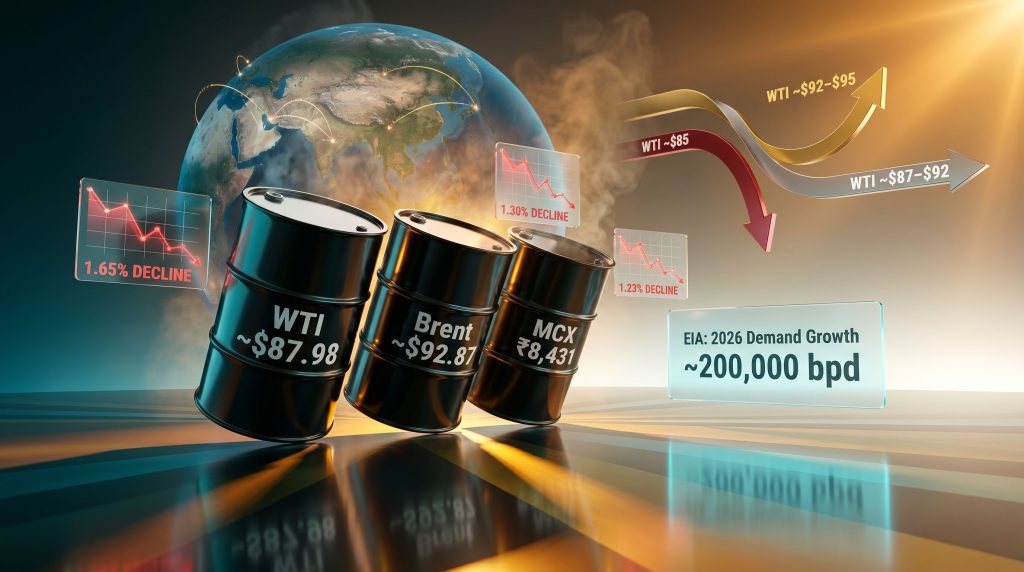
At the core of the current crude oil futures fall amid weak global trends is a fundamental reassessment of how much oil the world actually needs. The U.S. Energy Information Administration (EIA) has revised its 2026 global oil demand growth forecast downward to approximately 200,000 barrels per day, a figure that sounds modest in isolation but carries significant weight when translated into futures market positioning.
To contextualise this revision: global oil consumption runs at roughly 100 to 103 million barrels per day. A downward revision of 200,000 barrels per day represents a shift of around 0.2% of total demand. While that percentage appears small, futures markets price forward expectations, meaning even marginal changes in the demand trajectory can trigger disproportionate price corrections. Futures participants do not wait for physical shortfalls to materialise; they reposition immediately when forward signals deteriorate.
Asian economies have emerged as the primary source of demand disappointment. Industrial output slowdowns, compressed manufacturing activity, and declining transportation fuel consumption across several major Asian consuming nations have collectively undermined the demand growth narrative. Furthermore, this is not simply a cyclical dip — structural factors including the gradual adoption of electric vehicles in China, sluggish post-pandemic industrial recovery in certain markets, and tighter credit conditions are all contributing to a more persistent consumption headwind. These geopolitical oil price factors interact with demand signals in ways that make accurate forecasting increasingly complex.
Why Spot Market Weakness Amplifies Futures Declines
One of the less-discussed dynamics in crude oil pricing is the feedback loop between physical spot markets and futures contracts. When refiners and industrial buyers reduce spot-market purchases, they signal weakening near-term demand directly to futures participants. Traders holding long positions in crude futures, anticipating that price weakness will persist, begin offloading those contracts to limit exposure.
This collective selling pressure adds a layer of downward force on futures prices that goes beyond what the underlying supply-demand fundamentals alone would justify. You can explore how crude oil trade geopolitics further compounds these dynamics across global benchmarks.
"When physical market buyers pull back, the signal travels instantly into futures pits. Speculative long positions become liabilities overnight, and the resulting offloading can temporarily overshoot the fundamental equilibrium price."
This is a critical distinction: the current price decline reflects both genuine demand weakness and the amplified selling behaviour it triggers in derivatives markets.
Cross-Benchmark Performance: WTI, Brent, and MCX Crude
The synchronised decline across all three major crude benchmarks confirms that this is a globally coordinated bearish signal, not a localised market disruption.
| Benchmark | Price Level | Percentage Decline | Trading Context |
|---|---|---|---|
| WTI Crude (New York) | ~$89.79/barrel | 1.65% | Global demand concerns |
| Brent Crude (New York) | ~$93.02/barrel | 1.30% | Weaker risk premium spread |
| MCX June Futures (India) | ₹8,606/barrel | 1.16% | Spot demand weakness + global alignment |
The MCX June delivery contract recorded a business turnover of approximately 6,533 lots, indicating active but distinctly bearish participation. On the MCX, one crude oil futures lot represents 100 barrels of oil, meaning this session reflected trading across roughly 653,300 barrels worth of contracts. That level of participation signals genuine directional conviction from market participants, not merely thin-market noise. For further context, Outlook Business reports on crude futures weakness align closely with the movements observed across these benchmarks.
The Brent-WTI Spread as a Sentiment Indicator
Brent crude typically commands a premium over WTI due to its role as the globally dominant pricing benchmark, its relevance to a broader range of international crude grades, and logistical factors tied to its North Sea origins. The current spread between WTI at $89.79 and Brent at $93.02 represents approximately $3.23 per barrel, which sits at the narrower end of historical norms.
A compressing Brent-WTI spread during a demand-led selloff often signals that international buyers are not stepping in to defend Brent's premium, reinforcing the globally uniform nature of the current bearish sentiment.
MCX Crude Futures and the Indian Market Dimension
India ranks among the world's largest crude oil importers, consuming well over 4.5 million barrels per day according to recent estimates, making domestic futures pricing directly consequential for industrial costs, transportation, and inflation dynamics. MCX crude oil futures are denominated in Indian Rupees but are structurally tethered to WTI benchmark prices, adjusted for the prevailing USD/INR exchange rate and applicable import duties.
This creates a dual-variable pricing environment. Even if WTI stabilises, a weakening rupee against the dollar can sustain or worsen MCX price pressures from an import cost perspective. Conversely, a strengthening rupee can partially cushion the impact of rising international crude prices. The MCX therefore functions as a composite signal of both global benchmark movements and India-specific currency dynamics.
Three Forces Driving the Current Crude Price Retreat
1. Structural Demand Deterioration
The demand-side story is not simply about one quarter of weak data. Several compounding factors are suppressing consumption growth across major economies:
- Central bank tightening cycles over the past two years have raised borrowing costs, slowing industrial investment and manufacturing activity in energy-intensive sectors
- Electric vehicle penetration in China has progressed faster than many demand models anticipated, structurally reducing gasoline consumption in the world's largest crude importing nation
- Post-pandemic industrial recovery in parts of Asia has plateaued below pre-crisis consumption trajectories, leaving prior demand growth forecasts overstated
- Seasonal demand patterns in early 2026 have underperformed expectations across both refinery intake and transportation fuel consumption metrics
2. Speculative Position Offloading
A less visible but equally important driver is the behaviour of speculative participants in futures markets. Managed money funds and other speculative traders had accumulated significant long positions in crude oil contracts during earlier price-supportive periods. As demand signals weakened, these participants began systematically reducing long exposure to manage risk.
This is fundamentally different from a refiner or producer selling hedges. Speculative offloading is driven by risk management models and stop-loss thresholds rather than physical commodity needs, meaning it can occur rapidly and at scale. The result is a price decline that outruns the pace of actual demand deterioration. The broader effects of trade war oil markets dynamics have further complicated speculative positioning across these contracts.
"Demand-driven crude price corrections historically tend to be more prolonged than supply-shock-driven declines. Supply disruptions typically resolve within months; demand structural shifts can take years to reverse."
3. Geopolitical Risk as a Counterbalancing Force
The one factor that has prevented a more severe decline is persistent geopolitical uncertainty in Middle Eastern producing regions. Brent crude pricing embeds a geopolitical risk premium specifically because supply disruption scenarios in the Middle East disproportionately affect internationally traded crude grades. This premium has acted as a partial floor beneath Brent prices even as demand signals weaken.
However, risk premiums are inherently unstable. When bearish demand evidence accumulates sufficiently, even elevated geopolitical tension may fail to sustain price support. Historical precedent from 2014 to 2016 illustrated this dynamic clearly: supply concerns were overwhelmed by the scale of demand-side and supply-glut fundamentals, and prices collapsed despite ongoing regional instability.
Scenario Analysis: Where Do Crude Prices Go From Here?
Directional conviction in crude oil markets is unusually difficult to maintain when bearish demand signals and bullish geopolitical risk narratives are competing simultaneously. Three plausible price trajectories deserve consideration:
Scenario A: Extended Demand-Led Decline
If EIA demand revisions continue downward and Asian economies fail to recover consumption momentum through mid-2026, WTI could test the $85/barrel support zone while Brent approaches $90/barrel. MCX crude would face further pressure toward the ₹8,300-₹8,400 range.
Scenario B: Geopolitical Supply Shock Recovery
A meaningful supply disruption in a major producing region could trigger rapid risk-premium repricing, pushing WTI back toward $92-$95/barrel and Brent reclaiming $96-$98/barrel. MCX futures would likely rebound sharply toward ₹8,800-₹9,000 per barrel. This scenario is characterised by speed rather than sustainability.
Scenario C: Range-Bound Consolidation
The most probable near-term outcome involves OPEC+ production discipline offsetting demand weakness, producing sideways price action. Understanding OPEC's market influence is therefore critical in assessing whether range-bound consolidation holds. WTI trades between $87-$92/barrel, Brent holds $91-$95/barrel, and MCX crude oscillates in the ₹8,500-₹8,700 band.
Stakeholder Impacts: Who Wins and Who Loses?
Indian Consumers and the Downstream Sector
India's retail fuel pricing mechanism does not adjust in real time to international crude movements. Government pricing policy, excise duties, and state-level taxes create a buffer between international benchmark volatility and petrol and diesel prices at the pump. However, sustained crude price declines do eventually reduce India's overall import bill, easing pressure on the current account deficit and providing fiscal headroom.
A $5/barrel reduction in average crude import prices, sustained over a full fiscal year, can reduce India's annual oil import expenditure by approximately $8-9 billion, given current import volumes. This provides meaningful relief to both currency and inflation dynamics.
OPEC+ and the Fiscal Breakeven Calculus
Saudi Arabia's fiscal breakeven oil price — the crude price at which the government balances its budget — is estimated in the range of $80-$85/barrel by multiple independent energy research organisations. With WTI currently trading at approximately $89.79, the current price still sits above this threshold, but the margin is narrowing.
If prices continue to deteriorate, the probability of OPEC+ announcing additional production cut extensions rises considerably. The OPEC production impact on price floors has historically been swift when fiscal stability is at risk. The group has demonstrated willingness to sacrifice market share to defend price floors, and that policy response typically introduces a sharp but temporary price recovery.
Energy Sector Equities and Commodity Investors
Upstream exploration and production companies are among the most directly exposed to crude price movements, with a rough rule of thumb suggesting that a $1/barrel sustained change in crude prices affects pre-tax earnings by $100-300 million annually for major integrated producers, depending on production volumes. Falling crude prices compress margins at exploration-heavy companies faster than at integrated majors, which benefit from downstream refining margins that can improve when feedstock costs fall. Consequently, portfolio positioning across energy equities requires close attention to benchmark direction during periods of sustained bearish sentiment.
The next major ASX story will hit our subscribers first
Frequently Asked Questions About Crude Oil Futures
Why do crude oil futures fall when global demand is weak?
Futures market participants holding buy positions reduce their exposure by selling contracts when demand signals deteriorate. This collective selling increases downward price pressure before any physical delivery shortage occurs, as futures pricing reflects forward expectations rather than current physical transactions.
What is the structural difference between WTI and Brent crude?
WTI is a light, sweet crude benchmark primarily reflecting North American supply and demand conditions, traded on the NYMEX exchange. Brent is derived from North Sea crude grades and serves as the global pricing reference for approximately 70-80% of internationally traded crude, commanding a premium that reflects its broader market reach and geopolitical risk exposure. For instance, the Energy Economic Times has documented how this spread behaves during periods of demand-led price weakness.
How does MCX crude oil pricing connect to international benchmarks?
MCX crude futures track WTI prices adjusted for the USD/INR exchange rate plus applicable duties and logistics costs. A 1.65% WTI decline will typically produce a closely correlated MCX decline within the same trading session, though the rupee exchange rate introduces additional variability.
What is a futures lot on the MCX?
Each MCX crude oil futures lot represents 100 barrels of crude oil. The June delivery contract's session turnover of 6,533 lots therefore reflects participation across approximately 653,300 barrels in contract value, providing a useful measure of market liquidity and directional sentiment.
Can geopolitical events reverse a demand-driven crude price decline?
Yes, but the reversal is typically sharp and short-lived unless the supply disruption is both severe and prolonged. Historical episodes suggest that demand fundamentals ultimately reassert dominance over geopolitical risk premiums within weeks to months, unless actual production volumes are materially affected.
Key Takeaways for Energy Market Participants
- Synchronised benchmark declines across WTI, Brent, and MCX confirm a globally coordinated bearish signal rooted in demand fundamentals rather than any single market anomaly
- EIA demand revisions cutting 2026 growth forecasts to approximately 200,000 barrels per day represent a fundamental reassessment of consumption trajectories, particularly in Asia
- Speculative position offloading amplifies price declines beyond fundamental levels, creating potential for temporary overshooting before equilibrium is restored
- MCX June futures at ₹8,606/barrel with 6,533 lots of turnover reflects active but directionally bearish Indian market participation aligned with global movements
- OPEC+ production discipline remains the critical stabilising variable, with Saudi Arabia's fiscal breakeven price serving as a practical policy trigger for supply response decisions
- Geopolitical risk premiums embedded in Brent pricing provide a partial buffer but are vulnerable to erosion if demand deterioration evidence continues to accumulate
Disclaimer: This article is intended for informational and educational purposes only. It does not constitute financial, investment, or trading advice. Commodity futures markets involve significant risk, and past price patterns are not indicative of future performance. Readers should consult qualified financial advisers before making investment decisions. Price data referenced reflects conditions as reported for the June 9, 2026 trading session.
Want to Spot High-Potential Commodity Opportunities Before the Broader Market?
While crude oil futures navigate demand-driven headwinds and complex cross-benchmark signals, Discovery Alert's proprietary Discovery IQ model delivers real-time alerts on significant ASX mineral discoveries, instantly converting complex commodity data into actionable investment insights for both traders and long-term investors. Explore historic examples of exceptional discovery returns or start your 14-day free trial today to position yourself ahead of the market.