June 9, 2026
The Structural Forces Reshaping How Mines Operate
For most of the twentieth century, mining productivity gains came from bigger machines, deeper shafts, and larger workforces. That model has reached its physical and economic ceiling. Global average copper ore grades have declined by roughly 25% over the past two decades, according to industry research, while extraction depths at many major gold and base metal operations have increased substantially, driving up ventilation, hoisting, and cooling costs. At the same time, energy price volatility has made fuel and power budgets increasingly unpredictable, and tightening ESG obligations now require miners to demonstrate measurable environmental performance rather than simply comply with minimum standards.
These pressures are not cyclical. They are structural, and they are converging at the same moment. The result is a fundamental rethink of how mining operations are designed, managed, and optimised, with digital mining solutions emerging as the primary response to a set of challenges that analogue methods are simply no longer equipped to solve.
When big ASX news breaks, our subscribers know first
Defining Digital Mining Solutions: More Than a Technology Upgrade
The term digital mining solutions is frequently used loosely, but its operational meaning is precise. It refers to the integrated deployment of artificial intelligence, Internet of Things sensor networks, autonomous equipment systems, cloud computing infrastructure, digital twin environments, and advanced analytics platforms across the full mining value chain, from early-stage exploration through to processing, logistics, and environmental compliance.
The critical distinction in modern deployments is between point solutions and platform-based ecosystems:
- Point solutions address isolated operational problems, such as a single autonomous truck fleet or a standalone ventilation monitoring system.
- Platform-based ecosystems create company-wide, cloud-native operational environments where data flows continuously between equipment, processing facilities, logistics networks, and management dashboards.
The platform model is increasingly favoured because it generates compounding returns. Each additional data source improves the quality of AI-driven decisions across the entire system, rather than optimising a single process in isolation. This architecture reflects the core principles of Industry 4.0, where physical and digital systems are integrated into a unified, self-optimising operational environment. Furthermore, data-driven mining operations are increasingly central to how leading operators build long-term competitive advantage.
"Digital mining solutions represent a converged operational model where data flows continuously from the pit face to the boardroom, enabling decisions at machine speed rather than human speed."
How Autonomous Equipment Is Transforming Mine Productivity and Safety
The Mechanics of 24/7 Machine Operations
Autonomous haulage, drilling, and loading systems are now commercially deployed at a growing number of major mining operations worldwide. These systems operate through the integration of advanced sensor arrays, high-precision GPS positioning, LiDAR navigation, and AI-based obstacle detection algorithms that allow machines to function continuously across complex terrain without direct human control.
The productivity implications are significant. Where conventional equipment operates for approximately 14 to 16 hours per day due to shift changes, fatigue management requirements, and safety protocols, autonomous systems are capable of operating continuously across a 24-hour cycle. The performance differential is substantial:
| Performance Metric | Conventional Equipment | Autonomous Equipment |
|---|---|---|
| Operating Hours per Day | ~14-16 hrs | Up to 24 hrs |
| Fuel Efficiency | Baseline | Up to 10-15% improvement |
| Maintenance Scheduling | Reactive | Predictive / AI-driven |
| Workforce Hazard Exposure | High | Significantly reduced |
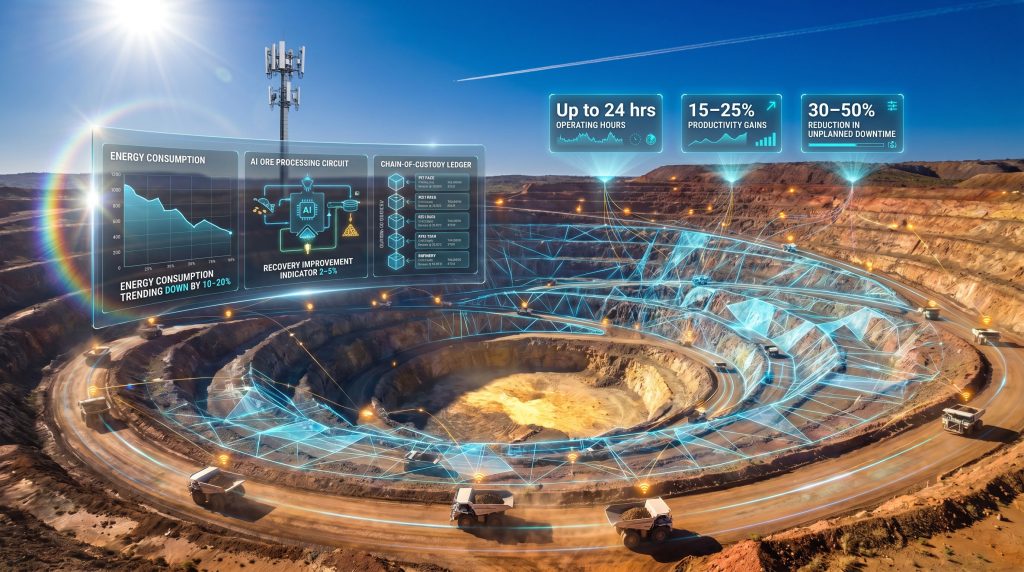
| Productivity Uplift | Baseline | 15-25% reported gains |
In addition, the broader landscape of mining automation trends continues to evolve rapidly, with new applications emerging across haulage, processing, and underground operations.
The Safety Dividend
One of the most underappreciated returns from autonomous equipment investment is the safety dividend. By removing operators from hazardous environments, including active blast zones, unstable underground headings, and high-traffic haulage corridors, autonomous systems directly reduce the frequency of lost-time injuries and fatalities.
A single remote operations centre can oversee multiple autonomous asset fleets simultaneously across geographically dispersed sites, concentrating expertise and enabling faster incident response. Regulatory frameworks governing autonomous machine certification and operator licensing are evolving in parallel, with jurisdictions including Australia, Canada, and Chile progressively updating mining safety legislation to accommodate fully autonomous operational models.
Fleet Optimisation and Fuel Cost Management
AI-driven dispatch systems add a further layer of efficiency by dynamically routing haulage fleets in real time based on current load weights, road surface conditions, grade profiles, and production targets. Rather than following fixed schedules, these systems continuously recalculate the optimal route and task assignment for each vehicle in the fleet. The result is measurable reductions in fuel consumption, tyre wear, and brake maintenance costs, all of which compound into significant operating cost reductions at the scale of a major mining operation.
Digital Twins: Building a Virtual Mine for Smarter Decision-Making
Architecture and Data Integration
A digital twin in a mining context is a continuously updated virtual replica of physical assets, operational processes, and environmental conditions. The model is populated through multiple real-time data streams:
- Equipment telemetry from onboard sensors
- LiDAR scanning and photogrammetric survey data
- Geospatial and geological modelling inputs
- Environmental monitoring feeds covering air quality, water, and ground stability
- SCADA system outputs and enterprise resource planning platform integrations
The power of the digital twin lies not in its static accuracy but in its dynamic responsiveness. As conditions change on site, the virtual model updates in near real time, giving engineers and managers a continuously accurate representation of what is physically occurring underground or on the surface.
Predictive Maintenance: Restructuring the Cost Model
The maintenance application of digital twins is arguably their highest-value use case in mining. Traditional maintenance approaches are either reactive — fix what breaks — or scheduled by elapsed time, replacing components regardless of condition. Both approaches carry significant cost inefficiencies.
Digital twin-enabled predictive maintenance identifies early-stage mechanical degradation signals, such as subtle vibration anomalies, temperature deviations, and hydraulic pressure trends, before failure events occur. Industry benchmarks indicate that well-implemented predictive maintenance programmes can reduce unplanned equipment downtime by 30 to 50%. At operations where a single primary crusher or haul truck represents tens of thousands of dollars per day in production capacity, that reduction translates directly into revenue protection.
"Predictive maintenance enabled by digital twins does not merely prevent breakdowns. It restructures the entire maintenance cost model, shifting expenditure from emergency repair to scheduled, lower-cost intervention."
AI-Enhanced Mine Planning
Digital twin environments are increasingly being combined with machine learning models to improve ore body characterisation and extraction sequencing. For instance, AI in drilling and blasting applications are delivering higher-confidence resource models, more economically optimised mining sequences, and reduced waste generation through precision blast design and selective extraction. AI-assisted geological modelling can interpret drill core imagery, geophysical survey datasets, and remote sensing data at speeds and resolutions that exceed traditional manual interpretation.
IoT Sensor Networks and Real-Time Operations Control
The Connected Mine Infrastructure
Modern digital mining solutions rely on dense IoT sensor networks deployed across every operational domain of a mine site. The deployment architecture typically includes:
- Equipment health monitoring sensors on mobile plant, fixed plant, and infrastructure
- Environmental sensors measuring air quality, dust particulates, water discharge quality, and noise levels
- Geotechnical instruments monitoring slope stability, ground movement, and void detection
- Worker safety wearables providing gas detection, fatigue monitoring, proximity alerting, and emergency location tracking
Edge computing nodes process high-volume sensor data locally before transmission to centralised control infrastructure, reducing latency and ensuring that time-critical safety decisions can be made without dependence on distant cloud connectivity. This architecture is particularly important in underground operations where communication reliability is a persistent challenge.
Live Operational Visibility
Centralised dashboards consolidate real-time KPI data from across the operation, enabling management teams to monitor production performance without requiring physical presence on site. Key metrics tracked in real time typically include:
- Tonnes moved per hour by each fleet asset
- Equipment availability and utilisation rates
- Energy consumption across processing, haulage, and ventilation circuits
- Blast performance against design parameters
- Processing throughput and recovery rates
The reduction in decision latency that real-time visibility enables is not trivial. In conventional operations, production managers often receive performance data hours after events have occurred. Digital systems compress that lag to minutes or seconds, allowing corrective actions to be implemented before small deviations become costly production shortfalls.
Artificial Intelligence Across the Mining Value Chain
Ore Processing Optimisation
AI applications in mineral processing represent one of the clearest cases of measurable financial return. Machine learning models trained on historical processing data can predict incoming ore quality based on upstream sensor readings and geological characterisation, allowing processing parameters — including grind size, reagent dosing, and flotation circuit conditions — to be adjusted dynamically ahead of the ore arriving in the plant.
Documented performance improvements from AI-powered mining efficiency programmes have demonstrated recovery rate gains of 2 to 5 percentage points in multiple commercial deployments. At the scale of a major copper or gold processing facility, a 2% improvement in metal recovery can represent millions of dollars in additional annual revenue from the same ore feed, with no corresponding increase in mining costs.
Predictive Risk Analytics
Beyond processing, AI models are being applied to operational risk management in areas including:
- Equipment failure probability forecasting based on real-time sensor trend analysis
- Slope stability risk assessment integrating geotechnical monitoring data with historical failure records
- Production bottleneck prediction based on fleet performance and crusher throughput patterns
- Scenario modelling tools that allow operators to stress-test operational decisions before committing resources
The integration of predictive risk frameworks into daily operational planning represents a qualitative shift in how mining operations are managed — from experience-based intuition to data-validated decision-making.
The next major ASX story will hit our subscribers first
Blockchain Technology and the Supply Chain Transparency Imperative
Why Provenance Verification Matters Now
The mining industry faces growing pressure from downstream manufacturers, institutional investors, and regulators to demonstrate the ethical origin and responsible sourcing of the minerals and metals they supply. Regulatory frameworks including the EU Critical Raw Materials Act, the OECD Due Diligence Guidance for Responsible Mineral Supply Chains, and Dodd-Frank Section 1502 have progressively raised the compliance bar, making traditional paper-based certification systems inadequate.
Distributed ledger technology addresses this gap by creating tamper-proof, sequentially verified records of mineral origin, processing history, and chain-of-custody transfers. Each entry on the blockchain is cryptographically linked to prior records, making retroactive alteration detectable and effectively impossible at scale. For a deeper look at how these systems deliver immediate returns, several independent analyses have documented compelling ROI cases across supply chain and compliance applications.
Practical Applications in Mining Supply Chains
Blockchain-based mineral traceability systems are being deployed across several application layers:
- Mine-site extraction records documenting ore source, grade, and extraction date
- Smelter and refinery processing logs confirming material provenance through transformation stages
- Trader and logistics documentation recording each custody transfer point
- Digital product passport integration for downstream manufacturers requiring component-level material certification
The efficiency benefits extend beyond compliance. Shared blockchain infrastructure eliminates the duplication of documentation across supply chain participants, reducing administrative costs and accelerating the verification process for time-sensitive commercial transactions.
Digital Solutions and the Sustainability Transition
Real-Time Environmental Monitoring
Advanced environmental monitoring systems using fixed sensor networks and drone-based survey platforms are enabling continuous tracking of mine site environmental impact rather than periodic compliance audits. Real-time data on air quality, water discharge parameters, and emissions concentrations allows operators to identify and respond to exceedances within minutes rather than discovering them in quarterly reports.
This shift from periodic to continuous monitoring has meaningful implications for regulatory relationships, community trust, and ESG reporting quality.
Energy Optimisation and Decarbonisation
AI-driven energy management systems dynamically allocate electrical and fuel-based power across processing, haulage, and ventilation systems based on real-time demand profiles. These systems can intelligently defer non-critical high-consumption tasks to periods of lower energy cost or higher renewable generation output. Consequently, mining electrification and decarbonisation goals are becoming increasingly attainable through the integration of solar, wind, and battery storage assets into mine site power infrastructure.
Documented outcomes from smart energy management deployments have demonstrated site-level energy consumption reductions of 10 to 20% in commercial applications, representing both direct cost savings and measurable Scope 1 and 2 emissions reductions.
"Digital tools are not peripheral to mining's decarbonisation agenda. They are the operational backbone that makes measurable emissions reduction achievable at the scale and speed that regulators and investors now demand."
Carbon Accounting and ESG Disclosure
Software platforms that automate Scope 1, 2, and 3 emissions calculations are becoming integral components of the digital mining solutions stack, supporting alignment with disclosure frameworks including TCFD, GRI Standards, and the Paris Agreement commitments embedded in major mining company corporate strategies. Automated carbon accounting reduces reporting preparation costs and improves data accuracy by eliminating manual aggregation processes.
Technology Stack Comparison: Maturity and Application
| Technology | Primary Application | Key Benefit | Maturity Level |
|---|---|---|---|
| Autonomous Equipment | Haulage, drilling, loading | Safety and productivity uplift | High (commercially deployed) |
| Digital Twins | Asset management, mine planning | Predictive maintenance, downtime reduction | Medium-High |
| AI / Machine Learning | Processing optimisation, exploration | Recovery improvement, cost reduction | Medium-High |
| IoT Sensor Networks | Real-time monitoring, safety | Operational visibility, compliance | High |
| Blockchain | Supply chain traceability | ESG compliance, fraud prevention | Medium |
| Cloud Analytics Platforms | Enterprise-wide data integration | Decision velocity, reporting automation | High |
| Drone / UAV Monitoring | Environmental and survey applications | Compliance monitoring, survey accuracy | High |
Barriers to Adoption and How the Industry Is Responding
Infrastructure and Connectivity Challenges
Deploying reliable high-bandwidth communications infrastructure at geographically remote mine sites remains one of the most persistent practical barriers to digital mining transformation. Private LTE networks, emerging private 5G deployments, and low-earth-orbit satellite connectivity solutions are progressively closing this gap. However, capital expenditure requirements for legacy system modernisation and IT/OT network integration remain substantial for many operators.
Workforce Transition and Change Management
The shift to digital operations requires a workforce capable of interpreting data, managing autonomous systems, and operating within technology-enabled environments. This creates a skills gap that many mining companies are addressing through:
- Partnerships with technical education institutions to develop mining-specific digital skills curricula
- Internal training programmes focused on data literacy and digital platform operation
- Structured change management frameworks to manage cultural resistance from experienced workforces accustomed to conventional operating models
Cybersecurity in Connected Mining Infrastructure
The proliferation of IoT devices and the convergence of IT and operational technology networks have materially expanded the cybersecurity attack surface of modern mine sites. Operational technology systems that control physical mining assets — including autonomous equipment fleets, processing control systems, and tailings management infrastructure — represent critical infrastructure requiring protection frameworks commensurate with their risk profile. Industry-specific cybersecurity standards and the application of zero-trust network architectures are progressively being adopted to address this exposure. For operators seeking a broader perspective on implementation approaches, Hatch's digital mine framework offers useful context on integrating cybersecurity within a holistic digital transformation strategy.
Frequently Asked Questions: Digital Mining Solutions
What are digital mining solutions?
Digital mining solutions encompass the integrated deployment of AI, IoT, automation, cloud computing, digital twins, and analytics platforms across mining operations to improve productivity, safety, cost efficiency, and environmental performance.
How do autonomous mining systems improve safety?
By removing operators from hazardous zones and enabling remote oversight of multiple asset fleets simultaneously, autonomous systems directly reduce workforce exposure to the injury and fatality risks inherent in active mining environments.
What is a digital twin in mining?
A digital twin is a continuously updated virtual replica of a physical mine asset or process, synchronised with real-time sensor data to enable predictive maintenance, operational optimisation, and scenario planning without interrupting physical operations.
How does AI improve ore processing efficiency?
Machine learning models predict incoming ore quality and dynamically adjust processing parameters to maximise metal recovery and minimise reagent consumption, with documented recovery improvements of 2 to 5 percentage points in commercial deployments.
What is the ROI of digital mining investment?
Documented return metrics include 30 to 50% reductions in unplanned downtime, 10 to 15% fuel efficiency improvements in autonomous fleets, 15 to 25% productivity uplifts, and 10 to 20% site-level energy consumption reductions from smart energy management systems.
How is blockchain used in mining supply chains?
Blockchain creates tamper-proof, auditable records of mineral origin and chain-of-custody transfers, enabling compliance with ethical sourcing regulations and building verifiable trust between miners, processors, traders, and manufacturers.
The Strategic Outlook for Digital Mining
Platform Convergence and Operations-as-a-Service
The fragmented landscape of point solutions that characterised the early phase of digital mining adoption is giving way to integrated, cloud-native platform models. An emerging development is the operations-as-a-service model, where technology vendors assume contractual responsibility for specific operational performance outcomes rather than simply supplying software tools. This model transfers execution risk and aligns vendor incentives directly with mine operator productivity, fundamentally changing the commercial relationship between technology providers and mining companies.
5G and Edge Computing as Enablers of Next-Generation Autonomy
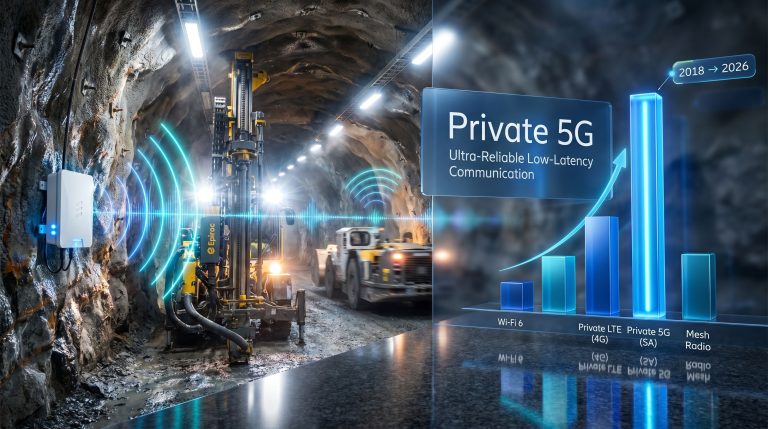
Private 5G networks will enable ultra-low-latency data transmission between autonomous equipment, control systems, and remote operations centres, supporting the real-time responsiveness that fully autonomous and semi-autonomous systems require at scale. Edge computing architectures that process data locally reduce dependency on centralised cloud infrastructure for time-critical operational decisions, improving system resilience and reducing communication-related failure risks.
Digital Capability as a Competitive Differentiator
Early adopters of comprehensive digital mining platforms are establishing structural cost and productivity advantages over peers that are still navigating the early stages of transformation. Beyond operational performance, digital capability is increasingly relevant to capital markets access. ESG-aligned institutional investors are applying growing scrutiny to operational technology disclosure, environmental monitoring capability, and supply chain transparency as components of investment assessment frameworks.
The mining companies best positioned for the next decade are those treating digital transformation not as a technology project, but as a core strategic capability that touches every dimension of how they operate, report, and compete in an increasingly resource-constrained and transparency-demanding global economy.
Readers interested in exploring broader industry perspectives on digital transformation in mining can visit related editorial content published by Metals Mining Review, which covers emerging breakthroughs and operational trends across the sector.
Want to Identify the Next Major ASX Mineral Discovery Before the Broader Market Does?
As digital transformation reshapes how mines operate and discoveries are made, Discovery Alert's proprietary Discovery IQ model cuts through the complexity by delivering real-time alerts on significant ASX mineral discoveries, turning raw announcement data into actionable investment insights the moment they hit the exchange — explore the historic returns major discoveries have generated and begin your 14-day free trial today to position yourself ahead of the market.