May 22, 2026
The Quiet Crisis Driving a New Wave of Mining Technology
The global mining industry is sitting on a paradox. Exploration budgets have climbed steadily over the past two decades, yet the rate of significant new mineral discoveries has fallen sharply. According to data compiled by Geoscience Australia and industry analysts, the number of major base metal finds exceeding one million tonnes declined from a historical average of six to eight per year during the 1990s to just two or three annually between 2010 and 2020. Meanwhile, the International Energy Agency projects that copper demand alone will rise by approximately 50% before 2040, with nickel demand set to triple over the same period as electrification infrastructure scales globally.
The arithmetic simply does not work. The tools being used to find new deposits have not kept pace with the urgency of finding them. It is against this backdrop that Earth AI founder Roman Teslyuk built a company designed to collapse the time and cost of mineral discovery using artificial intelligence, vertical integration, and a startup mentality more common in San Francisco than in the Australian outback.
When big ASX news breaks, our subscribers know first
A Geoscientist Who Thought Like an Engineer
Understanding why Earth AI works the way it does requires understanding the person who built it. Roman Teslyuk is not a typical mining entrepreneur. His background combines rigorous scientific training with an applied problem-solver's instinct for systemic inefficiency.
Teslyuk's geological foundation was built early, winning a national geology olympiad in Ukraine before pursuing advanced study that culminated in doctoral research at the University of Sydney. He accumulated over a decade of field experience working across some of the world's most geologically diverse and logistically demanding environments, including the Arctic, the Middle East, Oceania, and the Far East. That breadth of firsthand exposure gave him something rare: an intimate understanding of where the traditional exploration workflow breaks down at the operational level, not just in theory.
He is a member of the Australian Institute of Mining and Metallurgy, situating him firmly within the professional geoscience community. However, his pivot away from conventional geology toward technology entrepreneurship is what defines his current trajectory. Teslyuk became the first person in Australia to be granted an entrepreneur visa, a distinction that signals the degree to which his approach was viewed as structurally different from anything the industry had seen before.
The rarest combination in any technical industry is someone who has enough domain expertise to identify a real problem and enough systems-level thinking to rebuild the solution from scratch. That intersection is where Earth AI's founding logic lives.
The Core Observation That Changed Everything
What Teslyuk identified was not simply that exploration was slow or expensive. It was that the industry had accumulated vast quantities of useful geological data over decades of surveying, drilling, and sampling, yet lacked any mechanism to synthesise that data at scale. Geophysical surveys, satellite imagery, historical drill records, and electromagnetic data all existed in fragmented, inconsistent formats spread across government archives, junior explorer databases, and legacy contractor files.
Human geological teams, no matter how skilled, cannot process that volume of multi-layered, heterogeneous data quickly. The result is that meaningful patterns linking surface signatures to buried mineralisation go undetected, not because the data does not exist, but because the analytical throughput is too limited. Furthermore, this challenge is only intensifying as the critical minerals demand required by the energy transition continues to grow.
How Earth AI's Technology Platform Actually Functions
Earth AI's core technology is a machine learning system trained on multiple overlapping data types:
- Remote sensing data, including satellite and aerial imagery capturing surface geochemistry and structural geology
- Geophysical survey outputs, spanning electromagnetic, gravity, and magnetic datasets that reveal subsurface density and conductivity contrasts
- Historical exploration records, including decades of drill hole assays, geophysical logs, and geological mapping reports
- Regional mineral systems data, linking known deposit styles to their broader geological contexts
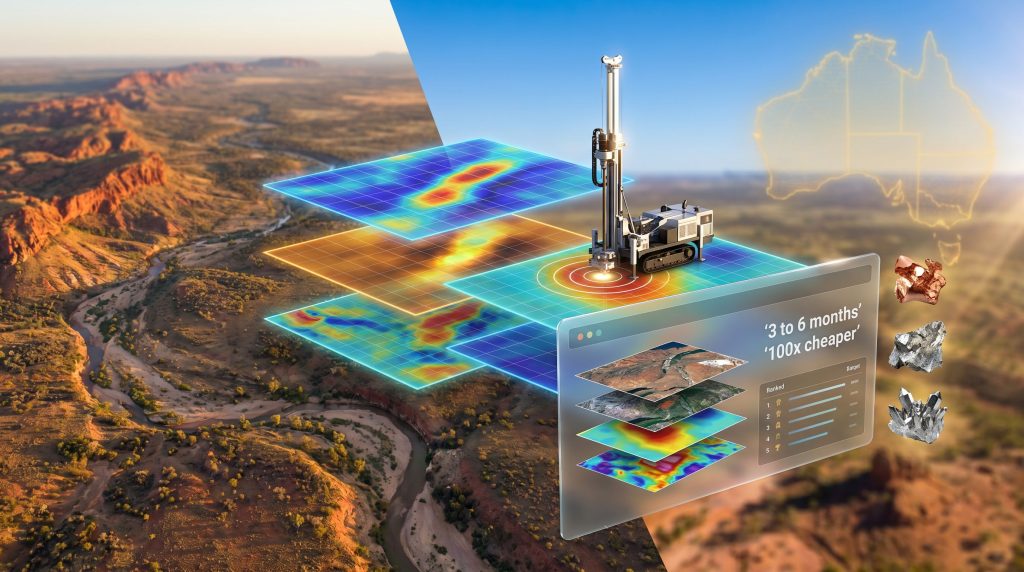
The system identifies anomalous signatures within these datasets that statistically correlate with known mineralisation patterns. Crucially, it does this across entire regions simultaneously, ranking and prioritising targets in a way that would take conventional geological teams months or years to replicate manually. In addition, the role of AI in mineral exploration more broadly is reshaping how the industry approaches target generation at scale.
Why Vertical Integration Is the Real Differentiator
The AI-generated target list is only as valuable as the speed with which those targets can be physically tested. This is where most technology-adjacent exploration companies stall. An algorithm can identify a compelling anomaly, but if drilling that anomaly requires engaging separate contractors for site access, rig mobilisation, sampling logistics, and laboratory assaying, the timeline extends by months and the cost compounds at every handover point.
Earth AI eliminates this bottleneck by bringing drilling, sampling, and testing under the same operational roof. The result is a feedback architecture that traditional explorers cannot replicate:
- AI identifies and ranks high-probability mineral targets across a region
- In-house drilling teams mobilise rapidly to priority targets without contractor coordination delays
- On-site sampling and analysis produce results within the same operational campaign
- Drill results are fed back into the AI model, refining its geological understanding and improving future targeting accuracy
- The cycle repeats with progressively better inputs and higher hit rates
This feedback loop is arguably more strategically significant than the AI platform itself. Every drilling campaign makes the system smarter, creating a compounding performance advantage that widens over time relative to conventional competitors.
Exploration Timelines Compared
| Metric | Traditional Exploration | Earth AI Model |
|---|---|---|
| Prospect Identification | Manual geological mapping | AI-ranked from multi-source datasets |
| Drilling Method | Outsourced contractors | In-house operational teams |
| Sampling and Assaying | Third-party laboratories | Integrated on-site processing |
| Time from Detection to Drill-Test | 12 to 36+ months | Reported 3 to 6 months |
| Comparative Discovery Cost | Industry baseline | Reported approximately 100x lower |
| Data Utilisation | Limited by human throughput | Scaled machine learning synthesis |
Note: The 3 to 6 month timeline and 100x cost reduction are figures stated by Earth AI and have not been independently audited at the time of writing. Investors should treat these as company-reported performance claims rather than verified third-party benchmarks.
The Y Combinator Chapter: Mining Meets Silicon Valley
Earth AI's participation in Y Combinator, one of the world's most selective startup accelerator programs and the early backer of companies including Airbnb, Stripe, and Dropbox, was an unusual move for a company operating in the resource sector. It was also a deliberate one.
Teslyuk was not positioning Earth AI as a mining company experimenting with technology. The Y Combinator pathway was a statement of intent: Earth AI would be built as a technology company that happened to operate in mining, not the other way around. That distinction matters enormously for how the company iterates, allocates capital, and measures progress.
Beyond the seed capital, Y Combinator brought something harder to quantify: exposure to a product development culture built around rapid iteration, user-focused design, and scalable systems architecture. These principles are almost entirely absent from the junior exploration sector, where development cycles are measured in years and operational pivots are expensive and infrequent. For further context on how Australian exploration trends are evolving, the structural shift toward technology-led models is becoming increasingly apparent.
Investor Backing and Funding Structure
Earth AI has attracted capital from a range of institutional and strategic investors across the technology and resources sectors:
| Investor | Category |
|---|---|
| Y Combinator | Accelerator and Seed |
| Cantos | Venture Capital |
| Tamarack Global | Strategic Investor |
| Blackbird Ventures | Australian Venture Capital |
A reported funding round of $20 million was directed toward scaling the company's AI-driven discovery operations. This figure is sourced from reported financial commentary and has not been confirmed through audited filings at the time of publication.
The Exploration Productivity Crisis in Context
The problem Earth AI is addressing is not marginal. The Fraser Institute's 2022 Survey of Mining Companies found that junior explorers face an estimated success rate of approximately one significant discovery per one thousand to two thousand prospects evaluated, representing an extraordinary destruction of capital at the early-stage exploration level.
The IEA's landmark 2021 report on critical minerals and clean energy transitions quantified the scale of the challenge with clarity: copper supply must expand by roughly 50% before 2040, nickel by approximately 300%, and vanadium by as much as five-fold through 2050 to meet energy storage and grid infrastructure requirements. The deposits needed to supply these volumes do not yet exist in the discovery pipeline at sufficient scale.
Three Structural Failures the Industry Has Not Solved
1. Data fragmentation at the geological record level
Decades of geophysical survey work, drill campaigns, and sampling programmes have produced enormous quantities of information. However, this data sits in siloed, inconsistent, and often analogue formats that resist systematic integration. No conventional geological team has the processing capacity to extract pattern-level insights from this volume of material.
2. Workflow fragmentation across the exploration supply chain
Traditional exploration involves sequential handoffs between geological consultants, drilling contractors, sampling firms, and assaying laboratories. Research published in Mining Journal identified that multi-contractor exploration projects typically experience timeline delays of 15 to 25 percent due to coordination overhead alone, before accounting for any technical setbacks.
3. Capital allocation inefficiency at the junior explorer level
Without robust data-driven prioritisation, junior explorers allocate exploration budgets based on geological heuristics that have not fundamentally changed in decades. The resulting hit rate is low, and a substantial proportion of exploration expenditure is consumed by low-probability targets that better data would have deprioritised.
Targeting Critical Minerals Where They Are Most Needed
Earth AI's commodity focus is not incidental. The company targets copper, zinc, vanadium, nickel, and iron ore — the materials that sit at the structural centre of the global energy transition. Geoscience Australia's 2023 assessment of the country's identified mineral resources ranked Australia in the top three globally for reserves of copper, nickel, zinc, and vanadium, making it a logical primary jurisdiction for early operations.
Australia also offers a significant practical advantage: the country has accumulated extensive historical geophysical survey data through decades of government-funded programmes by Geoscience Australia and state geological surveys. This data density is essential for training and deploying an AI model that depends on rich multi-source inputs. Consequently, techniques such as downhole geophysics are becoming increasingly integral to how companies like Earth AI validate and refine their AI-generated targets in the field.
Earth AI has announced six new mineral prospects identified through its AI platform in Australian territory. The company's underlying technology is designed to be jurisdiction-agnostic. Wherever sufficient historical geoscience data exists, the model can be deployed. This points to natural expansion pathways into Canada and the United States, both of which combine significant critical mineral prospectivity with data-rich geological archives accumulated over many decades of survey activity.
The next major ASX story will hit our subscribers first
What Geological Data Actually Reveals About AI's Advantage
One dimension of Earth AI's approach that is not immediately obvious to investors outside the geoscience sector is how the combination of geophysical data types creates interpretive power that no single dataset can match. Electromagnetic surveys reveal conductive bodies that may indicate sulphide mineralisation. Gravity surveys detect density contrasts that point to mafic intrusions or alteration zones. Magnetic surveys outline structural corridors that channel hydrothermal fluids carrying metal-rich precipitation.
Individually, each of these datasets produces ambiguous signals that require expert interpretation and are prone to false positives. In combination, and cross-referenced against surface geochemistry from remote sensing data, the overlap of anomalous signatures narrows dramatically. A machine learning system trained on thousands of known deposits can apply this multi-dimensional filtering at a scale and speed that human teams cannot approach, systematically eliminating low-priority areas and concentrating attention on geological sweet spots.
The exploration industry does not have a data shortage problem. It has a data synthesis problem. The difference between those two diagnoses is what separates Earth AI's operating model from incremental improvements on conventional methods.
The Broader Disruption Pattern and What It Means for Mining
The trajectory Earth AI is following mirrors a pattern observed across multiple industries where software-native companies entered incumbent markets and restructured the competitive landscape. Fintech companies rebuilt lending and payments not by working within bank infrastructure but by redesigning the workflow from first principles. Proptech companies changed real estate not by improving existing agency models but by replacing key steps with technology-mediated alternatives.
The mining industry has historically resisted technology adoption at the operational level. This resistance is partially structural: mining projects operate on multi-decade timescales, capital is committed years before revenue arrives, and regulatory frameworks create inertia that slows innovation adoption. However, that same resistance creates a first-mover advantage for companies willing to absorb the integration complexity of a genuinely different approach.
Furthermore, understanding how the mineral discovery curve has shifted over recent decades helps contextualise why Earth AI founder Roman Teslyuk's vertically integrated model generates such strategic interest. The compounding data advantage from every drill campaign is characteristic of software businesses, not mining companies, and it is what makes the architectural choice so significant for long-term competitive positioning.
This article is intended for informational purposes only and does not constitute financial advice. Company-reported performance claims, including cost reduction ratios and drilling timelines, have not been independently audited and should be evaluated alongside publicly available disclosures. Forecasts regarding critical mineral demand are derived from IEA, USGS, and Geoscience Australia publications and are subject to revision based on evolving technological and policy conditions.
Want to Catch the Next Major Mineral Discovery Before the Market Does?
Discovery Alert's proprietary Discovery IQ model scans ASX announcements in real time, instantly identifying significant mineral discoveries across more than 30 commodities and translating complex geological data into clear, actionable insights — exactly the kind of edge that matters in a sector being reshaped by AI-driven exploration. Explore why historic discoveries have delivered extraordinary returns and begin your 14-day free trial today to position yourself ahead of the market.