May 25, 2026
The Economic Calculus Behind Corporate Caution in Venezuela's Oil Sector
Global energy markets face mounting pressures as traditional supply sources confront unprecedented challenges. While Venezuela holds the world's largest proven crude reserves, estimated at over 300 billion barrels, U.S. oil companies cautious on Venezuela return reflects deeper structural concerns than simple political hesitation. Furthermore, the fundamental economics of Venezuelan operations present a complex risk-return equation that corporate boards struggle to justify under current conditions, particularly when considering broader geopolitics & oil prices.
Capital Requirements vs. Production Reality
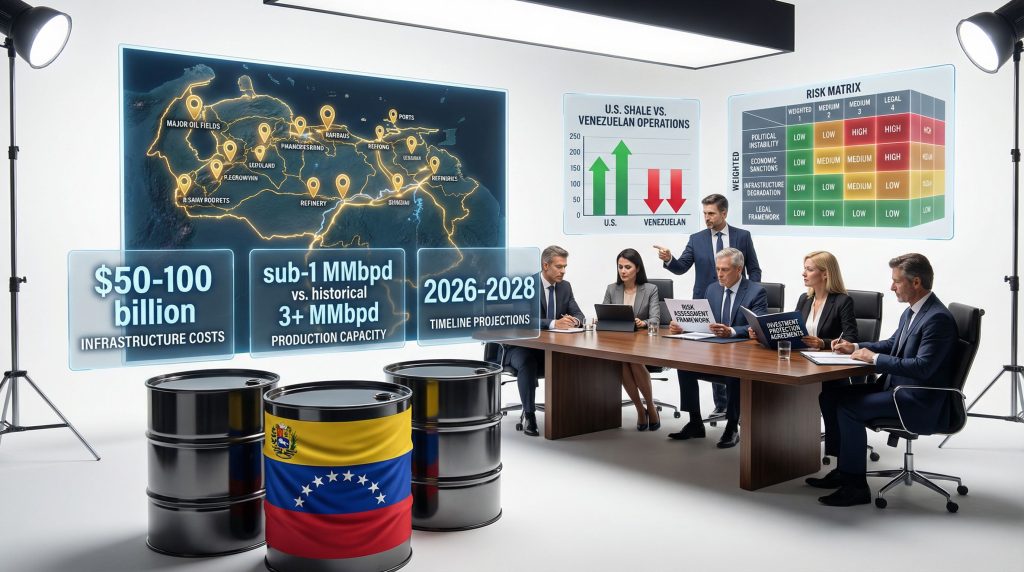
Venezuela's oil production has collapsed from approximately 3.0 million barrels per day (MMbpd) in 1997 to less than 1 MMbpd as of 2025, according to U.S. Energy Information Administration data. This dramatic decline represents one of the steepest production falls in modern petroleum history outside of active warfare zones.
Infrastructure rebuild costs present staggering financial commitments. Industry analysts estimate $50-100 billion over a decade would be required to restore meaningful production capacity. To contextualise this figure, comparable heavy crude projects in Canada's oil sands required approximately $40-60 billion in cumulative investment to achieve 500,000-700,000 bpd production increases over similar timeframes.
Venezuela's refining capacity has deteriorated equally dramatically. Domestic refining capability has declined from approximately 1.3 million barrels per day in the 2010s to roughly 800,000 bpd by 2024, with some facilities operating at merely 20-30% capacity due to equipment failures and maintenance backlogs.
Break-even economics for Venezuelan operations face multiple headwinds:
- Venezuelan crude (Merey grade, approximately 16-17° API gravity) requires specialised heavy crude processing infrastructure
- Transportation costs to U.S. Gulf Coast refineries range $3-5 per barrel including pipeline and diluent expenses
- Current blended economics suggest $45-55 per barrel break-even costs for extraction, processing, and market delivery
- Heavy crude reservoirs experience natural decline rates of 20-30% annually without continuous re-investment, creating a capital treadmill effect
Risk-Adjusted Return Models for Venezuelan Operations
Political risk premiums for Venezuelan investments typically require 2-4% annual premiums on insured capital value through political risk insurance providers. On a $50-100 billion investment portfolio, this represents $1-4 billion annually in insurance costs alone, before considering operational risks or currency devaluation impacts.
The Venezuelan bolívar has experienced hyperinflation from approximately 2,500 bolívares per USD in 2016 to over 36,000 bolívares per USD by 2024. Consequently, long-term project economics become highly sensitive to currency devaluation rates affecting local cost escalation and revenue repatriation mechanisms.
Opportunity cost analysis reveals stark contrasts with alternative investment destinations:
| Investment Option | All-in Cost per Barrel | Payback Timeline | Risk Profile |
|---|---|---|---|
| U.S. Shale Production | $30-40 | 2-3 years | Low-Medium |
| Guyana Operations | $35-45 | 4-5 years | Medium |
| Venezuelan Heavy Crude | $45-60 | 7-10+ years | High |
Operational risk factors compound these economic challenges. Infrastructure decay affects not only production facilities but supporting systems including power grid reliability, pipeline network integrity, and port facility capacity. In addition, security costs for international operations add additional expense layers often not required in more stable jurisdictions.
When big ASX news breaks, our subscribers know first
What Historical Precedents Shape Current Investment Decisions?
Corporate memory of asset seizures fundamentally shapes contemporary risk assessment frameworks. The 2007 nationalisation events under Hugo Chávez created demonstrable precedent that influences current board-level decision making processes across major international oil companies.
The 2007 Nationalisation Legacy and Asset Recovery Challenges
ExxonMobil's experience illustrates the complexity of asset recovery in politically volatile environments. In April 2007, Chávez's government seized ExxonMobil's 41.67% stake in the Cerro Negro heavy oil project, which was producing approximately 130,000 bpd at the time of seizure. The company initiated arbitration proceedings under bilateral investment treaty protections, but recovery outcomes proved disappointing.
ConocoPhillips faced similar challenges with its Venezuelan operations. The company held a 50.01% stake in Petrozuata and Hamaca heavy oil projects, producing 330,000 bpd combined when assets were nationalised. ConocoPhillips filed arbitration claims in May 2010 under the U.S.-Venezuela bilateral investment treaty, ultimately receiving an ICSID ruling in November 2013 awarding $375 million.
However, actual recovery proved far more limited. Venezuelan government counterclaims reduced net awards, and enforcement mechanisms proved inadequate. Estimated actual recovery reached only $30-50 million through settlement negotiations, representing approximately 10-15% of original claim value. The timeline from seizure to legal determination extended over 6+ years, demonstrating the practical limitations of international arbitration as asset protection.
Outstanding arbitration awards against Venezuela currently total approximately $1.4-2.0 billion across multiple claimants. However, actual recovery through Venezuelan asset seizure or voluntary payment has been minimal, estimated at 5-15% of awarded amounts. This recovery rate establishes baseline expectations for future investment protection mechanisms.
Sanctions Regime Evolution and Compliance Complexity
U.S. sanctions against Venezuela's petroleum sector evolved through multiple stages, creating compliance complexity that persists despite recent political changes:
- August 2017: Initial sectoral sanctions targeting Venezuelan state oil company (PDVSA) financing arrangements
- January 2019: Comprehensive oil sanctions prohibiting purchase of Venezuelan crude by U.S. companies
- February 2020-2024: Intensified sanctions with periodic refinements, including specific prohibitions on re-export activities and third-country intermediaries
Companies operating under special licence face extensive compliance requirements. Chevron's conditional operations demonstrate these constraints: monthly reporting requirements to U.S. Treasury, restrictions on revenue repatriation where payments must meet specific licensing criteria, and sanctions prohibitions on technology transfer or capital equipment imports from sanctioned countries.
Potential civil penalties range from $20,000-$250,000+ per violation, with criminal penalties reaching $1 million plus imprisonment. This enforcement framework creates operational complexity extending beyond simple licensing arrangements.
How Do Geopolitical Dynamics Influence Energy Investment Strategy?
Strategic competition in Latin American energy markets adds layers of complexity to corporate investment decisions. Chinese and Russian presence in Venezuela's oil sector creates geopolitical considerations that influence U.S. policy approaches and corporate risk assessments, particularly when examining trade war oil markets dynamics.
U.S. Foreign Policy Objectives vs. Corporate Governance
Chinese state-owned enterprises have invested approximately $60-70 billion in loans, equity investments, and infrastructure projects in Venezuela from 2003-2023, representing the single largest source of external financing for the country's energy sector. China National Petroleum Company (CNPC) maintains operational presence through joint venture arrangements and production sharing agreements.
Chinese involvement includes structured debt arrangements where Venezuelan crude oil deliveries to Chinese refineries occur at below-market rates or as equity stakes in Venezuelan oil projects. Estimated 400,000-500,000 bpd of Venezuelan crude flows annually to Chinese refineries under these arrangements.
Russian technical assistance, while more limited in scale, includes Gazprom and Rosneft involvement in oil production and equipment supply. Current estimates suggest Russian entities participate in approximately 50,000-100,000 bpd of Venezuelan production capacity, though this involvement has been constrained by U.S. sanctions on Russia following the 2022 Ukraine invasion.
The January 9, 2026 reporting indicates the Trump administration's concern that U.S. energy companies' absence from Venezuela creates a strategic vacuum filled by China and Russia. This represents a shift in U.S. foreign policy calculus where restored U.S. company presence is positioned as a countervailing geopolitical force.
Strategic Competition with China and Russia in Latin American Energy
Corporate boards face fundamental conflicts between fiduciary duty to shareholders and political pressure for strategic engagement. ESG compliance frameworks create additional due diligence requirements, particularly regarding human rights, environmental protection, and transparency in politically sensitive regions.
Supply chain security implications for North American refineries add strategic considerations. U.S. Gulf Coast refineries are optimised for heavy crude processing, making Venezuelan crude technically attractive despite political complications. However, alternative heavy crude sources from Canada and other regions provide supply security without geopolitical risks.
Energy security considerations in Western Hemisphere strategy reflect broader U.S. policy objectives, but corporate governance structures require quantifiable risk mitigation mechanisms rather than political assurances subject to government change.
What Are the Technical and Operational Challenges for Sector Revival?
Infrastructure degradation presents immediate operational challenges requiring massive capital deployment before achieving production increases. Pipeline network condition assessment reveals extensive replacement requirements across Venezuela's petroleum transportation system.
Infrastructure Degradation Assessment
Power grid reliability issues affect operations throughout Venezuela's oil sector. Electrical infrastructure deterioration impacts everything from drilling operations to refinery processing and pipeline pumping stations. Backup power generation requirements add operational costs and complexity to any large-scale production restoration efforts.
Port facility upgrades for export capability restoration require significant investment. Venezuela's petroleum export terminals have experienced capacity reductions due to maintenance backlogs and equipment failures. Restoring full export capability requires coordinated infrastructure investment across multiple facility types.
Refining capacity limitations create bottlenecks for domestic fuel supply and export product streams. Modern extraction methods require sophisticated refining infrastructure to optimise product yields, particularly for heavy crude processing operations.
Human Capital and Technical Expertise Gaps
Skilled workforce migration during Venezuela's economic crisis created expertise gaps across technical disciplines. Petroleum engineers, geologists, refinery operators, and maintenance specialists emigrated to other countries during the extended economic downturn.
Technology transfer requirements for modern extraction methods present regulatory and commercial challenges. International oil companies typically require protection of proprietary technologies through licensing agreements and intellectual property frameworks that may conflict with Venezuelan legal structures.
Training and development investment needs extend beyond immediate operational requirements. Rebuilding technical expertise requires sustained educational programmes and knowledge transfer mechanisms that represent long-term capital commitments.
Local content requirements and capacity building may be mandated by Venezuelan regulations, adding complexity to workforce development strategies and potentially constraining operational efficiency during initial phases.
Which Market Factors Drive Investment Timing Decisions?
Global oil market dynamics create price sensitivity considerations that influence Venezuelan investment economics. Heavy crude pricing differentials affect project viability, particularly when compared with lighter crude alternatives, especially considering the impact of oil price trade wars on market stability.
Global Oil Market Dynamics and Price Sensitivity
Venezuelan heavy crude typically trades at discounts to benchmark pricing due to quality characteristics and processing requirements. Transportation costs to U.S. Gulf Coast refineries, combined with heavy crude processing complexity, create margin pressures that affect overall project economics.
Competition with Canadian oil sands and other heavy crude sources provides alternative supply options for refineries designed for heavy crude processing. Market share implications for existing supply arrangements may limit Venezuelan crude demand even if production capacity increases.
Blending requirements and diluent availability affect Venezuelan heavy crude marketability. Heavy crude often requires diluent mixing to achieve pipeline transportation specifications, adding cost and logistical complexity to marketing operations.
Refinery Configuration and Processing Economics
U.S. Gulf Coast refineries optimised for heavy crude processing provide natural market outlets for Venezuelan production. However, these facilities have adapted supply chains and operational procedures for alternative heavy crude sources during Venezuelan production declines.
Product yield optimisation strategies depend on refinery configuration and crude quality characteristics. Furthermore, oil futures and energy markets typically yield different product mixes compared with light crude operations, affecting overall refinery economics and market positioning.
Environmental compliance costs for heavy crude processing add operational expenses that influence overall project economics. Heavy crude operations often require enhanced environmental management systems compared with conventional crude processing.
How Do Legal Frameworks Affect Investment Protection?
Contract stability and dispute resolution mechanisms represent fundamental concerns for international oil company investment decisions. Venezuelan legal frameworks must provide credible investment protection superior to the mechanisms that failed during previous nationalisation events.
Contract Stability and Dispute Resolution Mechanisms
International arbitration clause requirements face practical enforcement limitations demonstrated by previous Venezuelan cases. While bilateral investment treaties provide legal frameworks for dispute resolution, actual asset recovery proves challenging when sovereign states lack cooperative payment mechanisms.
Force majeure provisions for political risk events require careful structuring to address Venezuelan-specific risks including potential future nationalisation, sanctions imposition, or civil unrest. Standard commercial force majeure clauses may prove inadequate for the political risks inherent in Venezuelan operations.
Revenue sharing and taxation framework negotiations must balance Venezuelan government fiscal needs with international company return requirements. Fiscal terms significantly impact project economics and must provide stability throughout project lifecycles extending multiple decades.
Intellectual Property and Technology Transfer Protections
Proprietary technology licensing agreements require protection mechanisms for valuable intellectual property transferred to Venezuelan operations. International oil companies typically require guarantees that proprietary technologies remain protected even during potential future political changes.
Joint venture structure considerations must address potential Venezuelan government participation requirements while protecting international partner interests. Local partnership requirements may be mandated, requiring careful structuring to preserve operational control and technology protection.
Data security and confidentiality protections become increasingly important as petroleum operations generate valuable geological and operational data. International companies require assurance that proprietary data remains protected and transferable in various political scenarios.
The next major ASX story will hit our subscribers first
What Alternative Strategies Are Companies Considering?
Corporate investment strategies for Venezuelan engagement reflect risk management approaches rather than traditional expansion models. Companies evaluate phased entry mechanisms that limit initial capital exposure while maintaining option value for future expansion, particularly considering the implications of OPEC production impact on global markets.
Phased Entry and Risk Mitigation Approaches
Service contract models provide alternative engagement structures that limit capital exposure compared with equity participation. Companies can provide technical services and equipment while Venezuelan entities retain asset ownership and primary political risk exposure.
Joint venture partnerships with experienced operators allow risk sharing and local expertise access. International companies may partner with entities having established Venezuelan presence and government relationships, distributing political risks across multiple parties.
Staged capital deployment based on political stability metrics creates option value while limiting initial exposure. Companies can establish operational presence through limited initial investments, with expansion contingent on demonstrated political and commercial stability.
Exit strategy planning and asset protection mechanisms require advance consideration given Venezuelan historical precedent. Investment structures must provide multiple exit options and asset protection mechanisms that function under various political scenarios.
Portfolio Diversification vs. Concentration Strategies
Venezuelan opportunity cost analysis compares potential returns with alternative global investment opportunities. Companies must evaluate Venezuelan investments against competing projects in more stable jurisdictions offering potentially superior risk-adjusted returns.
Regional exposure limits in Latin American operations reflect portfolio risk management principles. Companies may limit total regional exposure to manage concentration risk, potentially constraining Venezuelan investment scale even under improved conditions.
Technology deployment priorities across global portfolios influence Venezuelan investment strategies. Companies must allocate limited advanced technologies across multiple projects, with Venezuelan operations competing against opportunities in more stable environments.
Capital allocation optimisation frameworks require systematic comparison of Venezuelan opportunities against alternative investments. Corporate capital allocation processes must demonstrate superior risk-adjusted returns to justify Venezuelan engagement over alternative opportunities.
Understanding Corporate Decision-Making in Venezuelan Energy
Why don't oil companies simply accept government security guarantees?
Corporate boards require legally binding investment protection agreements with international arbitration mechanisms, not political assurances that can change with future administrations. Fiduciary duty to shareholders demands quantifiable risk mitigation mechanisms backed by enforceable legal frameworks rather than policy commitments subject to political change.
How long would it realistically take to restore Venezuelan oil production?
Industry analysts estimate 5-7 years for meaningful production increases, requiring sustained political stability and $50+ billion in infrastructure investment. This timeline assumes consistent political support, regulatory stability, and successful capital deployment without major operational disruptions.
What role does ESG compliance play in investment decisions?
Environmental, social, and governance standards create additional due diligence requirements, particularly regarding human rights, environmental protection, and transparency in politically sensitive regions. International oil companies must demonstrate ESG compliance to institutional investors, adding complexity to Venezuelan investment evaluation processes.
Investment Timeline Scenarios and Market Impact Projections
Conservative investment approaches reflect corporate risk management priorities in Venezuelan engagement strategies. Companies evaluate multiple timeline scenarios with varying degrees of political and commercial risk exposure.
Conservative Re-entry Scenario Analysis
2026-2028: Limited service contracts and technical assessments represent initial engagement phases with minimal capital exposure. Companies may provide technical services, equipment supply, and feasibility studies while Venezuelan entities retain asset ownership and primary risk exposure.
2029-2031: Conditional equity participation with political risk insurance allows expanded engagement contingent on demonstrated political stability. International companies may pursue equity stakes in Venezuelan projects with comprehensive insurance coverage and exit option protections.
2032-2035: Full-scale development if stability metrics are maintained represents maximum engagement scenarios requiring sustained political and commercial stability. Large-scale capital deployment occurs only after multiple years of demonstrated government reliability and commercial viability.
Production impact projections vary significantly across timeline phases. Initial service contract phases may support 100,000-200,000 bpd production increases through equipment supply and technical assistance. Equity participation phases could support 300,000-500,000 bpd increases with sustained investment. Full-scale development scenarios might achieve 700,000+ bpd production increases over extended timeframes.
Aggressive Investment Scenario Modelling
Immediate large-scale capital deployment presents both opportunities and risks that corporate boards must carefully evaluate. Fast-track production restoration timelines require massive upfront capital commitments with uncertain political and commercial outcomes.
Market share capture opportunities exist for companies willing to accept higher initial risks. Early engagement in Venezuelan operations might provide competitive advantages in regional heavy crude markets, particularly if other international companies delay entry decisions.
Competitive positioning implications for delayed entry suggest that companies avoiding Venezuelan engagement might face long-term market share losses if operations prove successful. However, failed investments could compromise corporate financial positions and shareholder value.
The following comparative assessment illustrates key risk factors affecting corporate investment decisions:
| Risk Factor | Weight (1-10) | Current Status | Mitigation Options |
|---|---|---|---|
| Political Stability | 9 | Uncertain | Phased investment, insurance |
| Legal Framework | 8 | Developing | International arbitration |
| Infrastructure | 7 | Poor | Joint ventures, staged rebuild |
| Market Access | 6 | Restricted | Sanctions compliance |
| Technical Capability | 5 | Limited | Technology transfer agreements |
Disclaimer: This analysis presents scenarios based on current information and industry assessments. Actual investment outcomes may vary significantly due to political, economic, and market factors beyond current forecasting capabilities. Readers should conduct independent due diligence before making investment decisions related to Venezuelan energy sector opportunities.
The complex interplay of political risk, infrastructure requirements, and market dynamics continues shaping corporate approaches to Venezuelan energy sector engagement. However, U.S. oil executives remain noncommittal on Venezuela despite political pressure, demonstrating that U.S. oil companies cautious on Venezuela return reflects fundamental business considerations rather than mere political hesitation. While political changes may create new opportunities, fundamental economic and risk management considerations will likely drive corporate decision-making processes regardless of government encouragement or policy support.
Looking for Strategic Energy Investment Opportunities?
Discovery Alert's proprietary Discovery IQ model delivers real-time alerts on significant ASX mineral discoveries, instantly empowering subscribers to identify actionable opportunities in the resources sector before broader market awareness. Explore Discovery Alert's discoveries page to understand how major mineral discoveries have generated substantial returns, and begin your 30-day free trial today to position yourself ahead of the market with cutting-edge investment intelligence.