June 10, 2026
The Refining Layer That Could Define North America's Battery Future
Every decade or so, industrial history reveals a chokepoint that was hiding in plain sight. In the nineteenth century, it was steel refining. In the twentieth, it was semiconductor fabrication. Today, the critical constraint shaping the global energy transition is neither mining nor cell manufacturing, but the narrow and largely offshore processing layer that sits between raw ore and battery-ready chemicals. For nickel, this midstream gap is especially acute in North America, where the continent produces meaningful quantities of the metal but refines almost none of it into battery-grade form domestically.
Understanding this structural deficit is the starting point for evaluating the strategic logic behind the Electra U.S. nickel refinery, a proposed processing facility that would target precisely the segment of the supply chain that the continent has consistently failed to develop at scale.
When big ASX news breaks, our subscribers know first
North America's Invisible Nickel Problem
Nickel's role in the energy transition is frequently discussed in terms of mines and gigafactories, with comparatively little attention paid to what happens in between. The refining step, where intermediate nickel products are converted into battery-grade nickel sulfate or refined nickel metal, is technically demanding, capital-intensive, and geographically concentrated in Asia, particularly in China and Indonesia. Understanding nickel uses and properties helps clarify why this refining bottleneck carries such significant strategic weight.
The table below illustrates just how stark the regional imbalance has become:
| Region | Refining Capability | Battery-Grade Nickel Output | Strategic Risk Level |
|---|---|---|---|
| China | Dominant, integrated processing | High | Low (for China) |
| Indonesia | Growing, HPAL expansion underway | Increasing | Medium |
| Europe | Limited, emerging capacity | Low to moderate | High |
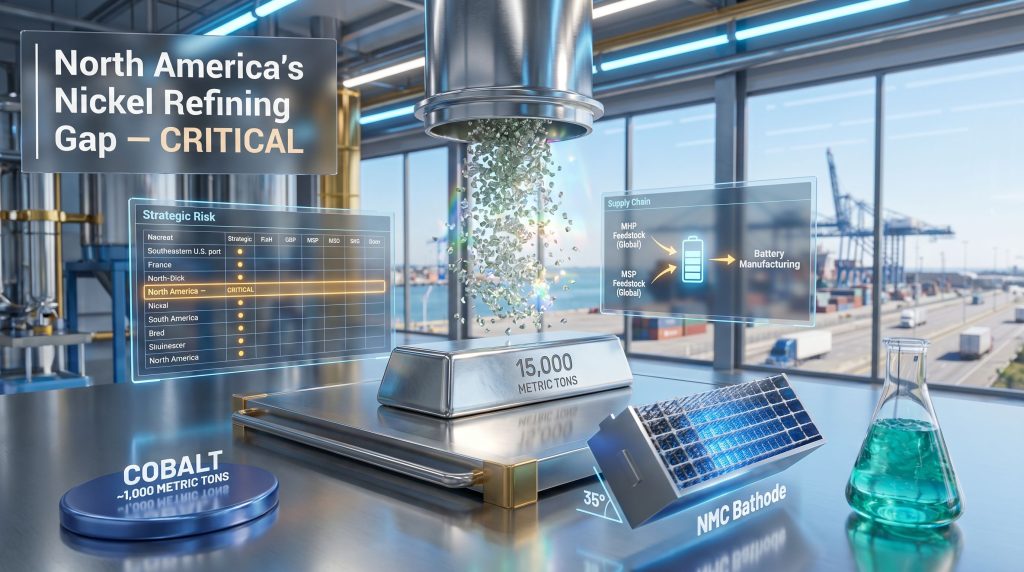
| North America | Minimal, no major domestic refinery | Near-zero | Critical |
This is not simply an economic inconvenience. The U.S. government has explicitly identified nickel refining as a national security priority, recognising that battery-grade nickel supply chains anchored entirely offshore create structural vulnerabilities for both the electric vehicle industry and broader defense and advanced manufacturing sectors. No amount of domestic mining investment fully addresses this if the refining capacity to convert that ore into usable battery material does not exist within the continent.
Why Mining and Cell Manufacturing Alone Cannot Close the Loop
A common misconception in critical minerals policy discussions is that expanding mine output and building gigafactories at home will organically generate a complete domestic supply chain. In practice, raw ore or even mined concentrate cannot be fed directly into battery cathode production. It must first pass through a hydrometallurgical refining process that strips impurities and converts intermediate products into precise chemical forms, most importantly nickel sulfate for lithium-ion batteries.
Without that refining layer, domestic mining output must still travel offshore for processing, and battery manufacturers must still import finished chemicals. The midstream gap remains, regardless of how many mines or cell plants are built domestically. Furthermore, the broader battery metals landscape makes clear that this is a systemic challenge rather than one isolated to nickel alone.
Nickel's Dual-Use Demand: Batteries, Defense, and Industrials
Nickel's strategic value extends well beyond the battery sector. The metal serves as a core input in:
- Superalloys used in jet engines and gas turbines for defense and aerospace applications
- Stainless steel production, where nickel provides corrosion resistance
- Advanced manufacturing processes requiring high-performance metal inputs
- Lithium-ion battery cathodes, particularly in NMC (nickel manganese cobalt) and NCA (nickel cobalt aluminum) architectures, which require high-purity nickel sulfate
This multi-sector demand profile means that a domestic U.S. nickel refinery serves not just the EV market but a much broader industrial base, which considerably strengthens the investment thesis relative to a single-use processing asset.
What the Electra U.S. Nickel Refinery Proposes to Build
Electra Battery Materials Corp. has engaged engineering consultants to conduct a development study for a battery-grade nickel refinery in the southeastern United States. The study is assessing capital requirements, operating parameters, development timelines, and the conditions necessary for commercial viability.
Key Project Metrics at a Glance
| Output Category | Annual Target Capacity |
|---|---|
| Nickel Sulfate and Nickel Metal | ~15,000 metric tons |
| Cobalt Metal (co-product) | ~1,000 metric tons |
| Refining Technology | Conventional hydrometallurgical |
| Target Region | Southeastern United States |
| Primary Feedstocks | Globally sourced MHP and MSP |
The proposed ~15,000 metric ton per year output figure is meaningful in context. A single large-scale EV gigafactory operating at 40 GWh of annual capacity may require roughly 10,000 to 15,000 tonnes of nickel sulfate per year, depending on the cathode chemistry used. This means the proposed facility could theoretically supply one to two major battery manufacturing operations, representing a tangible, if initial, step toward domestic supply chain self-sufficiency.
Disclaimer: All production targets and capacity figures are based on proposed development parameters and are subject to the outcomes of ongoing engineering studies. They do not represent confirmed operational outcomes or investment commitments.
Why the Southeast United States?
Site selection for the Electra U.S. nickel refinery is centred on the southeastern United States for reasons that reflect both logistical practicality and industrial strategy:
- Deep-water port access enables the import of globally sourced MHP and MSP feedstocks at scale
- Proximity to the U.S. battery manufacturing corridor, which is concentrated in states like Georgia, Tennessee, Kentucky, and the Carolinas, minimises downstream logistics costs
- Workforce availability in established chemical processing and manufacturing regions reduces recruitment risk
- Supply chain partner alignment with existing materials and logistics networks specific to the battery sector
The southeastern corridor has attracted significant gigafactory investment from manufacturers including Hyundai, Toyota, and several battery cell producers, creating a natural anchor customer base for a domestic nickel sulfate supplier.
Building on a Proven Refining Blueprint
One of the less-discussed aspects of the Electra U.S. nickel refinery project is the degree to which it draws on institutional knowledge already built within the company. Electra's cobalt sulfate refinery in northern Ontario, which is designed to be the only facility of its kind in North America once commissioned, has given the company's technical team direct engineering experience in designing and constructing hydrometallurgical refining infrastructure from the ground up.
Electra's CEO Trent Mell has noted that the expertise developed through the cobalt refinery's design and construction provides a strong technical foundation for evaluating nickel refining opportunities. This is significant because hydrometallurgical project development involves highly specialised knowledge around solvent extraction, electrowinning, and process chemistry that does not easily transfer from other industries.
The 2022 Multi-Party Study as a Technical Foundation
The current nickel refinery development study builds on prior engineering work completed in 2022 by Electra in collaboration with Glencore plc and Talon Metals Corp., with involvement from the Ontario government. That study evaluated a battery-grade nickel sulfate refinery across a range of potential feedstocks and was originally conceived as part of a broader battery materials park concept near Electra's cobalt refinery and recycling facilities in Ontario.
The evolution from that integrated Ontario concept to a standalone U.S. facility reflects a strategic pivot toward locating the asset closer to both port infrastructure and the battery manufacturing customer base. The technical groundwork, however, carries directly forward.
What Are MHP and MSP, and Why Do They Matter?
Feedstock Explainer: Mixed Hydroxide Precipitate (MHP) is an intermediate nickel product derived primarily from the processing of laterite nickel ores using High Pressure Acid Leach (HPAL) technology. Mixed Sulfide Precipitate (MSP) is produced from sulfide nickel ore processing. Both contain nickel and cobalt in concentrations suitable for further hydrometallurgical refining into battery-grade nickel sulfate or nickel metal. Their flexibility as feedstocks makes them central to any refinery strategy that does not depend on a single upstream ore source.
By anchoring initial feedstock supply to globally available intermediate products rather than waiting for domestic North American mining supply chains to reach the scale and purity required, the project can progress through development phases without being blocked by upstream capital cycles. This mirrors the approach taken at the cobalt refinery, where globally sourced cobalt intermediates support near-term operations while North American supply options, including recycled black mass, are developed in parallel.
Battery-Grade Nickel Sulfate vs. Standard Nickel Metal: Why the Distinction Matters
Not all nickel products serve the same markets. Understanding the distinction between battery-grade nickel sulfate and standard nickel metal is essential for evaluating both the demand dynamics and the technical requirements of any proposed refinery.
Nickel sulfate is a crystalline chemical compound produced through the dissolution of nickel in sulfuric acid. It must meet strict purity specifications, typically exceeding 99.8% nickel content with tightly controlled trace element limits for cobalt, copper, zinc, and other impurities. Battery cathode manufacturers require this level of purity to ensure consistent electrochemical performance in NMC and NCA lithium-ion cells.
Nickel metal, by contrast, serves industrial markets including stainless steel, superalloys, and electroplating. While also requiring high purity, the specifications differ from those required for battery-grade applications. The proposed Electra U.S. nickel refinery is designed to produce both, which hedges its commercial exposure across different demand cycles.
Cathode Chemistry and Nickel Intensity
The nickel intensity of lithium-ion batteries varies significantly by cathode formulation:
| Cathode Chemistry | Nickel Content | Primary Applications |
|---|---|---|
| NMC 811 | ~80% of cathode transition metals | High-range EVs |
| NMC 622 | ~60% of cathode transition metals | Mid-range EVs |
| NMC 532 | ~50% of cathode transition metals | Consumer electronics, EVs |
| NCA | ~80-85% of cathode transition metals | Premium EV applications |
| LFP | Zero nickel | Budget EVs, stationary storage |
The trend toward higher-nickel cathode formulations in premium EV segments is a structural demand driver that favours investment in battery-grade nickel sulfate production capacity. In addition, the escalating critical minerals demand driven by the energy transition further reinforces the long-term commercial case for domestic refining infrastructure.
Risk Factors Investors and Analysts Should Monitor
The following section involves forward-looking analysis. Readers should not treat speculative scenarios as financial advice or confirmed project outcomes.
Capital Intensity
Hydrometallurgical nickel refineries are among the most capital-intensive processing assets in the critical minerals sector. HPAL and solvent extraction facilities of comparable scale have historically required capital expenditures ranging from several hundred million to over one billion U.S. dollars, depending on site conditions, feedstock complexity, and regional construction costs. The ongoing engineering study is specifically tasked with defining these parameters for the proposed U.S. facility.
Feedstock Competition
The global MHP market, while growing alongside Indonesian HPAL expansion, is also increasingly contested. China's Indonesian nickel push has seen Chinese refining operators historically secure long-term MHP offtake agreements with Indonesian producers, which may constrain the volume and pricing of freely traded MHP available to North American refiners. This is a structural risk that the development study will need to address through supply agreements established well in advance of commissioning.
Nickel Price Volatility
Nickel has demonstrated extraordinary price volatility in recent years. Consequently, the LME nickel crisis analysis from the March 2022 short squeeze — which caused trading to be suspended and trades to be cancelled — serves as a stark reminder of how severely market confidence can be damaged. Price forecasting for nickel sulfate over a multi-year development horizon carries substantial uncertainty, and project economics will need to demonstrate viability across a range of price scenarios.
Permitting and Regulatory Timelines
U.S. environmental permitting for hydrometallurgical processing facilities involves multiple federal and state-level review processes, including Clean Air Act and Clean Water Act compliance assessments. Timelines for these processes are not easily predictable, and delays can materially affect development schedules and capital deployment timing.
The next major ASX story will hit our subscribers first
Electra's Broader Midstream Platform
The nickel refinery study does not exist in isolation. It represents the next logical expansion of a platform that Electra has been deliberately building around midstream refining specialisation. The company's pipeline currently encompasses:
- The cobalt sulfate refinery in northern Ontario, which remains the primary development priority with a Q2 2027 commissioning target
- Black mass recycling operations aimed at recovering critical minerals from end-of-life lithium-ion batteries, a segment that will grow substantially as the first generation of EV batteries reaches end-of-life in the late 2020s
- The Idaho Cobalt Belt land package, which includes the Iron Creek project and surrounding exploration properties, providing potential upstream feed for the processing platform over the longer term
- The proposed U.S. nickel refinery, which would extend the platform into a second critical mineral and a second jurisdiction
This multi-asset midstream model is relatively rare in the North American critical minerals landscape, where most companies are structured either as miners or as battery manufacturers, with the processing layer in between left largely unaddressed. For a more detailed look at the engineering study underpinning this expansion, Electra's official announcement provides further context on scope and technical parameters.
Frequently Asked Questions: Electra U.S. Nickel Refinery
What is the proposed annual output of the refinery?
The facility is being evaluated for approximately 15,000 metric tons per year of nickel sulfate and nickel metal, plus around 1,000 metric tons per year of cobalt metal as a co-product.
Where is the refinery being considered?
Electra has identified a preferred location in the southeastern United States, citing port infrastructure, proximity to battery manufacturing facilities, and logistics advantages.
What feedstocks will be used?
The study centres on Mixed Hydroxide Precipitate (MHP) and Mixed Sulfide Precipitate (MSP) sourced from global suppliers, with the longer-term intention of supplementing these with North American mining and recycled battery material.
How does this relate to the cobalt refinery?
The cobalt sulfate refinery in Ontario remains the primary development priority. The nickel refinery represents a downstream pipeline expansion, with the cobalt project providing both institutional knowledge and a development blueprint.
When could the nickel refinery become operational?
No commissioning timeline has been confirmed. The project is in development study phase, with engineering outcomes needed before a construction decision can be made.
Why is midstream refining strategically critical now?
The U.S. government has identified nickel refining as a national security priority. Without domestic refining capacity, even domestically mined nickel must be sent offshore for processing, leaving battery manufacturers dependent on foreign-refined chemicals.
What This Project Signals About the Future of Critical Minerals Processing
The Electra U.S. nickel refinery study reflects a broader recognition that the energy transition's most strategically valuable real estate is not at the mine gate or inside the gigafactory, but in the refining layer connecting the two. Nations and companies that control this layer control the pricing, availability, and security of battery-grade inputs.
China understood this dynamic a decade earlier than most Western competitors, systematically building integrated refining capacity across cobalt, nickel, and lithium that now processes the majority of the world's battery-grade metals regardless of where the ore was originally mined. Reversing that concentration requires exactly the kind of focused midstream investment that projects like the Electra U.S. nickel refinery represent.
The engineering study outcomes, expected site confirmation, and subsequent development milestones will be closely watched by supply chain analysts, battery manufacturers, and policymakers assessing the pace at which North America can close its midstream refining deficit. For additional industry commentary on the project's significance, coverage from Recycling Today provides useful third-party perspective on its place within the broader battery materials ecosystem.
For investors and industry observers, the key question is not whether domestic nickel refining capacity will eventually be built in North America, but which companies and projects will define the landscape when it is.
This article is intended for informational purposes only and does not constitute financial or investment advice. All forward-looking statements regarding production targets, timelines, and project economics reflect proposed parameters subject to engineering study outcomes and are not guaranteed results.
Want to Track the Next Major Critical Minerals Discovery Before the Market Does?
Discovery Alert's proprietary Discovery IQ model delivers real-time alerts on significant ASX mineral discoveries — including battery metals like nickel — instantly transforming complex geological data into actionable investment insights for both short-term traders and long-term investors. Explore historic examples of exceptional discovery returns or start your 14-day free trial today to position yourself ahead of the broader market.