May 24, 2026
The Hidden Cost Architecture That Makes Diesel Haulage a Structural Liability
Every commodity cycle eventually forces mining operators to confront the same uncomfortable truth: the costs they can control matter far less than the costs they cannot. Fuel sits at the top of that uncontrollable category, and for operations running large truck fleets, that exposure is not simply a line item on a budget spreadsheet. It is a structural vulnerability baked into the design of conventional haulage systems themselves.
The global mining sector is currently navigating a period of heightened energy price uncertainty, driven in part by geopolitical disruptions affecting supply routes through critical maritime chokepoints including the Strait of Hormuz. Furthermore, the recent oil price rally driven by tariff uncertainty has compounded diesel procurement risk for mine operators globally. For diesel-dependent operations, these disruptions translate directly into compressed margins and deteriorating cost-per-tonne performance at the mine level.
Unlike labour or capital costs, where operators retain at least partial negotiating leverage, diesel pricing is determined entirely by forces beyond the mine gate. This is the context driving a fundamental reassessment of electrified mine haulage systems across the global mining industry. What was once framed primarily as a decarbonisation initiative is now being evaluated on purely economic grounds, and the financial case is proving considerably stronger than many operators previously assumed.
When big ASX news breaks, our subscribers know first
Why Diesel Dependency Is a Cost Architecture Problem, Not Just a Fuel Problem
The conventional framing of diesel haulage risk focuses on price volatility: when oil is cheap, trucks are economical; when oil is expensive, margins suffer. This framing, while accurate, understates the deeper problem. Diesel dependency creates a cost architecture where every dimension of scale amplifies exposure rather than reducing it.
Conventional diesel truck fleets scale costs in a fundamentally linear fashion. Increasing production volume requires more trucks, more operators, more supervisory staff, more maintenance cycles, and more fuel. Each additional unit of output carries the full embedded cost structure of the fleet. There is no efficiency gain from scale in the variable cost base; there is only more of the same exposure, multiplied.
Underground operations face a compounding layer of this problem that surface-level cost comparisons frequently miss. Diesel combustion in enclosed environments generates both heat and particulate matter, creating a mandatory ventilation burden that can consume a disproportionate share of total underground energy expenditure. Standard diesel truck cost modelling in many feasibility studies excludes two particularly significant cost categories: the accumulated expense of truck rebuilds across the life of mine, and the ventilation costs directly attributable to diesel fleet operation.
When these excluded figures are incorporated into a genuine lifecycle comparison, the economic case for alternative systems strengthens materially beyond headline per-tonne differentials. The benchmark haulage cost for conventional diesel truck operations at established global mining installations has been documented at approximately $4.00 per tonne, according to operational workbook analysis from an existing global mining installation published by Railveyor CEO Tas Mohamed in Metal Tech News (April 2026).
What Are Electrified Mine Haulage Systems? A Technical Breakdown
Electrified mine haulage systems encompass several distinct technology architectures, each designed for different operational contexts. Understanding the differences between these approaches is essential for evaluating their respective economic and operational profiles. In addition, mining electrification trends are reshaping how operators approach long-term fleet planning and capital allocation.
The Primary Technology Categories
| Technology Type | Primary Application | Key Operational Feature |
|---|---|---|
| Trolley-Assist Systems | Open-pit uphill haul roads | Overhead wire power delivery via pantograph contact |
| Battery-Electric Vehicles (BEVs) | Underground loaders and trucks | Zero-emission propulsion, fast-swap battery systems |
| Hybrid Rail-Conveyor Systems | Surface and underground bulk haulage | Fixed electrified infrastructure, autonomous operation |
| Autonomous Haulage Systems (AHS) | Large-scale open-pit operations | Consistent production flow, electrification-compatible platforms |
Trolley-assist technology operates by connecting trucks to electrified overhead lines during uphill haul segments via retractable pantograph arms. The system delivers substantially greater power to the drivetrain during loaded uphill cycles compared to diesel-only operation, while diesel engines remain available for off-wire segments. This hybrid mobility model preserves operational flexibility while reducing fuel consumption on the highest-energy portions of the haul cycle.
Modern trolley systems from technology providers including ABB's eMine platform address historical mobility constraints that limited earlier-generation installations. Battery-electric vehicles eliminate combustion entirely, removing the ventilation cost burden associated with diesel underground fleets. Leading original equipment manufacturers including Sandvik and Epiroc's electric truck range have deployed commercially available BEV platforms across global underground operations.
Fast battery exchange systems available from major OEMs enable rapid battery replacement, minimising production downtime and making BEV platforms increasingly competitive on cycle time metrics. Hybrid rail-conveyor systems represent a structurally distinct category. Rather than replacing a mobile fleet with an alternative mobile fleet, this technology category deploys fixed electrified infrastructure that operates as a continuous, autonomous material handling system.
The fundamental difference is architectural: fixed infrastructure does not scale labour proportionally with throughput increases, creating a cost structure that diverges from the diesel fleet model as production volumes grow.
The Operational Cost Structure of Electrified Rail-Based Haulage: What the Numbers Actually Show
Operational cost modelling from a documented global mining installation provides a detailed, category-level breakdown of what an electrified, infrastructure-based haulage system actually costs to run. The analysis, conducted by Railveyor and published in Metal Tech News (April 2026), identifies five primary cost categories and reveals a cost structure that differs from diesel fleet economics in both magnitude and behaviour.
Cost Category Breakdown: Electrified Infrastructure-Based System
| Cost Category | Share of Total Opex | Structural Characteristic |
|---|---|---|
| Labour | ~41.9% | Decoupled from throughput growth; does not scale linearly |
| Power Consumption | ~9.1% | Sourced at industrial electricity tariffs; insulated from oil markets |
| Equipment and Consumables | Remaining share | Significantly reduced vs. diesel fleet; no engines, transmissions, or tyres |
| Remote Software Support | Included in structure | Enables predictive maintenance and performance optimisation |
| On-Site Technical Support | ~13.5% | Specialist maintenance; lower frequency than diesel fleet servicing |
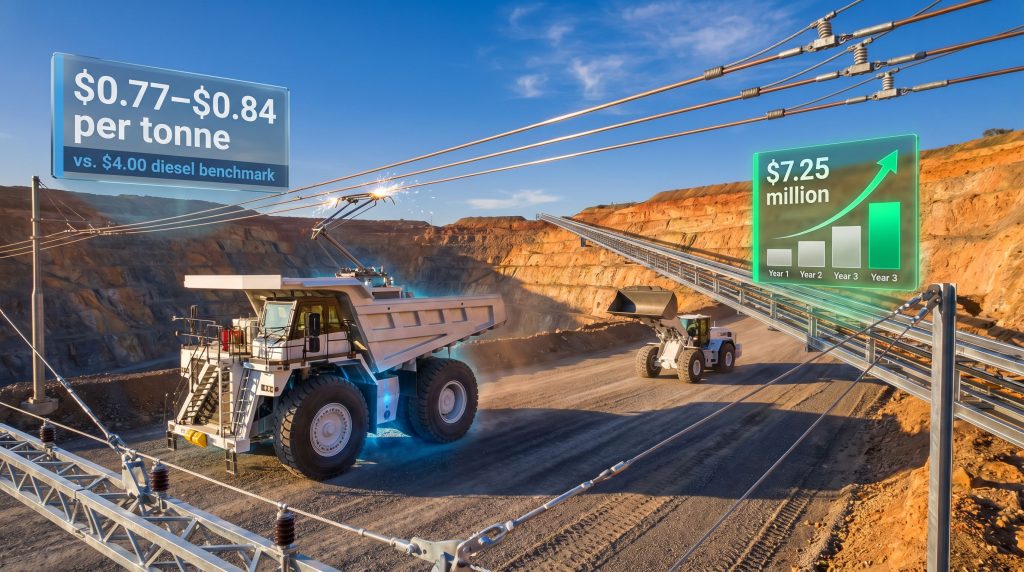
Key Finding: According to operational analysis from an existing global mining installation, electrified infrastructure-based systems can reduce haulage costs to between $0.77 and $0.84 per tonne, compared to a diesel truck benchmark of approximately $4.00 per tonne, representing a saving exceeding $3.00 per tonne. (Tas Mohamed, CEO, Railveyor, Metal Tech News, April 2026)
At an annual throughput of 823,000 tonnes, this cost differential generates avoided haulage expenditure of approximately $2.6 million per year. The same analysis modelled cumulative savings of more than $7.25 million over a three-year operational period, based on historical throughput data from the installation.
Two critical points are worth emphasising about these figures. First, the analysis explicitly excluded truck rebuild costs and underground ventilation costs attributable to diesel fleet operation. Including those categories would further strengthen the comparative economic position of electrified alternatives. Second, the figures are drawn from a real operational installation rather than theoretical projections, which lends the analysis a degree of empirical credibility that hypothetical modelling cannot match.
Why Labour Decoupling Changes the Long-Term Cost Equation
Labour represents the largest single cost component in this electrified system model at 41.9% of attributable operational expenditure. This may initially appear to undermine the cost advantage, until the structural characteristic of that labour cost is examined closely.
In conventional diesel truck fleets, every increment of production growth requires additional operators, shift supervisors, and maintenance personnel. Labour scales directly with fleet size. In an electrified fixed infrastructure system, however, throughput can increase without proportional additions to headcount. This decoupling of labour from production volume becomes increasingly valuable as operations grow, and it is particularly significant in jurisdictions where skilled operators are becoming both scarcer and more expensive.
Strategic Insight: The labour decoupling effect compounds over the life of mine. As production targets increase, the gap between the linear labour cost trajectory of a diesel fleet and the relatively fixed labour cost base of an electrified system widens with every tonne of additional throughput.
The 9.1% Power Cost Metric: What It Actually Means
Electricity consumption representing just 9.1% of total operating expenditure is a decisive structural indicator. For comparison, fuel costs in conventional diesel truck fleets typically dominate the variable cost base, creating the volatile opex exposure that mine planners must budget against. At 9.1%, electricity in an electrified system is almost incidental relative to its diesel equivalent.
Industrial electricity tariffs provide cost predictability that diesel procurement cannot match at any price level. Furthermore, the integration of renewable energy in mining operations offers a compounding advantage: in regions where grid electricity is partially or fully renewable-sourced, the efficiency benefit is amplified by decarbonisation outcomes that are increasingly carrying financial weight through carbon pricing mechanisms and ESG compliance requirements.
Comparing Electrified Haulage Technologies: Which Architecture Fits Which Operation?
Selecting the appropriate electrification architecture requires site-specific analysis. Generic cost benchmarks provide directional guidance, but investment-grade decisions require calibrated modelling against a mine's specific haul parameters, throughput profile, and infrastructure context.
Multi-Technology Comparison Framework
| Evaluation Dimension | Trolley-Assist | Battery-Electric (BEV) | Hybrid Rail-Conveyor |
|---|---|---|---|
| Best Suited For | Open-pit uphill hauls | Underground loaders and trucks | High-volume bulk haulage |
| Infrastructure Requirement | Overhead wire network | Charging and swap stations | Fixed rail corridor |
| Mobility Flexibility | High (diesel off-wire backup) | High | Low (fixed route) |
| Labour Scaling | Linear with fleet size | Linear with fleet size | Decoupled from throughput |
| Energy Cost Profile | Partially insulated from oil | Fully insulated from oil | Fully insulated from oil |
| Ventilation Cost Impact | Partial reduction | Full elimination (underground) | Full elimination (underground) |
| Capex Profile | Moderate | Moderate | Higher upfront, lower opex |
| Decarbonisation Contribution | Partial | Full (zero tailpipe emissions) | Full (zero tailpipe emissions) |
Technology providers including ABB offer simulation-based feasibility tools that model trolley, BEV, and conveyor options against a mine's specific operational parameters including haul road gradient, cycle time, annual throughput, and local electricity tariffs. Site-specific discrete event simulation is essential for producing accurate energy and cost projections, as these variables materially affect comparative outcomes across technology types.
One dimension of the BEV case that deserves specific attention is the underground ventilation cost elimination. This is a cost category that many standard comparative analyses omit entirely. When diesel combustion heat and particulate generation require dedicated ventilation infrastructure, the true cost of diesel underground haulage is substantially higher than surface-level cost-per-tonne figures suggest. BEV platforms and fixed electrified systems eliminate this burden entirely, shifting a previously hidden cost into direct opex savings.
The Decarbonisation Dimension: When Environmental Performance Becomes a Financial Variable
The environmental case for electrified mine haulage systems is well-established. The global mining sector contributes approximately 7% of total global greenhouse gas emissions, with diesel-powered haulage representing the dominant emissions source within that share, according to data cited in industry literature. Consequently, the mining decarbonisation benefits are becoming increasingly central to mine operators' strategic planning rather than a peripheral ESG consideration.
Regulatory pressure, investor ESG mandates, and emerging carbon pricing frameworks are progressively converting emissions performance from a reputational metric into a direct financial variable. Operations that carry significant diesel haulage emissions exposure are increasingly likely to face either direct carbon costs or indirect costs through tightening compliance requirements, financing conditions, and investor scrutiny.
Electrified haulage systems deliver near-zero operational emissions and are inherently compatible with renewable energy supply. When powered by grid electricity from renewable sources, electrified haulage can approach net-zero emissions performance for the entire haulage function. This integration pathway is structurally unavailable to diesel-dependent fleets without complete vehicle replacement.
There is also an energy recovery dimension that adds further efficiency to certain electrified architectures. Fixed rail systems and trolley-assist configurations with regenerative braking capabilities can recover kinetic energy during descent cycles and feed it back into the mine's electrical grid. In high-throughput operations with significant elevation differentials, this energy recovery meaningfully reduces gross power consumption per tonne moved.
The next major ASX story will hit our subscribers first
Barriers to Adoption: What Is Preventing Faster Uptake of Electrified Haulage?
The economic case for electrified mine haulage systems is compelling, yet adoption has been uneven across the global mining sector. Several genuine barriers constrain the pace of transition, and understanding them is important for assessing which operations are most likely to move first and fastest.
Capital Expenditure and Infrastructure Deployment Challenges
Fixed infrastructure systems require upfront capital investment that typically exceeds the procurement cost of an equivalent diesel truck fleet. Rail corridors, overhead wire networks, and electrified handling systems demand significant front-end commitment before a single tonne of savings is realised. For brownfield operations, retrofit complexity adds further cost: existing haul road geometries, underground development profiles, and electrical supply infrastructure may require modification to accommodate new systems.
Battery-electric vehicle adoption faces a separate constraint: battery energy density limitations on long-haul or high-gradient cycles where diesel energy density retains a meaningful advantage. While battery technology is advancing rapidly, this remains a genuine operational boundary for certain duty cycles.
Operational Transition Risks
Transitioning from a diesel fleet to an electrified system requires retraining maintenance and operations personnel across new technology platforms. Supply chain support for electrified systems, including battery replacement, software updates, and specialist technical services, is considerably less mature than the established diesel equipment service network in most mining regions. Remote mine sites face additional challenges in accessing the electrical grid infrastructure required to power large-scale electrified haulage systems.
The Financial Viability Thresholds
Decision Framework for Mine Operators: Electrified mine haulage systems demonstrate the strongest financial case when the following conditions are present:
- Annual throughput exceeds approximately 500,000 tonnes, providing sufficient scale to amortise fixed infrastructure costs
- Remaining mine life is 10 years or longer, enabling full lifecycle cost recovery
- Diesel price exposure is material relative to total opex
- Underground ventilation costs represent a significant budget line
- Carbon pricing or emissions compliance costs are present or anticipated in the operating jurisdiction
- Skilled operator availability is constrained and wage costs are rising
Operations that meet several of these criteria simultaneously are the most likely early adopters, and the savings case in those contexts is not marginal. At 823,000 tonnes of annual throughput, the documented analysis shows savings exceeding $2.6 million per year against a diesel fleet baseline.
Step-by-Step: How Mine Operators Evaluate and Implement Electrified Haulage Systems
Phase 1: Operational Baseline Assessment
- Quantify current diesel consumption volume and cost as a percentage of total haulage opex
- Document haul cycle parameters: distance, gradient, payload, cycle time, and annual throughput
- Identify underground ventilation costs attributable to diesel fleet operation
- Establish a full lifecycle cost model for the existing fleet, including rebuild and replacement schedules
Phase 2: Technology Selection and Feasibility Modelling
- Engage technology providers for site-specific simulation modelling across applicable electrification options
- Assess local electricity grid capacity, tariff structures, and renewable energy availability
- Model capital expenditure requirements against projected opex savings over the mine's remaining life
- Evaluate commercial structures including equipment-as-a-service or battery-as-a-service arrangements that reduce upfront capital exposure
Phase 3: Pilot Deployment and Performance Validation
- Implement a defined pilot scope covering a single haul corridor or a limited BEV fleet deployment
- Collect operational performance data against pre-defined KPIs: cost per tonne, energy consumption per tonne, system availability, and maintenance frequency
- Compare pilot outcomes against pre-feasibility modelling assumptions
- Refine full-scale deployment business case using validated operational data
Phase 4: Full-Scale Integration and Optimisation
- Scale infrastructure deployment across identified haul corridors or production zones
- Integrate remote monitoring and digital optimisation platforms to maximise system efficiency
- Establish long-term service agreements covering software support and technical maintenance
- Incorporate electrified haulage performance data into mine planning and life-of-mine cost modelling
The Role of Digital Systems in Electrified Haulage Performance
One dimension of electrified mine haulage systems that frequently receives insufficient attention is the role of integrated digital technology. Remote monitoring and control systems are not simply supplementary features; they are structural components of the cost efficiency model. In addition, AI-powered mining efficiency platforms are increasingly being integrated with electrified haulage infrastructure to further enhance operational performance.
In the cost architecture of documented electrified installations, remote software support appears as a distinct opex category precisely because digital optimisation continuously improves system performance and reduces the frequency of on-site intervention. Predictive maintenance algorithms identify potential failure conditions before they translate into production disruptions, improving availability metrics while reducing unplanned maintenance expenditure.
This digital layer also enables electrified systems to generate operational data at a granularity that diesel fleet management typically cannot match. Cycle time analysis, energy consumption per tonne, load optimisation, and system availability can all be monitored and adjusted in real time, creating a continuous improvement mechanism that is structurally absent from conventional fleet operations.
The on-site technical support category, accounting for approximately 13.5% of opex in the documented analysis, reflects specialist maintenance requirements for electrified infrastructure. While this represents a genuine cost, it is significantly lower in frequency and aggregate cost than the maintenance burden associated with complex diesel machinery operating in harsh conditions.
Frequently Asked Questions: Electrified Mine Haulage Systems
What is the primary financial advantage of electrified mine haulage over diesel trucks?
The most significant advantage is the structural reduction and predictability of operating costs. Documented operational analysis shows electrified infrastructure-based systems can reduce haulage costs to between $0.77 and $0.84 per tonne, against a diesel truck benchmark of approximately $4.00 per tonne. At an annual throughput of 823,000 tonnes, this differential equates to avoided haulage costs of approximately $2.6 million per year, rising to cumulative savings exceeding $7.25 million over a three-year period (Tas Mohamed, CEO, Railveyor, Metal Tech News, April 2026).
Are electrified haulage systems suitable for underground mining?
Battery-electric vehicles are particularly well-suited to underground applications because they eliminate diesel combustion, removing the heat and particulate generation that requires costly ventilation infrastructure. Fixed rail-conveyor systems are also applicable to underground bulk haulage corridors and deliver the same ventilation cost elimination benefit.
What role does digital technology play in electrified haulage systems?
Remote monitoring, predictive maintenance software, and autonomous control systems are integral components of modern electrified haulage architectures. Digital optimisation platforms reduce the need for on-site intervention, improve system availability, and enable continuous performance improvement, contributing directly to the overall cost efficiency profile of the system.
How do electrified haulage systems support mining decarbonisation targets?
Electrified systems deliver near-zero operational emissions and are directly compatible with renewable energy supply. When powered by grid electricity from renewable sources, electrified mine haulage systems can approach net-zero emissions performance for the haulage function — a pathway that is structurally unavailable to diesel-dependent fleets without complete vehicle replacement.
What is the typical payback period for electrified haulage infrastructure?
Payback periods vary significantly based on throughput volume, mine life, local electricity tariffs, and diesel price levels. Operations with annual throughput above 500,000 tonnes and remaining mine lives exceeding 10 years typically demonstrate the strongest financial cases. Site-specific modelling is essential for accurate payback period determination, as generic industry benchmarks provide directional guidance only.
The Long-Term Strategic Outlook: Why Energy Price Uncertainty Permanently Alters the Haulage Calculus
The current period of energy market instability is not an anomaly requiring a temporary operational response. It is a condition that structural trends in global geopolitics, energy supply concentration, and fossil fuel dependency make increasingly probable on a recurring basis. For mine operators, the strategic question is not whether diesel prices will again spike severely, but whether to structure operations so that the next spike becomes irrelevant.
Electrified mine haulage systems answer that question by eliminating diesel exposure entirely at the haulage level. The cost structure that results, anchored in electricity consumption at 9.1% of opex rather than diesel at a dominant and volatile share, insulates mining economics from the oil market disruptions that have historically created sudden, unmanageable cost escalations.
The convergence of three independent pressures is accelerating this transition beyond the pace that purely internal mine economics would drive alone. Rising carbon pricing frameworks are adding a regulatory cost dimension to diesel operations. Investor ESG requirements are tightening financing conditions for carbon-intensive assets. And the proven, documented performance of electrified alternatives is removing the uncertainty that once justified delaying adoption.
Important note: This article discusses operational cost modelling from published industry sources and should not be interpreted as financial advice or a guarantee of specific cost outcomes at any individual mining operation. All figures referenced are drawn from analysis of a specific existing global mining installation and will vary based on site-specific conditions, local electricity tariffs, diesel price assumptions, and operational parameters. Readers should conduct independent site-specific feasibility analysis before making capital allocation decisions.
Want to Know Which Mining Companies Are Capitalising on the Electrification Revolution?
Discovery Alert's proprietary Discovery IQ model scans ASX announcements in real time, instantly identifying significant mineral discoveries and actionable investment opportunities — including companies at the forefront of mining's structural transformation. Explore historic discoveries and their remarkable returns on Discovery Alert's dedicated discoveries page, and begin your 14-day free trial to position yourself ahead of the market.