May 24, 2026
What Makes Emirates Global Aluminium's UAE Facility a Global Manufacturing Benchmark?
Industrial aluminium production represents one of the most energy-intensive manufacturing processes in modern industry, requiring precise integration of advanced technology, massive electrical infrastructure, and specialised expertise. The technical sophistication needed to operate primary aluminium smelting facilities at global scale creates natural barriers that separate world-class producers from conventional operations. Understanding these operational complexities becomes essential when evaluating facility capabilities and assessing international technology transfer opportunities, particularly as industry innovation trends continue to reshape global manufacturing landscapes.
Production Scale and Technical Specifications
Emirates Global Aluminium operates two major smelting complexes in the UAE, with the Al Taweelah facility maintaining nominal capacity of approximately 1.4 million metric tonnes per annum, positioning it among the largest integrated aluminium smelting operations globally. Combined capacity across both facilities exceeds 1.6 MTPA, demonstrating the massive scale required for competitive primary aluminium production.
The facilities employ Pre-baked Anode technology, representing one of the most advanced electrolytic reduction methods available for primary aluminium manufacturing. Energy consumption rates maintained at approximately 12.5-13.5 kWh per kilogram of aluminium produced reflect industry-competitive efficiency levels, though electricity costs typically represent 25-35% of total production expenses.
During the recent Emirates Global Aluminium Oklahoma plant tour conducted in February 2026, delegation members from Oklahoma's public and private sectors observed firsthand how these technical specifications translate into operational reality. The facility demonstration revealed that achieving world-class production standards requires simultaneous optimisation across multiple operational dimensions.
Advanced Smelting Technology Integration
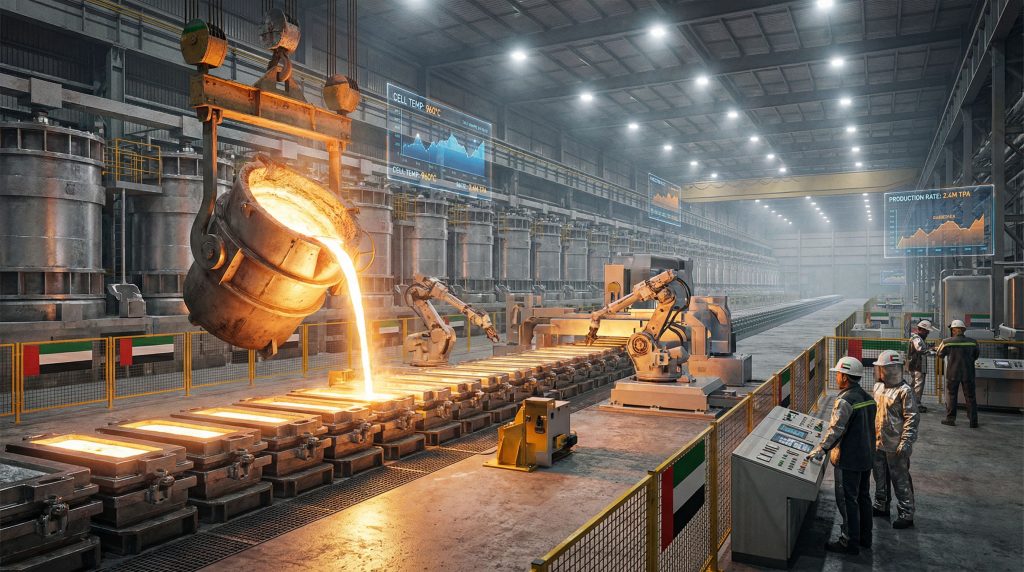
Modern primary aluminium facilities utilise the Hall-Héroult electrolytic process, passing electric current through molten cryolite containing dissolved alumina at temperatures of 960-970°C. This process architecture demands sophisticated integration of multiple technical systems:
- Electrolytic reduction cells arranged in continuous potlines
- Carbon anode management systems handling precise consumption rates
- Molten metal temperature regulation maintaining consistent thermal profiles
- Cast house facilities enabling real-time alloy customisation
The technical tour provided Oklahoma delegation members practical understanding of how these components function as integrated systems rather than isolated processes. Representatives from Public Service Company of Oklahoma assessed electrical load requirements, while Tulsa Ports Authority representatives evaluated transportation infrastructure needed to support continuous raw material flows.
Workforce Development and Automation Balance
World-class aluminium production facilities demonstrate successful integration of advanced automation technologies with skilled workforce expertise. The EGA facility showcases this balance through deployment of sophisticated control systems while maintaining substantial direct employment across multiple skill categories.
Oklahoma Department of Commerce Chief Executive John Budd noted that observing the facility's operational scale provided tangible understanding of workforce requirements for similar operations. The seamless integration of technological systems with human expertise creates operational capabilities that pure automation cannot replicate, particularly for quality control, maintenance, and process optimisation functions.
When big ASX news breaks, our subscribers know first
How Does Primary Aluminium Production Transform Regional Economies?
Large-scale industrial facilities generate economic impacts extending far beyond direct employment creation, establishing interconnected networks of suppliers, service providers, and complementary businesses that reshape entire regional economies. Primary aluminium production facilities, due to their massive scale and technical complexity, create particularly pronounced transformation effects across multiple economic sectors simultaneously.
Employment Multiplier Effects in Industrial Communities
Research from the International Aluminium Institute indicates that primary aluminium facilities typically generate direct employment ranging from 500-1,500 positions depending on facility capacity and automation levels. However, secondary employment effects create additional opportunities across supply chain networks, technical services, and regional commercial activity.
Economic multiplier effects typically range from 1.5:1 to 3:1, meaning each direct manufacturing position supports between 1.5 and 3 additional jobs throughout the regional economy. These positions span diverse skill levels and industries:
- Technical and engineering services for equipment maintenance and process optimisation
- Transportation and logistics for raw material delivery and product distribution
- Construction and infrastructure for facility expansion and utility upgrades
- Commercial and retail services supporting increased regional population
The Oklahoma delegation's assessment of EGA's facility provided concrete visualisation of these employment patterns. Furthermore, mining sustainability transformation initiatives are creating additional opportunities for skilled workers across manufacturing sectors.
Infrastructure Development Requirements
Primary aluminium production creates cascading infrastructure investment requirements that benefit entire regional economies. The proposed Inola facility's development necessitates coordinated upgrades across multiple systems:
- Electrical grid enhancement to support massive continuous power loads
- Transportation network expansion for alumina delivery and product shipping
- Water supply and treatment systems for cooling and process requirements
- Telecommunications infrastructure supporting advanced automation and global connectivity
Public Service Company of Oklahoma's participation in the facility tour reflected recognition that utility infrastructure development creates long-term competitive advantages extending beyond the primary facility itself. Enhanced electrical transmission capacity, once installed, supports additional industrial development and economic diversification opportunities.
Supply Chain Integration Opportunities
Modern aluminium smelting operations require integration with complex supply networks spanning raw material procurement, specialised services, and downstream processing capabilities. The Inola facility's strategic positioning relative to existing infrastructure creates opportunities for supply chain cluster development.
Raw Material Supply Networks:
| Component | Annual Volume Requirements | Quality Specifications |
|---|---|---|
| Alumina | 1.9-2.0 tons per ton aluminium | 99.5%+ purity levels |
| Carbon Anodes | 0.4-0.5 tons per ton aluminium | 85-90% carbon content |
| Electricity | 13-15 MWh per ton aluminium | Consistent high-capacity supply |
The Arkansas River transportation corridor, accessible through Tulsa Ports Authority infrastructure, positions the Oklahoma facility advantageously for alumina imports and finished product distribution. This geographic advantage creates opportunities for complementary logistics and processing businesses to establish regional operations.
What Are the Core Components of Modern Aluminium Smelting Operations?
Primary aluminium production requires precise coordination of multiple technical processes operating continuously under demanding conditions. Understanding these operational components becomes essential for assessing facility capabilities, evaluating investment requirements, and appreciating the technical expertise needed for successful operations.
Essential Input Materials: Electricity, Alumina, and Carbon Anodes
Three principal inputs drive all primary aluminium production, each requiring specific quality standards and continuous availability:
Electricity serves as the primary energy source for electrolytic reduction, with modern facilities consuming 12.5-15 kWh per kilogram of aluminium produced. Electrical supply must maintain consistent voltage and frequency characteristics while delivering massive continuous loads. For a facility producing 500,000 tonnes annually, electricity requirements exceed 650 GWh per year, equivalent to powering approximately 60,000 average American households.
Alumina (Al₂O₃) provides the raw material feedstock, requiring 99.5%+ purity levels for optimal smelting performance. Approximately 1.9-2.0 tonnes of alumina produce one tonne of primary aluminium through the electrolytic process. Quality variations in alumina composition directly impact energy efficiency, product purity, and overall operational performance.
Carbon anodes facilitate electrical conductivity through the molten electrolyte, requiring 85-90% carbon content with precise physical and chemical properties. Anodes are consumed during the electrolytic process at rates of approximately 0.4-0.5 tonnes per tonne of aluminium produced, necessitating continuous replacement and quality control. Moreover, data-driven operations enable precise monitoring and optimisation of anode consumption patterns.
Molten Metal Processing and Cast House Operations
Once extracted from electrolytic cells, molten aluminium at approximately 960-970°C undergoes sophisticated processing to achieve customer specifications. Cast house operations represent the critical transition from primary production to market-ready products.
Temperature stabilisation and purity assessment remove impurities including iron, silicon, copper, and zinc through chemical additives and filtration systems. This purification process ensures that finished products meet stringent quality standards required for downstream applications.
Alloying capabilities enable customisation to customer requirements through controlled addition of elements such as:
- Copper and magnesium for structural applications requiring enhanced strength
- Silicon for casting alloys with improved fluidity and corrosion resistance
- Manganese for beverage container applications requiring formability
- Zinc for aerospace applications demanding maximum strength-to-weight ratios
Product Customisation and Alloy Specifications
Modern cast house facilities produce multiple standardised product forms optimised for different downstream applications. Direct Chill casting technology enables formation of ingots, billets, and rolling ingots with precise dimensional tolerances and metallurgical properties.
Primary product categories include:
- 1000 series alloys: Commercially pure aluminium for electrical and chemical applications
- 3000 series alloys: Manganese-containing compositions for packaging and construction
- 5000 series alloys: Magnesium-containing materials for marine and automotive uses
- 6000 series alloys: Heat-treatable compositions for architectural and transportation applications
The Emirates Global Aluminium Oklahoma plant tour demonstrated how cast house flexibility enables real-time production adjustments based on customer orders and market demands. This operational capability creates competitive advantages through reduced inventory requirements and enhanced customer responsiveness.
Why Is the Oklahoma-UAE Partnership Significant for US Manufacturing?
The collaboration between Emirates Global Aluminium and Century Aluminium represents a watershed moment for American industrial development, marking the first major expansion of primary aluminium production capacity in the United States since the 1970s. This partnership addresses strategic supply chain vulnerabilities while introducing advanced manufacturing technologies that could reshape domestic industrial capabilities.
First New US Smelter Development in Nearly Five Decades
Historical analysis reveals that the most recent primary aluminium smelter construction in the United States occurred in 1973 with Alcan's Sebree, Kentucky facility. The 53-year gap between then and the proposed Inola development reflects broader trends affecting American manufacturing competitiveness.
US Primary Aluminium Capacity Decline:
- 1970s capacity: Approximately 4 million metric tonnes per annum across multiple facilities
- Current capacity: Roughly 1 million metric tonnes per annum from remaining operations
- Facility closures: Major smelters in Washington, Tennessee, North Carolina, and New York ceased operations
The remaining US primary aluminium infrastructure consists of limited facilities including the Magnitude 7 smelter in Kentucky, Intalco's Bellingham operations, and Tri-Arrows Aluminum's Nevada facility. This constrained domestic capacity creates strategic vulnerabilities for industries requiring reliable aluminium supplies.
Century Aluminium's partnership with Emirates Global Aluminium brings proven operational expertise and advanced technology to American soil. EGA's global production experience, demonstrated through facilities processing over 2.6 million tonnes annually, provides technical capabilities that domestic operators can leverage for competitive advantage.
Strategic Domestic Supply Chain Strengthening
The Inola facility's development addresses critical supply chain resilience issues affecting multiple American industries. Domestic primary aluminium production reduces dependence on imports while creating opportunities for vertical integration across manufacturing sectors.
Strategic supply benefits include:
- Transportation cost reduction through proximity to end-user markets
- Supply security enhancement reducing geopolitical and logistical risks
- Quality control improvement through direct customer-producer relationships
- Innovation acceleration enabling rapid prototype and specification development
M-D Building Products' participation in the facility assessment tour reflects recognition that reliable domestic aluminium supplies create competitive advantages for American manufacturers. Direct supplier relationships enable customisation, reduce inventory requirements, and improve supply chain predictability.
International Technology Transfer Benefits
Emirates Global Aluminium's commitment to deploying leading-edge technology in Oklahoma creates opportunities for substantial technology transfer benefiting broader American manufacturing capabilities. Advanced smelting technologies, automation systems, and operational methodologies developed through EGA's global experience become available to American workers and suppliers.
Technology transfer encompasses:
- Process optimisation techniques improving energy efficiency and product quality
- Automation systems integration enhancing operational safety and consistency
- Environmental management practices meeting stringent regulatory requirements
- Workforce development programmes creating specialised technical expertise
The collaboration also establishes pathways for American suppliers to participate in global aluminium industry supply chains. In addition, AI in mining automation technologies being developed can complement traditional smelting operations.
How Do Billion-Dollar Smelter Projects Impact State-Level Economic Development?
Massive industrial investments create transformational economic effects that extend far beyond immediate construction and operational activities. The scale of capital deployment, infrastructure requirements, and long-term operational commitments associated with primary aluminium facilities generate sustained economic development across multiple sectors and timeframes.
Direct and Indirect Job Creation Patterns
Large-scale aluminium smelting facilities typically generate 500-1,500 direct employment positions depending on capacity and automation levels. However, comprehensive economic impact extends through multiple employment categories:
Construction Phase Employment:
- Peak construction workforce: 2,000-4,000 positions during facility development
- Specialised trades: Electrical, mechanical, and industrial construction expertise
- Duration: 3-4 years from groundbreaking through commissioning
Operational Phase Employment:
- Direct manufacturing positions: Technical operators, maintenance specialists, quality control
- Administrative and support roles: Engineering, logistics, environmental, safety management
- Contractor services: Specialised maintenance, transportation, technical support
Regional Multiplier Effects:
Large-scale aluminium smelting facilities typically generate employment ratios of 1:3, meaning each direct manufacturing job creates approximately three additional positions across supporting industries and services.
Oklahoma Department of Commerce analysis indicates that the Inola project represents generational economic opportunity with employment impacts extending across decades rather than typical project lifecycles.
Skills Training and Educational Partnership Requirements
Primary aluminium production demands specialised technical expertise that typically requires dedicated workforce development programmes. Successful facility operations depend on skilled personnel capable of managing complex electrolytic processes, advanced automation systems, and sophisticated quality control procedures.
Essential skill categories include:
- Electrolytic process operations requiring understanding of electrochemistry and thermal management
- Automation systems management integrating digital controls with physical processes
- Metallurgical quality control ensuring product specifications and alloy composition accuracy
- Industrial maintenance supporting continuous operations with minimal downtime
Educational partnerships with regional institutions create pathways for developing these specialised capabilities. Community colleges, technical schools, and universities can establish curriculum programmes specifically designed to support aluminium industry requirements while creating broader technical education capabilities benefiting other industries.
Long-term Regional Competitiveness Enhancement
Successful industrial anchor projects create competitive advantages that attract additional investment and economic development opportunities. The technical infrastructure, skilled workforce, and supply chain networks established to support primary aluminium operations provide foundations for broader manufacturing diversification.
Regional competitiveness factors include:
- Industrial infrastructure: Enhanced electrical grid, transportation networks, technical services
- Workforce capabilities: Specialised skills transferable to other advanced manufacturing
- Business ecosystem: Suppliers, contractors, and service providers supporting industrial operations
- Innovation capacity: Research and development capabilities supporting continuous improvement
Ryan Plotkin emphasised that realising these opportunities requires coordinated collaboration between industry, government, utilities, and community stakeholders. This collaborative approach becomes crucial for positioning regions to compete successfully in global manufacturing markets over extended timeframes.
What Operational Insights Can Manufacturing Delegations Gain from Facility Tours?
Direct facility observation provides manufacturing professionals, government officials, and potential partners with practical understanding that cannot be achieved through documentation or presentations alone. The complexity and scale of modern primary aluminium operations create learning opportunities across multiple operational dimensions.
Scale Visualisation and Capacity Planning
Physical facility tours enable delegation members to comprehend the massive scale requirements for competitive primary aluminium production. The EGA facility demonstration revealed operational footprints, equipment dimensions, and material handling systems that transform abstract capacity numbers into tangible reality.
Key scale observations include:
- Facility footprint requirements spanning hundreds of acres for complete operations
- Equipment dimensions with individual reduction cells, cranes, and processing equipment
- Material flow volumes demonstrating continuous raw material and product movement
- Utility infrastructure scale including electrical transmission and cooling water systems
Oklahoma delegation members gained practical appreciation for infrastructure requirements, construction complexity, and operational logistics that inform realistic project planning and resource allocation decisions.
Technology Assessment and Implementation Strategies
Modern aluminium smelting facilities integrate sophisticated technologies across multiple operational areas. Direct observation enables assessment of automation levels, control systems integration, and technology deployment strategies that influence operational performance and competitiveness.
Technology evaluation areas include:
- Process automation systems managing electrolytic cell operations and molten metal handling
- Quality control technologies ensuring consistent product specifications and purity levels
- Environmental management systems meeting regulatory requirements while optimising performance
- Data integration platforms connecting operational systems with management and customer networks
The facility tour provided concrete examples of how advanced technology deployment creates operational advantages while requiring specialised workforce capabilities and maintenance expertise.
Workforce Integration Models
Successful primary aluminium operations depend on effective integration of technological systems with skilled human expertise. Facility tours demonstrate how world-class operations balance automation capabilities with workforce involvement across multiple functional areas.
Workforce integration observations encompass:
- Operational roles requiring technical expertise for process management and quality control
- Maintenance functions demanding specialised skills for complex equipment and systems
- Safety protocols ensuring personnel protection in high-temperature, high-energy environments
- Continuous improvement activities leveraging workforce experience for operational optimisation
John Budd noted that observing the seamless integration of advanced automation with highly trained workforce demonstrated the employment quality and career development opportunities that major industrial projects can provide. Consequently, the insights gained from the Emirates Global Aluminium Oklahoma plant tour will inform workforce development strategies.
The next major ASX story will hit our subscribers first
How Does Modern Aluminium Production Address Environmental and Sustainability Concerns?
Contemporary primary aluminium production faces increasing environmental scrutiny and regulatory requirements, driving technological innovation and operational improvements across the industry. Advanced facilities demonstrate that environmental performance and operational efficiency can be achieved simultaneously through strategic technology deployment and process optimisation.
Energy Efficiency Optimisation Strategies
Electricity consumption represents the largest environmental impact category for primary aluminium production, consuming 13-15 kWh per kilogram of metal produced. Modern facilities implement comprehensive energy management strategies to minimise consumption while maintaining production quality.
Energy optimisation approaches include:
- Advanced cell technology reducing electrical resistance and thermal losses
- Process control systems maintaining optimal operating conditions across all reduction cells
- Heat recovery systems capturing waste thermal energy for beneficial uses
- Power factor management improving electrical system efficiency and reducing transmission losses
Emirates Global Aluminium's operational experience demonstrates that systematic energy management can achieve consumption levels at the lower end of industry ranges while maintaining consistent production quality and operational reliability.
Carbon Footprint Reduction Technologies
Primary aluminium production generates carbon dioxide emissions through multiple pathways, including anode consumption during electrolytic reduction and electricity generation for process energy. Advanced facilities implement comprehensive carbon management strategies addressing both direct and indirect emission sources.
Carbon reduction strategies encompass:
- Improved anode technology reducing carbon consumption rates per unit of metal produced
- Renewable electricity sourcing displacing fossil fuel-generated power with clean energy
- Process efficiency improvements reducing total energy requirements through operational optimisation
- Carbon capture consideration for future implementation of emerging CO₂ management technologies
The UAE's strategic commitment to renewable energy development creates opportunities for EGA facilities to access clean electricity sources, potentially providing competitive environmental advantages for the Oklahoma facility through technology transfer.
Circular Economy Integration Approaches
Modern aluminium production increasingly emphasises circular economy principles through materials recovery, waste minimisation, and product lifecycle optimisation. Primary producers implement strategies that extend beyond facility boundaries to encompass entire value chains.
Circular economy initiatives include:
- Aluminium recycling integration incorporating secondary metal sources into production streams
- By-product utilisation converting production wastes into useful materials for other industries
- Packaging optimisation reducing material requirements while maintaining product protection
- End-of-life recovery facilitating aluminium product collection and reprocessing
These approaches create operational synergies while addressing environmental concerns and potentially reducing raw material costs through improved resource efficiency.
What Are the Critical Success Factors for International Industrial Partnerships?
Complex international partnerships involving billion-dollar industrial investments require coordination across multiple stakeholder groups, regulatory frameworks, and technical systems. Successful project development depends on addressing diverse requirements simultaneously while maintaining alignment toward common objectives.
Government-Industry Collaboration Requirements
Effective public-private partnerships for major industrial development require sustained collaboration between government entities and private sector partners. Successful collaboration addresses regulatory requirements, infrastructure coordination, and economic development objectives through structured engagement processes.
Government collaboration elements include:
- Regulatory coordination streamlining permitting and approval processes across multiple agencies
- Infrastructure planning aligning utility, transportation, and community development investments
- Workforce development supporting education and training programmes for specialised technical skills
- Economic incentive structuring balancing public investment with private sector commitments
Oklahoma Department of Commerce leadership emphasised that successful partnership development requires sustained commitment from both public and private sector participants throughout extended project development and operational phases.
Utility Infrastructure Coordination
Primary aluminium facilities require massive, reliable utility services that often exceed existing regional infrastructure capabilities. Successful project development necessitates early coordination with utility providers to ensure adequate capacity and reliability for continuous operations.
Utility coordination requirements encompass:
- Electrical transmission enhancement providing consistent high-capacity power delivery
- Grid stability management maintaining system reliability despite massive continuous loads
- Water supply and treatment supporting cooling and process requirements
- Waste management systems handling industrial by-products and water treatment residuals
Public Service Company of Oklahoma's participation in the facility assessment tour reflected recognition that utility infrastructure development requires long-term planning and substantial capital investment coordination.
Community Stakeholder Engagement
Large-scale industrial development creates community impacts extending beyond direct employment and economic benefits. Successful project implementation requires comprehensive stakeholder engagement addressing community concerns while building support for long-term operations.
Community engagement strategies address:
- Environmental impact transparency providing clear information about emissions, water use, and waste management
- Local hiring commitments ensuring community residents access employment opportunities
- Infrastructure impact mitigation addressing traffic, housing, and public service requirements
- Long-term community partnership establishing ongoing communication and collaboration mechanisms
Ryan Plotkin's emphasis on collaborative approaches reflects industry recognition that community support becomes essential for successful long-term operations in competitive global markets.
Future Outlook: Positioning for Global Aluminium Market Leadership
The Emirates Global Aluminium-Century Aluminium partnership positions Oklahoma to participate in evolving global aluminium markets while addressing strategic supply chain requirements for American industries. Understanding market dynamics and technological trends becomes essential for maximising long-term competitive advantages.
Production Capacity Expansion Potential
The Inola facility's development creates opportunities for additional capacity expansion based on market demand evolution and operational success. Strategic positioning relative to transportation infrastructure, electricity supply, and skilled workforce development supports potential growth beyond initial facility capabilities.
Expansion opportunities include:
- Phased capacity additions responding to market demand growth and operational experience
- Downstream processing integration adding casting, rolling, or fabrication capabilities
- Specialised alloy development creating custom products for specific customer applications
- Technology demonstration projects showcasing advanced production methods or environmental technologies
Successful initial operations provide foundations for positioning Oklahoma as a competitive centre for American aluminium production and processing activities. Furthermore, North American market trends support strategic expansion opportunities.
Market Demand Projections and Supply Security
Global aluminium demand continues growing driven by transportation lightweighting, renewable energy infrastructure, and packaging applications. Domestic production capability creates strategic advantages for American manufacturers while reducing supply chain risks.
Market drivers supporting expansion include:
- Electric vehicle adoption increasing demand for lightweight structural materials
- Renewable energy deployment requiring aluminium for solar panels and transmission infrastructure
- Infrastructure modernisation utilising aluminium for bridges, buildings, and transportation systems
- Packaging sustainability replacing other materials with recyclable aluminium alternatives
The facility's strategic positioning enables rapid response to market opportunities while providing supply security for domestic customers requiring consistent material availability.
Technological Innovation Integration Opportunities
Emerging technologies in aluminium production create opportunities for competitive advantage through early adoption and development partnerships. The Oklahoma facility's modern design enables integration of advanced technologies as they become commercially viable.
Innovation areas include:
- Carbon-free production technologies reducing or eliminating CO₂ emissions from smelting processes
- Advanced automation systems improving operational efficiency and product quality consistency
- Digital twin integration optimising operations through real-time modelling and predictive analytics
- Circular economy technologies maximising materials recovery and waste utilisation
Strategic technology partnerships position the facility to maintain competitive advantages while contributing to industry-wide advancement and sustainability improvement efforts.
Disclaimer: This analysis includes forward-looking projections and market assessments based on current industry trends and announced partnerships. Actual results may vary based on market conditions, regulatory changes, technological developments, and execution risks. Readers should conduct independent research before making investment or business decisions related to aluminium industry investments.
Ready to Capitalise on the Next Major Industrial Discovery?
Discovery Alert's proprietary Discovery IQ model delivers real-time alerts on significant ASX mineral discoveries, instantly empowering subscribers to identify actionable opportunities ahead of the broader market. Understand why major mineral discoveries can lead to substantial market returns by exploring Discovery Alert's dedicated discoveries page, and begin your 14-day free trial today to position yourself ahead of the market.