June 9, 2026
The Hidden Cost Multiplier Reshaping Equipment Decisions Across Peru's Mining Landscape
Across the extractive industries of South America, a quiet but consequential shift is underway. The criteria by which heavy equipment gets evaluated, purchased, and retained has fundamentally changed. For decades, procurement decisions for crushing infrastructure centred on throughput capacity and capital outlay. Today, an entirely different metric drives the conversation: energy intensity per tonne processed. In Peru, where the crushing stage routinely represents the single largest energy draw on any mining or aggregate site, this shift carries profound financial consequences.
Understanding why energy-saving crushing plants in Peru have moved from niche consideration to procurement priority requires looking at the full cost architecture of Andean and coastal operations, not just the sticker price of the equipment itself.
When big ASX news breaks, our subscribers know first
Why the Crushing Stage Has Become Peru's Most Scrutinised Energy Cost Centre
The crushing circuit is not simply one energy consumer among many. At most hard-rock mining and aggregate quarry operations, it commands a disproportionate share of total site power draw. Comminution, the process of breaking rock from run-of-mine size down to product specification, is thermodynamically inefficient by nature. Industry research consistently shows that only a small fraction of the energy input to a crusher actually performs useful fracture work, with the remainder dissipated as heat, vibration, and noise.
This inherent inefficiency, combined with the long operating hours characteristic of Peruvian operations, means that cumulative energy expenditure at remote sites frequently surpasses the original capital cost of crushing equipment within a three-to-five-year operational window. That single economic reality reframes every procurement conversation: lifecycle cost, not purchase price, is the defining variable.
The Compounding Pressure of Energy Price Volatility and Margin Compression
Peru's operators face a convergence of pressures that amplifies the importance of energy efficiency. Diesel prices fluctuate with global crude benchmarks, but the delivered cost to remote high-altitude sites bears an additional logistics premium that can be substantial. Industrial electricity tariffs in coastal and peri-urban zones have climbed steadily over recent years. Simultaneously, ore grades at some established Peruvian copper and polymetallic deposits have declined over successive mining cycles, compressing per-tonne margins and reducing the operator's capacity to absorb rising input costs.
A crushing plant that achieves 15% lower specific energy consumption delivers a direct margin improvement on every tonne processed, assuming all other cost inputs remain constant. At scale, across operations processing hundreds of thousands of tonnes annually, this differential becomes a structurally significant competitive advantage. Furthermore, the broader shift toward mining electrification trends is reinforcing this pressure across the sector.
What Energy-Saving Crushing Plants Actually Are: A Technology Architecture Overview
The term energy-saving crushing plant describes a category, not a single invention. Modern efficient crushing systems layer multiple discrete technologies, each delivering incremental savings that compound into substantial overall reductions. No single innovation accounts for the full efficiency gain; rather, it is the integration of complementary improvements across the drive system, material handling, and chamber geometry that produces meaningful results.
Drive System Efficiency: The Largest Single Lever
The most impactful transition available to Peruvian operators is the move from diesel-hydraulic to electric drive systems. A conventional diesel engine converts approximately 35% of fuel energy into usable mechanical power, with the remainder lost to heat rejection, exhaust, and drivetrain friction. An electric motor operating on grid or hybrid power achieves efficiencies exceeding 90%, a gap that translates directly into operating cost.
For operations running 5,000 hours per year, a figure typical of many Peruvian continuous operations, this efficiency differential generates enormous cumulative fuel and power cost savings. The table below illustrates how different drive configurations compare across key performance dimensions:
| System Type | Typical Drive Efficiency | Estimated Energy Saving Potential | Best-Fit Application |
|---|---|---|---|
| Conventional Diesel-Hydraulic | ~35% fuel-to-mechanical conversion | Baseline | Remote sites with no grid access |
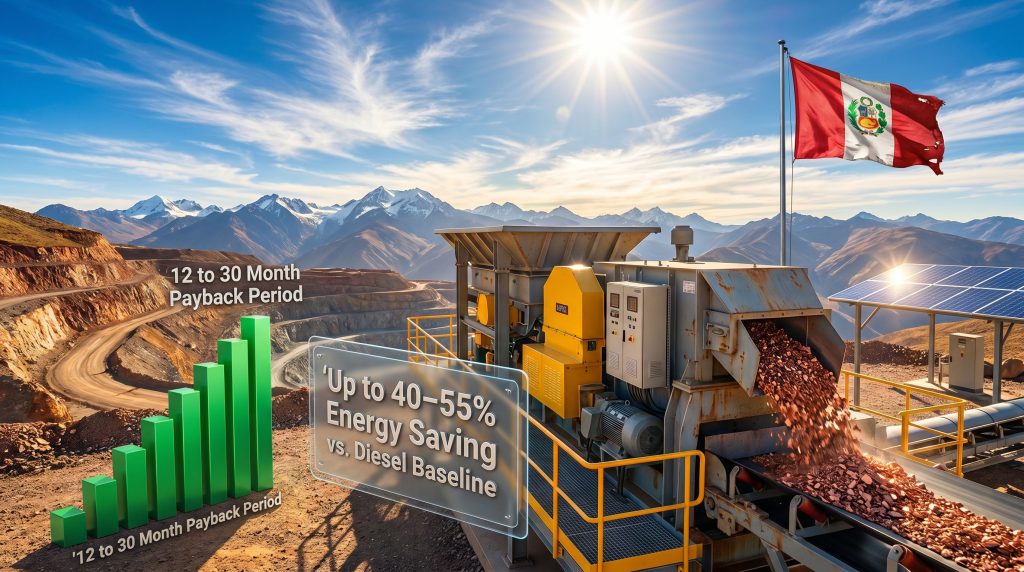
| Electric Motor (Grid-Connected) | 90%+ efficiency | 40-55% vs. diesel baseline | Coastal and urban quarries with grid access |
| Hybrid Electric-Diesel | 60-75% effective efficiency | 20-35% vs. full diesel | Semi-remote sites with intermittent grid |
| VFD-Equipped Electric Plant | 90%+ with demand-matched speed | Up to 30% additional vs. standard electric | High-variability feed operations |
Variable Frequency Drives: Mature Technology with Fast Payback
Variable frequency drives represent one of the most accessible and fastest-payback efficiency improvements available to Peruvian operators, including those working with existing equipment. Conventional crushing plant designs run conveyors, feeders, and ancillary motors at fixed speed regardless of actual material flow. This approach wastes energy whenever the system operates at partial load, which is the majority of operating time at most sites.
VFDs dynamically match motor speed to real-time feed conditions. When the crusher cavity approaches full capacity, the feeder decelerates. When material availability increases, it accelerates to match. According to energy-efficient crushing practices, this adjustment alone typically reduces energy consumption on the material handling system by 10 to 20%. VFD components are widely available through Lima and Arequipa supply chains, and retrofit installations can often be completed within days.
Step-by-step VFD payback assessment for existing operations:
-
Measure baseline conveyor and feeder energy consumption in kWh per hour across a representative 30-day production period
-
Obtain manufacturer efficiency curves for VFD-compatible motor replacements matched to your existing system ratings
-
Calculate projected annual kWh savings based on documented load variability patterns at your specific site
-
Source local VFD component pricing through Lima or Arequipa industrial supply networks
-
Divide total retrofit capital cost by annualised energy saving value to establish payback period
-
Incorporate secondary financial benefits including reduced mechanical wear on belts, bearings, and drive components from lower peak-load stress
Chamber Geometry and Interparticle Crushing Mechanics
Less visible than drive system changes but equally significant is the role of crusher chamber geometry in determining specific energy consumption. Modern chamber designs engineered for energy efficiency use deeper profiles that promote interparticle crushing, where rock fragments break against each other rather than purely against liner surfaces. This mechanism reduces the energy demand placed on the eccentric drive, lowering kWh per tonne at equivalent throughput.
Critically, liner profile optimisation extends the window over which a chamber maintains its designed efficiency characteristics as wear progresses. Older chamber designs see efficiency degrade materially as liners wear, creating a hidden escalating energy cost mid-liner-cycle. Buyers comparing options across different suppliers should explicitly request specific energy consumption data across the full liner wear cycle, not just at commissioning.
Hybrid Power Architecture for Remote Site Deployment
One of the most consequential engineering developments for Peruvian operations in remote regions is the maturation of hybrid power configurations. A common misconception is that electric crushing plants are viable only where reliable grid access exists. Hybrid systems challenge this assumption directly.
In a well-designed hybrid configuration, the crushing plant operates on grid power when available, switching to an onboard diesel generator only during supply interruptions. Because the generator handles outage-only duty rather than continuous operation, it can be sized significantly smaller than a generator supporting a fully diesel plant. The capital and fuel cost implications of that size reduction are substantial. Southern Peru's exceptionally high solar irradiance also creates emerging viability for photovoltaic supplementation during daytime-dominant production schedules, further reducing dependence on diesel backup. This aligns closely with broader developments in renewable energy in mining across the region.
How Operational Environment Shapes the Energy-Saving Business Case
The financial justification for energy-saving crushing plants in Peru varies meaningfully across the country's distinct operational environments. Understanding these differences allows operators to calibrate their investment cases to site-specific conditions.
High-Altitude Copper and Polymetallic Mining Zones
Operations situated above 4,000 metres face an energy challenge that compounds every other efficiency consideration: altitude-related diesel performance degradation. Combustion efficiency deteriorates at high elevation due to reduced atmospheric oxygen density, meaning diesel engines consume more fuel per tonne of material processed than their rated specifications would suggest. Electric motors face no equivalent constraint and maintain rated performance regardless of elevation.
The altitude penalty on diesel equipment is not widely appreciated outside specialist circles. An engine operating at 4,500 metres may produce only 70 to 80% of its sea-level rated output while consuming a substantially similar fuel volume, meaning the effective fuel cost per unit of mechanical work rises sharply. For high-altitude Peruvian copper and polymetallic operations, this creates a compelling case for electrified crushing infrastructure that justifies a higher capital expenditure than a like-for-like diesel comparison would suggest.
Diesel logistics at elevation add a further cost layer. Transporting fuel to high-altitude sites by road involves significant haulage costs, vehicle wear, and operational risk. Eliminating or substantially reducing diesel consumption at the crusher removes this cost and risk exposure entirely.
Coastal and Peri-Urban Aggregate Supply Chains
Quarries supplying Lima and other coastal urban centres operate in a different cost environment. Grid connectivity is reliable, but industrial electricity tariffs have risen steadily. Margins in aggregate supply are structurally thinner than in metallic mining, making per-tonne energy cost a critical competitive variable.
Documented efficiency gains from replacing ageing conventional plant with modern energy-saving configurations at coastal quarries reach 25 to 30% in well-executed implementations. Under current tariff structures, payback timelines for this capital investment typically fall within a 24 to 36-month range. For aggregate producers competing on delivered price to Lima construction markets, this cost reduction translates directly into either margin improvement or competitive pricing capacity.
Mobile and Semi-Mobile Deployments in Remote Regions
A dimension of total energy cost that is frequently overlooked in fixed-plant comparisons is the energy embedded in long-haul material transport. Fixed crushing infrastructure requires rock to be hauled from the working face to the plant, often over significant distances as the mine or quarry advances. This transport energy is real but does not appear in the crusher's energy consumption figures.
Mobile and semi-mobile crushing systems eliminate much of this transport energy by repositioning the plant closer to the active working area. The comparative cost structure across fixed and mobile deployment models looks substantially different when transport energy is included in the analysis:
| Cost Category | Fixed Plant Model | Mobile/Semi-Mobile Model |
|---|---|---|
| Site civil construction | High | Low to Moderate |
| Material haulage distance | Long (to fixed plant) | Short (plant moves to material) |
| Fuel consumption (transport) | High | Significantly reduced |
| Crusher energy consumption | Equivalent | Equivalent |
| Relocation flexibility | None | High |
| Total 5-year energy cost profile | Higher | Lower at remote sites |
Building a Rigorous Financial Case: Total Cost of Ownership in Practice
The shift toward total cost of ownership analysis in Peruvian crushing equipment procurement is one of the more significant structural changes in how the industry approaches capital expenditure decisions. A ten-year ownership horizon, rather than a three-year payback focus, reveals efficiency premiums in a very different light. In addition, data-driven mining operations are increasingly enabling operators to model these cost trajectories with greater precision before committing capital.
How to calculate energy-saving equipment payback with rigour:
-
Establish baseline energy intensity by measuring current kWh per tonne or litres of diesel per operating hour over a representative period, capturing seasonal and production cycle variation
-
Obtain verified efficiency data from shortlisted suppliers, specifically requesting independent third-party test results rather than manufacturer marketing claims for specific energy consumption at rated throughput
-
Calculate annual energy cost saving by multiplying annual tonne throughput by the per-tonne energy cost differential between current and proposed plant configurations
-
Quantify maintenance cost differential recognising that electric and VFD-equipped systems typically carry lower maintenance expenditure due to fewer moving parts, reduced vibration loading, and elimination of diesel engine servicing requirements
-
Apply conservative local energy price projections using upward trend assumptions for both Peruvian diesel delivery costs and industrial grid tariffs over the ownership horizon
-
Divide the efficiency premium (the additional capital cost of the energy-saving specification vs. a standard plant) by total annual savings to determine payback period
-
Stress-test across energy price scenarios modelling payback under current prices, a 15% escalation, and a 30% escalation to understand how the investment case performs under adverse conditions
Payback periods for energy-saving crushing plant upgrades in Peru typically fall within a 12 to 30-month range depending on site remoteness, energy source, and throughput volume. At the lower end of this range, the investment case is exceptional by any capital allocation standard.
Environmental and Regulatory Dimensions of the Efficiency Transition
Financial returns alone do not fully explain the adoption trajectory for energy-saving crushing plants in Peru. Environmental compliance and social licence considerations are accelerating the transition independently of pure economics.
Peru's mining and quarrying regulatory environment has progressively tightened emissions standards and environmental impact assessment requirements. Operations facing community relations challenges related to diesel exhaust, noise, and vibration find that electric crushing infrastructure directly addresses these concerns. Zero-exhaust electric systems eliminate a significant source of community complaint and can materially improve environmental impact assessment outcomes for permitting and operational review processes.
For operations with international investors, ESG reporting requirements add a further dimension. The crushing stage, as a major Scope 1 emissions source at diesel-powered sites, is directly visible in carbon footprint reporting. Reducing crushing energy intensity and transitioning away from diesel-generated power improves ESG scorecards in ways that are increasingly material to financing conditions and investor relations. Indeed, the mining decarbonisation benefits extend well beyond compliance, shaping long-term operational competitiveness.
The next major ASX story will hit our subscribers first
A Structured Procurement Framework for Energy-Efficient Crushing Plants
Translating awareness of energy-saving technology into a disciplined procurement decision requires a structured evaluation framework. The following technical specifications represent the minimum data set buyers should request from suppliers before advancing any procurement process:
-
Specific energy consumption rating in kWh per tonne at rated throughput across the full liner wear cycle
-
Drive system type and verified motor efficiency class certification
-
VFD compatibility and control system integration capability documentation
-
Chamber design engineering documentation and liner wear profile data showing efficiency retention over wear life
-
Hybrid power compatibility specifications including generator sizing requirements for outage-only duty
-
Altitude performance ratings, including any derating factors applicable to Andean deployment elevations
Buyers should distinguish between supplier claims based on laboratory conditions and verified field performance data from comparable operational environments. Pilot testing protocols, including 30-day energy consumption benchmarking before full capital commitment, represent best practice for high-value procurement decisions.
Frequently Asked Questions: Energy-Saving Crushing Plants in Peru
What is the average energy saving achievable with a modern crushing plant in Peru?
Modern energy-saving configurations deliver efficiency gains ranging from 10 to 55% depending on the technology combination and the baseline being compared. Transitioning from full diesel-hydraulic to grid-connected electric drive represents the largest single improvement, at up to 55% energy reduction. VFD retrofits on material handling systems typically contribute an additional 10 to 20% on top of the base drive saving.
Are electric crushing plants viable in areas without reliable grid access?
Yes, through hybrid power architecture. A properly designed hybrid system sizes the backup generator for outage-only duty, substantially reducing both capital cost and fuel consumption compared to a fully diesel plant. This configuration is viable across a wide range of remote Peruvian sites.
How do variable frequency drives reduce crushing plant energy consumption?
VFDs match motor speed to real-time material feed conditions rather than running at fixed speed regardless of load. This demand-matched operation eliminates energy waste during partial-load periods, which represent the majority of operating time at most crushing plants.
What is the typical payback period for upgrading to an energy-efficient crusher in Peru?
Payback periods typically range from 12 to 30 months depending on site remoteness, energy source, throughput volume, and the degree of efficiency improvement achieved. High-altitude sites with diesel logistics premiums tend to see the fastest payback.
How does operating altitude affect crushing plant energy consumption?
Diesel engines operating above 4,000 metres may produce only 70 to 80% of their sea-level rated output due to reduced atmospheric oxygen density, while consuming comparable fuel volumes. This means the effective fuel cost per unit of work rises sharply at altitude. Electric motors maintain full rated performance regardless of elevation, making electrification particularly valuable for Andean operations.
Can existing crushing plants be retrofitted with energy-saving technologies?
Yes. VFD retrofits represent the most accessible and fastest-payback option for existing plants. Liner profile upgrades and hybrid power system integration are also viable retrofit paths depending on the specific plant configuration and site energy supply situation.
What role do mobile crushing plants play in reducing total energy costs at remote Peruvian sites?
Mobile plants reduce total site energy costs by eliminating long-haul material transport from working face to fixed plant location. This transport energy is often invisible in crusher-specific analyses but represents a real and substantial cost that mobile configurations eliminate or substantially reduce.
Strategic Outlook: The Compounding Competitive Advantage of Early Adoption
The trajectory of energy-saving crushing plant adoption in Peru points toward an accelerating transition rather than a gradual evolution. Three structural forces are converging to make early adoption increasingly advantageous.
First, energy prices in Peru, both delivered diesel at remote sites and industrial grid tariffs in coastal zones, show no credible long-term trajectory other than upward. Operations that have already invested in efficiency improvements are insulated from this escalation to a degree that late adopters will not be.
Second, the technology ecosystem supporting efficient crushing is maturing rapidly. Hybrid power systems, solar supplementation, advanced chamber geometries, and VFD control integration are moving from specialist options to standard configurations. This maturation is reducing both the capital premium and the technical complexity of adopting energy-saving designs.
Third, environmental compliance and ESG reporting requirements are tightening across the Peruvian mining and aggregate sector. Operations that have reduced their crushing stage emissions profile are structurally better positioned to meet these requirements without incremental compliance cost. Furthermore, the surge in energy transition demand is placing additional strategic weight on efficient, low-emission production infrastructure across the region.
Peruvian mining and aggregate operators that commit to energy-efficient crushing infrastructure are not simply executing a cost reduction. They are building a structural operational advantage that compounds over time as energy prices escalate and environmental compliance requirements intensify. The efficiency gap between early adopters and operators still running conventional diesel-hydraulic infrastructure will widen materially over the coming decade, making this a strategic investment decision with implications well beyond the next equipment replacement cycle.
Operators and procurement professionals seeking additional technical analysis on crushing plant efficiency and Latin American mining equipment trends can explore industry resources available through Mining Doc, which publishes technical content covering operational trends across the South American mining sector. In addition, the Weir Group's research on comminution efficiency provides valuable independent analysis of the energy-saving opportunity available across the crushing and grinding circuit.
Want to Spot the Next Big ASX Mining Discovery Before the Market Does?
As energy-efficient operations reshape the economics of mining globally, the fundamentals driving resource investment remain unchanged — identifying transformative mineral discoveries early is what separates exceptional returns from ordinary ones. Discovery Alert's proprietary Discovery IQ model delivers real-time alerts on significant ASX mineral discoveries, turning complex data into actionable investment insights the moment announcements hit the exchange — explore what historic discoveries have returned and begin your 14-day free trial to position yourself ahead of the broader market.