June 9, 2026
The Science Behind Rock That Makes Its Own Hydrogen
Deep beneath the surface of ancient ocean floors, a chemical reaction has been quietly generating hydrogen for hundreds of millions of years. No turbine. No electrode. No power grid. Just iron-rich rock, water, and time.
This process, known as serpentinisation, is now attracting serious attention from energy technologists and mining companies who believe it can be deliberately engineered rather than simply observed. The concept underpinning engineered mineral hydrogen at Pipestone XL Newfoundland is built on exactly this premise: that the same geochemical reaction responsible for creating awaruite nickel alloys can be stimulated on demand to produce clean hydrogen at commercially meaningful scale.
When big ASX news breaks, our subscribers know first
What Serpentinisation Actually Does, and Why It Matters
Serpentinisation occurs when water infiltrates ultramafic rock formations containing high concentrations of iron and magnesium silicate minerals, principally olivine and pyroxene. As water molecules interact with these minerals at elevated temperatures and pressures, a series of oxidation reactions takes place. Iron within the rock is oxidised, and hydrogen gas is released as a direct byproduct of this mineral transformation.
The resulting rock, converted partly into serpentinite, carries a distinctive greenish appearance. However, the commercially significant output is the molecular hydrogen (H₂) generated throughout the reaction sequence. Ophiolite complexes, which are ancient fragments of oceanic crust thrust onto continental margins through tectonic activity, represent some of the most geologically predisposed environments for this process. Furthermore, interest in natural hydrogen formation processes has been accelerating globally as the energy sector searches for low-cost, low-emission alternatives.
What distinguishes engineered mineral hydrogen from its naturally occurring counterpart is deliberate intervention. Rather than waiting for subsurface conditions to drive the reaction passively over geological timescales, the EMH approach involves drilling wellbores into identified ultramafic formations and injecting water to actively stimulate and accelerate serpentinisation at depth.
How EMH Works: A Step-by-Step Technical Overview
Understanding the operational sequence helps clarify both the promise and the complexity of this production pathway:
-
Site identification begins with geological mapping and geophysical surveys to locate iron-rich ultramafic formations with confirmed hydrogen generation potential, validated through laboratory rock sample testing.
-
Wellbore drilling targets the most reactive zones within the host rock, guided by subsurface data on mineral composition and fracture networks.
-
Water injection is introduced through the wellbore system under controlled conditions, bringing reactive fluids into contact with olivine and pyroxene-bearing rock at depth.
-
Geochemical reaction proceeds as injected water oxidises ferrous iron within the mineral matrix, generating molecular hydrogen as a direct output of the mineralogical transformation.
-
Hydrogen capture involves extracting the produced gas through the wellbore network, followed by processing and purification for downstream energy or industrial application.
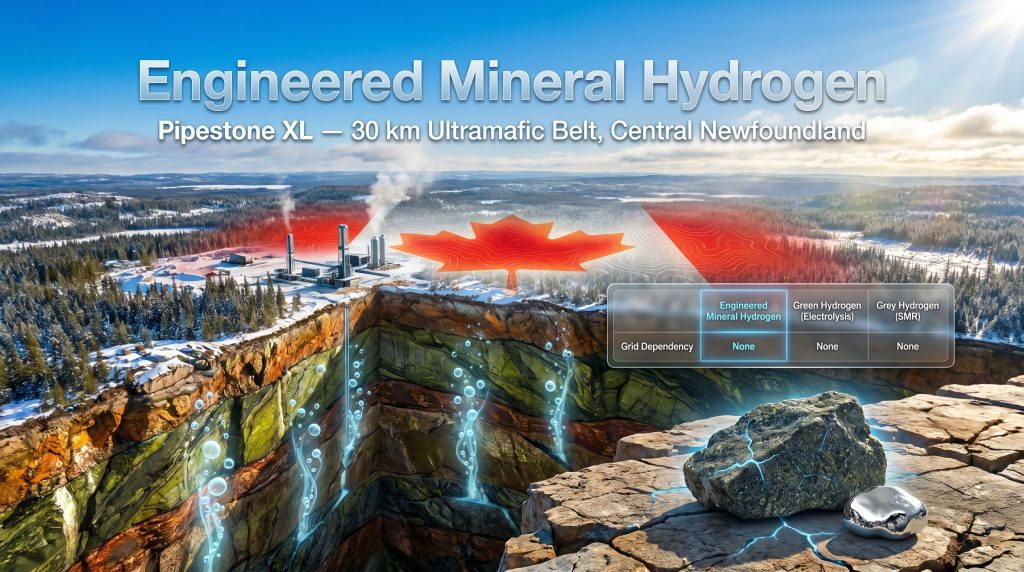
A critical competitive differentiator for EMH is the absence of any requirement for grid electricity to drive the reaction. Unlike green hydrogen produced via electrolysis, where renewable power drives water splitting, EMH relies entirely on the chemical energy stored within the rock itself. This makes the technology particularly relevant for remote or off-grid locations where power infrastructure is either unavailable or prohibitively expensive to build. In addition, renewable energy in mining contexts is already reshaping how the sector approaches energy sourcing at isolated sites.
Comparing Hydrogen Production Pathways
| Attribute | Engineered Mineral Hydrogen | Green Hydrogen (Electrolysis) | Grey Hydrogen (SMR) |
|---|---|---|---|
| Primary energy input | Geochemical reaction | Renewable electricity | Natural gas |
| Grid dependency | None | High | Moderate |
| Carbon emissions | Near-zero | Low to zero | High |
| Infrastructure requirement | Wellbore and water injection | Electrolyser and power supply | Reformer and gas supply |
| Technology maturity | Early commercial/pilot | Commercial | Fully commercial |
| Cost trajectory | Potentially competitive | Declining | Established |
EMH's independence from electricity grids is its most strategically distinctive characteristic, particularly for remote industrial regions where energy logistics represent a significant and persistent cost burden.
The Pipestone XL Ophiolite: Why This Formation Stands Out
The Pipestone Ophiolite Complex in central Newfoundland extends across approximately 30 kilometres of ultramafic belt terrain. As a fragment of ancient oceanic crust now exposed within the Canadian continental interior, it carries the mineralogical signatures expected of an ophiolite system with elevated serpentinisation history.
Over the twelve months preceding the formal announcement of their collaboration, Vema Hydrogen and First Atlantic Nickel & Cobalt Corp conducted a systematic technical evaluation of the formation. This included analysis of geological and geophysical datasets, infrastructure mapping across the belt, and critically, the laboratory testing of rock samples collected during site visits.
Those samples were transported to Vema's research facility in Orléans, France, where testing confirmed that stimulated serpentinisation successfully produced hydrogen from Pipestone host rocks. This laboratory validation represents a meaningful technical milestone, though it is important to understand what it does and does not confirm.
It establishes that the mineralogy of the site is reactive under the right conditions, but it does not yet prove field-scale yield, sustainable production rates, or commercially viable unit economics.
Several characteristics differentiate Pipestone XL from other ultramafic sites:
- Scale: A 30-kilometre belt offers sufficient rock volume to contemplate meaningful hydrogen production over extended project lifetimes.
- Mineral composition: The presence of awaruite, a naturally occurring nickel-iron-cobalt alloy that forms specifically through serpentinisation, functions as a geological proxy confirming the system's historical hydrogen generation activity.
- Infrastructure proximity: Central Newfoundland's existing road, power, and port access reduces logistical barriers compared to more isolated ultramafic terrains elsewhere in Canada.
- Co-location potential: Pairing hydrogen production with an active awaruite nickel-cobalt mining programme creates opportunities for shared infrastructure, reducing the marginal capital requirement for either operation individually.
Awaruite: The Mineral That Signals a Hydrogen-Rich Past
Awaruite (chemical formula Ni₃Fe) is a naturally occurring nickel-iron-cobalt alloy that forms specifically as a product of serpentinisation. When hydrogen generated during the reaction reduces dissolved nickel and iron in the hydrothermal fluids percolating through ultramafic rock, awaruite precipitates as a stable metallic alloy. Its presence at any ultramafic site is therefore a direct geological indicator that serpentinisation occurred at significant intensity in the geological past.
This creates a compelling dual narrative at Pipestone XL: the same process that built the nickel-cobalt resource now being evaluated by First Atlantic is the same process that Vema Hydrogen intends to engineer for hydrogen production. Consequently, the awaruite distribution across the belt effectively functions as a prospecting tool for EMH site selection.
From a supply chain perspective, awaruite is attracting increasing attention quite separately from its hydrogen connection. The US Geological Survey has identified awaruite as a potential solution to nickel concentrate supply constraints, largely because its physical properties make recovery significantly less technically demanding than conventional nickel sulphide ores. This intersects directly with broader critical minerals demand trends shaping global energy and industrial policy.
Awaruite vs. Conventional Nickel Sulphide Processing
- Awaruite recovery: Achievable through magnetic separation and flotation, leveraging the mineral's naturally magnetic and metallic character.
- Pentlandite recovery (conventional nickel sulphide): Typically requires energy-intensive smelting, high-temperature roasting, or aggressive acid leaching circuits.
- Capital and environmental implications: Awaruite's simpler processing pathway reduces both capital intensity and environmental footprint compared to sulphide-based nickel operations.
- Battery supply chain relevance: As demand for battery-grade nickel grows alongside electric vehicle adoption, awaruite's processing simplicity could support more cost-competitive nickel supply, reinforcing ongoing battery storage expansion across the clean energy sector.
The Joint Venture Structure and What It Signals
The proposed partnership between Vema Hydrogen and First Atlantic Nickel & Cobalt Corp is structured as a 50/50 joint venture, formalised at this stage through a non-binding Letter of Intent. In resource sector development, an LOI serves as a statement of mutual commercial intent rather than a binding contractual commitment. It establishes the framework for deeper due diligence, technical collaboration, and the negotiation of definitive agreements.
Investors should understand that an LOI carries no obligation to proceed. Conversion to a binding joint venture agreement typically depends on the completion of additional technical work, resolution of regulatory and permitting questions, and satisfactory commercial negotiation between the parties.
The current project status can be summarised as follows:
- Laboratory validation: Completed, confirming hydrogen generation potential from Pipestone rock samples.
- Supplemental exploration permit: Received, covering wellbore water injection, additional drilling, and geophysical programmes needed to advance the pilot concept.
- Binding JV agreement: Not yet executed; remains subject to further negotiation and due diligence.
- Commercial production: Not yet commenced; this remains an early-stage development project.
Investors and technical analysts should draw a clear distinction between validated geological potential and demonstrated field-scale commercial production. These are sequential milestones separated by significant technical and financial work, and Pipestone XL has successfully completed the first but not yet the latter.
The next major ASX story will hit our subscribers first
Vema's Quebec Reference Point: What the Thetford Project Demonstrates
Vema Hydrogen's established presence at the Thetford ophiolite in Quebec provides important context for evaluating the engineered mineral hydrogen at Pipestone XL Newfoundland development. The Quebec site is described as the world's first operational EMH project, making it a unique reference point for the entire emerging sector.
Lessons learned from site development, wellbore design, water injection parameters, and hydrogen capture at Thetford are directly transferable to Newfoundland given the geological parallels between the two ophiolite systems.
This operational precedent matters for risk assessment. Unlike many early-stage technology concepts, EMH has at least one field-scale reference point from which engineering knowledge can be systematically applied to new sites. That said, each ophiolite system carries its own geological variability, and successful production at Thetford does not guarantee identical outcomes at Pipestone XL without site-specific pilot testing.
Real Risks That Require Honest Evaluation
Several material uncertainties remain unresolved at the current project stage, and any analytical assessment of Pipestone XL's potential must account for them:
Technical uncertainties:
- Subsurface hydrogen yield at field scale may differ substantially from laboratory observations due to fracture networks, permeability variation, and reaction kinetics at depth.
- The long-term sustainability of stimulated serpentinisation reactions within a bounded rock volume is not yet empirically demonstrated at commercial scale.
- Gas capture efficiency and purity standards required for energy and industrial end uses introduce additional engineering requirements beyond simple reaction confirmation.
Commercial and financial risks:
- No binding offtake agreements are in place, and hydrogen demand infrastructure in central Newfoundland remains nascent.
- Capital requirements for wellbore construction, water injection systems, and gas processing are non-trivial, and financing for early-stage geologic hydrogen projects operates in a limited funding environment.
- Hydrogen pricing dynamics remain volatile globally, and the cost threshold at which EMH achieves genuine parity with competing fuel sources has not yet been established through field production data.
Regulatory pathway:
- The supplemental exploration permit now in place covers the next technical phase, including wellbore water injection testing and expanded geophysical surveys. Progression from this phase to a full pilot programme and eventual commercial development will involve additional regulatory processes whose timeline is difficult to predict with precision.
The Broader Case for Newfoundland as an EMH Development Region
Newfoundland's geography creates both a challenge and an opportunity for energy-intensive industries. Remote mining and industrial operations in the province have historically depended on long-distance diesel supply chains, with associated costs, logistical complexity, and emissions exposure. Locally produced hydrogen from EMH, if successfully developed, could progressively displace diesel across energy end uses at the site.
Downstream industrial co-location opportunities are also worth noting. A proven EMH production base at an ultramafic site with co-located critical mineral applications and mining could attract investment in adjacent industries including clean ammonia synthesis, hydrogen-dependent manufacturing, and clean fuel supply for broader regional industrial activity.
Furthermore, ammonia represents a viable hydrogen carrier for export via Atlantic Canada's maritime trade routes, creating potential pathways to international hydrogen demand markets that do not yet exist domestically. According to recent industry analysis, engineered mineral hydrogen is increasingly being positioned as a next-generation energy disruption opportunity amid explosive global demand for low-carbon fuel sources.
Frequently Asked Questions
What is engineered mineral hydrogen?
Engineered mineral hydrogen is a process that deliberately stimulates the natural geochemical reaction of serpentinisation within ultramafic rock formations to produce molecular hydrogen (H₂). Unlike electrolysis, it requires no grid electricity, using instead the chemical energy stored within iron-bearing minerals reacting with injected water.
What is the current status of the Pipestone XL hydrogen project?
The project of engineered mineral hydrogen at Pipestone XL Newfoundland is at an early development stage. Laboratory testing of rock samples has confirmed hydrogen generation potential, a supplemental exploration permit is in place, and a non-binding LOI for a 50/50 joint venture has been signed. Commercial hydrogen production has not commenced.
Why does awaruite confirm hydrogen system history?
Awaruite forms when hydrogen produced during serpentinisation reduces dissolved nickel and iron in hydrothermal fluids. Its presence at a site indicates that serpentinisation occurred at sufficient intensity and duration to drive this reduction reaction, making it a reliable geological proxy for prior hydrogen generation activity.
How does EMH compare to green hydrogen from electrolysis?
The primary differentiator is grid independence. EMH produces hydrogen through subsurface geochemical reactions without requiring electricity input, making it potentially advantageous in remote regions. Green hydrogen from electrolysis, however, requires significant renewable power infrastructure but benefits from more advanced technology readiness and established commercial frameworks.
What makes awaruite easier to process than conventional nickel ores?
Awaruite's naturally magnetic and metallic character allows recovery through magnetic separation and flotation circuits, avoiding the energy-intensive smelting, roasting, or acid leaching typically required to process pentlandite-based nickel sulphide ores. This simplifies the processing flowsheet and reduces both capital costs and environmental footprint.
Want to Catch the Next Major Mineral Discovery Before the Market Does?
Discovery Alert's proprietary Discovery IQ model scans ASX announcements in real time, instantly identifying significant mineral discoveries across critical commodities — from nickel and cobalt to the emerging hydrogen economy — and delivering actionable insights directly to subscribers. Explore historic discoveries and their extraordinary returns, then begin your 14-day free trial to position yourself ahead of the market.