June 9, 2026
The Hidden Infrastructure Crisis Beneath Every Modern Mine
For decades, the mining industry has poured capital into autonomous drills, remotely operated loaders, and AI-driven fleet management systems. Yet across many operations, the single most limiting factor holding these technologies back has nothing to do with the machines themselves. It is the wireless network carrying their commands, sensor data, and telemetry streams that remains the weak link. Underground environments in particular expose the fragility of legacy wireless infrastructure with startling clarity, and the gap between what automation demands and what networks deliver has quietly become one of mining's most pressing operational challenges.
Understanding why Epiroc and Ericsson 5G connectivity in mining has become a major talking point in 2026 requires understanding this infrastructure deficit first, because the commercial agreement formalised this year is fundamentally a response to a problem that has been building for years. Furthermore, data-driven mining operations have made reliable connectivity not just desirable but essential across modern mine sites.
When big ASX news breaks, our subscribers know first
Why Legacy Wireless Infrastructure Fails Underground
The Physics Problem No Software Update Can Fix
Underground mining environments present a uniquely hostile set of conditions for wireless signal propagation. Unlike surface deployments where line-of-sight coverage can be extended with straightforward antenna placement, underground tunnels, stopes, and decline ramps create complex geometric constraints that cause signal reflection, absorption, and dead zones. Traditional Wi-Fi networks based on 2.4GHz and 5GHz frequencies suffer pronounced attenuation when signals travel through rock-laden, curved tunnel geometries, with coverage gaps emerging at precisely the locations where autonomous equipment most needs reliable communication.
The problem compounds when multiple machines operate simultaneously. A single autonomous drill rig streaming sensor telemetry, receiving navigation commands, and transmitting video feeds can consume significant bandwidth. When an entire fleet of autonomous loaders, haul trucks, and drilling rigs operates concurrently within the same network environment, legacy Wi-Fi infrastructure struggles to maintain consistent throughput across all devices without latency spikes that directly affect machine responsiveness.
There are also security dimensions to consider. Older wireless protocols deployed across both surface and underground mine sites carry vulnerabilities that become increasingly significant as operational technology systems become more interconnected. Cybersecurity exposure in mining is a growing concern, with industrial control systems and machine automation platforms now representing meaningful attack surfaces if underlying network infrastructure lacks the security architecture appropriate for mission-critical industrial environments.
Why Private Cellular Networks Change the Equation
Private LTE and standalone 5G networks operate on fundamentally different principles to both public carrier infrastructure and enterprise Wi-Fi. Rather than sharing spectrum with other users or relying on consumer-grade access points, private cellular networks use dedicated licensed or shared spectrum allocated specifically for the deployment site. This dedicated spectrum approach eliminates interference from competing devices and enables network engineers to configure quality-of-service parameters that prioritise safety-critical communications over routine data traffic.
The practical differences for mining operations are substantial:
- Coverage consistency: Private cellular networks use distributed antenna systems and small cells that can be positioned throughout tunnel networks, achieving consistent coverage in geometries where Wi-Fi fails
- Latency control: Standalone 5G networks can achieve latency figures below 10 milliseconds for industrial control applications, compared with Wi-Fi latency that can spike unpredictably under load
- Device density: Private 5G supports significantly higher numbers of simultaneous connected devices per square kilometre than Wi-Fi, a critical factor as autonomous fleets grow in scale
- Security architecture: Private cellular networks keep all traffic within the mine operator's own infrastructure, eliminating exposure to public internet routing for sensitive operational data
What the Epiroc and Ericsson Global Agreement Actually Delivers
From Eight-Year Relationship to Commercial Alliance
The relationship between these two companies did not emerge overnight. Epiroc and Ericsson first entered a formal cooperation agreement in 2018, initially focused on exploring LTE and 5G applications in mining contexts. That agreement led to real-world validation work at the Kvarntorp test mine in Sweden, where Ericsson network infrastructure was used to support telematics and remote operation functions under genuine underground conditions. The experience built over nearly eight years provided both parties with a clear understanding of the technical requirements and operational realities before the global commercial agreement was formalised in 2026.
| Milestone | Year | Significance |
|---|---|---|
| Initial cooperation agreement signed | 2018 | First formal commitment to explore LTE and 5G for mining applications |
| Kvarntorp test mine deployment (Sweden) | Post-2018 | Real-world validation of Ericsson network supporting telematics and remote operations |
| Global go-to-market agreement formalised | 2026 | Epiroc authorised to resell and deploy Ericsson enterprise connectivity solutions worldwide |
In addition, Epiroc and Ericsson's 5G partnership has been publicly documented as a key step in bringing next-generation wireless capability to mining environments, reinforcing the credibility of this long-term collaboration.
How Distribution Through Epiroc's Customer Centre Network Works
The commercial structure of the agreement positions Ericsson's enterprise wireless solutions within Epiroc's existing global customer centre network. This means mining operators engaging with Epiroc for equipment, automation, and digital solutions can now access private LTE and 5G network infrastructure through the same OEM relationship rather than managing a separate procurement process with a telecommunications vendor.
This distribution approach is strategically significant for several reasons. Mining companies operating in remote locations often lack the internal telecommunications expertise to design, specify, and procure private cellular networks independently. Embedding Ericsson's technology within Epiroc's service offering lowers the adoption barrier considerably, allowing operators to receive integrated solutions where the connectivity layer and the automation layer are designed to work together from the outset.
The partnership maintains a technology-agnostic positioning within Epiroc's broader digital portfolio. Connectivity functions as a foundational infrastructure layer beneath Epiroc's automation and digitalisation stack, enabling operators to integrate existing operational technology ecosystems without being locked into a single vendor architecture for every system component.
According to Epiroc's Digital Solutions Division leadership, robust communications infrastructure has become a prerequisite rather than an optional enhancement for mining companies actively advancing automation and digitalisation across their operations.
Five High-Value Use Cases That Private 5G Unlocks in Mining
The Automation Applications Driving Network Investment
The deployment of Epiroc and Ericsson 5G connectivity in mining unlocks a distinct set of operational capabilities that inferior networks simply cannot support reliably. Consequently, automation in mining technology has increasingly depended on this kind of robust wireless foundation to deliver meaningful results:
-
Autonomous and remote-controlled equipment: Real-time command and telemetry exchange across drill rigs, loaders, and haul trucks requires sustained low-latency connectivity. Any communication interruption that causes an autonomous machine to lose contact with its control system triggers a protective stop, halting production until connectivity is restored.
-
Collision avoidance systems: Proximity detection and emergency response systems in underground environments have sub-millisecond latency requirements. These are safety-critical functions where network reliability is not a preference but a regulatory and operational necessity.
-
Predictive maintenance and telematics: Continuous machine health data streaming to centralised analytics platforms enables maintenance teams to identify developing faults before they cause unplanned downtime. This capability depends on consistent high-bandwidth data transmission from instrumented equipment across the entire fleet.
-
Situational awareness platforms: Live environmental monitoring, personnel location tracking, and hazard detection systems depend on real-time data exchange between distributed sensors and central control rooms, particularly in underground environments where physical access for rapid intervention is constrained.
-
Operational digitalisation: Integrated data flows connecting extraction, processing, and logistics systems across dispersed mine sites require a unified, reliable communications backbone that legacy wireless infrastructure cannot consistently provide.
Understanding URLLC: The 5G Capability Mining Actually Needs
A technically important distinction often overlooked in general discussions about 5G in mining is the difference between the various service categories within the 5G standard. Most public 5G coverage focuses on enhanced mobile broadband (eMBB), which prioritises peak download speeds for consumer applications. The capability most relevant to mining automation is a separate 5G service category called ultra-reliable low-latency communication (URLLC).
URLLC is specifically engineered for industrial control environments where communication delays measured in single-digit milliseconds carry direct safety and productivity consequences. This makes private 5G deployments using URLLC fundamentally different in character from the consumer 5G services available on public networks, even when both technically carry the 5G designation.
This distinction matters for mining operators evaluating connectivity investments. A site with nominally 5G coverage from a public carrier does not necessarily gain access to the URLLC service guarantees that autonomous equipment operation requires. Private 5G deployments, configured and managed specifically for the industrial use case, provide the quality-of-service controls that make URLLC performance achievable in practice. For operators also exploring AI-powered drilling efficiency, URLLC-grade connectivity is increasingly the enabling layer beneath those advances.
Comparing Wireless Infrastructure Options for Mine Sites
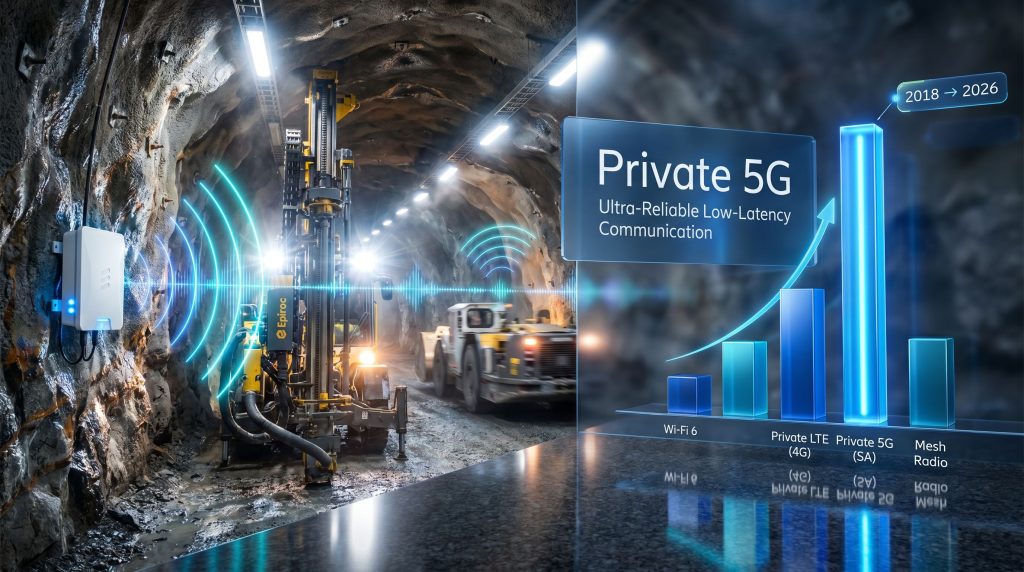
For operators currently evaluating connectivity upgrade pathways, the technology landscape offers several distinct options, each with meaningful differences in performance characteristics:
| Technology | Latency | Underground Coverage | Security | Scalability | Best Use Case |
|---|---|---|---|---|---|
| Wi-Fi 6 | Moderate | Limited | Moderate | Moderate | Surface office and light data |
| Private LTE (4G) | Low | Good | High | High | Fleet telematics and monitoring |
| Private 5G Standalone | Ultra-low | Excellent (with repeaters) | Very High | Very High | Autonomous operations |
| Mesh Radio | Variable | Moderate | Low | Low | Legacy voice and basic comms |
Key Deployment Considerations for Underground and Surface Operations
Operators planning connectivity upgrades should account for several practical dimensions beyond raw performance specifications:
- Infrastructure investment scope: Private 5G deployments require distributed antenna systems, edge compute nodes, and spectrum licensing arrangements that represent meaningful upfront capital expenditure
- Integration complexity: Connecting new cellular infrastructure with existing SCADA systems, fleet management platforms, and mine planning software requires careful systems integration planning to avoid creating new data silos
- Phased deployment strategy: Most operators achieve better outcomes by beginning deployment in high-value automation zones, demonstrating productivity and safety gains before committing to site-wide rollout
- Spectrum licensing pathway: In many jurisdictions, dedicated spectrum for private industrial networks requires regulatory engagement, and the licensing timeline should be factored into project planning from the outset
However, a five-step path to private 5G has been outlined by industry specialists to help operators navigate these deployment complexities in a structured and manageable way.
The Macro Forces Accelerating 5G Adoption Across the Mining Sector
Labour Pressures and Automation Demand Are Converging
The structural drivers pushing mining operators toward private cellular network investment extend well beyond technology preference. Global mining faces persistent skilled labour shortages, particularly for underground operating roles that involve significant safety exposure. Remote operation capabilities enabled by low-latency private 5G networks allow experienced operators to control equipment from surface control rooms, reducing the number of personnel required underground while simultaneously improving safety outcomes.
Labour cost pressures are equally significant. In high-wage mining jurisdictions including Australia, Canada, and the Nordic countries, the economics of autonomous and remote operations have become compelling for a growing range of mine types and production scales. Tier 1 operators including BHP, Rio Tinto, and Vale have already deployed autonomous haulage and drilling systems at scale, establishing digital transformation benchmarks that mid-tier producers are now actively working to replicate. Furthermore, mining's electrification and decarbonisation agenda is adding further urgency to the broader technology transformation underway across the sector.
The OEM-Led Connectivity Model Versus Direct Telecoms Sales
The structure of the Epiroc-Ericsson alliance reflects a broader industry shift in how mining connectivity solutions reach operators. Historically, mining companies seeking private wireless network infrastructure needed to engage directly with telecommunications vendors and system integrators, then separately integrate those networks with their equipment and automation systems. This approach placed significant technical coordination burdens on the mining operator.
The emerging OEM-led model, exemplified by this alliance, embeds connectivity as a component of the equipment and productivity solution rather than a separate infrastructure procurement. Ericsson's enterprise wireless leadership has noted that the partnership is designed to translate connectivity infrastructure into measurable operational outcomes, including safer working conditions and higher productivity benchmarks, rather than treating network deployment as an end in itself.
This framing reflects an important commercial insight: mining operators ultimately purchase productivity and safety outcomes, not telecommunications infrastructure. Positioning Epiroc and Ericsson 5G connectivity in mining as an integrated enabler of automation rather than a standalone technology investment aligns with how senior mining executives actually evaluate capital allocation decisions. In addition, AI-powered mining copilot tools depend on precisely this kind of reliable, low-latency network layer to function effectively at scale.
The next major ASX story will hit our subscribers first
Frequently Asked Questions: Epiroc and Ericsson 5G Connectivity in Mining
What is the Epiroc and Ericsson 5G mining partnership?
Epiroc and Ericsson formalised a global go-to-market agreement in 2026 enabling Epiroc to distribute and deploy Ericsson's private LTE and 5G enterprise connectivity solutions through its worldwide customer centre network. The alliance integrates Ericsson's cellular infrastructure expertise with Epiroc's digital and automation portfolio to deliver end-to-end connected mining solutions for both surface and underground operations.
When did Epiroc and Ericsson begin working together?
The two companies first entered a formal cooperation agreement in 2018, focused on exploring LTE and 5G applications in mining environments. The relationship was validated through real-world testing at the Kvarntorp test mine in Sweden before evolving into the expanded global commercial agreement announced in 2026.
Why is private 5G better than Wi-Fi for mining automation?
Private 5G offers significantly lower latency, higher reliability, stronger security, and superior coverage in complex underground geometries compared with Wi-Fi-based systems. For safety-critical applications such as autonomous equipment control and collision avoidance, where milliseconds of communication delay carry direct consequences, private 5G's URLLC capabilities provide a fundamentally more appropriate infrastructure foundation.
How does Ericsson's technology reach mining customers through Epiroc?
Ericsson's enterprise wireless solutions are resold and deployed through Epiroc's global customer centre network, allowing mining operators to access integrated connectivity and automation solutions through a single OEM relationship rather than managing separate telecoms and equipment procurement processes.
Strategic Outlook: What Mining Operators Should Be Evaluating Now
Near-Term Priorities and Longer-Term Technology Convergence
For operators considering connectivity upgrades, several immediate evaluation steps are worth prioritising:
- Conduct a connectivity audit mapping current coverage gaps against the locations of highest automation activity
- Assess total cost of ownership for private 5G deployment relative to ongoing productivity losses attributable to connectivity constraints
- Engage OEM partners early in capital project planning cycles to embed connectivity infrastructure requirements into mine design rather than retrofitting networks into completed infrastructure
Looking further ahead, the convergence of private 5G networks with AI-driven mine management platforms and edge computing infrastructure represents the next meaningful evolution in connected mining. Network slicing capabilities within standalone 5G architectures will allow operators to allocate dedicated virtual network segments for safety-critical communications, ensuring that collision avoidance and emergency response systems maintain performance guarantees even during periods of peak network load from routine data applications.
The convergence of operational technology and information technology networks, enabled by unified private cellular infrastructure, also has significant implications for data governance and cybersecurity strategy. As mine sites become more deeply instrumented and automated, the network carrying operational data becomes an asset requiring protection equivalent to any other critical piece of production infrastructure.
Disclaimer: This article is intended for informational purposes only and does not constitute financial or investment advice. Readers should conduct independent research before making investment or capital allocation decisions. Forward-looking statements and industry projections involve inherent uncertainty and should not be relied upon as guarantees of future outcomes.
Ready to Capitalise on the Mining Technology Revolution?
As private 5G networks and autonomous systems reshape the future of mining, Discovery Alert's proprietary Discovery IQ model scans ASX announcements in real time, instantly alerting subscribers to significant mineral discoveries before the broader market reacts — explore historic discoveries and their returns to see what's possible, then begin your 14-day free trial at Discovery Alert to position yourself at the forefront of the next major find.