June 8, 2026
Why the Race for Scale Is Reshaping Senior Gold Mining
The economics of gold mining have always rewarded patience, but rarely has the argument for scale been as compelling as it is today. Across the senior producer landscape, a structural shift is underway: institutional capital is concentrating into fewer, larger, pure-play gold companies, leaving smaller and mid-tier producers fighting for relevance in a market where visibility, liquidity, and reserve depth increasingly determine who receives capital and who does not.
Understanding why this is happening requires stepping back from individual transactions and examining the forces reshaping how global investors allocate to the gold sector. The Equinox Gold and Orla Mining merger is not simply a corporate combination. It is a case study in how transformative M&A can reposition a mining company within a different investable category entirely.
When big ASX news breaks, our subscribers know first
The Institutional Capital Logic Behind Scale in Gold Mining
Why Pure-Play Producers Command Premium Valuations
When pension funds, sovereign wealth vehicles, and large ETF mandates evaluate gold exposure, they operate within strict liquidity and market capitalisation thresholds. A producer below a certain size simply cannot absorb the volume of capital these institutions need to deploy without moving its own share price significantly. This liquidity constraint alone excludes many mid-tier gold producers from institutional mandates altogether.
Beyond liquidity, there is the concept of pure-play leverage. Investors who are constructively positioned on gold specifically want their mining equity to behave like gold. A large, single-commodity producer with substantial reserves and high production volumes delivers exactly that: revenue that is overwhelmingly gold-derived, margins that expand and compress in direct proportion to the metal price, and a business model that does not dilute investor exposure through unrelated commodity streams.
The scale argument also works through NAV multiples. Larger gold and mining equities with diversified mine portfolios, stronger balance sheets, and lower operational concentration risk have historically traded at premium price-to-NAV multiples compared to smaller or more operationally concentrated peers. The market assigns a lower risk premium to companies where no single mine accounts for the majority of production, where geographic diversification reduces country-risk exposure, and where access to debt markets at competitive rates provides financial flexibility through the cycle.
"Investors reward larger gold companies with better multiples because scale brings diversification, stronger financial conditions, and superior liquidity, all of which reduce risk and widen the pool of capital that can realistically access the stock."
How Multi-Asset Portfolios Change the Risk Profile
A single-mine producer carries enormous operational concentration risk. A processing plant fire, an unexpected geotechnical event, a permit suspension, or a labour dispute can eliminate most of a company's production in a single event. For institutional investors whose mandates require stable, predictable exposure, this kind of concentrated risk is disqualifying.
Multi-mine portfolios fundamentally change this calculus. When production is spread across six or more operating assets in multiple jurisdictions, any single operational disruption becomes a manageable earnings headwind rather than an existential event. Geographic diversification across politically stable jurisdictions further reduces country-risk premiums, lowering the discount rate investors apply to future cash flows.
Core Terms and Structure of the Equinox Gold and Orla Mining Merger
Transaction Architecture and Ownership Split
Announced on 13 May 2026, the Equinox Gold and Orla Mining merger is structured as an all-share combination with a nominal cash component. Orla Mining shareholders receive one Equinox Gold share plus $0.0001 in cash for each Orla share held.
| Shareholder Group | Post-Merger Ownership |
|---|---|
| Equinox Gold shareholders | ~67% |
| Orla Mining shareholders | ~33% |
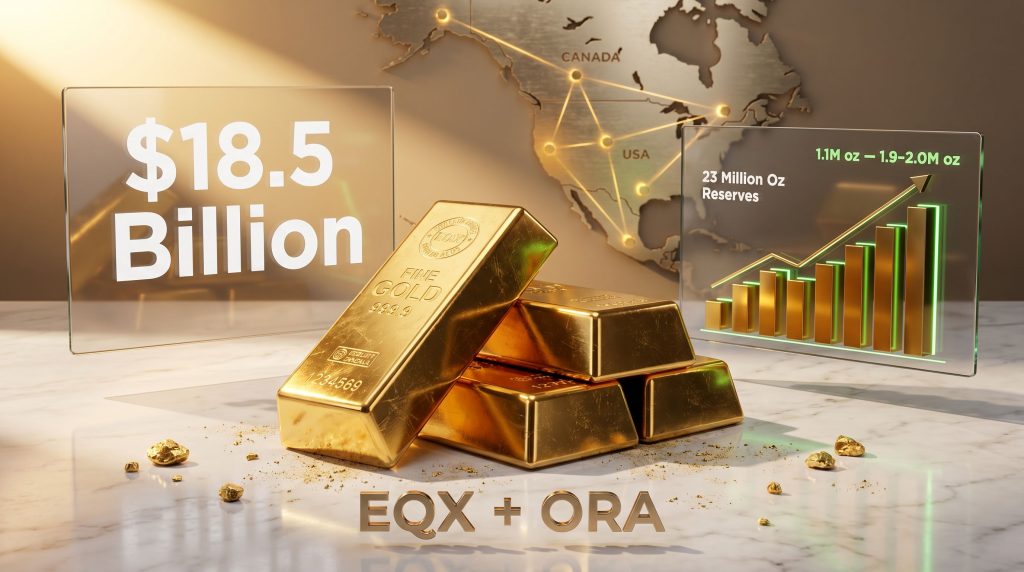
The implied equity value of the combined entity is approximately $18.5 billion, positioning it as one of the largest gold producers in North America by market capitalisation.
What the Combined Company Looks Like
The merged entity's operating and resource profile reflects the ambition behind the transaction:
- 2026 production target: approximately 1.1 million ounces of gold
- Long-term production pathway: internal growth projects support a trajectory toward 1.9 to 2.0 million ounces per annum
- Proven and probable reserves: approximately 23 million ounces
- Producing mines: six operating mines across multiple jurisdictions
- Advanced development projects: four assets in the pipeline
Internal growth alone, without further M&A, is expected to take annual production toward the 2 million ounce threshold, a level that would cement the combined company's position among the global senior producer tier.
Geographic Diversification Across the Portfolio
| Jurisdiction | Role in Combined Portfolio |
|---|---|
| Canada | Core production hub; second-largest Canadian gold producer after Agnico Eagle |
| United States | Existing producing operations across both predecessor companies |
| Mexico | Shared operational footprint; key synergy jurisdiction |
| Nicaragua | Additional producing asset within the combined portfolio |
The concentration of new Canadian producing assets within the portfolio is a deliberate strategic feature, not incidental. Canadian-listed, Canadian-producing gold companies have historically commanded a valuation premium relative to peers. Furthermore, the combination positions the merged entity as the second-largest Canadian gold producer by output, trailing only Agnico Eagle.
Regulatory Milestones and Closing Timeline
Approvals Required Before Completion
The transaction requires the following conditions to be satisfied before closing:
- Shareholder approval from both Equinox Gold and Orla Mining shareholder bases
- Regulatory clearances in Canada and Mexico, reflecting the combined company's cross-border operational presence
- Expected closing timeline: Q3 2026, subject to all conditions being met
The Canadian gold champion narrative carries genuine valuation significance. Two of the three major new Canadian gold-producing assets within the combined portfolio are recently commissioned operations, which adds near-term production credibility to what might otherwise be viewed as a longer-dated growth story.
The Macroeconomic Backdrop Driving Gold's Structural Repricing
From $1,350 to Record Highs: Understanding the Multi-Year Rally
Equinox Gold was founded in late 2017 and early 2018, at the very beginning of what proved to be a sustained, multi-year gold bull market. Gold was trading near $1,350 per ounce at that point. By early 2026, it had surged to record highs above $5,300 per ounce, before consolidating near $4,500 per ounce. The gold price outlook remains closely watched by investors seeking to understand future mining economics.
That trajectory, from $1,350 to $5,300 in roughly eight years, is not primarily a story about geopolitical disruption or short-term inflation surprises. It reflects a deeper, structural shift in how global capital thinks about monetary assets and reserve currencies.
The key demand drivers reshaping gold's role in global portfolios include:
- Dollar weaponisation: The 2022 freezing of Russian sovereign assets following the invasion of Ukraine fundamentally altered how global reserve managers think about the safety of US Treasury holdings. If sovereign assets can be frozen by political decision, the risk premium on dollar-denominated reserves is no longer zero.
- Central bank accumulation: Sovereign institutions across the emerging world have been diversifying reserves away from US dollar assets and toward gold at a pace not seen since the Bretton Woods era. In fact, central bank gold demand has emerged as one of the most significant structural forces underpinning the metal's multi-year rally.
- Fiscal credibility erosion: Moody's downgrade of the US sovereign credit outlook reinforced existing concerns about America's long-term debt trajectory. The traditional flight-to-safety trade, buying US Treasuries in times of stress, has weakened structurally since 2022 because the stress increasingly is the US fiscal position.
The 5,000-Year Store of Value Thesis
What is driving gold is ultimately a loss of confidence in the US dollar as the world's unchallenged reserve currency. When investors and central banks seek alternatives, the options are structurally constrained: the euro carries its own fiscal tensions, the renminbi operates within a capital control regime, and smaller currencies lack the scale to absorb sovereign reserve flows.
Gold, with its 5,000-year history as a store of value and a form of money, is reasserting its role in modern portfolio construction precisely because the alternatives are so limited. This is happening at the institutional level through central bank buying, and at the retail level through ETF and direct investment flows.
"Short-term events, including geopolitical flare-ups, central bank meeting outcomes, and macro data surprises, tend to create temporary noise in gold pricing. The persistent, multi-year uptrend in gold is best understood through the lens of long-term monetary credibility erosion, not event-driven volatility."
Why Geopolitical Events Are Not the Driver
Historical analysis across multiple conflict cycles shows a consistent pattern: geopolitical events produce short-lived gold price spikes that typically reverse within weeks as the immediate uncertainty resolves. The Gulf Wars, the Ukraine invasion, Middle East escalations, and similar events have all produced this pattern.
The more durable price drivers are structural: fiscal deficit trajectories, monetary policy credibility, and long-term reserve diversification by sovereign institutions. For mining companies building multi-decade asset bases, pricing models anchored to short-term geopolitical noise will systematically misjudge long-term economics.
Copper and Silver: Structural Fundamentals vs. Speculative Noise
Copper: A Decade-Long Repricing With Years Left to Run
Copper has risen from approximately $2 per pound a decade ago to near $6 per pound at current levels. This is not a speculative spike driven by financial flows. It reflects a genuine, structural demand-supply imbalance:
| Factor | Time Horizon | Price Impact |
|---|---|---|
| US import tariff speculation | Weeks to months | Temporary CME-LME spread widening |
| EV and grid electrification demand | 5 to 20 years | Structural demand floor |
| New mine supply response | 5 to 10 years | Gradual price moderation |
| Demand destruction at elevated prices | 3 to 7 years | Cyclical correction |
Recent media reporting on traders rushing copper into the United States ahead of possible import tariffs, and the resulting CME-LME price gap widening, is a transactional short-term dynamic. It has no bearing on the underlying supply-demand thesis. New copper mines require five to ten years from discovery to production, meaning today's high prices will persist well before meaningful new supply arrives.
That said, classic economics will ultimately prevail. Higher prices will stimulate supply and choke off some demand. The metal markets have always been cyclical, and copper is not exempt from that pattern.
Silver: Where Fundamental Demand Meets Speculative Excess
Silver reached approximately $120 per ounce in January 2026 before retreating to near $75 per ounce, a correction consistent with speculative excess unwinding whilst structural support remains. Even at $75, silver is trading at historically elevated levels by virtually any long-term benchmark.
The dynamics driving silver are layered:
- Industrial demand: Silver is a fundamental component of photovoltaic solar panel manufacturing, and electrification trends support a structurally higher demand baseline.
- Thrifting risk: At elevated prices, manufacturers substitute silver in solar cells with copper or alternative materials. This self-correcting mechanism organically reduces demand as prices rise, placing a ceiling on how far fundamental industrial demand can push the price before economics trigger substitution.
- Supply development timelines: New silver projects face the same ten-plus year development cycle as other major mining assets, meaning structural undersupply can persist even as prices eventually moderate.
One aspect of the silver market that is less commonly understood is the development timeline reality. A major new silver project, even one that could rank among the world's largest producers when operational, requires minimum ten-year timelines covering feasibility studies, regulatory approvals, financing, and construction. This means near-term supply responses to high prices are functionally impossible, even when the economics are compelling.
The next major ASX story will hit our subscribers first
Mine Construction Costs and the Inflation-Adjusted Price Reality
Why $4,500 Gold Today Is Not $4,500 Gold From Five Years Ago
One of the most underappreciated dynamics in current mining economics is the inflation-adjusted cost reality. Construction costs for major mining projects have approximately doubled relative to pre-2020 levels, driven by higher fuel prices, elevated labour costs, supply chain disruptions, and materials inflation.
This means that a gold price of $4,500 per ounce today may deliver similar economic returns to a project as $2,200 to $2,500 per ounce would have five or six years ago, once inflation-adjusted operating and capital costs are factored in. Investors and analysts who benchmark current project economics against historical price assumptions risk significantly overstating project profitability.
The same logic applies to copper. A price of $6 per pound today may provide returns comparable to $4 per pound five or six years ago, depending on jurisdiction, given the inflationary cost environment. Currency dynamics add further complexity: when the local currency of a mining jurisdiction strengthens against the US dollar, labour and operating costs rise in dollar terms, compressing margins even when the gold price holds steady.
Consequently, this cost environment strengthens the case for larger, lower-cost operations, which is precisely the type of asset base the Equinox Gold and Orla Mining merger is designed to create.
Building a Canadian Gold Champion: The Strategic Rationale
The Synergies Created by Combining Two Complementary Operators
The operational overlap between Equinox Gold and Orla Mining is a genuine synergy driver, not a theoretical one. Both companies operate in Mexico, the United States, and Canada, creating immediate cost and administrative efficiency opportunities across shared jurisdictions. According to the merger announcement details, the transaction draws on two established management teams with complementary operational expertise.
The combined entity's larger asset base and production profile, furthermore, improves its credit standing, lowering the cost of capital for future development expenditure. The gold miners outlook suggests that producers achieving this scale of diversification are increasingly well-positioned to attract the deepest pools of institutional capital.
Long-Term Value Creation vs. Short-Term Investor Demands
Mining companies face a recurring tension between the shifting demands of investors across the cycle and the long-duration nature of mine-building decisions. In one phase of the cycle, investors demand capital discipline and shareholder returns. In another, they demand growth investment and asset accumulation. A management team that reacts to each of these shifts risks making capital allocation decisions optimised for the wrong point in time.
The more durable framework is to anchor decisions to long-term value creation, independent of where sentiment sits at any given moment. The Equinox-Orla combination reflects exactly this philosophy: scale, diversification, and reserve depth are structural value drivers that compound over decades, regardless of the cyclical investor narrative in any given quarter.
The combined company's internal growth pipeline alone, without any further M&A activity, is expected to support a production trajectory toward 1.9 to 2.0 million ounces per annum, a level that would position it firmly within the global senior producer category and open access to capital pools that remain structurally closed to smaller producers.
Frequently Asked Questions: Equinox Gold and Orla Mining Merger
What is the Equinox Gold and Orla Mining merger?
A definitive all-share merger announced on 13 May 2026, combining Equinox Gold and Orla Mining into a single senior North American gold producer with an implied equity value of approximately $18.5 billion.
How many ounces of gold will the combined company produce?
The merged entity targets approximately 1.1 million ounces in 2026, with internal growth projects supporting a longer-term production pathway toward 1.9 to 2.0 million ounces per annum.
What happens to Orla Mining shareholders in the merger?
Orla Mining shareholders receive one Equinox Gold share plus $0.0001 in cash for each Orla share held, resulting in Orla shareholders owning approximately 33% of the combined company.
When is the Equinox-Orla merger expected to close?
The transaction is expected to close in Q3 2026, subject to shareholder approvals and regulatory clearances in Canada and Mexico.
How many gold reserves does the combined company hold?
The combined entity holds approximately 23 million ounces of proven and probable gold reserves.
Will the merged company be the largest Canadian gold producer?
No. The combined entity is positioned as the second-largest Canadian gold producer by output, behind Agnico Eagle, based on the concentration of producing and newly commissioned assets in Canada.
Key Takeaways: What This Merger Signals for the Gold Mining Industry
The Equinox Gold and Orla Mining merger is more than a single corporate transaction. It represents a template for how scale, geographic diversification, and pure-play commodity exposure can be deliberately engineered to unlock a higher valuation category. Indeed, broader gold M&A activity across global markets suggests this consolidation dynamic is accelerating well beyond North America.
Five structural forces make scale the dominant strategic priority in senior gold mining today:
- Institutional capital thresholds that exclude smaller producers from major ETF and fund mandates.
- NAV multiple premiums that reward diversification, lower operational risk, and superior liquidity.
- A macroeconomic backdrop featuring dollar credibility erosion, sovereign debt concerns, and central bank gold accumulation that supports structurally elevated gold prices.
- Inflationary cost pressures that favour large, low-cost operations over smaller, higher-cost producers.
- Development timeline realities that mean new supply, whether gold, copper, or silver, cannot respond quickly to high prices, sustaining the economic rationale for owning large reserve bases today.
Disclaimer: This article contains forward-looking statements, production estimates, and financial projections based on publicly available information and source material. These should not be construed as financial advice. Investors should conduct independent due diligence and consult qualified financial advisers before making investment decisions. Metal price forecasts and production targets are inherently subject to operational, geopolitical, and macroeconomic risks that could cause actual outcomes to differ materially from those described.
Want to Catch the Next Major Gold Discovery Before the Market Does?
Discovery Alert's proprietary Discovery IQ model delivers real-time alerts on significant ASX mineral discoveries, instantly translating complex geological data into actionable investment insights for both short-term traders and long-term investors — explore the historic returns major mineral discoveries have generated or visit the Discovery Alert home page to begin your 14-day free trial and position yourself ahead of the broader market.