May 22, 2026
Understanding Federal Research Infrastructure for Domestic Rare Earth Processing
The architecture of America's critical minerals research strategy relies heavily on coordinated efforts between national laboratories and private sector partners to validate domestic processing capabilities. The METALLIC (Minerals to Materials Supply Chain Research Facility) consortium represents a comprehensive approach to de-risking commercial rare earth development, bringing together nine national laboratories under the leadership of the National Energy Technology Laboratory to assess and improve mineral processing technologies.
Furthermore, this research framework specifically targets the gap between laboratory-scale demonstrations and commercial viability, addressing a critical bottleneck that has historically prevented domestic rare earth projects from achieving production status. The consortium's distributed approach across four research centers enables parallel testing of different processing methodologies, accelerating the validation timeline for companies seeking to advance their projects through federal partnership.
National Laboratory Collaboration Networks
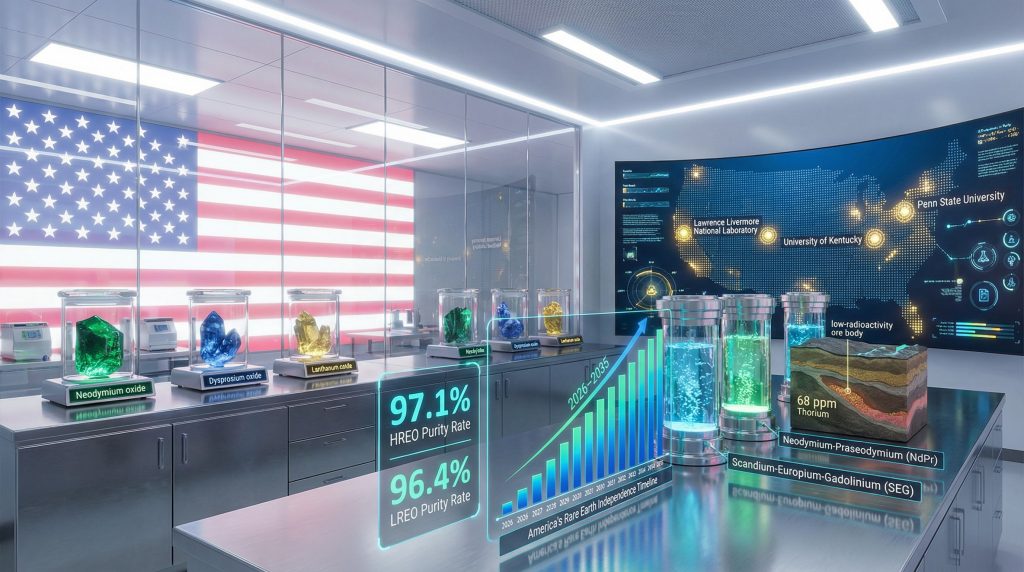
The METALLIC program demonstrates how federal research infrastructure can systematically reduce commercial risk through independent validation of company-developed processing methods. Lawrence Livermore National Laboratory, Idaho National Laboratory, and Oak Ridge National Laboratory represent three of the nine institutions contributing specialized capabilities to this consortium, each bringing decades of materials science expertise to rare earth processing challenges.
This collaborative model enables companies to access federal research capabilities whilst maintaining proprietary control over their processing technologies. In addition, the validation process involves systematic comparison of existing methodologies against potentially superior alternatives, providing both independent verification and optimisation opportunities that individual companies could not achieve independently.
Processing Validation Through Federal Partnerships
Recent developments illustrate how this research infrastructure functions in practice when considering data‐driven mining innovations. American Rare Earths supplies Halleck Creek ore for US DOE METALLIC research program through specimens from Wyoming's Cowboy State Mine to support comprehensive testing across multiple research centres, demonstrating the consortium's ability to evaluate domestic ore sources against various processing approaches.
The approximately five tonnes of allanite ore provided in December 2025 represents sufficient material for extensive testing protocols, enabling researchers to assess recovery rates, refining efficiency, and cost-effectiveness across different processing stages. This scale of testing bridges the gap between bench-scale experiments and pilot facility requirements, providing realistic performance data for commercial decision-making.
When big ASX news breaks, our subscribers know first
Strategic Significance of Low-Radioactivity Allanite Deposits for National Security
Allanite-hosted rare earth deposits present distinct advantages for domestic processing compared to traditional rare earth ore sources, particularly regarding regulatory compliance and operational safety considerations. The selection of allanite ore for federal research initiatives reflects recognition of these strategic benefits within government circles responsible for critical minerals policy development.
However, understanding the technical characteristics that distinguish allanite from other rare earth ore types helps explain why federal researchers prioritise this geological formation for domestic supply chain development. The comparative advantages extend beyond simple rare earth content to encompass processing complexity, environmental impact, and regulatory approval timelines.
Radioactivity Profile Advantages
Traditional rare earth processing faces significant challenges related to thorium and uranium content in source ores, creating regulatory complexity and increasing operational costs through required radiation safety protocols. Allanite deposits typically contain substantially lower radioactive element concentrations compared to monazite or bastnasite sources, simplifying environmental compliance requirements.
This lower radioactivity profile translates directly to reduced tailings management costs, simplified worker safety protocols, and accelerated environmental permitting timelines. For domestic rare earth projects seeking to compete against established international suppliers, these regulatory advantages can significantly impact project economics and development schedules.
Consequently, the strategic implications extend to facility location flexibility, as lower radioactivity ore sources enable processing facilities to operate in areas where more radioactive materials would face regulatory restrictions. This geographic flexibility supports supply chain resilience by enabling distributed processing capacity rather than requiring concentration in remote locations.
Magnetic Rare Earth Concentration Benefits
Allanite ore compositions frequently demonstrate favourable concentrations of magnetic rare earth oxides (MREO), particularly the neodymium and praseodymium compounds essential for permanent magnet manufacturing. These elements represent the highest-value components of rare earth ore, driving project economics and strategic importance for defence applications.
The presence of heavy rare earth oxides (HREO) including dysprosium and terbium within allanite formations provides additional strategic value, as these elements face the most severe supply constraints globally. The US mineral production order highlights how American Rare Earths supplies Halleck Creek ore for US DOE METALLIC research program containing both magnetic and heavy rare earth concentrations, positioning domestic sources to address multiple critical material dependencies simultaneously.
Processing efficiency for magnetic rare earth recovery directly impacts the commercial viability of domestic projects, as these elements command premium pricing whilst requiring sophisticated extraction techniques. Federal research validation of recovery rates provides essential data for investment decisions and production planning.
Advanced Processing Technologies Transforming Rare Earth Economics
The evolution from traditional acid leaching methods to bio-recovery and advanced solvent extraction techniques represents a fundamental shift in rare earth processing economics. These technological advances address both environmental concerns and cost competitiveness challenges that have historically prevented domestic rare earth production from achieving commercial scale.
Furthermore, federal research initiatives specifically focus on validating these advanced processing approaches through systematic comparison against conventional methods, providing independent assessment of their commercial potential. The research methodology involves multi-stage evaluation protocols designed to identify optimal processing pathways for specific ore compositions.
Multi-Stage Processing Optimisation
Modern rare earth processing involves sophisticated sequences of comminution, mineral separation, leaching, and solvent extraction stages, each requiring optimisation for specific ore characteristics. The research conducted through federal partnerships enables systematic evaluation of how processing modifications impact overall recovery rates and cost structures.
Comminution techniques focus on achieving optimal particle size distribution to maximise rare earth liberation whilst minimising energy consumption. Advanced grinding technologies can significantly impact downstream processing efficiency, as proper particle sizing directly affects leaching kinetics and separation effectiveness.
Mineral separation protocols utilise various physical and chemical methods to concentrate rare earth minerals before chemical processing. These techniques can substantially reduce the volume of material requiring chemical treatment, lowering reagent consumption and waste generation whilst improving overall process economics.
Leaching optimisation involves developing acid or alternative lixiviant systems that maximise rare earth dissolution whilst minimising impurity extraction. Bio-recovery approaches utilise microorganisms to enhance leaching efficiency whilst reducing environmental impact compared to traditional acid systems.
Target Oxide Production Capabilities
The ultimate objective of rare earth processing involves producing high-purity oxide compounds suitable for downstream applications in permanent magnets, catalysts, and advanced materials. Federal research validation focuses on demonstrating that domestic processing can achieve the quality standards required for these demanding applications.
Neodymium-Praseodymium (NdPr) extraction represents the highest-priority target for domestic processing, as these elements provide the foundation for permanent magnet manufacturing. Recovery rate optimisation for these magnetic rare earths directly impacts project economics and strategic value for national security applications.
For instance, Lanthanum, Dysprosium, and Terbium recovery addresses additional critical material needs across clean energy and defence sectors. Each element requires specialised processing approaches to achieve commercial purity levels whilst maintaining cost-effectiveness compared to international sources.
Scandium-Europium-Gadolinium processing represents emerging opportunities for value-added rare earth products, as these elements find increasing applications in advanced technologies. Federal research helps identify processing pathways that enable domestic sources to capture these premium market segments.
Market Applications Driving Federal Investment in Domestic Capability
The strategic rationale for federal rare earth research investment stems directly from critical dependencies in defence and clean energy applications where supply disruptions could compromise national security objectives. Understanding these end-use requirements helps explain the urgency behind federal research initiatives and the specific processing capabilities they seek to validate.
Electric vehicle manufacturing represents one of the largest growth markets for rare earth elements, particularly neodymium and dysprosium used in traction motor magnets. The rapid expansion of domestic EV production creates immediate demand for reliable rare earth supplies that cannot depend on potentially disrupted international sources.
Defence Technology Dependencies
Modern military systems incorporate rare earth elements throughout guidance systems, communications equipment, and propulsion technologies. The concentration of rare earth production in potentially adversarial nations creates unacceptable vulnerabilities for defence procurement, driving federal investment in domestic processing capabilities.
Permanent magnet requirements for defence applications often exceed commercial specifications for temperature stability, magnetic strength, and reliability under extreme conditions. Federal research validation helps ensure domestic processing can meet these demanding military requirements whilst maintaining cost competitiveness.
However, advanced materials applications in defence systems require rare earth elements for specialised alloys, optical systems, and electronic components. The diversity of these applications necessitates domestic processing capabilities across the full spectrum of rare earth elements rather than focusing exclusively on magnetic materials.
Clean Energy Infrastructure Needs
Wind turbine permanent magnet generators represent another critical application driving federal investment in domestic rare earth processing. Each megawatt of wind generation capacity requires substantial quantities of neodymium, dysprosium, and praseodymium, creating predictable long-term demand that supports commercial project development.
Wind turbine component specifications require rare earth magnets capable of maintaining performance across wide temperature ranges and extended operational periods. Federal research helps validate that domestic processing can produce materials meeting these demanding specifications whilst competing economically against international suppliers.
Additionally, energy storage applications increasingly utilise rare earth elements in advanced battery chemistries and grid-scale storage systems. The growing deployment of these technologies creates additional demand streams that support diversified rare earth processing capabilities.
Technology Transfer Pathways From Research to Commercial Production
The transition from federal research validation to commercial-scale production requires systematic technology transfer protocols that protect intellectual property whilst enabling industry access to government-funded innovations. This process involves multiple stakeholders including national laboratories, private companies, and regulatory agencies working to accelerate commercialisation timelines.
Federal research partnerships provide companies with access to advanced analytical capabilities and processing equipment that would require prohibitive capital investment for individual firms. This shared infrastructure enables smaller companies to validate their technologies against industrial standards whilst developing commercial partnerships for scaling production.
Intellectual Property Considerations
Technology development within federal research partnerships requires careful management of intellectual property rights to ensure companies maintain competitive advantages whilst enabling government access to critical capabilities. These arrangements typically involve complex licensing agreements that balance commercial interests with national security requirements.
The development of IP protection strategies for rare earth processing innovations must consider both domestic and international filing requirements, as companies seek to protect their technologies whilst enabling licensed production by strategic partners. Federal research partnerships often influence patent strategy development through access to specialised legal expertise.
Trade secret management becomes particularly important for companies participating in federal research programmes, as disclosure requirements must be balanced against maintaining competitive advantages in processing methodologies and optimisation parameters.
Commercial Scaling Challenges
The path from laboratory validation to commercial production involves multiple intermediate stages, each requiring substantial capital investment and technical risk management. Federal research partnerships help companies navigate these challenges by providing systematic validation data that supports financing decisions and regulatory approvals.
Pilot facility development represents the critical intermediate step between research validation and commercial production, requiring companies to demonstrate sustained processing performance at meaningful scale. The feasibility study insights derived from federal research data support pilot facility design and operation by providing baseline performance expectations and optimisation targets.
Consequently, economic viability indicators derived from federal research help companies assess market competitiveness and develop pricing strategies for domestic rare earth products. This data proves essential for securing project financing and developing customer relationships in advance of commercial production.
Timeline Projections for American Rare Earth Independence
Achieving meaningful domestic rare earth production capacity requires coordinated progress across multiple parallel development tracks, each with distinct technical requirements and timeline constraints. Federal research initiatives provide the foundation for this development by systematically validating processing technologies and reducing commercial risks for private investment.
The strategic timeline for rare earth independence involves both short-term milestones focused on process validation and long-term objectives targeting substantial domestic production capacity. Understanding these different timeframes helps explain the urgency behind current federal research investments and their relationship to broader national security planning.
Short-Term Research Milestones
Process optimisation completion through federal research partnerships provides the technical foundation for commercial project development, with validation results expected to support investment decisions by 2026-2027. These research outcomes will determine which domestic projects can advance to pilot-scale development and attract necessary financing.
Pilot facility development represents the next critical milestone, requiring successful companies to demonstrate sustained processing performance at 100-500 kg/day scale. This intermediate step provides essential data for commercial facility design whilst proving operational reliability for customer development and financing purposes.
Furthermore, regulatory approval pathways for domestic rare earth processing must be established through coordination between federal research results and environmental permitting processes. The lower radioactivity profile of allanite ores should accelerate these approvals compared to traditional rare earth processing projects.
Strategic Independence Objectives
Domestic production capacity projections based on current federal research initiatives suggest potential for meaningful rare earth independence by 2030-2035, assuming successful technology transfer and adequate private investment in commercial facilities. The validation of technologies through programmes where American Rare Earths supplies Halleck Creek ore for US DOE METALLIC research program represents one component of this broader strategic timeline.
The achievement of import reduction targets established through federal research will depend on achieving cost competitiveness with international suppliers whilst meeting quality specifications for defence and clean energy applications. Federal validation data supports these objectives by demonstrating technical feasibility and providing performance benchmarks.
However, national security supply chain resilience requires distributed domestic processing capacity capable of maintaining production during potential international disruptions. Federal research helps identify optimal facility locations and processing approaches to maximise supply chain robustness whilst maintaining economic viability.
The next major ASX story will hit our subscribers first
Are Domestic Processing Capabilities Ready for Commercial Scale?
The question of commercial readiness for domestic rare earth processing depends on multiple converging factors including technology validation, economic competitiveness, and regulatory framework development. Recent progress through federal research partnerships demonstrates significant advancement in technical capabilities whilst highlighting remaining challenges for commercial-scale implementation.
The transition from research validation to commercial production requires demonstrated performance at pilot scale operations before companies can secure financing for full commercial facilities. Current federal research initiatives provide the technical foundation for this progression whilst helping companies address specific processing challenges for allanite-hosted deposits.
For instance, the establishment of comprehensive industry evolution trends indicates growing investor confidence in domestic rare earth projects as federal research reduces technical risks and provides independent validation of processing capabilities.
What Makes Allanite Processing Different From Traditional Methods?
Allanite processing presents distinct advantages compared to traditional rare earth ore sources, particularly regarding environmental compliance and operational complexity. The lower radioactivity profile of allanite deposits eliminates many regulatory hurdles associated with thorium and uranium management in conventional rare earth processing.
The mineral composition of allanite enables different processing approaches that can achieve higher recovery rates for magnetic rare earth elements whilst reducing chemical consumption and waste generation. These technical advantages translate directly to improved project economics and accelerated development timelines.
Additionally, allanite deposits often contain favourable ratios of heavy rare earth elements, addressing supply constraints for the most strategically important materials in defence and clean energy applications. This composition advantage positions allanite-hosted projects as particularly valuable for national security objectives.
The transformation of America's rare earth independence strategy through systematic federal research represents a fundamental shift from market-dependent importing toward strategically autonomous domestic production capabilities. According to recent analysis from Proactive Investors, the validation of advanced processing technologies through collaborative partnerships between national laboratories and private companies creates multiple pathways for achieving this strategic objective whilst maintaining economic competitiveness against established international suppliers.
The success of programmes where American Rare Earths supplies Halleck Creek ore for US DOE METALLIC research program demonstrates the potential for systematic technology development to address critical mineral dependencies. As Mining.com reports, these collaborative efforts between industry and federal research institutions provide the technical foundation necessary for achieving meaningful rare earth independence whilst supporting broader national security objectives through diversified domestic processing capabilities.
Looking to Capitalise on Critical Minerals Investment Opportunities?
Discovery Alert's proprietary Discovery IQ model delivers instant notifications on significant ASX mineral discoveries, including emerging opportunities in rare earth and critical minerals sectors that align with global strategic initiatives. Visit the dedicated discoveries page to explore how major mineral discoveries have generated substantial returns, then begin your 14-day free trial to position yourself ahead of the market with actionable investment insights.