May 22, 2026
Finnish nuclear waste repository licensing represents one of the most significant regulatory challenges in the global nuclear industry, where permitting process insights from complex geological projects provide valuable context for understanding the intricate approval mechanisms required for permanent disposal facilities. The Finnish nuclear fuel repository licence delay demonstrates the extraordinary complexity involved when safety validation must span geological timeframes while addressing immediate operational requirements.
The regulatory frameworks governing deep geological repositories must address safety scenarios extending far beyond conventional industrial licensing, requiring assessment methodologies that account for geological stability, material degradation, and radionuclide containment across timescales that dwarf human civilisation. This extraordinary temporal scope creates unique challenges for regulatory authorities tasked with validating disposal concepts that will operate autonomously for thousands of generations.
Understanding Nuclear Waste Repository Licensing: A Global Regulatory Framework
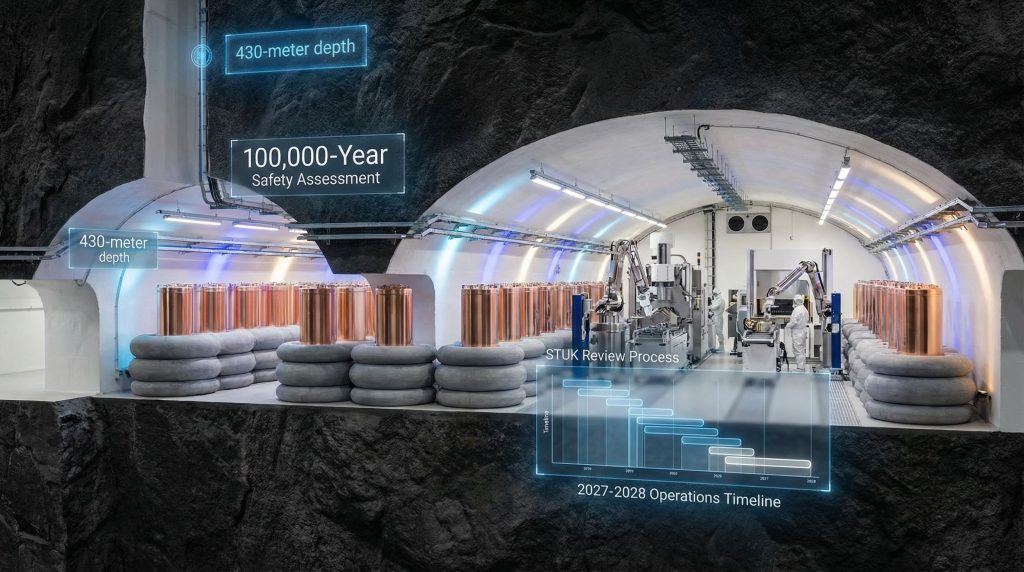
Deep geological repository licensing involves multi-layered safety assessments that examine engineered barriers, natural geological formations, and operational systems as integrated containment mechanisms. The complexity stems from the need to demonstrate safety performance across 100,000-year timeframes while validating near-term operational procedures and equipment reliability.
The Finnish nuclear fuel repository licence delay exemplifies these challenges, with regulatory authorities requiring comprehensive documentation spanning everything from immediate operational protocols to long-term geochemical evolution models. The Radiation and Nuclear Safety Authority (STUK) has extended its assessment deadline three times since beginning review in May 2022, now targeting completion by June 30, 2026.
| Country | Lead Regulator | Assessment Timeline | Key Safety Requirements |
|---|---|---|---|
| Finland | STUK | 4+ years (ongoing) | Multi-barrier system validation |
| Sweden | SSM | 2-3 years | KBS-3 methodology compliance |
| Canada | CNSC | 5-7 years | Indigenous consultation integration |
| USA | NRC | 8-10 years | Performance-based licensing |
The regulatory process requires coordination between multiple government entities, with STUK providing technical assessment while the Ministry of Economic Affairs and Employment retains final decision-making authority. This structure reflects the unprecedented nature of permanent geological disposal, where technical validation must align with broader policy considerations.
International safety standards provide overarching frameworks, but national regulators must adapt these guidelines to specific geological conditions, waste characteristics, and disposal technologies. The Finnish approach has become a global reference point, as other nations monitor STUK's regulatory methodology for insights applicable to their own repository development programs, particularly given the environmental regulatory challenges that modern resource extraction projects face.
When big ASX news breaks, our subscribers know first
The Technical Complexity Behind Repository Safety Assessments
The multi-barrier safety system at Finland's Onkalo repository operates at a depth of approximately 430 metres within crystalline bedrock, utilising multiple containment layers designed to function independently and collectively over geological timeframes. Each barrier component requires separate performance validation while demonstrating integrated system effectiveness.
Critical Safety Barriers Under Assessment:
• Iron-copper canisters: Primary containment vessels designed to resist corrosion for millennia
• Bentonite clay buffers: Swelling clay materials that isolate canisters from groundwater infiltration
• Tunnel backfill systems: Swellable clay materials that seal repository access routes
• Geological barriers: Natural bedrock formations providing ultimate containment
The regulatory complexity intensified when Posiva replaced the original bentonite clay composition with alternative materials, triggering comprehensive long-term safety reassessments. According to Finland's nuclear regulator, STUK identified that "the demonstration of the performance of the clay material, which acts as one of the barriers to the spread of radioactive substances, is still under way."
Furthermore, this material modification demonstrates how seemingly straightforward engineering changes cascade through regulatory review processes. The alternative bentonite composition necessitated updated geochemical models, revised thermal analysis, and extended performance testing protocols to validate barrier integrity under repository conditions.
Performance Assessment Methodologies:
• Probabilistic safety modelling: Monte Carlo simulations of barrier degradation scenarios
• Geochemical evolution analysis: Long-term groundwater interaction studies
• Thermal modelling: Heat load impacts on material properties and performance
• Seismic stability assessment: Geological formation integrity under dynamic loading
The regulatory framework requires demonstration that the disposal system will contain radionuclides even under conservative failure scenarios, accounting for geological uncertainties, material degradation pathways, and potential human intrusion events across unprecedented timeframes. This mirrors broader industry evolution trends where advanced modelling and comprehensive risk assessment have become standard practice.
Regulatory Bottlenecks: Documentation and Compliance Challenges
The Finnish nuclear fuel repository licence delay stems from multiple documentation categories requiring completion before STUK can issue its technical opinion. Project Manager Antti Tynkkynen confirmed that while "most of Posiva's operating permit application materials" have been received and approved, clarification requests remain outstanding with responses expected in early 2026.
Outstanding Documentation Requirements:
• Operational procedure manuals for safety-classified systems and equipment
• Trial run supervision reports validating facility testing and commissioning phases
• Updated safety case materials reflecting recent plant modifications and design changes
• Long-term performance data for revised barrier materials and components
STUK's quarterly assessment identified three primary delay factors: "deficiencies in the documentation, updates due to plant modifications made by Posiva, and the scope of the updates." Additionally, the regulator noted "uncertainties in the safety case review, the effects of which on long-term safety still need to be analysed."
Trial Run Supervision Complexities:
-
Real-time operational monitoring of all safety-critical disposal operations
-
Remote handling equipment validation for canister placement and positioning systems
-
Canister placement procedure verification under actual repository conditions
-
Backfilling material deployment assessment for tunnel sealing effectiveness
The iterative nature of regulatory review reflects the first-of-a-kind status of commercial geological disposal. Unlike established nuclear technologies with decades of operational precedent, repository licensing requires developing assessment methodologies while evaluating the specific application, as detailed in feasibility study insights that address similar complex project assessments.
The extension pattern from December 2023 through December 2025 to June 2026 demonstrates how complex technical validations resist rigid scheduling, particularly when material modifications trigger comprehensive safety reassessments.
The documentation challenge extends beyond administrative completeness to fundamental technical validation. Each component modification, operational procedure update, and safety case revision must demonstrate continued compliance with long-term safety requirements across geological timeframes.
Economic and Strategic Implications of Licensing Delays
The extended regulatory timeline creates substantial economic impacts across multiple stakeholder categories, from direct project costs to broader nuclear industry implications. Posiva has maintained facility construction and readiness since receiving its construction licence in November 2015, representing nearly a decade of pre-operational expenditure.
Direct Financial Impacts:
• Facility maintenance costs: Ongoing preservation of completed infrastructure during regulatory review
• Regulatory compliance expenses: Extended documentation development and technical assessment fees
• Construction cost escalation: Inflation impacts on remaining facility completion work
• Financing costs: Extended debt service on project financing during pre-revenue period
The repository's operational licence application covers the period from March 2024 to December 31, 2070, representing a 47-year operational window with significant revenue implications. Each month of delay postpones the commencement of waste disposal services for Finland's nuclear power plants.
| Impact Category | Short-term Effects | Long-term Consequences |
|---|---|---|
| Nuclear Operations | Extended interim storage requirements | Potential spent fuel storage capacity constraints |
| Energy Security | Continued nuclear generation capability | Enhanced waste management confidence |
| International Leadership | Delayed global precedent establishment | Strengthened international safety standards |
| Economic Development | Deferred regional economic benefits | Enhanced Finnish nuclear expertise export potential |
The strategic implications extend beyond Finland's borders, as multiple nations await the operational precedent to validate their own repository development programs. Sweden's SKB, Canada's Nuclear Waste Management Organization, and other international programs closely monitor Finnish regulatory decisions for applicable precedents.
Opportunity Cost Analysis:
The delay impacts Finland's nuclear operators TVO (Olkiluoto) and Fortum (Loviisa), which must maintain interim storage capabilities longer than originally planned. This creates cascading effects on plant operations, decommissioning schedules, and long-term nuclear generation planning.
Global Context: Finland as the World's First Commercial Repository
Finland's regulatory process establishes critical precedents for the global nuclear industry, as the first nation to advance commercial geological disposal through comprehensive licensing review. The extended timeline reflects the unprecedented nature of validating permanent disposal concepts with no operational analogues for comparison.
First-Mover Regulatory Challenges:
• Methodology development: Creating assessment frameworks without established precedents
• Safety standard interpretation: Applying general principles to specific technological implementations
• International scrutiny: Global nuclear community monitoring regulatory decisions
• Long-term liability frameworks: Establishing institutional control concepts for geological timeframes
STUK acknowledged this unique position, stating that "Posiva's project is the first in the world, so it understandably takes time to justify things and requires great care and expertise." This recognition emphasises how regulatory caution reflects appropriate diligence rather than administrative inefficiency.
The Finnish approach influences international repository development through multiple channels:
• Technical methodology transfer: Other nations adapting Finnish assessment approaches
• Regulatory best practices: International sharing of licensing framework elements
• Safety standard evolution: Finnish experience informing IAEA guideline updates
• Public acceptance strategies: Demonstrating feasibility of permanent disposal solutions
Success in Finnish licensing validation would provide confidence for repository programs in Sweden, Canada, Switzerland, and other nations currently in pre-licensing development phases. Additionally, the experience mirrors challenges seen across various sectors, including uranium market volatility where regulatory frameworks must adapt to evolving technical and market conditions.
The economic implications extend globally, as successful demonstration of commercial geological disposal could accelerate nuclear energy expansion by resolving long-term waste management concerns that have historically constrained nuclear power development.
Technical Deep Dive: Multi-Barrier System Performance Assessment
The regulatory assessment of Finland's disposal system requires validating performance across multiple independent containment barriers, each designed to function effectively even if other barriers fail. This defence-in-depth approach necessitates comprehensive modelling of barrier interactions under various degradation scenarios.
Barrier Performance Assessment Matrix:
| Barrier Component | Primary Function | Design Lifetime | Key Performance Metrics |
|---|---|---|---|
| Iron-copper canister | Radionuclide containment | 1,000+ years minimum | Corrosion resistance, structural integrity |
| Bentonite buffer | Isolation and thermal control | 100,000 years | Swelling pressure, hydraulic conductivity |
| Clay backfill | Tunnel sealing | 100,000 years | Permeability, chemical stability |
| Crystalline bedrock | Ultimate isolation medium | 100,000 years | Fracture characteristics, groundwater flow |
The replacement of original bentonite clay with alternative composition created the most significant current regulatory challenge. Consequently, STUK must validate that the substitute material maintains equivalent or superior performance characteristics across all assessment scenarios.
Geochemical Assessment Complexities:
• Groundwater interaction modelling: Chemical evolution over geological timeframes
• Radionuclide transport analysis: Migration pathways through multiple barrier systems
• Material degradation studies: Long-term stability under repository conditions
• Thermal impact evaluation: Heat effects on barrier performance and integrity
The 100,000-year assessment requirement necessitates probabilistic modelling approaches that account for uncertainties in geological conditions, material properties, and environmental evolution. Regulatory validation must demonstrate adequate safety margins under conservative assumption scenarios.
Climate Change Integration:
Repository safety cases must account for multiple ice age cycles, sea level variations, and potential human intrusion scenarios across assessment timeframes. These considerations add complexity layers that conventional nuclear facility licensing does not address.
The next major ASX story will hit our subscribers first
Future Outlook: Timeline Projections and Industry Implications
The current regulatory extension to June 30, 2026 represents what STUK describes as a "tight" but achievable deadline for completing the technical assessment. However, the pattern of previous extensions suggests continued vulnerability to further delays if additional technical issues emerge.
Realistic Timeline Scenarios:
• Optimistic projection: STUK opinion issued by June 2026, government approval by late 2026
• Baseline scenario: Regulatory completion in 2026, operational commencement in 2027
• Conservative outlook: Potential additional delays if major technical uncertainties require resolution
The bentonite clay performance demonstration represents the critical path item, with STUK indicating this assessment "is still under way." Resolution of material performance uncertainties will likely determine whether the June 2026 deadline proves achievable.
Global Industry Impact Projections:
-
Repository programme acceleration: Successful Finnish licensing could catalyse similar projects internationally
-
Investor confidence enhancement: Demonstrated feasibility may increase nuclear investment attractiveness
-
Technology transfer opportunities: Finnish expertise could support international repository development
-
Nuclear expansion facilitation: Resolved waste management concerns may enable broader nuclear adoption
The successful licensing and operation of Finland's repository would establish crucial precedents for the nuclear industry, demonstrating that permanent geological disposal represents a technically viable and regulatorily acceptable solution for high-level radioactive waste management.
In addition, repository operational success could fundamentally alter nuclear energy economics by resolving the waste management cost and liability uncertainties that have historically complicated nuclear project financing.
Risk Assessment: What Could Further Delay the Process?
Several categories of risk factors could extend the regulatory timeline beyond the current June 2026 target, ranging from technical discoveries to regulatory process complications. The pattern of previous extensions indicates sensitivity to both anticipated and unexpected complications.
Technical Risk Categories:
• Material performance issues: Discovery of unexpected bentonite clay behaviour under repository conditions
• Geological uncertainties: New findings regarding bedrock characteristics or groundwater behaviour
• Integration challenges: Difficulties coordinating encapsulation plant operations with disposal systems
• Safety case gaps: Identification of additional long-term safety scenarios requiring assessment
Regulatory Process Risks:
• Documentation completeness: Additional clarification requests or missing technical reports
• International standard updates: Changes in IAEA guidelines requiring compliance demonstration
• Stakeholder consultation: Extended public or expert review processes
• Government decision timing: Political or administrative delays in final licensing decisions
The first-of-a-kind nature of the project creates inherent uncertainty, as regulatory frameworks continue evolving alongside technical validation. Each new finding or requirement modification can trigger reassessment cascades that extend review timelines.
Mitigation Strategies:
-
Proactive documentation: Complete submission of all outstanding materials ahead of deadlines
-
Conservative safety margins: Demonstrate performance under worst-case scenario assumptions
-
Continuous stakeholder engagement: Maintain transparent communication with regulatory authorities
-
International coordination: Align with emerging global standards and best practices
The regulatory authority's acknowledgement that the timeline is "tight" suggests limited buffer for unexpected complications, making risk management critical for achieving the 2026 completion target. As noted by nuclear industry experts, the complexity of this unprecedented project requires careful balance between thoroughness and progress.
Balancing Safety Excellence with Operational Urgency
The Finnish nuclear fuel repository licence delay illustrates the complex equilibrium between comprehensive safety validation and practical waste management needs. While extended timelines create economic and operational challenges, they ultimately strengthen global confidence in geological disposal as a permanent solution for nuclear waste management.
The regulatory process has evolved into an iterative validation framework where technical modifications trigger comprehensive reassessments, reflecting appropriate caution for a technology with 100,000-year performance requirements. STUK's methodical approach establishes precedents that will influence international repository licensing for decades.
The successful completion of Finland's licensing process will provide crucial validation for the nuclear industry, demonstrating that permanent geological disposal represents both a technically viable and regulatorily acceptable approach to high-level radioactive waste management. This precedent could fundamentally alter nuclear energy economics by resolving long-standing waste management uncertainties that have historically complicated nuclear project development and financing.
The extended regulatory timeline, while creating near-term challenges, reflects the unprecedented responsibility of validating humanity's first commercial solution for permanent nuclear waste isolation across geological timeframes that span the entirety of human civilisation.
Looking for Investment Opportunities in Nuclear Technology and Energy Infrastructure?
Discovery Alert provides instant notifications on significant ASX mineral discoveries, including uranium and energy-related opportunities, powered by its proprietary Discovery IQ model. Understand why major mineral discoveries can lead to substantial market returns by exploring Discovery Alert's discoveries page, showcasing historic examples of exceptional outcomes, and begin your 30-day free trial today to position yourself ahead of the market.