June 9, 2026
The Hidden Architecture of a Bunkering Crisis: How Fujairah's VLSFO Market Collapsed
Most commodity markets absorb supply shocks gradually. Prices rise, alternatives emerge, and the system rebalances over weeks or months. The Fujairah VLSFO bunker supply crunch of June 2026 followed a different trajectory entirely. Within the span of roughly six weeks, one of the world's most critical marine refuelling hubs moved from functional market to near-total availability failure. Understanding how that happened requires looking well beyond the immediate trigger.
The Fujairah bunkering market does not operate in isolation. It sits at the intersection of multiple upstream dependencies, each one functioning as a potential point of failure. When geopolitical pressure severed several of those dependencies simultaneously, the result was not a pricing anomaly. It was a structural collapse.
When big ASX news breaks, our subscribers know first
Why Fujairah Is Not Just Another Bunkering Port
Ranked as the world's fourth-largest bunkering hub, Fujairah occupies a position in global marine fuel architecture that its raw throughput numbers alone do not fully capture. Unlike the ports of the Arabian Gulf, Fujairah sits on the UAE's eastern coast, facing the Gulf of Oman directly. This location, deliberately outside the Strait of Hormuz, was originally conceived as a strategic buffer against exactly the kind of chokepoint disruption that has now paralysed global energy flows.
The port serves as the primary refuelling node for East-West trade routes transiting the Arabian Sea and the northern Indian Ocean. Vessels moving between Asia and Europe, between the Persian Gulf and East Africa, and between South Asia and Mediterranean markets all converge on Fujairah's anchorage. When supply functions normally, the port's health is simply taken for granted. When it fails, the ripple effects reach across every segment of global shipping.
What most casual observers miss is the geographic paradox at the heart of Fujairah's vulnerability. The port was positioned outside the Strait of Hormuz to avoid supply disruption, yet its VLSFO production infrastructure depends almost entirely on feedstock flows that originate from refineries sitting inside the Gulf. That dependency was never stress-tested at scale until now.
Mapping the Supply Chain Collapse in Real Time
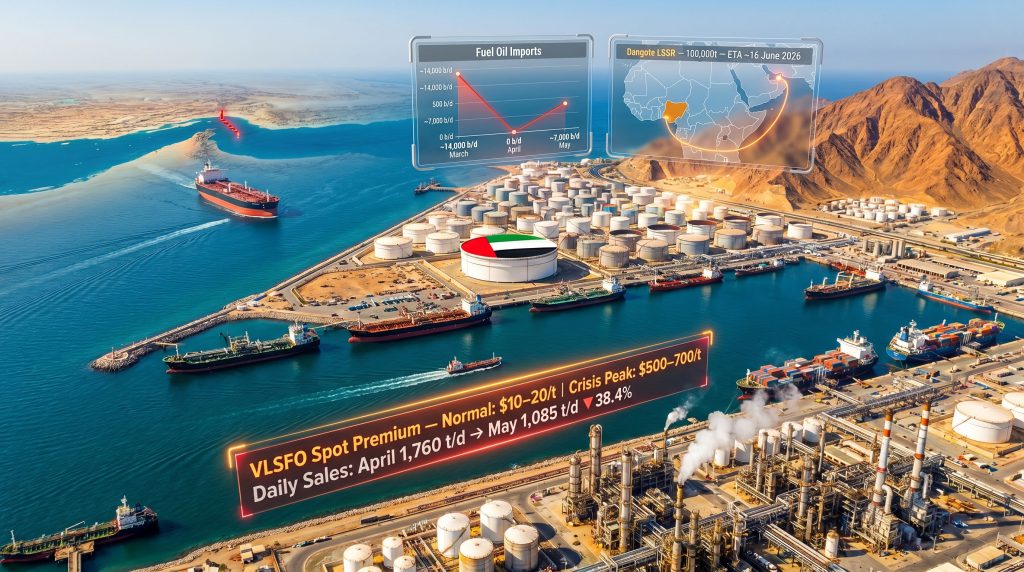
The sequence of events that produced the Fujairah VLSFO bunker supply crunch can be tracked with remarkable precision through import volume data. According to vessel tracking data compiled by global trade analytics firm Vortexa, fuel oil imports into Fujairah stood at approximately 14,000 barrels per day in March 2026. By April, that figure had fallen to effectively zero. A partial recovery to around 7,000 b/d was recorded in May, but this remained far below the volumes required to sustain normal bunkering operations.
The mechanism behind this collapse follows a clear three-stage cascade:
- Feedstock import severance: The US-Iran conflict disrupted regional refinery output and cut intra-regional feedstock trade routes that Fujairah's blending operations depend upon.
- Local blending capacity failure: Without incoming straight-run residuals and intermediate feedstocks, local refiners and blending terminals could not produce marine-grade VLSFO at meaningful volumes.
- Delivered fuel scarcity: Finished product inventories at bunker terminals were drawn down without replenishment, eventually reaching zero availability across most major suppliers.
A particularly significant upstream node was Kuwait's al-Zour refinery, which operates at a nameplate capacity of 615,000 barrels per day. The effective disconnection of this facility from Fujairah's supply network removed one of the most important feedstock contributors to the regional VLSFO supply chain. Al-Zour was designed partly to serve the growing marine fuel market created by the IMO 2020 sulphur regulations, making its absence from the supply picture disproportionately damaging. This situation further compounds the wider oil market disruption already reshaping global energy flows.
What the Pricing Data Actually Tells Us
Under stable operating conditions, delivered VLSFO in Fujairah trades at a premium of roughly $10 to $20 per tonne above front-month Singapore VLSFO cargo values. This spread reflects normal logistics costs, local storage margins, and the efficiency premium of a well-functioning market. It is essentially a rounding error in the context of total voyage fuel costs.
The following table illustrates the scale of market distortion that emerged during the crisis:
| Market Condition | Premium vs. Singapore Benchmark | Market Status |
|---|---|---|
| Normal operating conditions | $10 to $20/t | Functional |
| Tightening supply | $50 to $100/t | Elevated stress |
| Acute shortage, Fujairah (June 2026) | $500 to $700/t | Near-total failure |
| Residual supply, Khor Fakkan (8 June 2026) | ~$450/t | Severely constrained |
A premium of $500 to $700 per tonne does not represent a tight market. It represents a market in which the normal mechanisms of price discovery, contract fulfilment, and competitive supply have effectively ceased to function. At that price level, buyers are not choosing between suppliers based on cost. They are searching for any supplier willing to transact at all.
Argus-assessed spot premiums reached these all-time highs during the first week of June 2026, according to Argus Media's market reporting. The neighbouring port of Khor Fakkan, where residual supplies remained available, saw a cargo transact on 8 June 2026 at a $450 per tonne premium to the Singapore price basis. Even at this marginally lower level, the market was functioning at extreme stress rather than anything approaching normality.
The Demand and Volume Collapse
The pricing data is stark, but the volume data is perhaps even more revealing. Assessed daily VLSFO sales volumes across Fujairah fell from approximately 1,760 tonnes per day in April 2026 to a record low of 1,085 tonnes per day in May 2026, representing a contraction of roughly 38 percent in a single month.
| Metric | April 2026 | May 2026 | Change |
|---|---|---|---|
| VLSFO daily assessed sales volume | 1,760 t/d | 1,085 t/d | -38.4% |
| Fuel oil import volumes (Vortexa) | ~0 b/d | ~7,000 b/d | Partial recovery |
| March baseline import level | ~14,000 b/d | Reference | Reference |
| Spot premium vs. Singapore | $10-20/t (normal) | $500-700/t (peak) | +2,400 to 6,900% |
It is worth emphasising that this volume data captures an estimated 25 percent of total Fujairah market activity. The assessed figures therefore represent a directional snapshot rather than a complete market census, but industry participants regard the proportional decline as broadly representative of overall market conditions.
What makes the volume collapse particularly unusual is that demand destruction and supply withdrawal were occurring at the same time. Ordinarily, a supply shock produces a price spike that suppresses some demand while attracting incremental supply from alternative origins. In this case, the supply disruption was severe enough that prices rose to levels which effectively destroyed demand, yet the price signal was still insufficient to attract meaningful replacement supply within the short-term horizon. This simultaneous demand and supply collapse is a rare and analytically distinct market failure mode.
Why Major Suppliers Exited the Market Simultaneously
One of the less-discussed dimensions of the Fujairah VLSFO bunker supply crunch is the speed and synchronicity with which major suppliers withdrew from the market. Most major bunker suppliers in Fujairah reported zero availability for the remainder of the first half of June, representing a collective exit rather than a gradual thinning of supply.
The risk management logic driving this behaviour is straightforward. A supplier with zero inventory cannot honour a fixed-price or fixed-volume contract. Accepting orders under those conditions creates contractual liability, reputational exposure, and potential legal risk without any corresponding ability to generate revenue. The rational response is market withdrawal, even if that decision amplifies the supply crisis for remaining participants.
This self-reinforcing dynamic is one of the most dangerous features of acute bunkering market failures. As suppliers exit, remaining inventory concentrates among fewer participants. Those participants then face intensified counterparty pressure, accelerating their own withdrawal decisions. The market can move from tight to empty faster than most risk frameworks anticipate.
Furthermore, the ongoing middle east crisis has continued to compound supplier exit decisions, as operational risk assessment across the region deteriorates.
The next major ASX story will hit our subscribers first
LSSR, VLSFO, and the Processing Lag Problem
Understanding why a single incoming cargo cannot immediately resolve the supply shortage requires a brief technical detour into fuel specification requirements.
Very Low Sulphur Fuel Oil (VLSFO) became the dominant compliant marine fuel following the International Maritime Organization's 2020 global sulphur cap, which limited marine fuel sulphur content to a maximum of 0.5 percent by weight. This represented a dramatic tightening from the previous 3.5 percent limit outside Emission Control Areas and fundamentally restructured global bunker fuel demand.
Low-Sulphur Straight-Run Residuals (LSSR) are a refinery output product that meets the sulphur content threshold but does not conform to the viscosity, density, and stability specifications defined under ISO 8217, the international standard for marine distillate and residual fuels. Blending with complementary components, typically distillate cutter stocks, is required before LSSR can be delivered as a finished marine fuel product.
This processing requirement is what creates a critical lag between cargo arrival and market availability, even when a relief cargo is confirmed.
A 100,000-tonne cargo of LSSR sourced from Nigeria's Dangote refinery, transported aboard the vessel Indonesia Prosperity, was scheduled to arrive in Fujairah around 16 June 2026. The charterer of the vessel is trading firm Vitol, which also operates a 100,000 b/d refinery in Fujairah and maintains a proprietary bunkering arm in the port. Industry participants estimated a multi-day processing window would be required after arrival before the blended product could reach the broader market.
Vitol's integrated position, spanning refinery ownership and a bunkering distribution network, means its own supply chain receives first-priority access to processed product. Third-party suppliers and independent bunker traders will face a delayed and potentially partial supply restoration even after the cargo is blended. Even at full 100,000-tonne utilisation, this single shipment represents limited runway against a market that had gone to effectively zero availability.
Alternative Supply Corridors and Their Limitations
With the regional feedstock supply chain severed, market attention has shifted to longer-haul supply corridors. Several potential alternative sources have been evaluated by traders and vessel operators seeking to reconstruct Fujairah's supply base:
- Atlantic basin routes: West African refinery output, Mediterranean suppliers, and the Amsterdam-Rotterdam-Antwerp (ARA) hub all represent potential emergency feedstock origins, though the freight premium for long-haul LSSR cargoes routed to Fujairah substantially erodes economics.
- South Asian proximity advantage: India's western coast refinery complex, anchored by the Jamnagar and Vadinar facilities operated by Reliance Industries and Nayara Energy respectively, offers geographic proximity that significantly reduces freight costs and transit time compared to Atlantic basin alternatives.
- East African supply: Emerging refinery capacity in East Africa remains limited in the near term but represents a longer-term diversification option.
None of these corridors can replicate the volume, cost efficiency, or speed of the regional Middle Eastern supply chain that has been disrupted. They represent contingency solutions operating at the margin rather than structural replacements. In addition, the evolving LNG supply outlook across the region adds further complexity to near-term energy procurement strategies.
Operational Consequences for Vessel Operators
For ship operators transiting the Arabian Sea, the practical consequences of the Fujairah VLSFO bunker supply crunch are substantial and multi-dimensional.
Route deviation and fuel-loading costs: Vessels unable to bunker at Fujairah must either carry additional fuel from their previous port of call or divert to alternative hubs. Each option adds cost, schedule risk, or cargo capacity constraints.
Emergency bunkering at premium pricing: Ships requiring urgent bunkering face the prospect of transacting at Khor Fakkan at $450/t premium, or diverting to Oman's Sohar or Salalah ports, where availability remains more stable but freight positioning costs increase.
Voyage cost exposure at scale: For a typical Very Large Crude Carrier (VLCC) taking on 3,000 to 4,000 tonnes of VLSFO, the premium pricing environment translates to additional voyage fuel costs of approximately $1.5 to $2.0 million per voyage compared to normal market conditions. Across a fleet of vessels and multiple voyages per month, this exposure becomes material at the corporate level.
Charter party complications: Force majeure clauses, off-hire disputes, and laytime complications arising from bunkering delays introduce contractual complexity that extends the commercial impact well beyond the fuel cost itself.
The Broader Freight Rate and Supply Chain Feedback Loop
The Fujairah VLSFO bunker supply crunch does not operate in isolation from the wider shipping market disruption created by the Strait of Hormuz closure. The two pressures compound each other.
Container lines operating Asia to Europe services rerouted via the Cape of Good Hope already face significantly extended voyages compared to Suez Canal transit. The additional bunkering cost burden created by Fujairah's supply failure layers a second cost pressure onto routes that are already operating at elevated expense. These compounded costs create upward pressure on spot freight rates across tanker, dry bulk, and container segments, with eventual pass-through implications for landed goods prices in European import markets.
Meanwhile, the broader context is complicated further by the potential for El Niño-related disruption at the Panama Canal in 2027, which could affect Atlantic basin supply routes that are currently serving as partial alternatives to disrupted Middle Eastern energy flows. This dynamic closely mirrors the market dynamics trends observed across other commodities facing simultaneous geopolitical and logistical stress, according to Panama Canal Authority projections reported by Argus Media in June 2026.
Contingency Bunkering Options for Operators
Vessel operators seeking to maintain fuel continuity without access to Fujairah's normal market have several contingency bunkering locations available, each with distinct trade-offs:
| Alternative Hub | Location | Key Consideration |
|---|---|---|
| Khor Fakkan | UAE east coast | Limited supply; ~$450/t premium as of 8 June 2026 |
| Sohar | Oman, Gulf of Oman | Stable availability; modest route deviation |
| Salalah | Southern Oman | Arabian Sea hub; suited to Cape route vessels |
| Colombo | Sri Lanka | Indian Ocean option for Asia-Europe routes |
| Singapore | Southeast Asia | Primary global VLSFO hub; significant eastward deviation |
The Structural Resilience Gap
The events of June 2026 expose a policy gap that has existed at Fujairah for years without attracting serious remediation. Unlike Singapore, which maintains a strategic petroleum reserve framework designed to buffer the bunkering market against supply disruptions, Fujairah has no formal strategic bunker reserve requirement. The UAE's bunkering infrastructure relies on just-in-time supply chains that function efficiently under normal conditions but offer very limited buffer depth when upstream feedstock flows are severed.
A three-factor vulnerability framework helps clarify why Fujairah proved so susceptible:
- Feedstock origin concentration: The majority of Fujairah's VLSFO production depends on feedstock sourced from or transiting through the Middle East.
- Storage buffer depth: Terminal storage capacity cannot sustain normal demand volumes for extended periods without incoming cargoes.
- Alternative supply lead time: Emergency cargoes from Atlantic basin or South Asian origins require weeks of transit time to arrive, not days.
Fujairah scores unfavourably on all three dimensions. Addressing this vulnerability over the medium term would require a combination of multi-origin feedstock procurement strategies, expanded storage terminal capacity, and potentially a policy framework mandating minimum strategic bunker reserve levels, analogous to the approach taken by Singapore's authorities.
Whether the 2026 supply crisis accelerates vessel operator interest in dual-fuel capability as a partial hedge against VLSFO dependency remains an open and strategically significant question. LNG bunkering infrastructure at Fujairah exists but remains limited in scale. Methanol and ammonia as longer-term alternative marine fuels are unlikely to provide near-term supply security, but the 2026 disruption may meaningfully accelerate the investment case for alternative fuel infrastructure across the Arabian Sea region. The oil price shock experienced by energy executives globally has further underscored the urgency of these structural resilience questions.
Frequently Asked Questions: Fujairah VLSFO Supply Crisis
What caused the VLSFO shortage at Fujairah in June 2026?
The shortage resulted from the disruption of regional feedstock supply chains following the US-Iran conflict, which severed imports of blending materials needed for local VLSFO production. The disconnection of Kuwait's al-Zour refinery from Fujairah's supply network was a particularly significant contributing factor.
How high did VLSFO bunker premiums rise at Fujairah?
Spot premiums for delivered VLSFO reached $500 to $700 per tonne above front-month Singapore VLSFO cargo values during the first week of June 2026, compared to a normal range of $10 to $20 per tonne.
How much did daily VLSFO sales volumes fall?
Assessed daily volumes declined from approximately 1,760 t/d in April to a record low of 1,085 t/d in May 2026, a contraction of roughly 38 percent.
When is supply expected to recover?
A 100,000-tonne LSSR cargo from Nigeria's Dangote refinery was scheduled to arrive around 16 June 2026. However, multi-day blending processing is required before the product becomes available to the broader market. Full recovery depends on sustained normalisation of feedstock import volumes.
What is LSSR and why does it need blending?
Low-sulphur straight-run residuals meet sulphur content requirements but do not conform to the viscosity, density, and stability specifications required under ISO 8217 marine fuel standards. Blending with distillate cutter stocks is required to produce a finished VLSFO product suitable for vessel fuel systems.
This article is intended for informational and educational purposes. It contains forward-looking statements, scenario analysis, and market projections that are subject to significant uncertainty. Readers should not interpret any portion of this analysis as financial or investment advice. All market data referenced is sourced from Argus Media reporting as of June 2026. For real-time VLSFO price assessments and Fujairah bunker market updates, visit argusmedia.com.
Want to Stay Ahead of the Next Major Resource Disruption?
Whilst this article examines the structural vulnerabilities driving the Fujairah VLSFO crisis, investors tracking the commodity markets that underpin global energy and shipping can gain a critical edge through Discovery Alert's proprietary Discovery IQ model, which delivers real-time ASX mineral discovery alerts the moment they hit the market — explore historic discoveries and their returns to understand the scale of opportunity, and begin a 14-day free trial at Discovery Alert to position yourself ahead of the broader market.