May 21, 2026
Understanding Global Critical Minerals Strategy Dynamics
The race for critical minerals supremacy has intensified as nations worldwide recognise that supply chain vulnerabilities can undermine national security, technological advancement, and economic stability. Modern economies depend on materials where production concentrates in single countries, creating strategic dependencies that can be weaponised during geopolitical tensions. This reality has prompted allied nations to develop sophisticated mineral security frameworks that blend strategic stockpiling, production rights acquisition, and international cooperation mechanisms.
Strategic mineral reserves represent a fundamental shift from traditional commodity management approaches. Unlike conventional stockpiles that simply store materials for emergency use, modern critical minerals strategies integrate market stabilisation, supply chain diversification, and allied partnership coordination into comprehensive national security frameworks. These systems must balance immediate supply security needs against long-term strategic positioning in an increasingly multipolar global economy.
When big ASX news breaks, our subscribers know first
Strategic Reserve Architecture: The Australia Critical Minerals Strategic Reserve Framework
The Australia Critical Minerals Strategic Reserve represents a groundbreaking approach to mineral security that diverges significantly from traditional government commodity stockpiling models. This innovative framework combines direct production rights acquisition with selective physical inventory management, creating a dual-mechanism system designed to provide both immediate supply security and long-term market influence.
The reserve's hybrid architecture enables Australia to function as a "buyer of last resort" during market disruptions while simultaneously supporting domestic mining industry expansion through guaranteed purchase agreements. This approach reduces the massive capital requirements associated with maintaining large physical stockpiles, as demonstrated by the United States Strategic Petroleum Reserve, which requires approximately $20-30 billion in storage infrastructure and ongoing maintenance costs.
Production Rights vs. Traditional Stockpiling
Traditional government reserves typically require substantial upfront capital expenditure to purchase and store commodities. The Strategic Petroleum Reserve, established in 1975, maintains approximately 370 million barrels at peak capacity across multiple underground storage facilities, representing billions of dollars in both commodity value and infrastructure investment.
Australia's production rights model offers several strategic advantages. Furthermore, the approach includes reduced capital requirements, as forward contracts and production rights require lower immediate capital compared to full commodity purchases. In addition, the model provides market stabilisation capability, allowing the reserve to respond to price volatility by adjusting release timing and quantities.
The system also offers industry development support through guaranteed purchase agreements that provide mining companies with financing security for expansion projects. Moreover, flexible inventory management allows physical stockpiles to be optimised for the most critical applications whilst production rights cover broader supply security needs.
The Australia Critical Minerals Strategic Reserve distinguishes itself from international peers by integrating allied nation participation directly into the funding and governance structure. This creates shared risk and shared benefit arrangements that strengthen collective mineral security alongside the broader energy transition security initiatives.
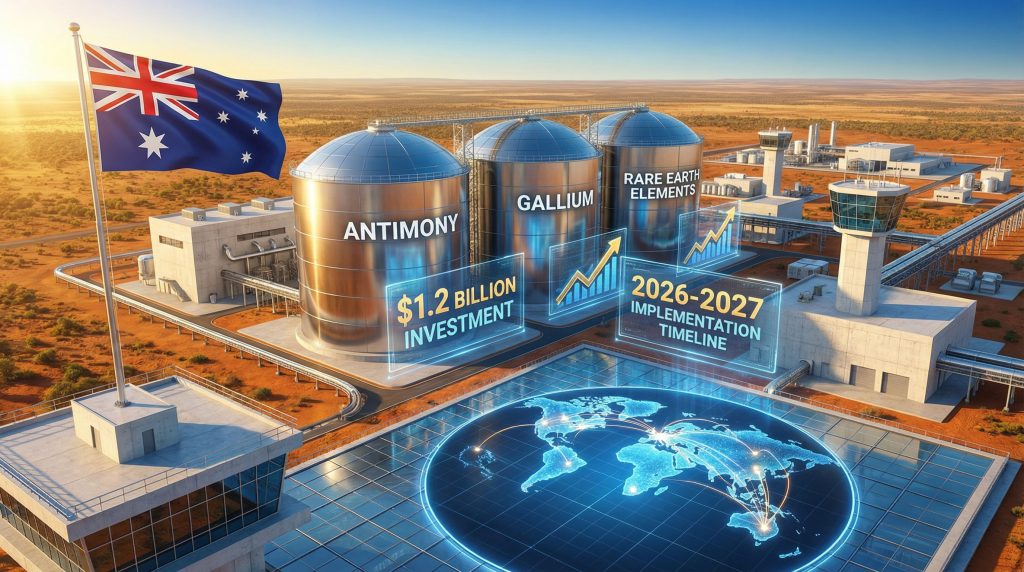
Critical Mineral Selection: Why Antimony, Gallium, and Rare Earth Elements Define Strategic Priority
The Australia Critical Minerals Strategic Reserve focuses on three mineral categories that represent the highest concentration of supply chain risk combined with the greatest strategic importance for allied defence, technology, and clean energy sectors.
Antimony's Defence Manufacturing Criticality
Antimony occupies a unique position in defence supply chains due to its essential role in ammunition hardening and specialised military alloys. China controls approximately 70-75% of global antimony production, creating a concentrated vulnerability for allied defence manufacturing capabilities. This concentration has prompted international investment in strategic antimony financing initiatives to secure alternative supply sources.
Global antimony production reaches approximately 180,000 metric tons annually, with primary producing regions concentrated in China, Bolivia, Russia, and Tajikistan. This geographic concentration presents systematic risk for allied nations that rely on antimony for critical defence applications.
Key defence applications include ammunition production, where antimony improves hardness and density in lead-core ammunition, enhancing penetration characteristics essential for military effectiveness. Additionally, the material's fire suppression properties are critical for military vehicle and aircraft safety systems. Furthermore, antimony is essential in solder compositions and semiconductor manufacturing for military-grade electronics, as well as in specialised alloys for type-metal printing and pewter applications in precision defence components.
The defence sector's antimony requirements represent approximately 5-10% of total global consumption. However, this relatively small percentage masks the material's absolute criticality for maintaining allied military capabilities. During supply disruptions, civilian applications including flame retardants and battery production compete directly with defence needs, potentially creating allocation challenges that could compromise military readiness.
Gallium's Semiconductor Supply Chain Leverage
Gallium represents perhaps the most strategically vulnerable mineral in the Australia Critical Minerals Strategic Reserve portfolio due to its extreme production concentration and irreplaceable role in advanced semiconductor manufacturing. China produces approximately 95% of global gallium supply, creating unprecedented single-source dependency for allied technology sectors.
Annual global gallium production reaches approximately 500-550 metric tons, with integrated circuit applications accounting for 95% of consumption. This concentration means gallium supply disruptions directly impact semiconductor manufacturing capacity across allied nations, affecting everything from consumer electronics to defence systems.
Critical semiconductor applications include radio frequency components, where gallium arsenide (GaAs) wafers enable high-frequency performance essential for 5G networks, satellite communications, and defence radar systems. Moreover, gallium nitride (GaN) technology provides high-efficiency power conversion for electric vehicles and grid-scale energy storage. The material is also irreplaceable for advanced military systems, as GaAs technology operates at frequencies where silicon reaches performance limitations.
China's demonstrated willingness to implement export quota restrictions on gallium and germanium in December 2023 directly affected allied semiconductor manufacturing capacity. This validates concerns about weaponised supply dependencies whilst highlighting the need for comprehensive critical minerals pivot strategies among allied nations.
Rare Earth Elements and Clean Energy Transition Security
Rare earth elements represent the most systemically important component of the Australia Critical Minerals Strategic Reserve due to their simultaneous criticality across defence, clean energy, and advanced technology applications. China dominates production with 60-70% global market share, creating strategic vulnerability that directly threatens allied clean energy decarbonisation timelines.
Global rare earth element production reaches approximately 850,000-900,000 metric tons of rare earth oxide equivalent annually. Permanent magnet applications account for 30-35% of consumption, representing the highest strategic value because these materials enable technologies that have no near-term substitutes.
Strategic applications span multiple sectors. In clean energy infrastructure, wind turbine generators require 200-600 kg of permanent magnets per megawatt capacity, whilst electric vehicle motors need 1-2 kg of permanent magnet material per vehicle. Global wind capacity additions exceed 70 GW annually, creating substantial rare earth reserves analysis requirements and demand growth.
Defence and aerospace systems depend heavily on precision-guided weapons targeting systems that rely on rare earth permanent magnet technology. Similarly, jet engine electromagnetic systems require high-temperature permanent magnets with dysprosium content, whilst advanced sonar and underwater detection systems utilise rare earth permanent magnet components.
The International Energy Agency estimates that achieving net-zero emissions by 2050 requires permanent magnet supply to increase 300-400% from 2020 baseline levels. This creates unprecedented demand growth that amplifies supply security risks across the global energy transition.
Financial Architecture: $1.2 Billion Investment Strategy and Implementation
The Australia Critical Minerals Strategic Reserve's financial structure represents a sophisticated approach to government-sponsored mineral security that leverages both direct investment and catalytic financing mechanisms. This approach achieves strategic objectives whilst minimising taxpayer risk exposure through innovative mechanisms.
Critical Minerals Facility Expansion Framework
The $1 billion Critical Minerals Facility expansion operates through Export Finance Australia (EFA) as an enhanced-mandate lending and financing instrument. This structure enables the government to support critical minerals projects without requiring immediate budget appropriations for commodity purchases.
Transaction mechanisms include direct project financing, where EFA provides capital for mine development, processing facility construction, and equipment acquisition. In addition, pre-purchase agreements allow EFA to advance funds against forward delivery contracts, reducing producer working capital requirements. The system also incorporates risk participation structures, enabling allied nations to co-invest alongside EFA loans, distributing geopolitical and completion risks.
Export Finance Australia's expanded mandate represents a strategic institutional evolution from traditional export credit to comprehensive mineral security financing. The organisation's annual lending volume across all sectors reaches approximately $3-5 billion, with the critical minerals facility representing a substantial expansion of operational capacity.
Strategic Stockpiling and Operational Investment
The $185 million stockpiling and operational budget covers physical inventory acquisition, storage infrastructure development, and implementation management through the 2026-2027 operational timeline. This component complements the production rights strategy by providing immediate supply security for the most critical applications.
Implementation phases include initial legislative approval completion and facility establishment in 2026. Subsequently, initial production rights agreements and stockpile accumulation occur during 2026-2027, followed by full operational capability and allied nation integration from 2027 onwards.
The hybrid financial model allows Australia to support approximately 5-8 major critical minerals projects simultaneously. This is based on average project financing requirements of $125-200 million per mine expansion, maximising strategic impact whilst distributing commercial and technical risks across multiple projects and partners.
Allied Nation Partnership Integration and Strategic Benefits
The Australia Critical Minerals Strategic Reserve's value proposition extends far beyond domestic supply security. It creates a comprehensive framework for allied nation collaboration that addresses collective strategic vulnerabilities whilst distributing costs and risks across partner countries, supporting the broader mining industry evolution towards strategic cooperation.
Primary Partnership Framework Analysis
United States strategic alignment addresses critical gaps in domestic critical minerals capacity whilst supporting broader AUKUS technology and defence collaboration. The $8.5 billion project pipeline implications suggest substantial integration between Australian mineral supply and U.S. defence manufacturing requirements.
European Union supply diversification efforts align directly with Australian reserve objectives through the Critical Raw Materials Act targets. This creates complementary policy frameworks that support mutual supply diversification away from concentrated sources. Furthermore, EU clean energy transition requirements create substantial demand for Australian rare earth elements and gallium supplies.
Asia-Pacific technology integration involves Japan and South Korea as critical technology sector partners with substantial semiconductor manufacturing capacity dependent on reliable gallium and rare earth supplies. Regional supply chain resilience building through Australian reserves reduces collective vulnerability to supply disruptions across the region.
Equity Participation and Risk-Sharing Mechanisms
Allied nations can participate in the Australia Critical Minerals Strategic Reserve through several structured mechanisms that balance strategic access with financial contribution. Investment structure options include direct equity stakes, where partner countries invest capital alongside Australian government funding.
Project-specific participation allows targeted investment in individual mining projects aligned with specific national priorities. Similarly, long-term supply agreements provide contractual commitments backed by financial guarantees, whilst technology transfer partnerships enable intellectual property and processing capability sharing arrangements.
| Partnership Benefit | United States | European Union | Asia-Pacific |
|---|---|---|---|
| Supply Security | Defence materials | Clean energy transition | Semiconductor inputs |
| Risk Reduction | Single-source mitigation | Diversified sourcing | Regional resilience |
| Technology Access | AUKUS integration | Processing innovation | Manufacturing efficiency |
| Timeline Impact | Immediate defence needs | 2030 climate targets | 5G infrastructure |
The partnership framework creates "insurance value" for allied nations by providing supply alternatives during market disruptions or geopolitical tensions. This insurance function justifies investment contributions even when Australian minerals may carry price premiums compared to current dominant suppliers.
International Strategic Reserve Comparative Analysis
Understanding how the Australia Critical Minerals Strategic Reserve compares to other nations' mineral security initiatives provides crucial context for evaluating its potential effectiveness and strategic positioning in the global critical materials landscape.
United States Strategic Reserve Models
The Strategic Petroleum Reserve represents the longest-running government commodity reserve globally, established in 1975 following the oil embargo crisis. The SPR maintains approximately 370 million barrels at peak capacity across underground storage facilities in Texas and Louisiana.
Key SPR characteristics include storage infrastructure that requires substantial ongoing maintenance and security costs. Moreover, release mechanisms coordinate through the International Energy Agency for maximum market impact. The reserve's scale economics mean large volume provides meaningful market influence during disruptions, though this creates operational complexity through physical inventory management across multiple secure facilities.
The United States has begun developing critical minerals stockpiling capabilities through the Defense Production Act authorities. However, these efforts remain significantly smaller in scale and scope compared to the comprehensive Australian approach.
European Critical Raw Materials Act Framework
The European Critical Raw Materials Act establishes regulatory frameworks for supply security targeting 10% of annual EU consumption through strategic stockpiles by 2030. This approach emphasises private sector coordination and cross-border partnerships rather than direct government stockpiling.
The EU strategic approach includes regulatory coordination through harmonised critical materials policies across member states. Additionally, private sector integration involves industry-led reserves with government support and coordination. The framework also incorporates supply diversification targets with specific percentage limitations on single-source dependencies, alongside processing capacity development emphasising European rare earth separation and refining capabilities.
China's Resource Security Strategy
China's approach to critical minerals represents the most comprehensive and integrated model globally. It combines state-owned enterprise control, strategic buyer coordination, and export restriction capabilities to maintain market influence and supply security simultaneously.
Chinese strategic advantages include production dominance with 60-95% market share across multiple critical minerals. Furthermore, integrated supply chains provide state coordination from mining through final manufacturing. The system also incorporates export control leverage through demonstrated ability to restrict supplies for strategic objectives, supported by comprehensive market intelligence and understanding of global demand patterns and vulnerabilities.
Australia's Competitive Strategic Position
The Australia Critical Minerals Strategic Reserve leverages several unique advantages that differentiate it from competing national strategies. Natural resource endowments mean Australia possesses substantial undeveloped reserves of antimony, gallium, and rare earth elements, providing production expansion potential that many allied nations lack.
Established allied relationships through AUKUS partnerships, Five Eyes intelligence cooperation, and QUAD strategic coordination create trust frameworks that facilitate deeper integration than purely commercial relationships. Additionally, geographic strategic positioning enables efficient supply chain access to both Asia-Pacific technology manufacturing centres and North American defence industrial base requirements.
Mining industry expertise through established companies including BHP, Rio Tinto, and Mineral Resources provides technical capabilities and operational experience necessary for rapid critical minerals production scaling.
The next major ASX story will hit our subscribers first
Implementation Challenges and Strategic Risk Assessment
While the Australia Critical Minerals Strategic Reserve represents a comprehensive approach to supply chain security, several implementation challenges could limit its effectiveness or delay strategic objectives.
Timeline and Operational Readiness Risks
The second half of 2026 operational target creates substantial execution pressure across multiple complex workstreams that must coordinate successfully for full strategic impact.
Critical timeline dependencies include legislative approval, where new legislation empowering Export Finance Australia requires parliamentary passage and regulatory implementation. Infrastructure development requires storage facilities, processing capabilities, and logistics networks to undergo construction and commissioning. Producer agreements necessitate completion of negotiations with mining companies for production rights and forward contracts, whilst allied nation coordination requires diplomatic and financial coordination across multiple governments.
Risk mitigation considerations include phased implementation, prioritising high-impact minerals for immediate deployment whilst developing broader capabilities. Furthermore, existing infrastructure utilisation can leverage current mining and storage facilities to accelerate operational timelines. Pre-negotiated frameworks can establish template agreements to streamline individual project negotiations.
Market Dynamics and Competitive Response
The Australia Critical Minerals Strategic Reserve must navigate complex global market dynamics whilst potentially triggering competitive responses from current dominant suppliers.
Market challenge scenarios include price competition, where existing suppliers could reduce prices temporarily to undermine Australian market entry and discourage long-term supply commitments from allied nations. Supply disruption tactics might involve concentrated suppliers implementing export restrictions or supply allocation changes to pressure allied nations before Australian alternatives achieve full capacity.
Technology and processing bottlenecks present additional challenges, as critical minerals require specialised processing to achieve end-use specifications. This creates potential chokepoints that could limit strategic reserve effectiveness despite raw material availability.
Scale and Expansion Considerations
The initial three-mineral focus represents a starting point rather than comprehensive critical minerals security. This creates questions about expansion priorities and resource allocation for maximum strategic impact.
The $1.2 billion investment scale must be evaluated against the magnitude of global critical minerals markets and allied nation requirements. This assessment determines whether Australian reserves can achieve meaningful market influence during supply crises and support broader strategic objectives.
Expansion priority analysis includes lithium and battery materials, where Australia possesses substantial lithium reserves that could complement the strategic reserve focus. Additionally, cobalt and nickel present electric vehicle battery supply chain opportunities, whilst copper and critical alloys address infrastructure and defence applications creating broad-based strategic requirements.
Production capacity limitations require Australian mining industry expansion to balance strategic reserve requirements against existing export commitments and domestic consumption needs across multiple mineral categories simultaneously.
Economic Impact Assessment for Australia's Mining Sector
The Australia Critical Minerals Strategic Reserve creates substantial economic opportunities across the domestic mining sector whilst positioning Australia as a cornerstone supplier for allied strategic requirements.
Major Resource Company Strategic Positioning
BHP Group strategic alignment focuses on copper and nickel operations that complement critical minerals priorities. Similarly, Rio Tinto brings alumina and rare earth processing expertise essential for gallium extraction and rare earth separation capabilities.
Mineral Resources Limited represents mid-tier producer opportunities with existing lithium operations that could expand into broader critical minerals production under strategic reserve financing support. These companies benefit from project financing access through the $1 billion Critical Minerals Facility, providing capital availability for expansion projects that might struggle to secure commercial financing.
Long-term contract security through production rights agreements provides revenue certainty that supports investment in processing and extraction capabilities. Moreover, technology transfer opportunities create access to advanced separation and refining technologies through allied nation partnerships. Market intelligence benefits arise from strategic reserve coordination, providing producers with enhanced understanding of global demand patterns and pricing dynamics.
Economic Multiplier Effects and Regional Development
Critical minerals production expansion generates substantial economic multiplier effects across regional communities and supporting industries.
Direct employment creation occurs as mining operations require skilled technical workers, equipment operators, and support personnel with wages typically exceeding regional averages by 25-40%.
Indirect economic impact spans transportation and logistics through increased rail, trucking, and port facility utilisation. Professional services expansion includes engineering, environmental consulting, and legal services growth. Equipment and maintenance demands increase for heavy machinery, spare parts, and technical services, whilst community services require expanded housing, retail, and healthcare capacity in mining regions.
Technology innovation ecosystem development results from strategic reserve requirements creating domestic demand for advanced separation, processing, and quality control technologies. This could support broader innovation clusters across Australia's technology sector.
Regional development opportunities arise as critical minerals processing facilities require substantial infrastructure investment that creates long-term economic foundations for regional communities beyond initial mining phases.
Performance Measurement and Long-Term Strategic Assessment
Evaluating the Australia Critical Minerals Strategic Reserve's success requires comprehensive metrics that capture both immediate supply security improvements and long-term strategic positioning achievements.
Supply Chain Resilience Indicators
Quantitative performance metrics include supply diversification ratios, measuring allied nations' dependency reduction on single-source suppliers across target minerals. Price volatility reduction involves statistical analysis of market stability improvements during supply disruption scenarios.
Strategic inventory adequacy measures stockpile sufficiency against documented allied consumption requirements during crisis scenarios. Production rights utilisation tracks the percentage of contracted production rights activated during normal and emergency market conditions.
Allied nation satisfaction assessment involves regular evaluation of partner country strategic requirements fulfilment and partnership agreement effectiveness across different scenario conditions. Market influence measurement includes analysis of Australian reserve market share influence and its correlation with global price stability and supply security improvements.
Future Expansion and Strategic Vision Evaluation
The initial three-mineral focus represents a foundation for broader critical minerals security that must be evaluated against expanding strategic requirements and market opportunities.
Current investment adequacy requires the $1.2 billion investment to demonstrate meaningful impact relative to global critical minerals market size and allied nation strategic requirements to justify expansion. Market share and influence analysis demands Australian production capacity additions achieve sufficient scale to influence global pricing and supply security during disruption scenarios.
Technology processing integration requires raw material reserves to develop corresponding domestic processing capabilities to maximise strategic value and reduce continued dependencies on concentrated processing facilities. Regional hub development potential suggests Australia's strategic positioning could support broader Asia-Pacific critical minerals coordination and supply chain resilience building beyond bilateral partnerships.
Strategic Success Scenarios and Risk Mitigation
High-success scenario indicators include allied nations achieving 25-30% supply diversification across target minerals within five years. Australian reserves must demonstrate market stabilisation capability during at least one significant supply disruption. Technology transfer partnerships should result in domestic processing capability development, whilst regional economic development creates sustainable long-term benefits beyond initial mining phases.
Risk mitigation and adaptation requirements include competitive response management through strategies for addressing potential market disruption attempts by existing dominant suppliers. Technology obsolescence protection requires continuous evaluation of mineral requirement changes due to technological developments.
Partnership evolution demands framework flexibility to accommodate changing allied nation priorities and strategic requirements. Scale expansion capability necessitates infrastructure and institutional capacity to add additional minerals and increase production volumes.
The Australia Critical Minerals Strategic Reserve represents a comprehensive approach to supply chain security, but its ultimate effectiveness depends on successful coordination between domestic production capabilities, international partnership frameworks, and rapidly evolving global market dynamics. Performance evaluation should account for both measurable supply security improvements and broader strategic positioning achievements that may require multiple years to fully materialise.
The strategic reserve initiative positions Australia at the centre of allied critical minerals security. However, success requires sustained commitment to implementation excellence, partnership coordination, and continuous adaptation to changing global strategic requirements across defence, technology, and clean energy transition priorities. According to the Australian government's critical minerals strategy, this initiative represents a crucial step towards securing supply chains for essential materials. Furthermore, the Parliamentary Budget Office's analysis confirms the financial framework supporting this strategic approach to mineral security.
Ready to Capitalise on Australia's Critical Minerals Boom?
The Australia Critical Minerals Strategic Reserve's $1.2 billion investment is creating unprecedented opportunities in antimony, gallium, and rare earth elements mining, with guaranteed government purchase agreements supporting major ASX-listed companies. Stay ahead of this strategic shift with Discovery Alert's proprietary Discovery IQ model, which delivers instant notifications on significant mineral discoveries that could benefit from government backing, helping you identify actionable investment opportunities before the broader market responds.