
June 10, 2026
The global energy sector faces unprecedented vulnerability through strategic maritime chokepoints that control the flow of essential commodities. When single waterways become focal points for geopolitical leverage, the resulting disruptions cascade through interconnected supply chains, affecting everything from fuel prices to industrial production. The concentration of critical infrastructure within contested regions creates systemic risks that extend far beyond immediate geographic boundaries, fundamentally altering the economics of energy security and international trade. Furthermore, the tariffs impact on markets demonstrates how geopolitical tensions create cascading effects across global financial systems.
Strategic Geography Defines Global Energy Vulnerability
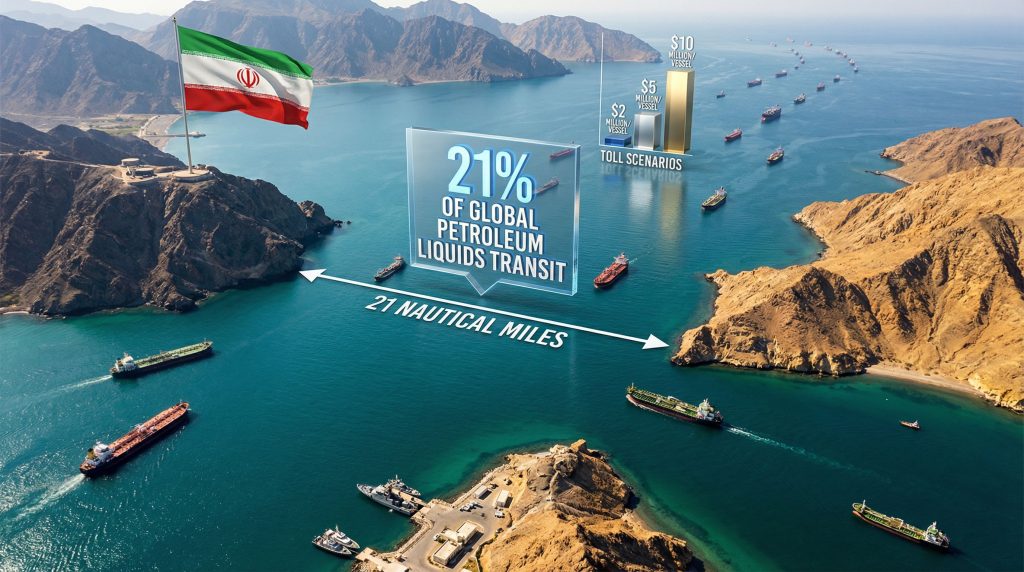
The Strait of Hormuz represents one of the world's most critical energy transit corridors, handling approximately 20-21% of globally traded oil according to U.S. Energy Information Administration assessments. This narrow passage, measuring just 21 nautical miles at its most constrained point, processes an estimated 18.5 million barrels per day of petroleum products under normal operating conditions.
The strait's geographic positioning creates unavoidable dependency for major oil-exporting nations. Saudi Arabia, the United Arab Emirates, Kuwait, and Iraq collectively account for 60-65% of total transit volume, with their combined exports flowing through this single maritime corridor. Consequently, the concentration of production from multiple nations through one passage amplifies systemic vulnerability beyond what any single country's output disruption might generate.
Regional export infrastructure demonstrates limited redundancy capabilities. The Saudi East-West Pipeline provides 5 million barrels per day capacity but currently operates at only 2.8 million barrels per day. In addition, the UAE's Abu Dhabi Crude Oil Pipeline offers 1.5 million barrels per day capacity, while Iraq's Turkey pipeline system remains largely inactive despite 1.6 million barrels per day potential.
Alternative Transportation Constraints:
- Cape of Good Hope routing adds 3,500 nautical miles to delivery distances
- Emergency rerouting increases journey time by 15-20 days
- Regional spare pipeline capacity covers only 40% of Hormuz transit volumes
- Arctic shipping routes remain seasonally limited and require specialized vessels
When big ASX news breaks, our subscribers know first
Legal Framework Challenges Iran's Toll Proposal
The United Nations Convention on the Law of the Sea establishes fundamental principles governing maritime transit rights through international waterways. Article 17 guarantees innocent passage rights for vessels of all nations, while Article 26 specifically prohibits coastal states from imposing charges solely for transit through territorial waters.
Iran's proposed toll collection system conflicts with established maritime law precedents spanning centuries. Professor Philippe Delebecque from Paris-Sorbonne University notes that freedom of navigation represents a foundational principle where the sea belongs to no single nation. Furthermore, the concern extends beyond the Iran tolls Strait of Hormuz to other critical waterways including the Strait of Gibraltar and Strait of Malacca, where similar toll schemes could disrupt $3.4 trillion in annual trade.
Critical Legal Distinctions:
| Permissible Charges | Prohibited Charges |
|---|---|
| Harbor pilotage services | Transit tolls |
| Waste disposal facilities | Passage fees |
| Navigation assistance | Geographic access charges |
| Port administrative costs | Waterway usage taxes |
Customary international law principles bind even non-signatory states to freedom of navigation doctrines. While neither Iran nor the United States has ratified the UN Convention on the Law of the Sea, both remain subject to maritime customs established through centuries of international practice. However, Julien Raynaut from the French Association of Maritime Law emphasises that non-ratification does not grant total freedom of action in strategic straits.
The precedent-setting implications concern maritime law experts globally. Constantinos Yiallourides from the British Institute of International and Comparative Law warns that legitimising Iranian toll collection could encourage similar restrictions in other strategic waterways, fundamentally undermining the international system of free maritime commerce.
Economic Impact Models Reveal Cascading Effects
Toll implementation scenarios demonstrate varying degrees of global economic disruption depending on fee structures and enforcement mechanisms. Analysis from the Bruegel Institute indicates that a $2 million vessel toll translates to approximately $1 per barrel for large crude carriers transporting 2 million barrels.
Projected Toll Impact Analysis:
| Toll Level | Per-Barrel Cost | Annual Iran Revenue | Global Additional Cost |
|---|---|---|---|
| $2 million/vessel | $1.00/barrel | $8.2 billion | $6.7 billion |
| $5 million/vessel | $2.50/barrel | $20.5 billion | $16.8 billion |
| $10 million/vessel | $5.00/barrel | $41 billion | $33.6 billion |
Secondary market effects amplify direct toll costs through insurance premium increases and alternative routing expenses. War Risk Insurance premiums for Gulf-origin shipments have increased 20-40% depending on vessel classification and flag state registration. Moreover, spot charter rates for alternative routing arrangements rise 30-40% due to extended voyage times and increased operational complexity.
Regional oil price differentials widen significantly under toll scenarios, with Gulf-to-Asian delivery spreads potentially expanding $8-12 per barrel beyond historical norms. This differential reflects not only direct transportation cost increases but also supply chain disruption premiums and inventory management challenges.
Import Dependency Vulnerabilities:
| Country | Hormuz Dependence | Annual Import Value | Additional Toll Costs |
|---|---|---|---|
| Japan | 85% | $89 billion | $2.1 billion |
| South Korea | 78% | $67 billion | $1.8 billion |
| India | 62% | $78 billion | $1.9 billion |
| China | 43% | $156 billion | $2.8 billion |
These vulnerabilities intersect with broader US-China trade tensions that already strain global supply chains and commodity markets.
Current Enforcement Mechanisms and Traffic Control
The Islamic Revolutionary Guard Corps operates what shipping analysts term a tollbooth system, requiring vessels to divert from standard shipping lanes to Larak Island for inspection and documentation processing. This mechanism involves detailed crew verification, cargo documentation, and payment processing reportedly conducted through Chinese yuan or cryptocurrency transactions.
Traffic flow data indicates significant disruption levels, with March 2026 transit volumes reportedly declining 78% from normal operational baselines. If accurate, this represents a reduction from approximately 645 vessels monthly to 142 vessels, fundamentally altering regional supply chain dynamics.
Operational Control Elements:
- Mandatory crew and cargo documentation
- Selective approval based on vessel origin
- Payment processing through non-traditional currencies
- Average processing delays of 3-7 days per vessel
- 67% of approved vessels reportedly maintain Iranian commercial relationships
Malaysian-flagged vessels reportedly receive preferential treatment, suggesting diplomatic relationships influence toll collection enforcement. Consequently, this selective application creates additional market distortions beyond direct cost impacts, favouring certain trading partners while disadvantaging others.
Infrastructure Development and Revenue Applications
Iran's toll collection proposal aims to generate reconstruction funding estimated between $8-20 billion annually depending on fee structures and enforcement success rates. Post-conflict infrastructure rebuilding costs range $150-200 billion, suggesting toll revenue could provide significant reconstruction financing over 8-12 year timelines.
The revenue model creates permanent income streams independent of traditional oil export revenues, potentially establishing Iran's strategic waterway control as a long-term economic foundation. For instance, this approach transforms geographic positioning into sustained financial leverage over global energy markets, similar to how oil price stagnation affects regional economic planning.
Reconstruction Funding Timeline:
Iran's infrastructure rebuilding requirements span multiple sectors including port facilities, refining capacity, transportation networks, and industrial production. Toll revenue provides foreign currency earnings that bypass traditional banking restrictions, enabling direct procurement of reconstruction materials and technology.
Geopolitical leverage expansion through selective toll exemptions could reshape regional alliance structures. Countries maintaining favourable diplomatic relationships might receive preferential treatment, while those supporting international sanctions face higher transit costs or complete access restrictions.
Alternative Supply Chain Adaptations
Global energy markets demonstrate increasing adaptation through alternative transportation infrastructure development. Saudi Arabia's East-West Pipeline expansion could accommodate additional 2.2 million barrels per day, while UAE facilities offer 1.5 million barrels daily capacity through Red Sea terminals.
Pipeline Bypass Development:
- Saudi East-West expansion: 75% capacity utilisation increase potential
- UAE Abu Dhabi system: 100% current capacity utilisation
- Iraq-Turkey corridor: Requires significant rehabilitation investment
- Regional interconnection projects: 18-24 month development timeline
Maritime rerouting through the Cape of Good Hope adds substantial distance and time costs but provides complete Strait of Hormuz avoidance. This routing increases transportation costs $3-5 per barrel while extending delivery schedules 15-20 days, creating inventory management challenges for importing nations.
Arctic shipping routes offer seasonal alternatives but require specialised ice-capable vessels and remain limited to 3-4 months annually. However, climate change may expand Arctic accessibility, though infrastructure development costs and environmental concerns limit immediate expansion potential.
These adaptations reflect broader shifts toward energy transition security as nations seek to diversify their energy supply chains.
The next major ASX story will hit our subscribers first
Diplomatic Resolution Frameworks
Multilateral diplomatic solutions focus on shared waterway management structures that address Iranian reconstruction financing while maintaining freedom of navigation principles. UN-supervised international waterway management could provide legitimate revenue streams through service-based fees rather than transit tolls.
Proposed Resolution Mechanisms:
- Shared toll collection between Iran and Oman
- Graduated fee reduction based on diplomatic milestones
- International compensation fund for reconstruction costs
- Revenue-sharing agreements with major importing nations
Investment partnership frameworks could channel reconstruction funding through international development institutions while maintaining waterway access rights. Furthermore, this approach addresses Iranian financing requirements without establishing precedents for unilateral toll collection in international straits.
Economic incentive structures might include preferential trade agreements, technology transfer arrangements, and financial assistance packages that exceed potential toll revenues while preserving maritime law principles.
Strategic Market Transformation Implications
Iran's toll proposal accelerates fundamental shifts in global energy market structures regardless of ultimate diplomatic outcomes. Importing nations increase strategic petroleum reserve capacities, enhance alternative supply source development, and accelerate renewable energy transition programmes to reduce Strait of Hormuz dependency.
Investment flows redirect toward non-Gulf production regions, including enhanced North American shale development, African offshore projects, and South American unconventional resources. In addition, this geographic diversification reduces Middle Eastern market concentration while creating new supply chain vulnerabilities in different regions.
Long-Term Market Adaptations:
- Permanent risk premium incorporation: $5-8 per barrel
- Strategic reserve expansion in importing nations
- Enhanced pipeline infrastructure development
- Accelerated renewable energy investment programmes
The precedent of successful toll collection could encourage similar schemes in other strategic waterways, fundamentally altering international maritime commerce. The Strait of Gibraltar controls 15% of global trade, while the Strait of Malacca handles 25% of traded goods, creating multiple potential chokepoints for future toll implementation.
Regional alliance structures may reorganise around energy security considerations, with importing nations forming partnerships to develop alternative supply chains and transportation infrastructure. These arrangements could reshape traditional diplomatic relationships based on shared vulnerability to strategic waterway disruption.
How might global insurance markets adapt?
Maritime insurance markets adapt through enhanced risk assessment models that incorporate geopolitical waterway control factors. Premium structures evolve to reflect route-specific vulnerabilities, creating financial incentives for alternative transportation infrastructure development while penalising continued dependence on contested passages.
The US economic impact of such disruptions extends beyond energy costs to include broader inflationary pressures and supply chain adaptations. Reports from financial markets indicate increasing concern about the long-term implications of Iran tolls Strait of Hormuz scenarios for global trade stability.
Risk Assessment Considerations: Energy market participants should consider the implications of Iran tolls Strait of Hormuz scenarios for long-term investment planning, supply chain diversification, and geopolitical risk management strategies. The evolving situation requires continuous monitoring of diplomatic developments, infrastructure alternatives, and market adaptation mechanisms.
Ready to Navigate Market Volatility from Geopolitical Events?
Discovery Alert's proprietary Discovery IQ model delivers real-time alerts on significant ASX mineral discoveries, providing investors with immediate insights during periods of global uncertainty and supply chain disruptions. Start your 14-day free trial today to position yourself ahead of market movements when geopolitical tensions create new investment opportunities.