June 8, 2026
When Bond Markets Dictate Metal Prices: The Rate Expectations Framework
Few forces reshape precious metals pricing as swiftly or as decisively as a shift in monetary policy expectations. While most investors fixate on the gold price itself, the more consequential action often unfolds in the futures markets for US Treasury bonds, where traders continuously reprice the probability of Federal Reserve rate decisions. This repricing process, triggered most reliably by US employment data, operates through a chain of cause and effect that stretches from payroll statistics all the way to the spot price of gold, silver, platinum, and palladium.
Understanding this transmission mechanism is not merely academic. For investors holding resource equities, precious metals positions, or development-stage mining companies, the relationship between US payroll growth and gold prices determines portfolio outcomes across both short and extended timeframes. Furthermore, the gold and bonds dynamics at play during rate-repricing events are among the most consequential forces shaping capital allocation decisions across the resource sector.
When big ASX news breaks, our subscribers know first
The Multi-Step Transmission Chain: Jobs Data to Gold Prices
How a Single Employment Report Reshapes Capital Market Pricing
The connection between US nonfarm payroll data and gold is indirect but operates with considerable precision. Strong employment figures do not reduce the physical demand for gold in any direct sense. Instead, they alter the perceived trajectory of Federal Reserve policy, which cascades through Treasury markets, dollar valuations, and ultimately the opportunity cost calculation that underpins gold's investment case.
The sequence functions as follows:
- Nonfarm payroll data prints materially above consensus expectations
- Markets interpret labour market resilience as evidence the economy can absorb tighter monetary conditions
- Implied Fed rate hike probabilities rise as traders reprice federal funds futures contracts
- US Treasury yields climb in anticipation of a higher-for-longer rate environment
- The US dollar strengthens, making dollar-denominated gold costlier for international buyers
- Capital rotates toward income-generating bonds, reducing the relative appeal of non-yielding gold
- Gold prices fall as institutional allocation shifts mechanically in response to the changed risk-adjusted return landscape
This chain explains why gold can decline sharply on a strong jobs report even when no actual rate change has occurred. Markets price expected policy, not enacted policy. As OANDA senior market analyst Kelvin Wong noted in commentary following the May 2026 report, gold's decline reflected rising expectations for future Fed tightening rather than any immediate change in interest rates.
What the May 2026 Jobs Report Revealed
Nonfarm Payroll Data: The Scale of the Upside Surprise
The May 2026 US employment report delivered a result that substantially exceeded what traders had positioned for, fundamentally restructuring the monetary policy outlook for the remainder of the year.
| Metric | Reported Figure | Prior Consensus Estimate |
|---|---|---|
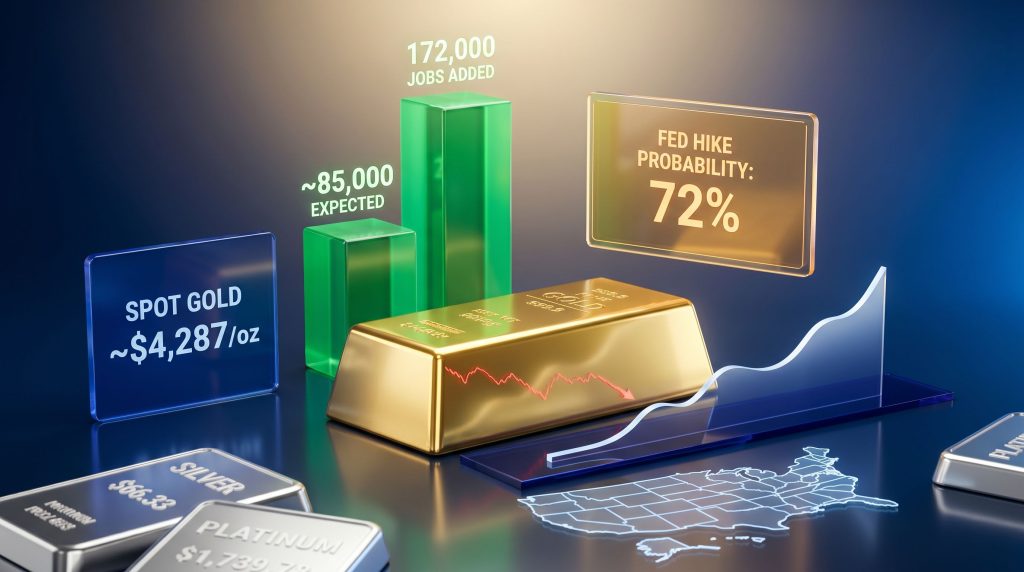
| May 2026 Nonfarm Payrolls | 172,000 jobs added | ~85,000 jobs expected |
| April 2026 Payrolls (Revised) | 179,000 jobs added | Previously lower |
| Unemployment Rate | 4.3% | Stable |
The gap between the 172,000 jobs reported and the roughly 85,000 anticipated was not a marginal beat. It represented approximately double the expected pace of hiring, a magnitude that carries disproportionate weight in shifting Fed rate expectations because it directly challenges the prevailing narrative of a softening labour market.
Several dynamics made this report particularly significant:
- A labour market adding jobs at twice the expected rate signals robust employer demand, which sustains consumer spending capacity
- Elevated employment levels typically preserve inflationary pressure, complicating the Fed's case for near-term rate reductions
- The upward revision to April's payroll figure to 179,000 reinforced the signal, indicating that hiring strength was not a one-month anomaly
- Persistent job creation combined with an unemployment rate holding at 4.3% removes the economic slack that would otherwise justify monetary easing
Capital Economics chief markets economist Jonas Goltermann observed that strong employment figures combined with elevated inflation supports the case for additional Federal Reserve tightening later in the year, a view that resonated strongly with interest rate futures markets in the hours following the release.
How Fed Rate Expectations Repriced After the Jobs Report
The CME FedWatch Probability Shift: From 45% to 72%
The most consequential immediate outcome of the May 2026 jobs report was the rapid repricing of Federal Reserve policy expectations embedded in interest rate futures markets.
| Timeframe | Implied Probability of December Fed Rate Hike |
|---|---|
| One week before the jobs report | ~45-50% |
| Immediately after the jobs report | ~68-72% |
| Net change | +22-27 percentage points |
A shift of this magnitude, moving from below-even odds to near-consensus expectation of further tightening, represents a material repricing event. The CME FedWatch tool, which derives implied probabilities from federal funds futures contracts, serves as the most widely referenced real-time barometer of market-based rate expectations and is the instrument through which this repricing is most visibly tracked.
"When the probability of a Fed rate hike crosses approximately the 65-70% level, institutional portfolio managers typically begin systematic rotation out of non-yielding assets. This rotation is not discretionary but mechanical, driven by mandate-constrained asset allocation frameworks that respond to changing risk-adjusted return differentials between asset classes."
The implication for gold is direct:
- Bond attractiveness increases as expected yields rise in advance of policy tightening
- Gold's relative value erodes because it generates zero income in an environment where risk-free instruments are offering improving yields
- Resource equity valuations compress as higher discount rates reduce the present value of future cash flows
- Development-stage project economics weaken as financing costs rise and capital becomes more selective across the resource sector
Gold's Price Response Across the Precious Metals Complex
Immediate Market Reaction Following the Employment Data
The repricing of Fed expectations triggered a broad-based selloff spanning the entire precious metals complex, with each metal declining in proportion to its sensitivity to interest rate movements and its dual role as both monetary and industrial commodity.
| Metal | Price After Jobs Report | Decline |
|---|---|---|
| Spot Gold | $4,287.66/oz | ~1.0% |
| Gold Futures (August) | $4,311/oz | ~1.2% |
| Silver | $66.33/oz | -2.2% |
| Platinum | $1,739.78/oz | -2.1% |
| Palladium | $1,207.50/oz | -1.5% |
Why Silver and Platinum Declined More Sharply Than Gold
The larger percentage declines in silver, platinum, and palladium relative to gold reflect a structural difference in how these metals are priced during rate-repricing events. Silver, platinum, and palladium each carry substantial industrial demand components that gold largely lacks. When rate hike expectations rise, markets simultaneously price in the potential for slower economic activity and reduced industrial consumption, creating a compounded headwind that amplifies the selloff beyond the purely monetary impact affecting gold.
Gold's relatively contained decline reflects its status as the most purely monetary of the precious metals. Its price drivers are dominated by real interest rates, central bank influence, and geopolitical risk premiums rather than cyclical industrial activity.
"Despite the sharp intraday correction, gold remained approximately 30% above its price level from twelve months prior at the time of the May 2026 report. Short-term rate-driven corrections occur within a broader structural backdrop that has sustained elevated gold prices through central bank accumulation programmes, persistent geopolitical risk premiums, and long-term de-dollarisation trends among emerging market reserve managers."
Why Treasury Yields Are Gold's Primary Competitor
The Opportunity Cost Mechanism in a Rising-Rate Environment
The benchmark 10-year US Treasury yield rising to a two-week high following the May 2026 jobs report was the most direct mechanism suppressing gold demand. This relationship sits at the core of understanding how US payroll growth and gold prices interact across any rate-sensitive market environment.
The opportunity cost logic is straightforward:
- Gold generates zero yield with no coupon, dividend, or interest payment
- When the 10-year Treasury yield rises, investors receive risk-free income by holding government bonds instead
- The wider the yield differential between fixed-income instruments and gold, the greater the incentive to reallocate capital away from precious metals
- This dynamic is most precisely captured through real interest rates (nominal yields minus inflation expectations): when real yields are positive and rising, gold faces its most significant structural headwinds
When Oil Prices and Gold Diverge: The Rate Expectations Override
A widely held assumption among retail investors is that rising oil prices support gold through the inflation hedge mechanism. The May 2026 episode exposed the limits of this assumption. Oil prices rose more than $3 per barrel on the same day gold declined, an apparent contradiction that reveals the hierarchy among gold's competing price drivers.
| Driver | Direction | Expected Gold Impact | Actual Gold Impact |
|---|---|---|---|
| Oil prices +$3/barrel | Bullish (inflation signal) | Positive | Overridden |
| 10-year Treasury yield at 2-week high | Bearish (opportunity cost) | Negative | Dominant |
| Fed hike probability +22-27 percentage points | Bearish (rate expectations) | Negative | Dominant |
The critical insight here is that in periods of acute monetary policy repricing, interest rate expectations and Treasury yield movements dominate all other price signals for gold. Furthermore, the gold-bond market relationship confirms that the inflation hedge narrative only regains influence over gold pricing when rate expectations are stable or falling, allowing inflation's positive effect on gold demand to express itself without the countervailing force of rising bond yields.
The next major ASX story will hit our subscribers first
A Lesser-Known Dynamic: Gold Trades on Expectations, Not Fed Actions
Why Price Moves Precede Policy Decisions
One of the most important but underappreciated aspects of gold's relationship with monetary policy is that gold prices can fall significantly before the Federal Reserve has actually changed rates at all. This occurs because institutional and algorithmic traders are not waiting for FOMC meeting outcomes. They are continuously pricing the probability distribution of future policy decisions based on incoming economic data.
The CME FedWatch tool makes this probability distribution visible in real time. Each new data release adjusts the implied odds of rate hikes or cuts at upcoming Fed meetings, and gold responds to those probability shifts immediately, often within minutes of a jobs report release.
This creates a counterintuitive dynamic that many retail investors miss:
- Gold can fall sharply even when the Fed holds rates steady, if the probability of a future hike rises
- Gold can rally even when the Fed has not cut rates, if the probability of a future cut increases
- The actual Fed decision at any given meeting is often already fully priced into gold well before the meeting date
In addition, two-year yield signals often provide an early warning of shifting rate expectations, making them a valuable leading indicator for investors monitoring the gold market. Consequently, investors who track only the federal funds rate itself are operating with a significant informational lag.
"Economic data releases are subject to material revision. April's payroll figure was revised upward to 179,000, meaning the initial market reaction to that month's data was based on an understated number. Investors who trade aggressively on individual data releases are exposed to reversal risk when subsequent revisions or contradictory data emerge."
How Higher Rates Ripple Through Resource Sector Valuations
The Discount Rate Problem for Development-Stage Projects
The repricing of Fed rate expectations does not affect only spot gold prices. It cascades through the entire resource investment ecosystem via changes to discount rates and project financing costs, with development-stage companies bearing the heaviest burden.
Key impact channels for resource companies include:
- Net Present Value compression: Higher discount rates mechanically reduce the present value of future cash flows, lowering modelled project valuations even without any change in commodity price assumptions
- Cost of capital increases: Companies seeking project financing face higher borrowing costs, narrowing the range of economically viable projects
- Equity market de-rating: Resource equities valued on future production potential face multiple compression as the rate applied to those future earnings rises
- Balance sheet vulnerability: Companies with high existing debt levels or near-term refinancing requirements face the sharpest exposure in a sustained high-rate environment
Moreover, the broader context of recession and gold prices is relevant here, as rate-driven slowdowns can simultaneously suppress industrial metals demand while creating complex crosscurrents for gold's safe-haven appeal.
"Development-stage mining and energy companies are disproportionately exposed to interest rate cycles because they are typically pre-revenue and depend on external capital markets for funding. In a high-rate environment, companies with strong balance sheets, minimal debt, and near-term production milestones are structurally better positioned than those with extended development timelines and significant ongoing capital requirements."
What Conditions Would Reverse Pressure on Gold
Key Thresholds and Reversal Indicators
Gold's recovery from rate-driven pressure depends on a reversal of the same transmission chain that produced the decline. Investors tracking the precious metals complex should monitor a specific cluster of indicators to identify when conditions are shifting back in favour of gold.
Primary reversal indicators:
- CME FedWatch December hike probability falling below 50%, signalling that markets have returned to a rate-hold or rate-cut baseline
- The 10-year Treasury yield retreating from recent highs, reducing the opportunity cost of holding non-yielding gold
- US CPI or PCE inflation data printing below consensus expectations, weakening the Fed's case for further tightening
- Subsequent nonfarm payroll reports missing consensus estimates, directly reversing the repricing event caused by the May upside surprise
Scenario Analysis: Two Paths for Gold in the Remainder of 2026
| Scenario | Fed Probability Trajectory | Treasury Yield Direction | Gold Price Outlook |
|---|---|---|---|
| Scenario A: Continued Labour Strength | Hike probability holds above 70% | Yields remain elevated or move higher | Sustained pressure; gold tests lower support levels |
| Scenario B: Labour Market Softening | Hike probability falls below 50% | Yields decline as rate-cut narrative returns | Recovery potential; gold reclaims recent highs |
A Framework for Investors Navigating Rate-Sensitive Markets
Structural Positioning Over Data-Release Trading
A single employment report rarely determines Federal Reserve policy. The Fed evaluates a broad and continuously updated array of economic indicators across multiple months before adjusting rates. Trading aggressively on individual data releases exposes investors to significant reversal risk if subsequent data contradicts the initial signal.
Rather than reacting to individual reports, a structured monitoring framework built around durable indicators provides more reliable positioning guidance:
- Track CME FedWatch probabilities on a weekly basis, focusing on the direction and momentum of change rather than absolute probability levels
- Monitor the 10-year real yield as the most direct transmission variable for gold, using TIPS-derived real yield estimates available through the Federal Reserve's published data
- Assess the rolling 3-month average of nonfarm payrolls rather than individual monthly prints to distinguish sustained trends from single-month noise
- Evaluate company-level balance sheet resilience, prioritising producers with positive free cash flow and low debt over development-stage companies with large capital requirements
- Watch for shifts in FOMC communication language, particularly around terms like "data dependence" and "sufficiently restrictive policy," which often precede formal market repricing events
Frequently Asked Questions: US Payroll Growth and Gold Prices
Does strong US job growth always push gold prices lower?
Not in every instance, but it does so reliably when the employment data is strong enough to materially shift Federal Reserve rate expectations. In environments where rate cuts are already fully priced out or where real yields are already deeply negative, a strong jobs report may have a more muted effect on gold because the marginal repricing of rate expectations is smaller.
How quickly does gold respond to jobs report data?
Gold typically responds within minutes of the nonfarm payroll release, with the most significant price movement concentrated in the first 30 to 60 minutes as algorithmic systems reprice across futures and spot markets. The sustained directional move over subsequent trading days depends on whether incoming inflation and labour data confirms or contradicts the initial signal. For instance, gold prices after weak reports demonstrate the precise inverse of the dynamics described in this article.
What is the relationship between the US dollar and gold following payroll data?
Strong payroll data strengthens the US dollar through the same rate expectations channel. A stronger dollar makes gold more expensive for buyers transacting in other currencies, creating a secondary source of downward pressure on gold beyond the domestic opportunity cost effect from rising Treasury yields.
How does the jobs report affect gold mining stocks differently from spot gold?
Gold mining equities face a compounded negative effect during rate-repricing events. The spot gold price falls, reducing revenue assumptions at the project level. Simultaneously, the discount rate applied to future cash flows rises, compressing valuation multiples. This dual compression typically causes gold mining stocks to underperform spot gold during the sharpest phase of rate-driven selloffs.
Key Takeaways: The US Payroll Growth and Gold Prices Relationship
| Concept | Core Principle |
|---|---|
| Transmission mechanism | Jobs data drives Fed expectations, which move Treasury yields, which alter gold's opportunity cost |
| May 2026 payroll surprise | 172,000 jobs vs. ~85,000 expected, approximately double the anticipated pace |
| Fed hike probability shift | Rose from ~45-50% to ~68-72% following the report |
| Gold's immediate response | Spot gold fell ~1% to $4,287.66; silver fell 2.2%; platinum fell 2.1% |
| Key recovery threshold | Hike probability falling sustainably below 50% signals potential gold recovery |
| Resource sector impact | Higher discount rates compress project NPVs and increase financing costs sector-wide |
| Strategic investor implication | Focus on balance sheet quality and structural rate indicators over individual data-release trading |
Readers seeking additional perspectives on Federal Reserve policy transmission and precious metals market dynamics can explore related financial analysis published by Crux Investor at cruxinvestor.com, which covers macro-driven resource market developments across global exchanges.
This article contains forward-looking statements and scenario analysis based on publicly available data as of June 2026. The scenarios and probability estimates discussed reflect market conditions at the time of writing and should not be construed as investment advice. All investments in resource equities and precious metals carry risk, including the risk of total loss of capital.
Want to Be First to Act on the Next Major ASX Mineral Discovery?
Discovery Alert's proprietary Discovery IQ model scans ASX announcements in real time, instantly transforming complex mineral data into actionable investment insights for both short-term traders and long-term investors — explore historic discoveries and their returns to understand the scale of opportunity, then begin your 14-day free trial at Discovery Alert to secure your market-leading edge before the broader market catches on.