May 22, 2026
Ancient geological forces rarely present themselves so dramatically at Earth's surface, yet Fujairah's mountainous terrain offers a remarkable exception. The convergence of tectonic plates across millions of years has created one of the planet's most accessible windows into deep crustal processes, establishing the emirate as a unique repository of mineral resources within the Arabian Peninsula's otherwise sedimentary landscape. Understanding the mineral exploration importance becomes crucial when examining such distinctive geological formations.
Understanding the Hajar Mountains: A Geological Marvel in the Arabian Peninsula
The Semail Ophiolite Complex: Ancient Ocean Floor Exposed
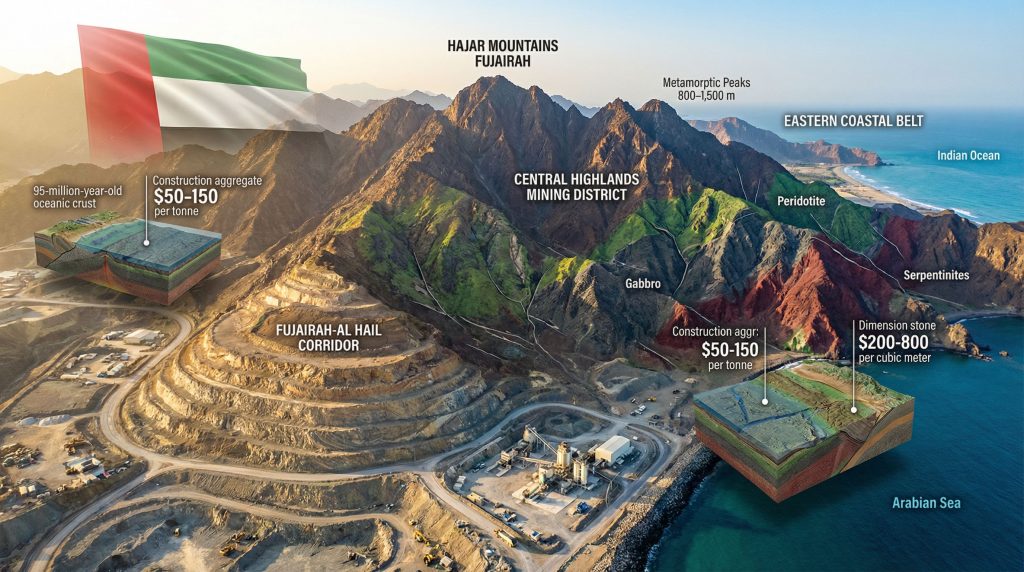
The geological foundation underlying Fujairah's unique geological diversity in Fujairah represents far more than typical mountain formation. The Semail Ophiolite Complex constitutes one of Earth's most complete and well-preserved sequences of ancient oceanic lithosphere, formed approximately 95 million years ago during the Late Cretaceous period. This extraordinary geological feature exposes sections of what was once deep ocean floor, thrust onto continental margins through powerful tectonic forces.
The ophiolite sequence displays a classic stratigraphic arrangement that provides scientists with direct access to materials normally buried beneath kilometers of sediment or ocean water. From bottom to top, the complex consists of mantle peridotite rich in olivine and pyroxene, overlain by cumulate gabbro showing evidence of magma chamber crystallization processes related to magmatic deposit formation.
Furthermore, these formations are followed by sheeted dike complexes indicating intense fracturing typical of mid-ocean ridge environments, and capped by pillow basalts with preserved glass rinds proving submarine eruption. This 95-million-year timeline places the formation during a critical period of global tectonic reorganization, when the Tethys Ocean was closing and the Arabian Peninsula was approaching the Eurasian landmass.
The preservation quality surpasses most global ophiolite exposures, including the well-known Troodos Ophiolite in Cyprus and Coast Range ophiolites in California, which often suffer from heavy metamorphic overprinting or structural disruption. Research conducted across the Semail Ophiolite has revealed depleted harzburgite compositions indicating significant partial melting history, suggesting these rocks originated in a suprasubduction zone environment.
Structural Geology and Fault Systems
The emplacement of oceanic lithosphere onto continental crust created complex thrust fault networks throughout Fujairah's geological framework. These low-angle fault systems, typically dipping 10-30 degrees in upper structural levels and steepening to 45-60 degrees at depth, control both the distribution of rock types and the concentration of economically valuable minerals.
Metamorphic grade variations across the region reflect the progressive burial and heating experienced during ophiolite emplacement. Lower elevations display prehnite-pumpellyite facies assemblages indicating relatively low-temperature conditions, while higher elevation exposures show amphibolite facies metamorphism reflecting deeper burial and higher thermal gradients.
The fracture pattern density increases dramatically in areas of higher strain concentration, creating natural pathways for groundwater circulation and hydrothermal fluid flow. These structural discontinuities fundamentally influence both the mechanical properties of rock masses and the geochemical processes that concentrate certain mineral species along fault zones, making downhole geophysics techniques essential for understanding subsurface characteristics.
Tight to isoclinal folding patterns in metamorphic sequences indicate the extreme deformation these rocks experienced during emplacement. The resulting structural complexity creates distinct mechanical domains with varying stability characteristics, directly impacting extraction planning and processing methodologies for mining operations.
When big ASX news breaks, our subscribers know first
How Do Fujairah's Three Mining Zones Compare in Resource Potential?
Zone 1: Fujairah-Al Hail Corridor Analysis
The first mining zone encompasses the Fujairah town and Al Hail region, characterized by lower-elevation terrain with established transportation infrastructure providing immediate commercial advantages. This zone represents the most accessible geological resources within the emirate's unique geological diversity in Fujairah, combining favorable topography with proximity to export facilities.
Primary resource categories within this corridor include high-quality construction aggregates derived from mafic and ultramafic intrusions, dimension stone suitable for both decorative and architectural applications. Additionally, industrial minerals including feldspar and mica concentrations provide multiple revenue streams from single extraction operations.
The zone's strategic positioning relative to Fujairah Port enables direct export access without reliance on transshipment through other emirates. Average transportation distances of 40-60 kilometers to deep-water port facilities significantly reduce logistics costs compared to inland mining operations elsewhere in the region.
| Resource Type | Quality Grade | Processing Requirements | Market Applications |
|---|---|---|---|
| Construction Aggregates | High-strength (>150 MPa) | Crushing, screening | Concrete production, road base |
| Dimension Stone | Premium decorative grade | Diamond wire cutting | Architectural facades, monuments |
| Industrial Feldspar | >95% purity | Magnetic separation | Ceramics, glass manufacturing |
| Mica Concentrates | High-grade flakes | Flotation processing | Electrical insulation, cosmetics |
Existing crushing and screening operations demonstrate proven processing capabilities that can be expanded to handle additional throughput volumes. The terrain gradient permits conventional open-pit extraction methodologies without the technical complications associated with underground mining or extreme slope stability challenges. Moreover, drilling results interpretation becomes vital for optimising extraction planning in these operations.
Zone 2: Central Highlands Mining District
The Central Highlands district operates at elevations ranging from 800-1,500 meters above sea level, creating significant topographic and logistical challenges while offering higher-grade mineral concentrations. This zone represents a higher-risk, higher-reward scenario within Fujairah's geological diversity, where access difficulties are balanced by specialty mineral potential.
Higher metamorphic grades at elevated positions correlate with increased economic potential for specialty minerals rarely available elsewhere in the Arabian Peninsula. The metamorphic recrystallization processes have concentrated certain elements and created mineral assemblages commanding premium pricing in international markets.
Chromite-bearing ultramafic bodies within this zone show potential for strategic metal recovery, while copper sulfide mineralization in metamorphic host rocks indicates possible base metal development opportunities. Early exploration has identified potential rare earth element (REE) concentrations in metamorphosed granitic rocks, though detailed resource quantification remains ongoing.
Remote positioning necessitates specialized transportation solutions, with estimated 30-50% higher transportation costs compared to Zone 1 operations. However, the typically higher unconfined compressive strength of metamorphic rocks due to recrystallization may provide superior aggregate quality justifying premium pricing.
Zone 3: Eastern Coastal Belt Operations
The Eastern Coastal Belt encompasses Quaternary marine terrace deposits indicating relatively recent geological activity within the past 2 million years. This zone presents unique dual-use challenges where mineral extraction must coexist with tourism development and stringent marine ecosystem protection requirements.
Marine terrace stratigraphy records multiple lifted beach deposits reflecting paleo-sea-level fluctuations during Quaternary climate cycles. These sedimentary sequences contain primarily clastic materials including sand and gravel with excellent particle shape characteristics due to wave-reworking processes, making them ideal for concrete applications.
Salt production methodologies employ solar evaporation ponds typical of regional coastal operations, with brine extraction from subsurface aquifer systems providing additional revenue streams. The complex hydrogeochemical environment created by marine influences and freshwater discharge zones requires sophisticated management approaches.
UAE Federal Environmental Laws impose strict restrictions on coastal zone extraction activities, limiting permitted operations to defined licenses with comprehensive environmental impact assessments. This regulatory framework requires the most rigorous environmental governance protocols among the three mining zones.
What Types of Igneous Rocks Define Fujairah's Mining Landscape?
Ultramafic Rock Formations
The ultramafic rock formations within Fujairah's unique geological diversity in Fujairah represent some of the rarest surface exposures of mantle-derived materials on Earth. These formations constitute less than 1% of global continental crust, with ophiolite-hosted exposures representing approximately 0.05% of terrestrial lithosphere.
Peridotite formations contain 60-90% olivine by volume with compositions ranging from Fo80-Fo95 (forsterite content), indicating highly magnesium-rich, refractory compositions. The high melting point exceeding 1,700°C for olivine-rich assemblages makes these materials invaluable for refractory applications in metallurgical and industrial furnace operations.
Serpentinite bodies formed through hydration of original peridotite at temperatures below 300°C consist of serpentine minerals including chrysotile, lizardite, and antigorite. These alteration products create economically valuable dimension stone applications while providing asbestos-free alternatives for industrial insulation applications.
| Rock Type | Olivine Content | Melting Point | Primary Applications | Global Rarity Index |
|---|---|---|---|---|
| Peridotite | 60-90% | >1,700°C | Refractory materials | Extremely rare |
| Serpentinite | Variable (altered) | N/A | Dimension stone | Moderate |
| Dunite | >90% | >1,800°C | Industrial sand | Very rare |
| Harzburgite | 70-85% | >1,750°C | Specialty refractories | Rare |
Dunite formations containing greater than 90% olivine represent extremely rare surface exposures providing specialized industrial sand and foundry applications. The high-purity olivine content makes these formations particularly valuable for refractory sand production and foundry molding applications.
Mafic Intrusive Complexes
Gabbro formations within the ophiolite sequence provide high-strength construction materials with unconfined compressive strengths typically exceeding 200 MPa. The coarse-grained texture and distinctive mineral assemblages make these rocks particularly suitable for decorative stone applications commanding premium prices in architectural markets.
Diabase dyke complexes represent the sheeted dyke component of the ophiolite sequence, providing excellent road base aggregates and concrete production materials. The fine-grained texture and high mechanical strength make these materials particularly valuable for high-performance concrete applications.
Basaltic sequences capping the ophiolite stratigraphy contain volcanic glass and pozzolan applications valuable for cement production and concrete admixture applications. The widespread distribution and consistent quality make these formations reliable sources for construction industry applications.
How Does Fujairah's Geological Diversity Compare Regionally?
Arabian Peninsula Geological Context
Fujairah's unique positioning as the only UAE emirate with exclusive Indian Ocean coastline exposure provides distinctive geological advantages compared to neighbouring emirates. While most of the Arabian Peninsula consists of sedimentary rocks related to ancient marine environments, Fujairah's ophiolite exposures provide access to mantle-derived materials rarely available elsewhere in the region.
The tectonic setting at the convergence zone between Arabian and Eurasian plates created the specific conditions necessary for ophiolite preservation. This geological positioning resulted in more diverse lithology than neighbouring emirates, where Tertiary and Quaternary sedimentary sequences dominate surface exposures.
Research significance extends beyond immediate economic applications, with Fujairah serving as a type locality for several mineral species first described from these exposures. International geological research programs continue to study these formations for insights into oceanic crustal formation and mantle processes, providing valuable supercontinent cycles insights for understanding regional geological evolution.
Furthermore, visitors can experience this remarkable geological heritage through guided tours that showcase the region's natural wonders and explore protected areas like the UNESCO Wadi Wurayah Biosphere Reserve.
International Geological Parallels
Similar ophiolite complexes exist in Cyprus (Troodos Ophiolite), Oman's interior regions, and California's Coast Ranges, but Fujairah's exposures offer superior accessibility and preservation state. The Cyprus Troodos Ophiolite, while scientifically important, suffers from heavy metamorphic overprinting, while California's ophiolites are often structurally disrupted by subsequent tectonic activity.
Comparative accessibility represents a crucial economic advantage, with Fujairah's ophiolite exposures occurring in areas with existing infrastructure development potential. Many global ophiolite occurrences exist in remote mountainous regions without realistic extraction possibilities, making Fujairah's combination of geological significance and commercial accessibility globally unique.
What Are the Economic Implications of This Geological Diversity?
Resource Valuation Framework
Construction materials derived from Fujairah's unique geological diversity in Fujairah command prices ranging from $50-150 per tonne for high-grade aggregates, reflecting the superior mechanical properties of ophiolite-derived materials. Premium decorative stone applications can achieve $200-800 per cubic meter depending on aesthetic properties and processing requirements.
Industrial minerals including high-purity feldspar, mica concentrates, and specialty refractories achieve $100-500 per tonne based on purity specifications and processing complexity. Rare mineral concentrates from metamorphic zones can command $1,000+ per tonne for specialty applications in high-technology industries.
Processing facility development offers opportunities for value-added manufacturing within the emirate, potentially increasing profit margins by 200-400% compared to raw material export. Advanced crushing, screening, and beneficiation technologies can optimise recovery rates while meeting stringent quality specifications for international markets.
Infrastructure Development Opportunities
Export logistics benefit from deep-water port access at Fujairah, enabling direct shipment to international markets without transshipment costs. The strategic location provides access to both Indian Ocean and Arabian Gulf markets, expanding potential customer base compared to landlocked mining operations.
Research institution partnerships with universities and geological surveys provide opportunities for technology transfer and advanced extraction technique development. International collaboration programmes can attract investment while establishing Fujairah as a regional centre for geological research and mining technology development.
Technology integration opportunities include automated extraction systems, AI-driven quality control, and real-time environmental monitoring systems that can optimise operations while maintaining strict environmental compliance standards.
How Do Environmental Factors Influence Mining Operations?
Ecosystem Protection Protocols
Wadi preservation requirements maintain freshwater catchment integrity critical for both environmental sustainability and community water security. Mining operations must demonstrate zero net impact on groundwater flow patterns and seasonal flood management systems.
Biodiversity conservation protocols protect endemic species habitats unique to the Hajar Mountains ecosystem. Environmental impact assessments require comprehensive surveys of flora and fauna, with mandatory habitat restoration programmes for any disturbed areas.
Restoration requirements mandate post-extraction landscape rehabilitation using native plant species and geomorphologically appropriate contouring. Progressive restoration during active mining phases minimises total environmental impact while demonstrating long-term stewardship commitments.
Climate Adaptation Strategies
Heat management protocols adjust operating schedules for extreme temperature conditions, with work stoppages during peak afternoon hours when temperatures exceed 45°C. Worker safety requirements mandate climate-controlled rest areas and enhanced hydration protocols.
Water scarcity challenges require closed-loop processing systems with >90% water recycling efficiency. Dust suppression technologies employ treated wastewater and recycled process water to minimise freshwater consumption while maintaining air quality standards.
Renewable energy integration offers opportunities for solar power systems to reduce operational costs while demonstrating environmental sustainability commitments. The consistent solar irradiation in the region provides ideal conditions for photovoltaic installations supporting remote operations.
The next major ASX story will hit our subscribers first
What Future Developments Could Transform Fujairah's Mining Sector?
Technology Integration Opportunities
Automated extraction systems employing remote-controlled mining equipment can improve safety while maintaining productivity in challenging terrain. GPS-guided drilling and blasting systems optimise extraction efficiency while minimising environmental disturbance.
Precision processing technologies using AI-driven quality control systems can optimise material separation and beneficiation processes. Real-time geochemical analysis enables immediate process adjustments to maximise recovery rates and product quality.
Environmental monitoring systems provide continuous ecosystem impact assessment using satellite imagery, ground sensors, and automated water quality monitoring. Predictive modelling helps anticipate environmental challenges before they require expensive remediation measures.
Strategic Investment Scenarios
International partnerships with global mining companies provide access to advanced technologies and international market networks. Joint venture arrangements can accelerate development while sharing technical expertise and financial risks.
Research collaborations with university and institute partnerships establish Fujairah as a regional centre for geological research and mining innovation. Technology development programmes can attract international investment while building local technical capabilities.
Infrastructure expansion including specialised transportation systems and advanced processing facilities can support value-added manufacturing initiatives. Deep-water port expansion enables handling of larger bulk carriers for international export markets.
Frequently Asked Questions About Fujairah's Geology
What makes Fujairah's rocks different from other UAE emirates?
Fujairah's geological foundation consists primarily of ancient oceanic crust (ophiolites) rather than the sedimentary rocks common elsewhere in the UAE. This creates unique mineral assemblages and structural characteristics not available in neighbouring emirates, providing access to mantle-derived materials typically found only in research settings.
How old are Fujairah's rock formations?
The dominant ophiolite sequences formed approximately 95 million years ago during the Cretaceous period, making them significantly older than most surface rocks in the Arabian Peninsula. These formations preserve ancient oceanic lithosphere that provides insights into Earth's deep processes during this critical period of global tectonic reorganisation.
What are the main challenges for mining operations in Fujairah?
Primary challenges include environmental protection requirements for sensitive mountain ecosystems, complex terrain access requiring specialised transportation solutions, water resource limitations in desert climate conditions, and balancing extraction activities with tourism development and conservation priorities while maintaining strict compliance with federal environmental regulations.
How does Fujairah's geology contribute to the UAE's economy?
The emirate's diverse geological resources support construction industries through high-quality aggregates and dimension stone, provide export opportunities for specialty minerals commanding premium international prices, and attract international research investment. These activities contribute to economic diversification goals while establishing Fujairah as a regional centre for geological research and sustainable resource development.
Fujairah's extraordinary geological legacy, anchored by the world-renowned Semail ophiolite complex, establishes the emirate as an unparalleled resource centre within the Arabian Peninsula. The three-zone mining framework, combined with rare igneous rock exposures and complex structural geology, creates sustainable development opportunities balancing economic growth with environmental stewardship. As technology advances and sustainability requirements evolve, Fujairah's geological assets will likely become increasingly valuable for both commercial applications and scientific research, cementing its position as a unique geological treasure within the UAE's diversified economic landscape.
Investment considerations should recognise that geological assessments, mineral reserve estimates, and extraction feasibility studies may be subject to revision based on detailed exploration results, environmental compliance requirements, and market condition changes.
Ready to Capitalise on the Next Major Mineral Discovery?
Discovery Alert's proprietary Discovery IQ model delivers instant notifications on significant ASX mineral discoveries, transforming complex geological data into actionable investment insights just like the remarkable formations found in Fujairah's unique landscape. Explore how historic mineral discoveries have generated substantial returns and begin your 14-day free trial today to position yourself ahead of the market with real-time alerts on breakthrough exploration results.