May 22, 2026
The modern economy increasingly depends on materials that barely existed in commercial quantities two decades ago, yet now underpin everything from renewable energy systems to national defence capabilities. Heavy rare earth elements represent perhaps the most strategically sensitive category within this critical materials ecosystem, with global supply chains concentrated in regions that may not align with Western industrial and security interests. The planned Aclara heavy rare earth separation facility exemplifies how innovative processing technologies could reshape these supply dynamics.
Understanding how separation technologies can reshape these supply dynamics requires examining both the technical complexities of lanthanide chemistry and the geopolitical forces driving investment in alternative processing infrastructure.
Understanding Heavy Rare Earth Element Processing Infrastructure
Heavy rare earth elements occupy a unique position in the periodic table where their chemical similarities create both extraordinary technological value and formidable processing challenges. Unlike light rare earth elements such as cerium and lanthanum, which occur in relatively high concentrations and can be separated using established metallurgical techniques, heavy rare earth elements like dysprosium and terbium exist in trace quantities within complex mineral matrices.
China currently controls approximately 85-90% of global rare earth processing capacity, according to the U.S. Geological Survey's 2025 Mineral Commodity Summaries. This dominance extends beyond mining into the sophisticated chemical separation processes that transform raw ore concentrates into the high-purity compounds required for advanced manufacturing applications.
The technical barriers to heavy rare earth separation stem from fundamental chemistry principles. The lanthanide contraction phenomenon creates overlapping solubility windows between adjacent elements, requiring precise control of pH levels, temperature parameters, and selective reagent application to achieve commercial purity standards. Moreover, these CRM facility trends are influencing how companies approach facility development globally. Most magnet-grade applications demand 99.5% or higher purity levels, necessitating sophisticated multi-stage extraction processes.
Traditional separation methodologies rely on liquid-liquid extraction using organophosphorus compounds such as di(2-ethylhexyl)phosphoric acid. These systems typically require 8-15 sequential extraction stages to achieve individual element purities when separation factors between adjacent lanthanides range from 1.5 to 3.0 in typical ionic clay sources.
The United States imports 100% of its refined dysprosium and over 90% of its terbium, classifying these materials as Category 1 Critical Minerals under federal legislation. This import dependency creates vulnerability in sectors ranging from electric vehicle manufacturing to wind turbine production. Furthermore, electric vehicles transforming mining operations require dysprosium to enable permanent magnet operation at elevated temperatures through additions of 5-8% by weight in neodymium-iron-boron alloy systems.
Heavy rare earth elements comprise only 0.01-0.1% of global rare earth ore deposits, compared to over 90% for light rare earth elements. This natural scarcity, combined with processing complexity, has historically concentrated separation capabilities in facilities with access to low-cost chemical inputs and relaxed environmental standards.
When big ASX news breaks, our subscribers know first
How Does the Aclara Heavy Rare Earth Separation Facility Transform Supply Chain Dynamics?
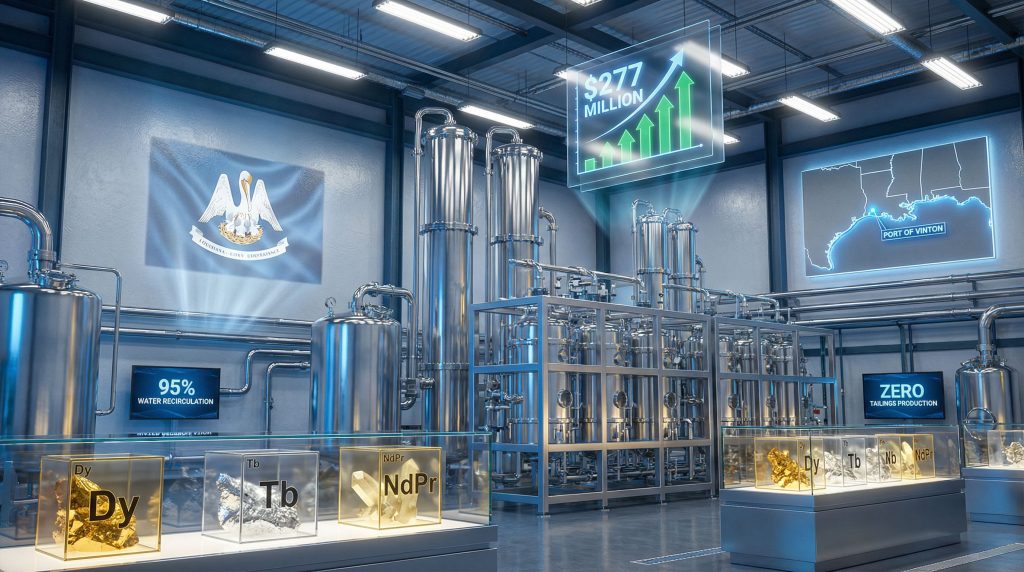
The planned $277 million heavy rare earth separation facility at the Port of Vinton in Calcasieu Parish, Louisiana, represents the first industrial-scale rare earth separation operation designed specifically for heavy rare earth elements in the Western Hemisphere. This facility targets a fundamentally different approach to supply chain architecture by integrating vertically from South American ionic clay sources to finished separation products.
The facility's design specifications target processing of mixed rare earth carbonates into high-purity dysprosium, terbium, and neodymium-praseodymium concentrates. Construction timelines project completion during 2026-2027, with full production capacity achieved by mid-2028. Louisiana state incentive packages totaling $46.4 million demonstrate governmental recognition of the facility's strategic value.
Production projections indicate the facility could supply 75% of U.S. dysprosium and terbium demand for electric vehicle applications, based on industry analysis from Rare Earth Exchanges. At projected U.S. EV heavy rare earth requirements of 800-1,000 tonnes annually by 2027-2030, this represents processing capacity of approximately 600-750 tonnes of separated heavy rare earth products per year.
The facility's strategic location within the Gulf Coast petrochemical corridor provides access to 43 specialty chemical manufacturing facilities within 50 miles, according to the Port of Calcasieu Association. This proximity reduces transportation costs for processing chemicals and ensures reliable supply chains for the complex reagents required in solvent extraction operations.
Counter-current liquid-liquid extraction stages will process feedstock arriving as intermediate concentrates rather than raw ore, eliminating the energy-intensive beneficiation typically required in hard-rock rare earth operations. This approach reduces the facility's energy footprint whilst enabling focus on the high-value separation processes that represent the primary bottleneck in Western rare earth supply chains.
The facility will target production of multiple product forms to serve different downstream applications:
• Rare earth oxides: Dry powder form with 99%+ purity for magnet manufacturing
• Rare earth chlorides: Aqueous solution form for metallurgical processing
• Specialty compounds: Customer-specific formulations for advanced applications
Deepwater port access enables direct import of South American ionic clay concentrates via Panamax and Neo-Panamax vessels, whilst finished products can be efficiently distributed to North American and European markets through established shipping channels. Additionally, the ongoing mining industry evolution continues to drive technological advances in processing methodologies.
What Makes Aclara's Circular Mineral Harvesting Technology Different?
The Aclara heavy rare earth separation facility incorporates Circular Mineral Harvesting technology that fundamentally redesigns conventional solvent extraction processes to minimise environmental impact whilst maximising resource efficiency. This approach addresses two critical vulnerabilities in traditional rare earth processing: waste generation and chemical consumption.
Conventional solvent extraction in non-optimised facilities generates 80-120 cubic metres of process water per tonne of separated heavy rare earth elements, with 10-15% reagent loss requiring replacement in each processing cycle. Traditional operations also produce 15-25 tonnes of aqueous effluent per tonne of heavy rare earth product, creating substantial disposal challenges.
The Circular Mineral Harvesting system achieves:
• 95% water recirculation through multi-stage clarification and ion-exchange polishing
• 99% reagent recovery via chemical regeneration and thermal processing cycles
• Zero liquid waste streams through crystallisation and evaporation recovery
• Elimination of tailings production by processing pre-concentrated feedstock
Water recirculation at 95% efficiency requires sophisticated engineering including clarification systems for suspended solids removal, membrane polishing for ion concentration control, and crystallisation recovery for salt management. This technology has proven operational feasibility in precious metals recovery operations such as Umicore's Hoboken facility in Belgium, which achieves 98% water recycling in scrap processing applications.
The 99% reagent recovery claim represents a significant advancement over conventional operations, though this metric requires validation through independent material balance audits during pilot plant operations. Furthermore, current critical minerals executive order initiatives may affect regulatory frameworks supporting such technologies. Successful reagent recovery depends on precise control of pH parameters, temperature cycling, and ionic strength management to prevent extractant degradation across multiple reuse cycles.
Energy efficiency improvements stem from processing ionic clay carbonates rather than raw ore, eliminating the 40-60 kWh per tonne energy consumption typical of crushing and milling operations in hard-rock rare earth processing. This approach reduces overall facility energy requirements whilst focusing resources on the high-value separation processes.
Comparable zero-discharge operations exist in specialised applications, including Jien Nickel Indonesia's laterite processing facility, which implements 96% water recirculation through acid regeneration and crystallisation stages. This represents the closest operational parallel to rare earth Circular Mineral Harvesting claims in terms of scale and chemical complexity.
The economic implications of circularity require evaluation against premium pricing for environmentally certified rare earth products. Water recirculation systems and acid regeneration equipment typically add 20-30% to operational expenses compared to open-loop discharge models, but Western markets currently support 10-15% price premiums for non-Chinese rare earth sources with demonstrated environmental compliance.
Where Will the Raw Materials Come From?
The Louisiana separation facility will process feedstock from Aclara's vertically integrated ionic clay operations across South America, creating a mine-to-separation supply chain outside traditional Chinese control. This integrated approach addresses both feedstock security and supply chain transparency concerns expressed by Western original equipment manufacturers.
Brazil – Carina Project represents the anchor asset for Louisiana facility feedstock supply. The project achieved the world's first declared NI 43-101 mineral reserves for an ionic clay rare earth deposit, transforming it from exploration prospect to bankable development opportunity. Pre-feasibility study economics report a $1.1 billion net present value with 22% internal rate of return and projected annual production of 175 tonnes of combined dysprosium and terbium.
The Carina project's production target represents approximately 11% of China's officially reported 2024 dysprosium and terbium output, according to industry analysis. This scale positions the project as strategically significant for Western supply chain diversification whilst remaining commercially viable under current heavy rare earth pricing structures.
Chile – Penco Module provides additional feedstock diversity through ionic clay deposits in a different geological and regulatory environment. The project has entered final-stage environmental review, with operational timelines dependent on regulatory approval. Aclara has strengthened its social licence through commitments to 100% recycled industrial water usage and development of local supplier networks comprising over 300 small and medium enterprises.
Ionic clay deposits offer several processing advantages over hard-rock rare earth sources:
• Simplified beneficiation: Elements exist in adsorbed form on clay minerals rather than complex mineral structures
• Selective leaching: Acid extraction targets rare earth elements whilst leaving gangue minerals intact
• Higher heavy rare earth ratios: Weathered profiles concentrate heavy rare earth elements relative to light rare earth elements
• Lower radioactivity: Ionic clays typically contain minimal thorium and uranium compared to monazite or bastnäsite sources
The geographic diversification across Brazil and Chile provides operational risk mitigation whilst ensuring feedstock supply security for Louisiana facility operations. Transport logistics utilise established South American port infrastructure with direct shipping access to Gulf Coast receiving facilities.
| Source Location | Resource Type | Key Elements | Annual Capacity | Development Status |
|---|---|---|---|---|
| Carina, Brazil | Ionic Clay | Dy, Tb, HREE | 175 tonnes Dy/Tb | NI 43-101 reserves |
| Penco, Chile | Ionic Clay | Dy, Tb, Y | TBD | Environmental review |
| Future Projects | Various | HREE concentrates | Expansion pipeline | Strategic acquisition |
U.S. Development Finance Corporation commitment of $5 million in development funding for the Carina project signals alignment with American strategic supply chain priorities, though this represents validation rather than full project financing. Additional capital requirements will be met through strategic investors including Chilean mining company CAP S.A. and the Hochschild Mining group.
How Does This Address U.S. Critical Minerals Security?
The Aclara heavy rare earth separation facility directly addresses identified vulnerabilities in American critical minerals supply chains, where strategic material imports from potentially adversarial nations create economic and security risks across multiple sectors. Current U.S. heavy rare earth dependency approaches 100% for refined products, creating potential disruption points in industries ranging from renewable energy to national defence.
Electric vehicle manufacturing represents the most rapidly growing demand sector for heavy rare earth elements. Dysprosium additions to permanent magnets enable efficient motor operation at the elevated temperatures encountered in automotive applications, whilst terbium provides similar temperature stabilisation benefits. U.S. electric vehicle penetration projecting 40-50% by 2030 translates to heavy rare earth demand growth of 25-30% annually through the decade.
Wind turbine permanent magnet generators constitute another critical application where heavy rare earth elements cannot be easily substituted without significant performance penalties. Direct-drive wind generators require approximately 200-600 kilograms of rare earth permanent magnets per megawatt of capacity, with dysprosium content ranging from 3-8% depending on design specifications and operating environment requirements.
Defence applications for heavy rare earth elements include guidance systems, communications equipment, and electronic warfare capabilities where supply disruption could compromise national security operations. The Department of Defense has identified rare earth supply chain resilience as a Tier 1 strategic priority under current procurement guidelines.
The Louisiana facility's projected output would address:
• 50% of total U.S. heavy rare earth requirements across all applications
• 75% of electric vehicle sector demand for dysprosium and terbium
• Strategic reserve accumulation capability for government stockpiling programmes
• Allied nation supply support for NATO and Indo-Pacific partner requirements
Current market pricing for non-Chinese heavy rare earth sources commands 2-3 times premium pricing relative to Chinese exports, reflecting supply security value perceived by Western purchasers. This premium structure provides economic viability for higher-cost Western processing operations whilst incentivising supply chain diversification investments.
The Infrastructure Investment and Jobs Act and related legislation provide policy framework supporting domestic critical minerals processing through tax incentives, development finance, and regulatory streamlining. However, these programmes require demonstration of economic viability and environmental compliance rather than providing open-ended subsidies. Meanwhile, US–China trade impact continues to influence supply chain decisions across critical minerals sectors.
Strategic considerations extend beyond immediate supply security to include technology transfer prevention and intellectual property protection in advanced manufacturing sectors. Domestic rare earth processing enables enhanced control over product specifications and quality standards whilst reducing exposure to export control restrictions that have affected Chinese rare earth trade.
What Role Does the Virginia Tech Pilot Plant Play?
The Virginia Tech pilot facility serves as the critical validation milestone between laboratory-scale Circular Mineral Harvesting technology and full-scale Louisiana commercial operations. Located at Virginia Tech's Corporate Research Centre in Blacksburg, this semi-industrial installation will process actual ionic clay concentrates under controlled conditions to verify separation efficiency, environmental performance, and product quality specifications.
Pilot plant operations target Q1 2026 startup with 18-month operational period generating data for Louisiana facility final engineering design. The scale represents approximately 1/50th of planned Louisiana capacity, enabling statistically relevant process validation whilst maintaining manageable capital investment and operational complexity.
Key validation objectives include:
• Separation efficiency confirmation: Achieving projected purity levels for dysprosium, terbium, and neodymium-praseodymium products
• Environmental metrics verification: Demonstrating 95% water recirculation and 99% reagent recovery under continuous operation
• Process optimisation: Fine-tuning pH control, temperature cycling, and extractant regeneration parameters
• Quality assurance: Establishing product specifications meeting downstream customer requirements
• Scale-up engineering: Validating equipment design principles for commercial-scale implementation
The pilot facility will process mixed rare earth carbonates shipped from Aclara's South American operations, replicating the exact feedstock composition expected for Louisiana operations. This approach eliminates uncertainty regarding feedstock variability and processing parameter optimisation that could affect commercial facility performance.
Virginia Tech's rare earth processing expertise provides independent technical validation of Aclara's proprietary technology claims. The university's materials science and chemical engineering departments have established research programmes in critical minerals processing, offering peer review capabilities for process performance evaluation.
Academic collaboration benefits include:
• Independent performance verification: Third-party validation of environmental and technical claims
• Process improvement research: Ongoing optimisation studies during pilot operations
• Workforce development: Training programmes for commercial facility operations
• Intellectual property development: Joint research on advanced separation techniques
The pilot plant timeline aligns with Louisiana facility engineering and permitting schedules, enabling real-time incorporation of operational learning into commercial facility design. This approach reduces technical risk whilst providing customer confidence in process performance claims.
Successful pilot operations will support project financing discussions by demonstrating technology readiness and process reliability to lenders and strategic investors. The Virginia Tech validation serves as a critical milestone for advancing the project from development phase to construction phase funding.
The next major ASX story will hit our subscribers first
Why Was Louisiana Selected Over Other Locations?
The Louisiana site selection reflects strategic analysis of multiple factors extending beyond traditional mining location considerations, focusing instead on industrial infrastructure optimisation and supply chain efficiency. The Port of Vinton location in Calcasieu Parish provides unique advantages for heavy rare earth separation operations requiring specialised chemical inputs and international logistics capabilities.
Chemical industry proximity represents the primary location advantage. The Gulf Coast petrochemical corridor hosts the highest concentration of specialty chemical manufacturing in North America, providing reliable access to the complex reagents required for solvent extraction operations. Local suppliers can provide organophosphorus compounds, acid regeneration chemicals, and process additives without long-distance transportation costs and supply chain risks.
Port infrastructure enables direct import of South American ionic clay concentrates and efficient export of finished rare earth products to global markets. Calcasieu Parish port facilities accommodate vessels up to Panamax and Neo-Panamax sizes, supporting cost-effective bulk material handling for both inbound feedstock and outbound product shipments.
Workforce availability leverages existing Gulf Coast chemical processing expertise rather than requiring development of specialised skills from scratch. The regional labour pool includes operators experienced in multi-stage separation processes, environmental compliance, and hazardous material handling protocols essential for rare earth processing operations.
Regulatory environment provides streamlined permitting processes and established frameworks for chemical processing facility approval. Louisiana's economic development incentives, totaling $46.4 million for the Aclara project, demonstrate state-level commitment to critical minerals processing investment whilst maintaining appropriate environmental oversight.
Utility infrastructure supports industrial-scale operations through reliable electrical power supply and process water availability. The region's established industrial base provides backup services, equipment suppliers, and maintenance capabilities reducing operational risk and capital requirements.
Site selection comparison evaluated alternative locations across the Southeast and Gulf Coast regions:
| Evaluation Factor | Louisiana (Selected) | Texas Gulf Coast | South Carolina |
|---|---|---|---|
| Chemical supply access | Excellent | Excellent | Limited |
| Port infrastructure | Direct access | Trucking required | Limited capacity |
| Regulatory timeline | 18-24 months | 24-36 months | 36+ months |
| Workforce availability | High | High | Moderate |
| State incentives | $46.4M package | Variable | Moderate support |
Environmental considerations favour the Louisiana location through established industrial zoning and existing environmental infrastructure. The site benefits from existing air quality monitoring, waste management systems, and emergency response capabilities developed for Gulf Coast chemical operations.
Strategic positioning places the facility within 500 miles of major Southeast manufacturing centres whilst maintaining access to international shipping networks. This location optimises both domestic market access and export capabilities for serving allied nation requirements.
The selection process prioritised operational efficiency over geographic diversification, recognising that rare earth separation operations require sophisticated chemical supply chains and specialised workforce capabilities that concentrate in established industrial regions rather than greenfield locations.
How Does This Compare to Asian Processing Facilities?
The Louisiana facility represents the first Western hemisphere rare earth separation operation designed specifically to compete with established Asian processing capabilities whilst addressing the environmental and supply chain limitations that characterise traditional facilities. Direct comparison reveals fundamental differences in approach, scale, and strategic positioning.
Chinese processing facilities dominate global rare earth separation through economies of scale and integrated supply chains. Baotou's processing complex handles approximately 40,000 tonnes annually of total rare earth oxides across light and heavy rare earth elements, though environmental compliance varies significantly across different operators and regulatory periods.
Technology differences distinguish the Louisiana facility's Circular Mineral Harvesting approach from conventional Asian solvent extraction methods:
| Processing Parameter | Traditional Asian | Louisiana CMH | Strategic Advantage |
|---|---|---|---|
| Water consumption | 80-120 m³/tonne | 5-10 m³/tonne | 90%+ reduction |
| Waste generation | 15-25 tonnes/tonne | Zero liquid waste | Environmental compliance |
| Reagent efficiency | 85-90% recovery | 99% recovery | Cost reduction |
| Energy intensity | Variable | Optimised for ionic clay | Process efficiency |
Japanese processing capabilities provide the closest technological comparison through facilities such as Shin-Etsu Chemical's Kasima operation, which achieves 95% water recirculation at approximately 2,000 tonnes annual capacity for heavy rare earth elements. However, Japanese facilities remain dependent on Chinese feedstock for raw material supply, limiting strategic independence.
Scale considerations position the Louisiana facility at intermediate capacity between pilot operations and large Chinese complexes. Projected 3,000-5,000 tonne annual heavy rare earth output targets strategic supply requirements rather than global market dominance, enabling focus on high-value, high-purity products for Western original equipment manufacturers.
Environmental performance represents a key differentiator where traditional Asian facilities have faced increasing regulatory pressure. China's environmental compliance enforcement has resulted in facility closures and capacity restrictions, creating supply volatility that supports premium pricing for environmentally certified Western sources.
Supply chain security distinguishes the Louisiana facility through transparent, allied-nation feedstock sources versus the opacity that characterises much Asian rare earth processing. Western purchasers increasingly value supply chain transparency for environmental, social, and governance compliance requirements.
Market access differences provide strategic advantages for the Louisiana facility:
• Export control immunity: No restrictions on sales to allied nations or strategic applications
• Currency stability: Pricing in stable Western currencies reduces financial risk
• Regulatory alignment: Compliance with Western environmental and labour standards
• Geographic proximity: Reduced transportation costs and delivery times to major markets
Cost structure analysis indicates higher operating expenses for the Louisiana facility due to environmental compliance and Western labour costs, offset by premium pricing for non-Chinese sources and reduced regulatory risk. Current market conditions support 2-3 times pricing multiples for verified Western heavy rare earth products.
Technology transfer considerations enable the Louisiana facility to incorporate best practices from global operations whilst avoiding intellectual property constraints that limit technology sharing with Asian facilities. Partnership with Stanford University for AI-driven optimisation represents technological advancement beyond conventional separation methods.
What Are the Economic Implications for Rare Earth Markets?
The Louisiana facility's development occurs during a fundamental restructuring of global rare earth markets driven by geopolitical tensions, supply chain diversification requirements, and evolving pricing mechanisms that increasingly value supply security over cost optimisation alone. These market dynamics create opportunities for non-Chinese processing operations that were economically unviable under previous pricing structures.
Pricing transformation has fundamentally altered heavy rare earth economics. Non-Chinese dysprosium and terbium sources now command 2-3 times premium pricing relative to Chinese exports, reflecting supply security value that Western purchasers assign to diversified sourcing. This premium structure provides economic foundation for higher-cost Western processing operations.
Long-term contract development represents a significant shift from traditional spot market pricing toward supply security arrangements. Original equipment manufacturers increasingly seek 5-10 year supply agreements with non-Chinese sources to ensure feedstock availability for electric vehicle and renewable energy manufacturing programmes.
Investment capital allocation has shifted toward supply chain resilience projects as institutional investors recognise strategic material access as fundamental business risk. The 300% share price increase experienced by Aclara during 2025 reflects market revaluation from junior explorer to integrated critical minerals platform.
Market structure evolution indicates movement toward regional supply chain hubs rather than centralised global processing. The Louisiana facility represents potential anchor point for North American rare earth supply networks, with similar initiatives under development in Australia and Europe.
Current heavy rare earth market fundamentals include:
• Global demand growth: 15-20% annually driven by electric vehicle and wind turbine expansion
• Supply concentration risk: 85%+ Chinese control creating vulnerability to export restrictions
• Price volatility: 200-300% price swings during geopolitical tensions
• Quality premiums: High-purity products commanding additional 20-30% pricing
Policy support mechanisms provide market stability through government backing of strategic projects. U.S. Development Finance Corporation involvement and Louisiana state incentives demonstrate governmental commitment to supply chain diversification that reduces private investor risk.
Customer qualification processes for new non-Chinese sources require 12-24 months of product testing and supply chain verification, creating market entry barriers but also customer loyalty once qualification is achieved. Early market entrants gain competitive advantages through established customer relationships.
Technology licensing opportunities emerge as Western companies develop proprietary processing methods. Intellectual property development in advanced separation technologies could generate revenue streams beyond direct processing operations through licensing arrangements with other strategic projects.
Strategic investor involvement through entities such as CAP S.A. and Hochschild Mining indicates institutional recognition of rare earth processing as infrastructure investment rather than speculative mining venture. These partnerships provide operational expertise and capital access beyond traditional mining finance sources.
Market timing considerations suggest optimal window for Louisiana facility development as demand growth accelerates whilst Chinese supply restrictions create sustained pricing support. Projects achieving operation by 2028-2030 timeframe benefit from peak demand growth without excessive competition from other Western facilities.
How Will This Impact Electric Vehicle Manufacturing?
Heavy rare earth elements serve as critical enablers for high-performance permanent magnets in electric vehicle traction motors, where dysprosium and terbium additions allow reliable operation at elevated temperatures encountered in automotive applications. The Aclara heavy rare earth separation facility development directly addresses supply chain vulnerabilities that could constrain electric vehicle scaling across North American and European markets.
Motor design requirements for electric vehicles demand permanent magnets capable of maintaining magnetic strength at temperatures exceeding 150°C during continuous operation and 200°C during peak performance periods. Dysprosium additions of 5-8% by weight in neodymium-iron-boron alloys provide necessary temperature stability whilst terbium serves similar functions at 1-3% concentrations.
Supply security implications for automotive original equipment manufacturers include reduced dependency on Chinese rare earth exports subject to potential restriction or manipulation for geopolitical purposes. Current heavy rare earth supply chains create single points of failure that could disrupt electric vehicle production programmes representing hundreds of billions in committed investment.
Cost predictability benefits emerge through long-term supply agreements with Louisiana facility output, enabling better financial forecasting for electric vehicle programmes. Automotive manufacturers increasingly structure rare earth procurement through multi-year contracts rather than spot market purchases to manage price volatility and ensure supply availability.
Performance optimisation opportunities arise through consistent heavy rare earth supply enabling advanced motor designs previously constrained by material availability uncertainty. Access to verified dysprosium and terbium sources supports higher-efficiency motor architectures and expanded operating temperature ranges.
Electric vehicle heavy rare earth demand projections indicate:
• Annual consumption: 40-60 kg dysprosium per 1,000 vehicles produced
• Market growth: 25-30% annually through 2030 in North American production
• Supply requirements: 1,500-2,000 tonnes annually by 2030 for U.S. EV manufacturing
• Premium pricing acceptance: 10-15% higher costs justified by supply security
Manufacturing localisation trends support regional rare earth processing as automotive companies establish electric vehicle production capacity in North America. Tesla, Ford, General Motors, and international manufacturers building U.S. facilities prefer proximate supply chains for critical materials to reduce logistics complexity and inventory requirements.
Quality assurance capabilities through domestic processing enable enhanced specification control and consistency verification that improve motor performance and reliability. Automotive quality standards require statistical process control and traceability that may be difficult to verify through international supply chains.
Innovation support emerges through collaboration between Louisiana facility operations and automotive research programmes. Access to reliable heavy rare earth supply enables development of next-generation motor technologies and magnetic materials optimisation previously limited by feedstock availability.
Strategic positioning for North American automotive manufacturing benefits from reduced transportation costs and delivery times for heavy rare earth materials. Domestic processing eliminates international shipping delays and customs clearance uncertainties that could disrupt just-in-time production schedules.
The facility's projected capacity to supply 75% of U.S. electric vehicle heavy rare earth demand positions it as essential infrastructure for automotive industry transformation rather than supplementary supply source, creating strategic value beyond commodity pricing considerations.
What Challenges Must Be Overcome for Success?
Despite strategic positioning and favourable market conditions, the Louisiana facility faces multiple execution risks that could impact timeline achievement, operational performance, and economic returns. Success requires navigation of technical, financial, regulatory, and market development challenges across an extended implementation period.
Financing completion represents the most immediate risk factor as the project requires substantial capital beyond current state incentive packages. The $277 million facility investment exceeds the $46.4 million in Louisiana state support, necessitating additional equity investment, development finance, or debt facilities for construction completion.
Technology validation through the Virginia Tech pilot plant must demonstrate projected separation efficiencies and environmental performance before full-scale implementation. The 99% reagent recovery and 95% water recirculation claims require independent verification under continuous operation conditions rather than laboratory testing.
Feedstock reliability depends on successful development and operation of South American ionic clay projects that remain subject to permitting, financing, and operational risks. The Carina project in Brazil and Penco module in Chile must achieve consistent production schedules and product quality specifications to support Louisiana facility operations.
Regulatory compliance involves multiple approval processes including environmental permits, chemical handling licences, and international trade certifications. Louisiana environmental permitting typically requires 18-24 months whilst federal approvals for rare earth processing may involve additional security reviews due to strategic material classification.
Critical execution dependencies include:
• Environmental permit approval: Air quality, water discharge, and waste management authorisations
• Chemical supplier contracts: Long-term agreements for specialised extraction reagents
• Equipment procurement: Custom separation equipment with 12-18 month delivery schedules
• Workforce development: Skilled operator training for complex separation processes
• Customer qualification: Product testing and supply chain verification by downstream purchasers
Market development requires building customer relationships and establishing long-term supply agreements with original equipment manufacturers and magnet producers. Customer qualification processes typically require 12-24 months for new rare earth sources, creating cash flow delays during initial operation periods.
Technical performance risks include achieving projected product purities, maintaining separation efficiencies, and demonstrating process reliability over extended operation periods. Any deviation from projected performance could affect customer acceptance and economic returns.
Competition response from Chinese rare earth producers could include pricing pressure or increased export availability designed to undermine economic viability of Western processing facilities. Strategic response planning must account for potential market manipulation attempts.
Operational complexity in rare earth separation requires sophisticated process control, environmental management, and safety protocols that exceed typical mining operations. Management capability in complex chemical processing operations represents critical success factor often underestimated in project development phases.
Policy continuity assumptions regarding government support for critical minerals processing could change with political transitions or budget constraints, affecting tax incentives, development finance, and regulatory support that influence project economics.
Risk mitigation strategies include staged development approaches, insurance coverage for technical performance guarantees, and diversified customer base development to reduce dependency on individual purchaser agreements.
What Does This Mean for Investors and Industry Stakeholders?
The Louisiana separation facility represents a fundamental shift in rare earth supply chain architecture with implications extending far beyond Aclara's immediate business operations, potentially catalysing broader transformation of strategic materials processing and investment patterns across critical minerals sectors.
Strategic positioning provides Aclara with first-mover advantages in Western hemisphere heavy rare earth processing, creating competitive moats through customer relationships, regulatory approvals, and operational expertise that would require years for competitors to replicate. Early market entry during peak demand growth offers optimal timing for market share capture.
Technology differentiation through Circular Mineral Harvesting creates intellectual property assets and operational capabilities that extend beyond single project applications. Successful demonstration could generate licensing opportunities, consulting revenue, and strategic partnerships for additional projects globally.
Investment thesis evolution from junior exploration company to integrated critical minerals platform attracts different investor categories with longer investment horizons and strategic rather than speculative motivations. The 300% share price appreciation during 2025 reflects this fundamental revaluation by equity markets.
Policy alignment with U.S. and allied critical minerals strategies provides governmental support, development finance access, and regulatory advantages that reduce traditional mining sector risks. Projects demonstrating strategic value benefit from public policy support that enhances private investment returns.
Key investor considerations include:
• Revenue visibility: Long-term customer contracts provide predictable cash flows
• Market positioning: Premium pricing for supply security creates margin protection
• Scalability: Technology platform applicable to multiple projects and regions
• Strategic value: Essential infrastructure rather than commodity operations
• ESG compliance: Environmental leadership supporting institutional investment criteria
Industry transformation potential extends beyond rare earth processing to broader critical minerals supply chain restructuring. Successful execution could demonstrate viability of Western processing operations across lithium, cobalt, graphite, and other strategic materials currently dominated by Chinese operations.
Strategic investor involvement through CAP S.A. and Hochschild Mining provides operational expertise, capital access, and industry credibility that enhance execution probability whilst demonstrating institutional recognition of strategic value. These partnerships signal broader industry commitment to supply chain diversification.
Market psychology increasingly values supply security over cost optimisation in critical minerals procurement, creating sustainable competitive advantages for diversified Western sources. This fundamental shift supports long-term premium pricing and market share protection against potential Chinese competition.
Economic moats develop through customer qualification processes, regulatory approvals, and operational expertise that create barriers to entry for potential competitors. First projects achieving successful operation establish competitive advantages that persist across extended time periods.
Capital allocation implications suggest institutional investor rotation toward strategic materials infrastructure as geopolitical risks highlight supply chain vulnerabilities. Critical minerals processing operations increasingly recognised as essential infrastructure requiring patient capital rather than speculative investment approaches.
The facility's success could catalyse additional investment in non-Chinese rare earth processing infrastructure, potentially reshaping global supply chain dynamics and establishing new paradigms for strategic materials security.
Looking to Capitalise on Critical Minerals Supply Chain Transformation?
Discovery Alert's proprietary Discovery IQ model delivers real-time alerts on significant ASX mineral discoveries, instantly empowering subscribers to identify actionable opportunities ahead of the broader market. Begin your 30-day free trial today and secure your market-leading advantage.