May 24, 2026
Why long-term power contracts matter more than ever in aluminium
Primary aluminium is one of the clearest examples of an industry where energy strategy can determine competitive survival. Smelters do not simply buy electricity as another input. They build operating models around it, hedge exposure years ahead, and align production, customer contracts, and decarbonisation plans with their power portfolio, which is why the Hydro Statkraft power supply contract for aluminium plants deserves close attention.
That is why the deal stands out as more than a routine procurement update. It is a case study in how an energy-intensive manufacturer manages cost risk, regional pricing exposure, and low-carbon positioning at the same time.
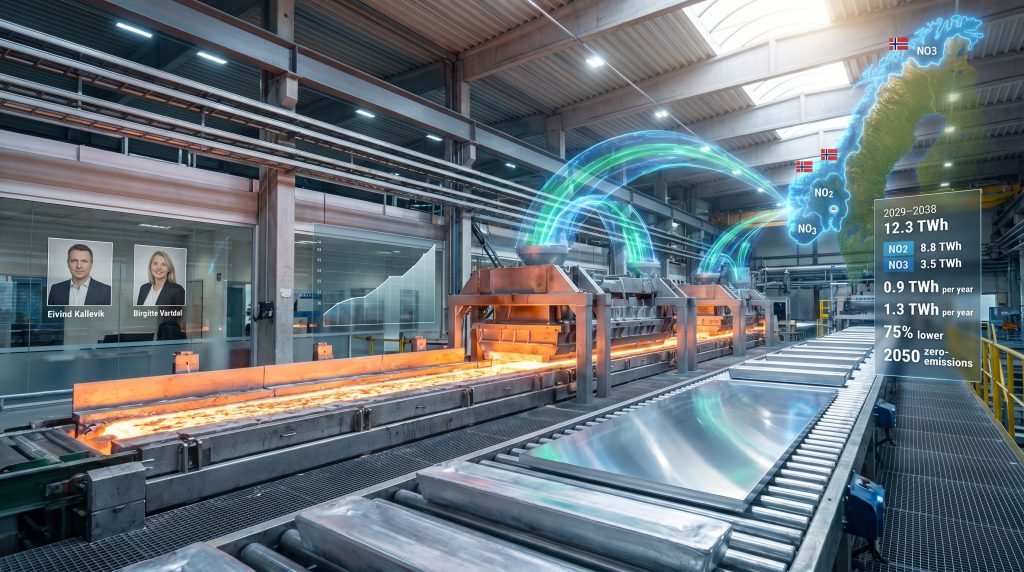
In practical terms, the agreement gives Norsk Hydro long-duration electricity coverage for Norwegian aluminium operations from 2029 to 2038, with a total contracted volume of 12.3 TWh. The supply is divided between NO2 with 8.8 TWh and NO3 with 3.5 TWh, while the annual delivery profile rises from 0.9 TWh in 2029 and 2030 to 1.3 TWh per year from 2031 through 2038.
For aluminium producers, power contracting is no longer just about securing electrons. It is also about protecting margins, stabilising production, and preserving a lower-emissions product profile in increasingly demanding end markets.
What the Hydro Statkraft power supply contract actually covers
The Hydro Statkraft power supply contract for aluminium plants is a long-term industrial electricity supply agreement for Hydro’s Norwegian aluminium operations. Based on the reported terms, the contract starts in 2029, runs until 2038, and covers 12.3 terawatt-hours of electricity in total.
Furthermore, the volume is split across two Norwegian bidding zones, NO2 and NO3, with a stepped delivery schedule that starts lower and increases after 2030. According to Statkraft’s announcement on long-term power contracts, the structure reflects Hydro’s long-term industrial demand in Norway.
Key contract facts at a glance
| Metric | Value |
|---|---|
| Buyer | Norsk Hydro |
| Supplier | Statkraft |
| Start year | 2029 |
| End year | 2038 |
| Total contracted volume | 12.3 TWh |
| NO2 allocation | 8.8 TWh |
| NO3 allocation | 3.5 TWh |
| Annual delivery in 2029 | 0.9 TWh |
| Annual delivery in 2030 | 0.9 TWh |
| Annual delivery in 2031 to 2038 | 1.3 TWh per year |
| Strategic relevance | Cost visibility, zonal risk management, support for low-carbon aluminium |
Why this is more than a standard supply deal
Aluminium smelting is exceptionally electricity-intensive. According to industry references from the International Aluminium Institute, primary aluminium production commonly requires roughly 12,000 to 15,000 kWh of electricity per tonne of metal, depending on technology and operating efficiency.
Because of that, electricity can represent a very large share of operating cost, often around 25% to 35% in broad industry cost frameworks. Consequently, long-term contracting becomes a core operating decision rather than a simple procurement exercise.
It can help reduce exposure to volatile spot markets, improve planning certainty, and support long-duration customer relationships in low-carbon aluminium markets. In addition, it sits alongside broader themes such as mining decarbonisation benefits and more resilient industrial supply chains.
Why electricity procurement is critical for aluminium plants
The Hall-Héroult smelting process relies on continuous electrolysis. In simple terms, aluminium is produced by passing strong electric current through alumina dissolved in molten cryolite. This is not a process that can be switched on and off casually.
If electricity becomes too expensive or unreliable, the consequences can be severe:
- Margins can compress quickly, since power price changes feed directly into unit costs
- Curtailments can become economically necessary when market prices spike
- Potlines can face operational stress if interruptions are prolonged
- Long-term investment decisions can be delayed when future power costs are uncertain
- Low-carbon product claims become harder to maintain if the power mix changes unfavourably
A useful rule of thumb often used in sector analysis is that a $10/MWh move in power price can alter aluminium production cost by roughly $120 to $150 per tonne, depending on plant energy intensity. That helps explain why producers lock in power years ahead rather than relying heavily on short-term markets alone.
Why companies hedge years in advance
Long-dated electricity contracting can help aluminium companies:
- Stabilise input costs across commodity cycles
- Plan production levels with greater confidence
- Support customer contracts for lower-carbon metal
- Reduce vulnerability to volatile seasonal power markets
- Protect competitiveness against producers in lower-cost energy regions
How the 12.3 TWh is structured across Norway’s power zones
Norway’s power market is divided into multiple bidding areas, commonly referred to as price zones. These include NO1, NO2, NO3, NO4, and NO5. Prices can differ between zones because of transmission bottlenecks, regional supply-demand balances, and hydrological conditions.
In the agreement, the volume is split between NO2 and NO3.
What NO2 and NO3 mean
- NO2 refers to a southern Norwegian power price area
- NO3 refers to a central Norwegian price area
- These zones can trade at different prices depending on grid congestion, reservoir levels, weather, and local generation conditions
That matters because a contract delivered in one zone is not the same as a contract delivered in another. Even if the total electricity volume is fixed, the economic outcome can vary with location-specific price dynamics.
Why the zonal split matters operationally
| Zone | Contracted volume | Share of total | Why it matters |
|---|---|---|---|
| NO2 | 8.8 TWh | 71.5% | Aligns supply with southern price exposure and plant needs |
| NO3 | 3.5 TWh | 28.5% | Adds geographic diversification and reduces single-zone concentration |
This zonal design suggests the contract is not merely about headline energy volume. Instead, it reflects price-area risk management. For readers tracking wider sector developments, this also fits the broader push towards renewable energy in mining and energy-linked industrial competitiveness.
A lesser-known point about Norwegian industrial power risk
In hydro-dominated systems like Norway’s, precipitation levels can significantly influence prices. Wet years can suppress local prices in some zones, while dry years can tighten supply and push prices higher, especially where transmission limits prevent cheaper power from flowing freely across the country.
That is one reason zonal allocation matters for large industrial buyers. As noted in industry coverage of Hydro’s power agreements, the long-term arrangement underlines how strategic these price-area exposures have become.
What the stepped delivery profile may reveal about Hydro’s strategy
The annual schedule is not flat. That is one of the most interesting parts of the agreement.
Year-by-year electricity delivery schedule
| Year | Contracted volume |
|---|---|
| 2029 | 0.9 TWh |
| 2030 | 0.9 TWh |
| 2031 | 1.3 TWh |
| 2032 | 1.3 TWh |
| 2033 | 1.3 TWh |
| 2034 | 1.3 TWh |
| 2035 | 1.3 TWh |
| 2036 | 1.3 TWh |
| 2037 | 1.3 TWh |
| 2038 | 1.3 TWh |
Why the contract ramps after 2030
The companies have disclosed the schedule, but not a detailed engineering explanation for the step-up. Therefore, any interpretation should be treated as analysis rather than confirmed fact.
Possible explanations include:
- Replacement of expiring contracts elsewhere in Hydro’s portfolio
- Layered hedging strategy, where coverage is built progressively over time
- Expected changes in plant load or utilisation after 2030
- Coordination with Hydro’s own renewable asset development and upgrades
This type of stepped arrangement is common in sophisticated industrial hedging. Instead of locking the same volume across the full period, a buyer may stagger commitments to preserve flexibility and reduce timing risk.
Analytical note: the stepped delivery profile may indicate a portfolio approach rather than a single-source solution. That interpretation is plausible, but it has not been explicitly confirmed in the reported contract summary.
How the deal supports low-carbon aluminium production in Norway
Hydro stated that aluminium produced in Norway using mostly renewable power has emissions of about 75% lower than relevant higher-emissions alternatives. That figure is central to why electricity sourcing matters far beyond the utility bill.
Why power sourcing changes the product itself
For primary aluminium, electricity is embedded in the emissions profile of every tonne produced. When the power mix is dominated by renewable generation, the carbon footprint of the final metal can be materially lower than aluminium produced in systems with heavier coal or gas exposure.
This matters to buyers in sectors such as:
- Automotive
- Construction
- Packaging
- Consumer goods
- Renewable energy equipment
Many of these customers increasingly want lower embedded emissions, better supply-chain traceability, and stronger disclosure around production inputs. In parallel, investors also compare this strategy with other low-carbon aluminium strategy moves across the sector.
Connection to Hydro’s 2050 climate objective
Hydro has a stated ambition of reaching zero emissions by 2050. A long-term renewable-heavy power supply agreement does not achieve that target on its own, but it supports one of the biggest levers available in primary aluminium: the electricity input.
Other decarbonisation factors still matter, including:
- Raw material sourcing
- Process technology improvements
- Recycling integration
- Logistics emissions
- Asset efficiency upgrades
What executives are signalling about competitiveness
Hydro chief executive Eivind Kallevik framed the agreement as evidence that industrial development in Norway is closely tied to power access. He also indicated that competitive electricity is important for long-term aluminium competitiveness and future lower-carbon customer offerings.
Statkraft chief executive Birgitte Vartdal presented the agreement as part of Statkraft’s role as a supplier to industry and as a continuation of the companies’ established commercial relationship.
Taken together, those comments point to three themes:
- Power is a strategic industrial input, not a back-office purchase
- Low-carbon aluminium is being treated as a commercial product strategy
- Long-term supplier relationships still matter in volatile power markets
How this fits into Hydro’s broader energy security model
The reported material also notes that Hydro is working on expanding its own renewable energy base and upgrading existing assets. That suggests a dual-track model rather than reliance on one procurement channel.
The industrial power portfolio playbook
| Layer | Role |
|---|---|
| Long-term third-party contracts | Secure baseline volume and cost visibility |
| Owned or controlled renewable assets | Add strategic control and internal supply optionality |
| Short-term market balancing | Fine-tune exposure around actual demand |
| Efficiency and asset upgrades | Lower total electricity intensity over time |
A blended structure like this can be more resilient than relying entirely on spot purchases or entirely on self-generation. Moreover, it diversifies risk across counterparties, time horizons, and asset types.
This is especially relevant when comparing Hydro with other aluminium industry leaders that are also repositioning around power security, emissions intensity, and policy exposure such as aluminium market tariffs.
Risks and limitations investors and readers should keep in mind
A long-term contract improves visibility, but it does not eliminate all power risk.
Key limitations include:
- Regional basis risk between NO2 and NO3
- Transmission constraints that can still affect effective market exposure
- Hydrological variability in a renewable-heavy system
- Regulatory changes affecting grids, tariffs, or market structure
- Shifts in aluminium demand that alter actual load needs
- Unknown pricing terms, since the reported summary does not disclose whether pricing is fixed, indexed, or otherwise structured
For investors, that last point is especially important. The contract volume and duration are known, but the economic value depends heavily on price formula, optionality, and how the agreement interacts with Hydro’s wider electricity portfolio.
This article discusses industrial strategy and market structure, not investment advice. Any forward-looking interpretation of the contract’s impact is inherently uncertain because not all commercial terms are public.
FAQ: Hydro Statkraft power supply contract for aluminium plants
What is the Hydro Statkraft power supply contract?
It is a long-term electricity supply agreement under which Statkraft will provide Hydro with power for Norwegian aluminium plants from 2029 to 2038, with total contracted volume of 12.3 TWh.
How much electricity is covered?
The agreement covers 12.3 TWh in total.
Why are NO2 and NO3 important?
They are Norwegian electricity price zones. Power prices can differ between them, so splitting supply across NO2 and NO3 can help manage location-specific market exposure.
How does this help low-carbon aluminium?
Hydro says aluminium produced in Norway using mostly renewable electricity has emissions about 75% lower, making clean power sourcing an important part of lower-carbon metal production.
Is Hydro relying only on purchased power?
No. Reported information indicates Hydro is also working on expanding its own renewable energy base and improving existing assets, alongside external electricity contracts.
Final takeaway
The Hydro Statkraft power supply contract for aluminium plants is best understood as an operational architecture decision. The headline numbers matter, but the deeper significance lies in how the contract combines long-dated supply, zonal risk management, stepped annual volumes, and support for lower-emissions aluminium production.
For modern smelters, competitiveness is shaped not only by metal prices, raw materials, and plant efficiency, but also by how intelligently they structure power procurement. In that sense, the Hydro Statkraft power supply contract for aluminium plants is less about a single contract and more about the strategic reality of aluminium in the 2030s.
Could The Next Major ASX Discovery Shift A Market?
Discovery Alert’s proprietary Discovery IQ model delivers real-time alerts on significant ASX mineral discoveries, helping investors spot actionable opportunities before the broader market reacts. See how major discoveries have historically driven exceptional returns on the Discovery Alert discoveries page and start a 14-day free trial today.