May 23, 2026
The emergence of hydrofluorocarbon electrolyte for lithium battery technology represents a significant breakthrough in addressing the fundamental limitations that have constrained battery performance for decades. Traditional carbonate-based electrolyte systems encounter severe performance degradation at temperatures below -20°C while simultaneously limiting achievable energy densities to approximately 250-270 Wh/kg in commercial applications. These constraints create cascading limitations across industries from electric vehicles to aerospace applications, where both high energy density and extreme temperature tolerance represent critical requirements.
Recent advances in fluorine-coordinated electrolyte chemistry have emerged as a potential solution to these longstanding trade-offs. Furthermore, the development of hydrofluorocarbon electrolyte systems represents a paradigm shift away from oxygen-coordination frameworks toward molecular architectures that leverage weaker lithium-fluorine coordination bonds to achieve simultaneous improvements in energy density and cold-weather performance.
What Are Hydrofluorocarbon Electrolytes and Why Do They Matter for Battery Technology?
Hydrofluorocarbon electrolyte for lithium battery applications utilises monofluorinated alkane solvents to create fundamentally different ion coordination mechanisms compared to conventional battery chemistry. The core innovation involves replacing traditional oxygen-coordinated molecular structures with fluorine-coordinated systems that enable unprecedented performance metrics across challenging operating conditions.
The breakthrough centres on 1,3-difluoropropane (DFP) as the primary solvent component, which challenges previous assumptions about fluorinated hydrocarbons' inability to dissolve lithium salts at high concentrations. Research teams at Nankai University and Shanghai Institute of Space Power-Sources successfully achieved lithium salt dissolution exceeding 2 mol/L concentration, demonstrating the viability of fluorine-coordinated electrolyte architecture.
Critical Performance Specifications
The Nature publication (Volume 651, pages 383-389) documents specific performance characteristics that differentiate HFC electrolytes from conventional alternatives:
- Viscosity: 0.95 centipoise at room temperature
- Oxidation stability: Greater than 4.9 volts
- Ionic conductivity: 0.29 mS/cm at -70°C
- Lithium salt dissolution: Greater than 2 mol/L concentration
- Coulombic efficiency: 99.7% at room temperature, 98.0% at -70°C
These specifications indicate that hydrofluorocarbon electrolyte for lithium battery systems maintain functional ionic transport even under extreme cold conditions where conventional electrolytes experience dramatic conductivity collapse, typically declining below 0.01 mS/cm at -50°C.
Molecular Coordination Mechanisms
The fundamental advantage stems from weaker lithium-fluorine (Li⁺–F) coordination compared to traditional lithium-oxygen (Li⁺–O) bonds characteristic of carbonate-based systems. This reduced coordination strength creates multiple performance benefits:
- Enhanced ion mobility through reduced activation energy barriers for lithium-ion transport
- Superior wetting characteristics enabling minimal electrolyte loading requirements
- Stable lithium metal interface supporting reversible plating and stripping processes
- Reduced electrolyte mass contributing directly to higher gravimetric energy density
The weaker coordination bonds prove particularly advantageous at low temperatures where thermal energy becomes insufficient to overcome strong coordination barriers in conventional systems.
When big ASX news breaks, our subscribers know first
How Do HFC Electrolytes Achieve 700+ Wh/kg Energy Density?
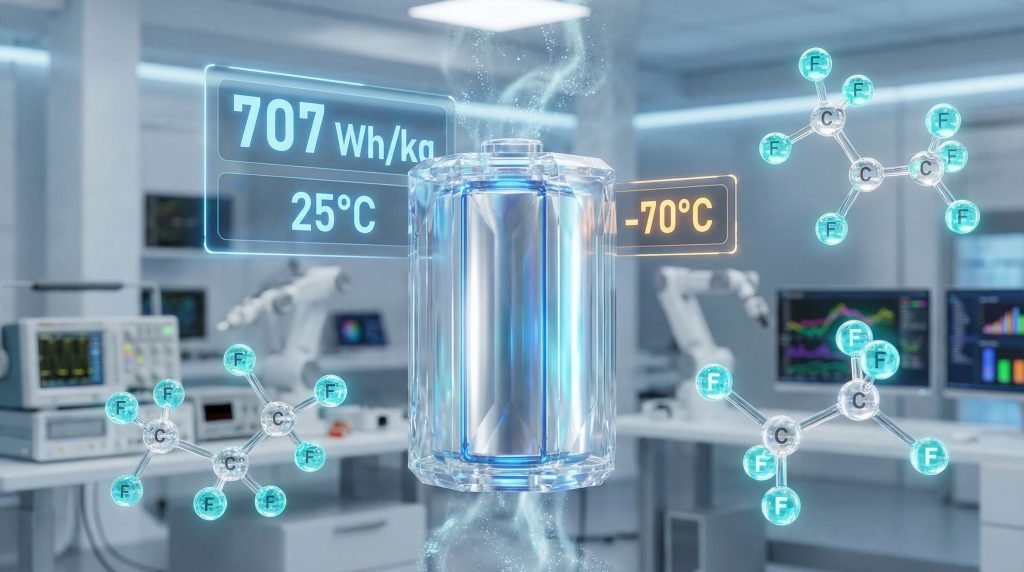
The demonstration of 707 Wh/kg energy density in lithium-metal pouch cells represents approximately 2.6 times the performance of conventional commercial lithium-ion batteries. This achievement results from synergistic optimisation across multiple battery engineering parameters rather than a single technological breakthrough.
Electrolyte Loading Optimisation
Hydrofluorocarbon electrolyte for lithium battery systems require substantially reduced electrolyte volumes compared to conventional alternatives. The superior wetting characteristics enable functional operation with less than 0.5 grams per ampere-hour of capacity, compared to typical requirements of 0.6-0.8 grams per Ah in carbonate systems.
This electrolyte loading reduction directly contributes to higher gravimetric energy density by minimising inactive material mass. Every gram of electrolyte eliminated enables proportional increases in active material content or overall energy density improvement.
Lithium Metal Anode Advantages
The transition from graphite anodes (theoretical capacity ~372 mAh/g) to lithium metal anodes (theoretical capacity ~3860 mAh/g) provides a fundamental capacity advantage. However, practical lithium metal implementation historically faced challenges with dendrite formation and rapid capacity degradation.
The fluorine-coordinated electrolyte system demonstrates exceptional lithium metal compatibility with Coulombic efficiency metrics indicating nearly reversible operation:
| Temperature | Coulombic Efficiency | Operational Significance |
|---|---|---|
| 25°C (Room Temperature) | 99.7% | Minimal lithium loss per cycle |
| -70°C (Extreme Cold) | 98.0% | Maintained reversibility |
These efficiency levels suggest that over 99 lithium ions successfully deposit and strip from the anode for every 100 electrons transferred, enabling practical lithium metal anode deployment.
Component Integration Analysis
Battery energy density calculation integrates contributions from cathode materials, anode materials, electrolyte mass, separator mass, current collectors, and packaging. Consequently, the 707 Wh/kg achievement likely represents optimised component selection across all categories specifically compatible with the HFC electrolyte system.
Key Integration Factors:
- Reduced electrolyte mass penalty enabling higher active material ratios
- Lithium metal anode compatibility unlocking theoretical capacity advantages
- High oxidation stability supporting advanced high-voltage cathode materials
- Improved interfacial contact reducing inactive conductive additives
What Temperature Ranges Can HFC Electrolyte Batteries Operate In?
The operational temperature window demonstrated by hydrofluorocarbon electrolyte for lithium battery systems extends far beyond conventional battery chemistry limitations. The verified performance across extreme temperature ranges addresses critical application constraints in aerospace, polar operations, and cold-climate electric vehicle deployment.
Temperature Performance Matrix
| Temperature Range | Energy Density | Operational Status | Key Limitations |
|---|---|---|---|
| 25°C (Room Temperature) | 707 Wh/kg | Peak performance | None identified |
| -50°C | ~400 Wh/kg | Stable operation | Reduced capacity |
| -70°C | Reduced capacity | Continued function | Limited discharge rates |
The maintenance of 0.29 mS/cm ionic conductivity at -70°C represents exceptional cold-weather performance. For context, conventional carbonate electrolytes typically experience conductivity collapse below 0.01 mS/cm at -50°C, rendering most battery systems non-functional.
Cold-Temperature Ion Transport Mechanisms
Battery operation depends fundamentally on lithium-ion transport across the electrolyte during charge and discharge cycles. At room temperature, thermal energy provides sufficient molecular motion to overcome coordination barriers between lithium ions and solvent molecules.
As temperature decreases, available thermal energy diminishes exponentially following Arrhenius kinetics. Conventional electrolytes with strong lithium-oxygen coordination require substantial thermal energy for ion liberation and transport. In contrast, the weaker lithium-fluorine coordination in hydrofluorocarbon electrolyte for lithium battery systems reduces these activation barriers, enabling continued ion mobility at extreme cold temperatures.
Viscosity and Transport Properties
The baseline viscosity of 0.95 cP at room temperature provides insight into cold-temperature behaviour expectations. Conventional carbonate electrolytes demonstrate viscosities around 1.2-1.5 cP at room temperature and increase dramatically (5-10 times) as temperatures approach -50°C.
The HFC electrolyte's low baseline viscosity combined with fluorine-coordination structure suggests viscosity increases with cooling are less severe, maintaining sufficient fluidity for ionic transport at temperatures where conventional systems solidify or become prohibitively viscous.
High-Temperature Stability Considerations
The oxidation stability specification exceeding 4.9 volts indicates thermal stability under high-voltage operating conditions. This stability suggests compatibility with advanced cathode materials and resistance to thermal runaway conditions that typically initiate around 4.5-4.7 volts in conventional systems.
Which Industries Could Benefit Most from HFC Electrolyte Technology?
The combination of high energy density and extreme temperature operation creates opportunities across sectors with demanding performance requirements that conventional battery technology cannot address. Furthermore, the development coincides with growing global battery metals investment as industries seek advanced energy storage solutions.
Aerospace and Space Applications
Space missions encounter temperature variations from +120°C in direct sunlight to -180°C in Earth's shadow. Current battery systems require complex thermal management systems adding substantial weight penalties. Hydrofluorocarbon electrolyte for lithium battery technology addresses both constraints through:
- 707 Wh/kg energy density reducing total battery mass requirements
- -70°C operational capability minimising thermal management complexity
- High oxidation stability supporting reliable operation across thermal cycles
The weight savings and thermal tolerance could enable extended mission durations and reduced launch costs for satellite and deep-space exploration applications.
Electric Vehicle Cold-Weather Performance
Consumer adoption of electric vehicles faces significant barriers in cold climates where conventional batteries experience dramatic range reduction. Winter range losses of 30-50% represent common consumer complaints affecting market penetration.
The maintained energy density of approximately 400 Wh/kg at -50°C could provide consistent vehicle range regardless of seasonal temperature variations, addressing one of the primary consumer concerns about electric vehicle reliability.
Grid-Scale Energy Storage in Extreme Climates
Utility-scale installations in regions experiencing extreme weather conditions currently require expensive thermal management infrastructure. Grid storage systems in northern Canada, Alaska, and northern European regions face operational challenges during winter months.
Hydrofluorocarbon electrolyte for lithium battery systems could enable:
- Reduced thermal management costs through extended operating ranges
- Improved reliability during extreme weather events
- Higher energy density reducing land use requirements
- Lower maintenance costs in remote installations
Specialised Industrial Applications
Cold Storage and Refrigeration Equipment:
Battery-powered equipment operating in frozen food warehouses, pharmaceutical cold storage, and industrial refrigeration systems could benefit from reliable battery performance at standard operating temperatures of -20°C to -40°C.
Polar Research and Military Applications:
Research stations in Antarctica and military equipment in arctic environments require reliable power systems capable of extreme cold operation without heating penalties that drain battery capacity.
How Do HFC Electrolytes Compare to Current Battery Technologies?
Understanding the competitive landscape requires comprehensive analysis across multiple performance dimensions beyond energy density measurements. In addition, the comparison must consider developments in sustainable battery recycling and manufacturing processes.
Comprehensive Technology Comparison
| Technology Type | Energy Density (Wh/kg) | Low-Temp Operation | Commercial Readiness | Manufacturing Scalability |
|---|---|---|---|---|
| Conventional Li-ion | 250-270 | Limited below -20°C | Fully commercial | Established infrastructure |
| Advanced Li-ion | 280-320 | Moderate cold performance | Commercial deployment | Scaling production |
| Solid-State | 300-400 (projected) | Under development | Pre-commercial | Pilot production |
| HFC Electrolyte | 707 | Functional to -70°C | Research phase | Laboratory scale |
Performance Trade-Off Analysis
Conventional lithium-ion batteries achieve reliable performance within established operating parameters but face fundamental limitations in cold weather and energy density scaling. The mature manufacturing infrastructure provides cost advantages and supply chain reliability.
Solid-state battery technology promises improved safety and moderate energy density gains but struggles with manufacturing scalability and temperature performance across wide ranges. Most solid-state systems demonstrate reduced performance below -10°C.
Hydrofluorocarbon electrolyte for lithium battery systems represent the highest demonstrated energy density with exceptional cold-weather capability, but require substantial development for commercial manufacturing and long-term reliability validation.
Cost-Performance Projections
Initial production costs for HFC electrolytes likely exceed conventional alternatives due to:
- Specialised synthesis requirements for monofluorinated alkane solvents
- Limited production volumes preventing economies of scale
- New quality control and purification processes
- Undeveloped supply chains for raw materials
However, the performance advantages could justify premium pricing in applications where conventional batteries prove inadequate, particularly aerospace, military, and extreme environment applications.
What Manufacturing Challenges Must Be Overcome?
Transitioning hydrofluorocarbon electrolyte for lithium battery technology from laboratory demonstrations to commercial production involves addressing several technical, economic, and scaling hurdles. Moreover, manufacturers must consider integration with emerging closed-loop battery recycling systems.
Chemical Synthesis and Production Scaling
Monofluorinated Alkane Production:
Manufacturing 1,3-difluoropropane and related HFC solvents requires specialised chemical processes distinct from conventional carbonate electrolyte production. Current global production capacity for these specialty chemicals remains limited, requiring substantial capacity expansion.
Purification Requirements:
HFC electrolytes demand precise control over fluorine content, molecular structure, and impurity levels. Trace impurities that prove acceptable in conventional electrolytes could significantly impact HFC performance, necessitating new analytical testing protocols and purification techniques.
Quality Control and Batch Consistency
Achieving consistent performance across production batches requires:
- Molecular composition control ensuring uniform fluorine distribution
- Water content management preventing hydrolysis reactions
- Lithium salt dissolution verification confirming >2 mol/L solubility
- Conductivity testing across temperature ranges from -70°C to +60°C
These requirements may necessitate entirely new quality assurance frameworks compared to established carbonate electrolyte manufacturing standards.
Production Infrastructure Development
Equipment Compatibility:
Existing electrolyte manufacturing facilities designed for carbonate systems may require substantial modifications to handle fluorinated compounds safely. Corrosion resistance, containment systems, and safety protocols need adaptation.
Supply Chain Integration:
Raw material sourcing for specialised fluorinated compounds involves supply chains distinct from conventional battery materials. Establishing reliable suppliers and logistics networks represents a significant development requirement. This challenge is particularly relevant considering the growing demand for battery-grade lithium refinery capacity globally.
Environmental and Safety Considerations
Fluorinated Compound Handling:
HFC electrolytes require specialised handling procedures due to the chemical properties of fluorinated organic compounds. Worker safety training, containment systems, and emergency response procedures need development.
Waste Stream Management:
Production waste containing fluorinated compounds requires specialised disposal or recycling methods to prevent environmental impact. These waste management systems add complexity and cost to manufacturing operations. The integration with existing battery recycling breakthrough technologies will be crucial for sustainable implementation.
The next major ASX story will hit our subscribers first
What Safety Considerations Apply to HFC Electrolyte Systems?
Battery safety encompasses thermal, chemical, mechanical, and environmental factors requiring comprehensive evaluation for new electrolyte chemistries.
Thermal Stability and Abuse Tolerance
The oxidation stability exceeding 4.9 volts suggests improved thermal abuse tolerance compared to conventional carbonate systems that typically experience breakdown around 4.5 volts. However, comprehensive safety testing under various failure modes remains essential for commercial deployment.
Critical Safety Testing Requirements:
- Thermal runaway characterisation under overcharge, overheat, and mechanical abuse
- Gas evolution analysis during thermal breakdown
- Fire propagation testing in battery pack configurations
- Short circuit behaviour under various environmental conditions
Chemical Reactivity Assessment
Hydrofluorocarbon electrolyte for lithium battery systems involve fluorinated organic compounds with distinct reactivity profiles compared to conventional carbonate electrolytes. Understanding chemical behaviour under normal and abuse conditions requires extensive testing.
Material Compatibility Analysis:
HFC electrolytes may interact differently with separator materials, current collectors, and battery housing components. Compatibility testing across the full range of battery materials ensures long-term reliability and safety.
Environmental Impact Evaluation
Hydrofluorocarbon compounds raise environmental considerations related to:
- Global warming potential if released to atmosphere
- Atmospheric persistence and breakdown pathways
- Disposal and recycling requirements for end-of-life batteries
- Manufacturing emissions during production processes
Life cycle assessment protocols specific to HFC electrolyte systems require development to understand environmental implications across the full product lifecycle.
Regulatory Compliance Framework
Battery systems incorporating HFC electrolytes must comply with transportation regulations, workplace safety standards, and environmental protection requirements that may differ from conventional battery systems.
Regulatory Considerations:
- UN transportation testing for new electrolyte chemistries
- Occupational exposure limits for fluorinated compounds
- Environmental discharge limits during manufacturing
- End-of-life disposal regulations for fluorinated materials
How Might HFC Electrolyte Technology Evolve?
Future development pathways focus on molecular optimisation, manufacturing scale-up, and application-specific customisation to maximise the potential of hydrofluorocarbon electrolyte for lithium battery systems.
Molecular Engineering Opportunities
Fluorine Content Optimisation:
Research suggests modulating carbon and fluorine ratios in HFC molecules could extend temperature ranges beyond the current -70°C limit and improve stability characteristics. This molecular tuning approach offers pathways for application-specific optimisation.
Coordination Strength Adjustment:
Fine-tuning lithium-fluorine coordination strength could optimise the trade-off between ionic conductivity and electrolyte stability. Weaker coordination improves cold-weather performance while stronger coordination enhances thermal stability.
Advanced Cathode Material Integration
The high oxidation stability exceeding 4.9 volts enables pairing with high-voltage cathode materials that conventional electrolytes cannot support. This compatibility could unlock additional energy density improvements beyond the current 707 Wh/kg demonstration.
Potential Cathode Pairings:
- High-nickel NMC cathodes operating above 4.5 volts
- Lithium-rich manganese oxide systems requiring >4.8 volt stability
- Novel high-voltage materials under development requiring extreme oxidation resistance
Manufacturing Process Innovation
Continuous Production Methods:
Developing continuous-flow synthesis processes for HFC solvents could reduce production costs and improve batch-to-batch consistency compared to traditional batch synthesis approaches.
Integrated Manufacturing:
Co-locating HFC electrolyte production with battery cell manufacturing could reduce handling costs, improve quality control, and minimise transportation requirements for specialty chemicals.
Application-Specific Optimisation
Different end applications may benefit from customised HFC electrolyte formulations:
Aerospace Applications: Optimised for extreme temperature cycling and radiation resistance
Automotive Applications: Balanced for cost, performance, and safety across consumer use patterns
Grid Storage Applications: Optimised for long calendar life and minimal degradation over decades
What Timeline Should Industry Expect for Commercial Availability?
The progression from research breakthrough to commercial deployment typically requires multiple development phases, each with distinct technical and business milestones.
Near-Term Development (2-3 Years)
Research Validation Phase:
- Extended laboratory testing across wider temperature ranges
- Cycle life characterisation under various operating conditions
- Safety testing protocols development and execution
- Manufacturing feasibility studies for pilot-scale production
Key Milestones:
- Demonstration of 1000+ cycle stability at rated energy density
- Comprehensive safety database across abuse conditions
- Pilot-scale electrolyte production capability establishment
- Initial cost projections for commercial production scenarios
Medium-Term Scaling (3-5 Years)
Commercial Development Phase:
- Pilot-scale manufacturing optimisation and quality control
- Automotive industry testing and validation programmes
- Regulatory approval processes for transportation and commercial use
- Supply chain development for raw materials and specialised equipment
Critical Pathway Dependencies:
- Raw material supply chain establishment for monofluorinated alkanes
- Manufacturing equipment development for HFC electrolyte production
- Industry partner engagement for application-specific testing
- Regulatory framework development for new electrolyte chemistries
Long-Term Commercialisation (5-10 Years)
Market Deployment Phase:
- Commercial production scale-up achieving cost competitiveness
- Market deployment across multiple applications and industries
- Manufacturing infrastructure expansion to meet demand projections
- Technology refinement based on commercial operational experience
Success Factors:
- Economic viability achievement through scale effects and process optimisation
- Performance validation across diverse real-world operating conditions
- Safety track record establishment through commercial deployment
- Competitive positioning against advancing conventional and alternative battery technologies
Strategic Market Implications and Investment Considerations
Hydrofluorocarbon electrolyte for lithium battery technology represents a potential inflection point in energy storage capabilities, offering solutions to longstanding performance constraints that limit current battery applications.
Market Disruption Potential
The demonstrated combination of 707 Wh/kg energy density with -70°C operational capability creates new market possibilities for applications previously considered technically infeasible:
- Extended-range electric vehicles operating reliably in arctic conditions
- Lightweight aerospace systems reducing payload penalties for satellite and space applications
- Polar research equipment eliminating thermal management complexity
- High-altitude aircraft operating at extreme temperatures with minimal heating requirements
Investment Risk Assessment
Technology Development Risks:
The progression from laboratory demonstration to commercial viability involves substantial technical hurdles including manufacturing scalability, long-term reliability validation, and cost optimisation. Historical battery technology development suggests 5-10 year timelines from breakthrough to commercial deployment.
Market Adoption Factors:
Commercial success depends on addressing manufacturing costs, safety validation, and supply chain development while competing against continuously improving conventional battery technology and alternative advanced battery approaches including solid-state systems.
Competitive Landscape Evolution
The breakthrough positions fluorine-coordinated electrolyte systems as a distinct technological pathway alongside solid-state batteries, advanced lithium-ion chemistries, and alternative battery technologies. Market success will depend on achieving commercial manufacturing viability before competing technologies address similar performance gaps.
Industries requiring high-performance energy storage in challenging environments should monitor this development closely as it progresses through the commercialisation pipeline. The technology's ultimate impact will depend on successfully navigating the complex transition from laboratory breakthrough to scalable manufacturing and market deployment.
This analysis is based on peer-reviewed research published in Nature (Volume 651, pages 383-389, DOI: 10.1038/s41586-026-10210-6). Performance claims and technical specifications reflect laboratory demonstration results that may not translate directly to commercial applications. Investment and deployment decisions should consider the early-stage nature of this technology and associated development risks.
Interested in Lithium and Battery Technology Investment Opportunities?
Discovery Alert's proprietary Discovery IQ model provides real-time notifications when significant lithium and battery metals discoveries are announced on the ASX, helping investors capitalise on breakthrough technologies before they reach mainstream attention. With historic discoveries generating substantial returns for early investors who recognised their potential, staying ahead of emerging battery technology developments becomes crucial for maximising investment opportunities in this rapidly evolving sector.