May 22, 2026
Hydrogeological Vulnerability in Western Australia's Agricultural Zones
Water security pressures across Australia's agricultural regions have intensified dramatically over the past two decades, driven by complex interactions between industrial extraction, climate variability, and evolving regulatory frameworks. The intersection of large-scale bauxite mining operations with traditional farming communities in Western Australia presents a compelling case study of these mounting pressures, where competing water demands create profound challenges for both agricultural sustainability and resource extraction economics. Furthermore, the farmer water issues South32 bauxite mine situation demonstrates how these conflicts can escalate rapidly when inadequate safeguards are in place.
Agricultural water systems operate within delicate hydrogeological equilibriums that can be disrupted by multiple factors. When industrial operations require substantial groundwater extraction in regions where farming communities depend on the same aquifer systems, the potential for conflict becomes significant. Understanding these dynamics requires examining both the technical mechanisms of water system disruption and the regulatory frameworks designed to balance competing interests.
When big ASX news breaks, our subscribers know first
Understanding Groundwater Extraction Impacts in Mining-Adjacent Agricultural Areas
Large-scale mining operations fundamentally alter regional water dynamics through multiple pathways. Bauxite extraction, in particular, requires substantial volumes of water for dust suppression, ore processing, and site rehabilitation activities. When mining companies extract hundreds of millions of litres annually from groundwater sources, the cumulative effects on surrounding agricultural operations can be profound.
Key mechanisms of agricultural water system disruption include:
• Groundwater table depression creating cone-shaped depletion zones extending several kilometres from extraction points
• Altered natural recharge patterns affecting seasonal water availability for farming operations
• Changes in hydraulic pressure relationships between deep aquifers and surface water sources
• Disruption of subsurface flow patterns that traditionally supported agricultural water security
The timing of these impacts often follows predictable patterns. Initial phases of mining expansion typically show minimal effects on adjacent agricultural water systems. However, as extraction volumes increase and multiple borefield installations begin operating simultaneously, cumulative impacts accelerate. Agricultural operators may first notice subtle changes in well water quality or yield, followed by more dramatic effects including complete loss of surface water sources during dry seasons.
Water quality degradation manifests through several pathways:
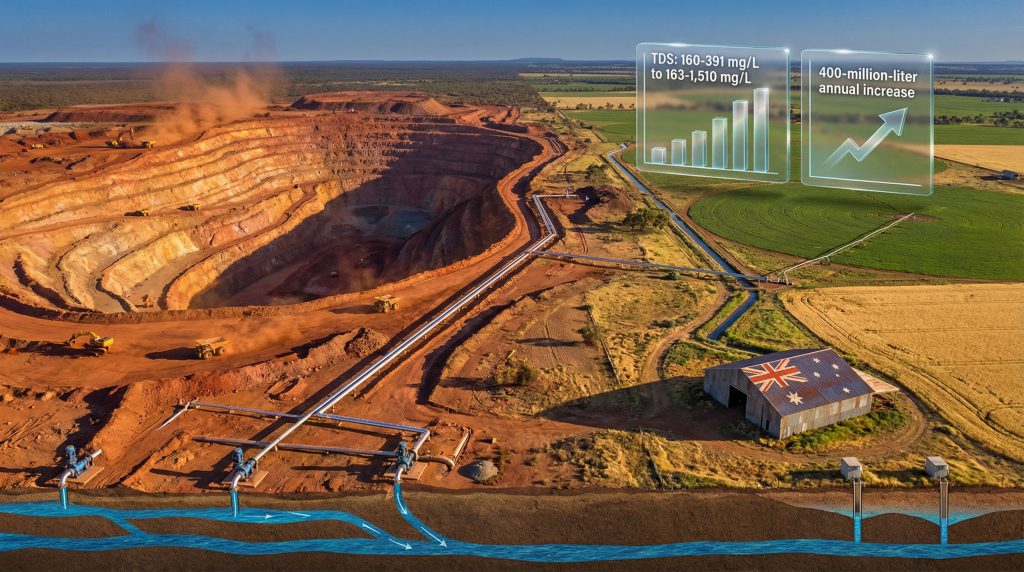
• Salinity escalation: Total Dissolved Solids concentrations can increase dramatically as mining extraction alters groundwater flow patterns, potentially rising from baseline ranges of 160-391 mg/L to levels exceeding 1,500 mg/L in some cases
• Chemical composition changes: Mining activities can mobilise naturally occurring salts and minerals, creating water quality challenges for both irrigation and livestock consumption
• Temporal correlation patterns: Water quality deterioration often correlates directly with mining expansion phases, though distinguishing between climate-induced and extraction-induced changes requires careful analysis
• Threshold exceedance events: Agricultural water systems may experience sudden quality shifts when extraction activities cross critical hydrogeological thresholds
The concept of "water mounding" represents a particularly complex challenge for agricultural operations. When mining extraction creates uneven groundwater pressure distributions, some areas may experience artificial water table elevation, leading to waterlogging in previously productive farmland. For instance, WA bauxite projects across the region have highlighted these complex hydrogeological interactions.
Regulatory Framework Gaps and Enforcement Challenges
Western Australia's regulatory approach to mining water management involves multiple agencies and overlapping jurisdictions. The Department of Water and Environmental Regulation oversees groundwater extraction permits, while mining operations must comply with environmental management plan requirements. However, significant gaps exist in protecting agricultural water rights when conflicts arise with industrial extraction activities. Additionally, mining permitting basics often fail to adequately address these complex water interactions.
Current regulatory limitations include:
• Inadequate baseline documentation: Many agricultural areas lack comprehensive pre-mining water quality and quantity measurements, making it difficult to establish causal relationships between mining activities and agricultural water problems
• Permit expansion processes: When mining companies seek to increase extraction from 500 million to 900 million litres annually, the approval process may not adequately consider cumulative impacts on neighbouring agricultural operations
• Compliance monitoring gaps: Self-monitoring by mining companies creates potential conflicts of interest in water impact assessment and reporting
• Compensation framework weaknesses: Agricultural operators face significant evidentiary burdens when seeking compensation for mining-related water damage
Recent policy discussions in Western Australia have highlighted tensions between expediting project approvals and maintaining environmental protections. Industry observers note concerns about environmental approvals and concentration of power in state development laws, with critics worried that facts may be sacrificed in the push for faster project approvals. The government maintains that proposed changes mean more transparency, but agricultural communities remain concerned about their ability to protect water resources from industrial impacts.
Trigger-level mechanisms present particular challenges:
• Response time delays: By the time water quality or quantity trigger levels are exceeded, significant agricultural damage may already have occurred
• Threshold adequacy questions: Current trigger levels may not reflect the actual vulnerability of agricultural water systems to incremental degradation
• Monitoring frequency limitations: Annual monitoring requirements may miss critical seasonal variations in water system impacts
• Enforcement capability constraints: Regulatory agencies may lack sufficient resources to conduct comprehensive compliance verification for multiple large-scale extraction operations
Agricultural Viability Under Altered Water Conditions
Agricultural operations depend on predictable water access patterns developed over decades or generations. When mining activities alter these patterns, farming communities face immediate operational challenges and long-term viability questions. The impacts extend beyond simple water quantity reductions to encompass complex changes in seasonal availability, quality parameters, and alternative supply costs. Consequently, the ABC reported on water issues affecting local farmers near mining operations.
Direct agricultural impacts manifest through multiple pathways:
• Irrigation system failures: When groundwater extraction lowers water tables below agricultural well depths, farmers must invest in deeper drilling or alternative water sources
• Livestock water quality problems: Elevated salinity levels can make groundwater unsuitable for livestock consumption, requiring expensive alternative supply arrangements
• Crop selection limitations: Changed water quality parameters may force farmers to abandon salt-sensitive crops in favour of more tolerant varieties with potentially lower economic returns
• Seasonal water security breakdown: Mining extraction can disrupt the natural seasonal recharge patterns that agricultural operations depend on for dry season water access
The economic implications for individual farming operations can be substantial. Property values in mining-adjacent agricultural areas may decline as water access becomes uncertain or costly. Crop insurance claims related to water quality deterioration create additional financial pressures, while infrastructure modification expenses for dealing with altered water conditions strain farm operating budgets.
Regional agricultural sustainability faces long-term challenges:
• Food security implications: Reduced agricultural productivity in traditional farming areas raises questions about regional food production capacity
• Export revenue impacts: Agricultural export earnings may decline as farming operations become less viable due to water access constraints
• Employment transition pressures: Rural communities may face difficult transitions from agriculture-dependent economies to mining-dependent alternatives
• Post-mining restoration uncertainties: Agricultural land degradation may prove irreversible even after mining operations cease
Surface water system disruption represents a particularly acute challenge for mixed farming operations. Stream flow cessation patterns linked to groundwater extraction activities can eliminate water sources that agricultural communities have relied on for generations. Therefore, mine reclamation innovation becomes critical for addressing these long-term sustainability concerns.
Monitoring Effectiveness and Mitigation Strategy Assessment
Current approaches to monitoring mining water impacts rely heavily on industry self-reporting supplemented by periodic regulatory oversight. This framework presents inherent limitations in detecting problems early and ensuring independent verification of compliance with environmental protection requirements.
Industry monitoring limitations include:
• Sampling frequency constraints: Company-conducted water quality assessments may not capture seasonal variations or short-term impact events
• Geographic coverage gaps: Monitoring wells installed by mining companies may not adequately represent conditions at agricultural properties located several kilometres from extraction sites
• Parameter selection issues: Standard mining industry monitoring protocols may not include agricultural water quality parameters most relevant to farming operations
• Data interpretation conflicts: Mining companies may interpret borderline monitoring results differently than agricultural communities or independent scientists
Third-party verification requirements remain limited in scope and frequency. While regulatory agencies conduct periodic inspections, the technical complexity of hydrogeological impact assessment often exceeds available regulatory resources. Independent monitoring by agricultural communities faces cost barriers and technical expertise requirements that many farming operations cannot readily meet. However, discussions at the WA mining conference have highlighted potential solutions.
Mitigation strategy effectiveness varies significantly:
• Water recycling programs: Dust suppression water recycling can reduce total extraction volumes, but may not address cumulative aquifer pressure effects
• Alternative water source development: Mining companies may invest in desalination or surface water diversions, but these approaches may not restore agricultural water access
• Groundwater remediation technologies: Post-mining restoration techniques show promise but remain largely untested at the scale required for major agricultural water system rehabilitation
• Preventive impact minimisation: Early-stage mitigation measures may reduce agricultural impacts but often fail to prevent them entirely
The temporal mismatch between mining operations and agricultural planning cycles creates additional monitoring challenges. Mining projects typically operate on timelines measured in decades, while agricultural water systems respond to both short-term seasonal variations and long-term climatic trends. Effective monitoring must account for these different temporal scales while maintaining sufficient sensitivity to detect incremental changes that may not become apparent until cumulative effects reach critical thresholds.
Economic Valuation of Mining Versus Agricultural Water Use
The economic trade-offs between mining water extraction and agricultural water security involve complex calculations that extend far beyond immediate operational costs. Mining operations generate substantial tax revenue and employment in regional economies, while agricultural activities provide food security, export earnings, and long-term land use sustainability. The WA resources impact demonstrates these economic complexities.
Direct economic impact comparisons reveal:
• Employment generation patterns: Mining operations typically provide higher per-capita wages but employ fewer people per hectare than agricultural activities
• Tax revenue structures: Mining royalties generate immediate government revenue, while agricultural tax contributions may be more modest but extend over longer timeframes
• Infrastructure investment requirements: Mining operations require substantial upfront infrastructure development, while agricultural activities utilise existing rural infrastructure more efficiently
• Economic multiplier effects: Both sectors generate downstream economic activity, but through different supply chains and service requirements
Regional communities face difficult decisions about balancing short-term mining revenues against long-term agricultural sustainability. Case studies from other Australian mining regions suggest that post-mining economic transitions can be challenging when mining operations conclude but agricultural capability has been permanently compromised.
Risk assessment frameworks must consider:
• Probability analysis of irreversible agricultural land degradation: Once groundwater systems are fundamentally altered, restoration may be technically impossible or economically unfeasible
• Economic valuation of water resource ecosystem services: Natural groundwater systems provide services beyond direct extraction value, including drought resilience and environmental sustainability
• Cost projection for post-mining environmental restoration: Full restoration of pre-mining water conditions may require ongoing expenditures extending decades beyond active mining operations
• Insurance and liability cost allocation: Determining financial responsibility for long-term agricultural water system impacts presents complex legal and practical challenges
The concept of "stranded agricultural assets" emerges when farming operations become unviable due to water access constraints but lack alternative economic uses. Rural properties may lose significant value without corresponding compensation mechanisms, creating regional economic disruption that extends beyond individual farm operations.
The next major ASX story will hit our subscribers first
Policy Integration and Future Directions
Addressing the complex interactions between bauxite mining water requirements and agricultural water security requires integrated policy frameworks that transcend traditional sectoral boundaries. Current approaches often treat mining and agricultural water uses as separate regulatory domains, missing opportunities for coordinated resource management that could benefit both sectors.
Comprehensive water impact assessment protocols should include:
• Regional cumulative impact analysis: Evaluating the combined effects of multiple mining operations on agricultural water systems at watershed scales
• Long-term monitoring requirements: Extending monitoring obligations throughout the operational life of mining projects and into post-closure phases
• Agricultural protection zone establishment: Identifying critical farming areas where industrial water extraction should be limited or prohibited
• Adaptive management strategies: Developing flexible regulatory responses that can adjust to changing water conditions and emerging impact patterns
International best practices for mining-agriculture water coexistence suggest several promising approaches. Some jurisdictions have implemented agricultural water impact bonds, requiring mining companies to provide financial guarantees for potential agricultural damage. Others have established mandatory consultation processes that give farming communities greater input into mining water management decisions. Additionally, Alcircle reported on groundwater concerns that illustrate the urgency of these policy reforms.
Innovation opportunities include:
• Advanced water treatment technologies: Developing cost-effective approaches for treating mining-affected water to agricultural quality standards
• Groundwater flow modelling: Improving predictive capabilities for assessing mining extraction impacts on agricultural water systems
• Alternative extraction methodologies: Exploring mining techniques that minimise groundwater disruption while maintaining operational efficiency
• Regional water security planning: Integrating mining and agricultural water demands into comprehensive watershed management frameworks
Climate change adaptation considerations add additional complexity to mining-agriculture water conflicts. As rainfall patterns become more variable and drought frequency increases, the competition for limited groundwater resources may intensify. Policy frameworks must account for these changing conditions while ensuring that both mining operations and agricultural communities can adapt to evolving water availability.
The farmer water issues South32 bauxite mine situation exemplifies these broader challenges. When agricultural operators experience growing water problems adjacent to major mining operations, the resolution requires not just addressing immediate water access concerns but developing long-term approaches that balance industrial development with agricultural sustainability. However, the farmer water issues South32 bauxite mine case demonstrates that current regulatory frameworks remain inadequate for protecting agricultural water rights. Effective solutions will likely require innovative partnerships between mining companies, agricultural communities, and regulatory agencies working toward shared water security objectives.
Disclaimer: This analysis is based on publicly available information and represents general trends in mining-agriculture water interactions. Specific circumstances vary significantly between locations and individual operations. Water management decisions should be based on site-specific hydrogeological assessments and current regulatory requirements. Economic projections are subject to market conditions, technological developments, and regulatory changes that may differ from historical patterns.
Looking to Invest in Water-Sensitive Mining Operations?
Discovery Alert's proprietary Discovery IQ model delivers real-time alerts on significant ASX mineral discoveries, instantly empowering subscribers to identify actionable opportunities ahead of the broader market. With complex environmental considerations like hydrogeological impacts increasingly affecting mining project valuations, staying informed about major discoveries ensures you can make quick, informed decisions in this evolving sector.