June 9, 2026
The Hidden Bottleneck Holding Back Africa's Most Oil-Rich Nation
When analysts debate the obstacles facing resource-dependent economies, the conversation gravitates quickly toward capital: drilling budgets, infrastructure financing, foreign direct investment pipelines. What receives far less attention is the quieter, harder-to-replace ingredient that determines whether that capital ever produces returns. Institutional knowledge — the accumulated operational memory of professionals who have managed complex systems under genuine pressure — is not a line item on a balance sheet. Yet its absence can render an entire investment thesis unworkable.
Nowhere is this tension more visible than in Libya's energy sector, where the gap between what the country possesses geologically and what it consistently delivers economically remains one of the most striking divergences in global energy markets. The geopolitical risk landscape surrounding major oil-producing nations further compounds this challenge, adding layers of complexity for international investors and domestic institutions alike.
When big ASX news breaks, our subscribers know first
Africa's Most Significant Hydrocarbon Endowment and Why It Underperforms
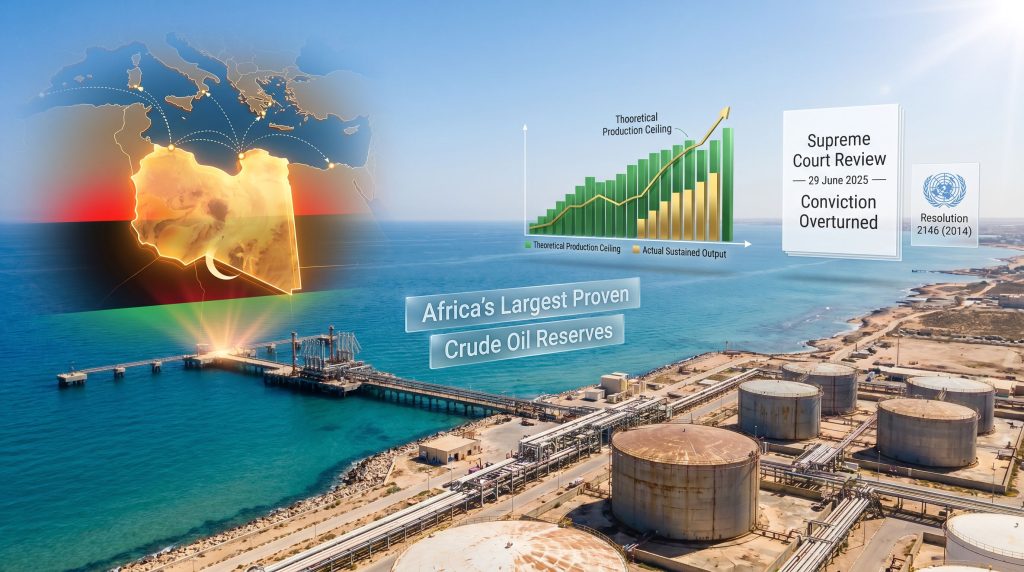
Libya holds Africa's largest proven crude oil reserves, estimated at approximately 48 billion barrels according to the U.S. Energy Information Administration. Its hydrocarbon endowment also includes substantial natural gas resources concentrated in the Sirte Basin, which remains the country's dominant producing region. By any geological measure, Libya should rank among the world's most consequential oil producers.
The operational reality tells a different story. Libya's production capacity has oscillated dramatically over the past decade, with output frequently disrupted by political fragmentation, force majeure declarations, and infrastructure degradation. At various points, the country has exported well below its theoretical ceiling, forfeiting billions in revenue that the national economy cannot afford to lose.
The structural roots of this underperformance involve three compounding dynamics:
- Political fragmentation that creates competing claims over oil revenues and production facilities, making unified operational strategy difficult to sustain
- Infrastructure deterioration across upstream fields, pipelines, and export terminals, where deferred maintenance compounds over years into structural output constraints
- Human capital erosion, as extended periods of instability create incentives for experienced professionals to disengage from the sector entirely
The third factor receives the least attention in mainstream energy investment analysis, yet it may be the most consequential over medium-term horizons. Capital can be deployed quickly. Technical expertise accumulated over careers cannot.
Libya's Mediterranean Geography and the European Supply Equation
Libya's strategic importance extends well beyond its reserve base. Its Mediterranean coastline places key export terminals within short-haul shipping distance of Southern European refining hubs, giving Libyan crude a logistics cost advantage over longer-haul suppliers. Italian refineries, in particular, have historically relied on Libyan light sweet crude as a preferred feedstock given its low sulphur content and high refinery yield characteristics.
This geographic advantage has taken on renewed significance as European energy buyers have systematically sought to diversify away from Russian pipeline supply. Furthermore, the broader LNG supply outlook for 2025 and beyond reinforces this diversification imperative across the continent. Libya's light crude grades, particularly Es Sider and Sharara blend, compete favourably in Mediterranean spot markets, and the country's proximity reduces the shipping cost differential that disadvantages Atlantic Basin or Middle Eastern suppliers competing for the same refinery slots.
The strategic calculus is straightforward: a Libya that consistently delivers contracted volumes at predictable quality standards would be an exceptionally valuable long-term supplier to European buyers currently managing diversification risk. Achieving that consistency is the challenge.
Why Regional Policy Shifts Add Further Complexity
Regional dynamics, for instance the shifting Venezuela energy policy under evolving US frameworks, illustrate how quickly competitive supply landscapes can change. Consequently, Libya's window to consolidate its position in European markets may be narrower than institutional inertia currently acknowledges.
Understanding Libya's National Oil Corporation: Structure, Mandate, and Operational Reality
The National Oil Corporation (NOC) functions as the central institutional vehicle for every major dimension of Libya's hydrocarbon sector. Its mandate spans upstream exploration and production, international crude oil marketing, and domestic petroleum product distribution. In practice, it also operates as a quasi-regulatory authority in an environment where formal governance structures remain contested.
The NOC's operational divisions reflect the breadth of this mandate:
- The International Marketing Department manages Libya's crude export transactions, including pricing against benchmark references, counterparty selection, and contract terms with international buyers
- The Products Marketing Department oversees domestic fuel supply chains, including procurement, storage, quality assurance, and distribution logistics
- Upstream production subsidiaries manage field-level operations across the Sirte Basin and other producing regions
What makes the crude marketing function disproportionately influential is the commercial leverage it carries. Pricing decisions, counterparty relationships, and contract structures directly determine the revenue Libya captures per barrel exported. In a sector where the spread between a well-negotiated and a poorly-structured crude sale can represent tens of millions of dollars across a cargo portfolio, the expertise within the International Marketing Department has direct and quantifiable consequences for national fiscal outcomes.
Who Is Imad Ben Rajab and Why Does His Career Matter to Libya's Recovery?
Within the Imad Ben Rajab Libya energy sector context, his career trajectory is particularly relevant to current debates about institutional capacity. He held senior leadership positions within the NOC's commercial divisions, including heading the International Marketing Department from 2018 to 2023 and previously leading the Products Marketing Department. This dual exposure spanning both export-facing crude sales and domestic fuel supply chain management represents a combination that is operationally rare and strategically valuable.
Managing Libya's international crude marketing operation during 2018 to 2023 was not a routine executive assignment. That period encompassed:
- Ongoing political fragmentation that complicated unified export strategy
- Force majeure events affecting major production facilities and export terminals
- Periods of contested NOC authority requiring commercial decisions under institutional ambiguity
- Counterparty negotiations with international oil companies and trading houses operating under heightened risk assessments for Libyan supply
The experience of maintaining export relationships and protecting revenue continuity through those conditions is not replicable through formal training programmes. It is the product of sustained operational exposure under genuine adversity. Analysts examining Libya as a strategic energy hub have consistently highlighted this depth of operational expertise as central to the country's long-term commercial rehabilitation.
In 2019, Imad Ben Rajab was designated by the UN Security Council as Libya's official focal point for monitoring and preventing illicit petroleum exports under Resolution 2146 (2014). This resolution, adopted in response to concerns about unauthorised crude sales during Libya's political division, authorised UN member states to inspect and detain vessels suspected of carrying illicitly exported Libyan petroleum.
Designation as a UN Security Council focal point for petroleum export compliance carries real technical and institutional weight. It requires demonstrated competence, the ability to interface credibly with international monitoring bodies, and the reliability to function effectively in a role with direct implications for international energy market integrity.
The 2023 Case and the Supreme Court's 2025 Ruling: Unpacking the Evidentiary Findings
In July 2023, a Tripoli criminal court convicted Imad Ben Rajab on allegations related to non-compliant fuel imports. The case attracted significant attention within Libya's energy sector, both because of the seniority of the individual involved and because it emerged against a backdrop of ongoing concerns about fuel quality standards and regulatory enforcement in the country's petroleum product supply chain.
On 29 June 2025, Libya's Supreme Court overturned that conviction and remanded the case for retrial. The grounds for the reversal centred on substantive evidentiary deficiencies identified during the appellate review. Independent commentary on the proceedings has also set the record straight regarding several key takeaways from the case that were misrepresented in earlier coverage.
| Legal Stage | Date | Key Finding |
|---|---|---|
| Initial Criminal Conviction | July 2023 | Allegations of non-compliant fuel imports upheld at trial level |
| Supreme Court Review | 29 June 2025 | Conviction overturned; case remanded for retrial |
| Laboratory Evidence Assessment | Supreme Court proceedings | Analysis conducted by a facility lacking appropriate accreditation for required testing |
| Fuel Quality Determination | Investigative findings | Quality issues attributed to maintenance deficiencies and storage conditions, not deliberate misconduct |
| Financial Loss Assessment | Technical review | No evidence of substantial losses as originally alleged; fuel processed via established blending procedures |
The evidentiary findings carry implications that extend significantly beyond the individual case outcome.
Why Unaccredited Laboratory Evidence Is a Systemic Concern
The determination that the original analytical evidence was produced by a laboratory lacking appropriate accreditation for the testing involved raises important questions about the forensic infrastructure supporting regulatory enforcement in Libya's energy sector. In technically complex disputes involving fuel quality, molecular composition, or contamination assessment, the validity of laboratory findings is entirely dependent on whether the testing facility holds the relevant accreditations and follows validated methodologies.
When that foundation is absent, the entire evidentiary chain is compromised. The distinction the Supreme Court's review drew between operational maintenance failures and deliberate misconduct is equally significant. Fuel quality degradation in storage is a well-documented phenomenon in environments with ageing infrastructure and constrained maintenance budgets. Conflating a technical operational failure with deliberate wrongdoing misallocates accountability in ways that can produce unjust outcomes and distort institutional incentives across the sector.
The pattern of technically complex disputes being adjudicated using inadequate forensic infrastructure is a recurring vulnerability in emerging market energy governance, and Libya is not unique in confronting it.
The next major ASX story will hit our subscribers first
Human Capital as a Binding Constraint: The Evidence from Comparable Economies
The structural importance of experienced human capital in resource sector recovery is well-documented in the development economics literature. Post-conflict resource economies that successfully restored production capacity after periods of disruption consistently demonstrated one common characteristic: they retained or rapidly reintegrated experienced sector professionals into active operational roles rather than allowing institutional knowledge to disperse through extended sidelining or brain drain.
The cost of the alternative is difficult to quantify precisely but substantial in practice:
- Operational continuity gaps emerge when institutional memory of complex systems, workarounds, and counterparty histories is lost
- Commercial relationships built over years with international buyers, traders, and partners deteriorate without consistent senior-level maintenance
- Regulatory navigation capability within both domestic and international compliance frameworks requires professionals who have directly managed those frameworks, not only studied them
- Crisis decision-making quality degrades when the professionals with direct experience of analogous past disruptions are absent from the room
For Libya specifically, the talent retention challenge is acute. Extended legal uncertainty creates rational incentives for experienced professionals to pursue opportunities outside the sector or outside the country entirely. If that pattern extends across a generation of mid-to-senior NOC leadership, the resulting skills gap cannot be resolved through capital injection. It requires years of institutional rebuilding that the country's fiscal position makes difficult to absorb.
What International Investors Actually Require Before Committing to Libya
International oil companies and trading houses evaluating Libyan exposure consistently apply a multi-factor risk assessment framework that goes beyond reserve quality and production targets. Understanding what drives investment confidence in Libya provides important context for why institutional and human capital questions matter commercially.
The investment confidence framework typically encompasses four dimensions:
- Political risk mitigation — evidence that institutional arrangements protecting contract sanctity are durable rather than contingent on current political configurations
- Regulatory predictability — clear and consistently applied frameworks for licensing terms, cost recovery mechanisms, revenue sharing, and dispute resolution
- Operational competence within the NOC — demonstrated capacity to execute complex projects, manage force majeure situations, and maintain export scheduling commitments
- Legal system credibility — confidence that commercially and technically complex disputes will be adjudicated on their merits rather than resolved through political influence
The Supreme Court's willingness to overturn the 2023 conviction on technical evidentiary grounds is, from an investor's perspective, a constructive signal for the fourth dimension. It suggests that Libya's judicial system retains the capacity for technically rigorous review, which is a meaningful data point for parties evaluating contractual risk. However, sustained oil price volatility in global markets continues to complicate the financial modelling that underpins these investment decisions.
Libya's Production Recovery Roadmap: Infrastructure Priorities and Market Positioning
Closing the gap between Libya's theoretical production ceiling and its sustained actual output requires a sequenced investment programme across several infrastructure categories:
- Upstream field rehabilitation across ageing Sirte Basin installations, where production decline rates have been accelerated by deferred maintenance and periods of conflict-related shutdown
- Pipeline integrity restoration, particularly on export corridors connecting inland fields to coastal terminals
- Export terminal upgrades at facilities including Es Sider and Ras Lanuf, which handle the bulk of Libya's crude export volume
- Refinery modernisation to reduce domestic dependence on refined product imports and strengthen domestic fuel supply security
Each of these investment categories requires not only financing but also the operational expertise to manage procurement, contractor oversight, technical specification compliance, and handover processes. This is precisely where experienced sector professionals provide value that generic project management capacity cannot replicate.
Libya's proximity advantage in European markets provides a durable commercial foundation for this investment case. As European buyers continue diversifying supply portfolios and assessing long-term import commitments against geopolitical risk, a Libya that delivers reliably on quality, volume, and scheduling terms would represent a compelling alternative. Achieving that positioning, however, depends on the institutional and human capital improvements that will ultimately determine whether production targets translate into actual export performance.
The Broader African Pattern: Why Libya's Challenge Is Structurally Common
Libya's predicament reflects a pattern visible across numerous sub-Saharan and North African resource economies. The empirical relationship between institutional quality and the efficiency with which natural resource endowments are converted into sustainable economic development is well-established in the academic literature on the so-called resource curse. Moreover, the oil price shock dynamics of 2025 have further stressed the fiscal buffers available to governments navigating this transition.
The framing of a resource curse, however, can be analytically misleading. The problem in most underperforming resource economies is not the presence of natural wealth itself but the governance architecture surrounding it. Countries that invested systematically in domestic technical expertise in petroleum engineering, commercial management, regulatory design, and institutional capacity consistently achieved superior long-term conversion of resource endowments into economic development.
Libya possesses the geological foundation. It is building, unevenly, the institutional framework. What it cannot afford to lose is the accumulated human capital that bridges those two components. Viewing the reintegration of experienced energy sector professionals into active roles as a strategic economic priority — rather than a peripheral personnel matter — reflects an accurate reading of what the Imad Ben Rajab Libya energy sector experience ultimately illustrates about the country's recovery requirements.
The conversation about Libya's energy future benefits from this reframing. Barrels of oil and billions in investment commitments matter enormously. However, the professionals capable of converting those inputs into operational continuity, commercial performance, and long-term revenue generation are not interchangeable with financial capital. They are, in the most precise sense, irreplaceable.
This article contains forward-looking analysis and assessments based on publicly available information. It does not constitute investment advice. Readers should conduct their own due diligence before making any investment or commercial decisions related to Libya's energy sector.
Want To Stay Ahead Of Significant Mineral Discoveries On The ASX?
Discovery Alert's proprietary Discovery IQ model delivers real-time alerts on major ASX mineral discoveries, transforming complex data into actionable investment insights for traders and long-term investors alike — explore the historic returns major discoveries have generated and begin your 14-day free trial at Discovery Alert to position yourself ahead of the market.