May 22, 2026
What Drives India's Unprecedented Energy Demand Surge?
Global energy markets stand at a transformational inflection point, with developing economies fundamentally reshaping consumption patterns and infrastructure requirements. India energy demand growth represents one of the most significant trends in the global energy landscape, with traditional energy hubs focusing on transition pathways whilst emerging markets experience demand acceleration at unprecedented scales, driven by industrialisation, urbanisation, and technological adoption converging simultaneously.
Economic Transformation Fundamentals
India's economic expansion creates a compounding effect on energy requirements across multiple sectors. The nation's industrial electrification accelerates as manufacturing capabilities modernise, requiring substantial power infrastructure investments to support steel, cement, and chemical production facilities.
Per-capita energy consumption differentials between India and developed economies reveal significant catch-up potential. Current consumption levels remain substantially below OECD averages, suggesting sustained growth trajectories as living standards improve and energy access expands across demographic segments.
Demographic and Urbanisation Pressures
Urban populations approaching one billion people create concentrated demand centres requiring massive infrastructure development. This demographic shift drives electricity consumption through residential, commercial, and transportation networks operating at higher intensity levels than rural counterparts.
Rising middle-class consumption patterns directly translate into appliance adoption, mobility requirements, and service sector expansion. Regional energy access disparities between developed urban centres and emerging rural areas generate catch-up demand as electrification programmes expand coverage and reliability.
When big ASX news breaks, our subscribers know first
How Fast Is India's Energy Consumption Actually Growing?
Current Consumption Metrics and Benchmarks
Table: India Energy Consumption Overview 2024
| Metric | Value | Growth Rate |
|---|---|---|
| Total primary energy | 1,213 Mtoe | 6.5% annually since 2020 |
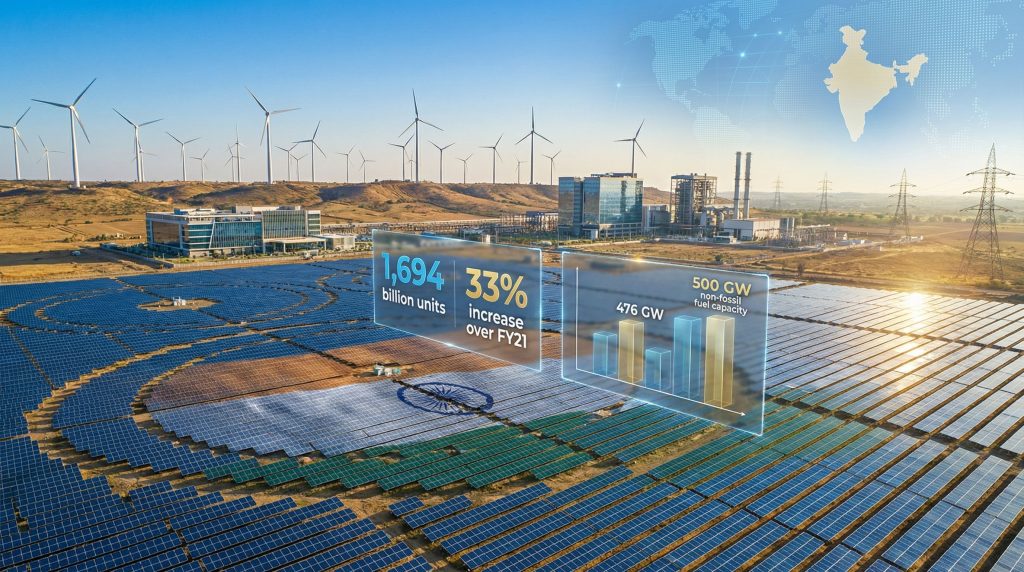
| Electricity consumption | 1,694 billion units | 33% increase over FY21 |
| Peak power demand (FY26) | 277 GW | – |
| Peak power demand (2031-32) | 366.4 GW | – |
These consumption patterns reflect an economy operating through quantum leaps rather than incremental progress, creating year-over-year variations that challenge traditional forecasting methodologies. Furthermore, according to the International Energy Agency, India energy demand growth acceleration outpaces global averages, positioning India as a primary driver of worldwide consumption increases.
Comparative Global Context
Between now and 2040, global oil demand will remain above 100 million barrels per day, whilst LNG demand is expected to rise by more than 50 percent and electricity demand by around 50 percent. India's contribution to these global increases significantly exceeds its current share of world energy consumption, indicating disproportionate growth influence.
The country's emergence as the world's third-largest energy consumer establishes a foundation for continued expansion across all fuel categories. Growth rate differentials versus established economies like China, the United States, and European Union members demonstrate India's unique position in the global energy landscape.
Which Sectors Are Driving India's Energy Demand Explosion?
Industrial and Manufacturing Acceleration
Steel, cement, and chemical industries require substantial energy inputs for expansion programmes supporting infrastructure development and export capabilities. These energy-intensive sectors operate with extended planning horizons, creating predictable demand growth patterns over decades.
Data centre capacity expansion represents one of the most dramatic sectoral growth stories, with projections indicating a 10-fold increase driven by digital transformation, artificial intelligence deployment, and cloud computing adoption. This expansion requires not only direct electricity consumption but also cooling infrastructure and backup power systems.
Green hydrogen production infrastructure development adds another layer of industrial energy demand, particularly as manufacturing capabilities scale to serve both domestic consumption and potential export markets.
Transportation and Mobility Revolution
Air travel growth projections indicate 150 percent increases over 15 years, reflecting rising incomes, business expansion, and tourism development. Aviation sector expansion requires airport infrastructure modernisation, fuel supply systems, and potentially future electric aircraft charging networks.
Electric vehicle adoption creates new electricity demand patterns whilst potentially reducing petroleum consumption. However, the charging infrastructure required for widespread EV deployment necessitates substantial grid capacity additions and distribution network upgrades.
Freight electrification and logistics modernisation contribute additional demand through railway electrification programmes, port facility upgrades, and warehouse automation systems requiring consistent power supply.
Residential and Commercial Consumption Patterns
Air conditioning proliferation represents perhaps the most visible driver of residential electricity demand growth. Global expansion from 1.6 billion to 5.6 billion air conditioning units by 2050 creates demand equivalent to 10 new units sold per second for 30 years, with India representing a disproportionate share due to climate and income factors.
Urban cooling demand extends beyond residential applications into commercial buildings, retail spaces, and industrial facilities. Smart city initiatives incorporate building efficiency standards whilst simultaneously increasing baseline electricity consumption through digital infrastructure and automated systems.
What Role Does Technology Play in India's Energy Transformation?
Artificial Intelligence and Grid Optimisation
Technology deployment across energy systems creates both demand growth and operational efficiency improvements. Real-time demand forecasting systems enable better load balancing whilst requiring computational resources for data processing and analysis.
Predictive maintenance capabilities reduce unplanned shutdowns through continuous monitoring systems. International examples demonstrate that AI tools can successfully halve unplanned outages whilst optimising production efficiency, though these benefits require substantial technology investments and digital infrastructure.
Smart grid infrastructure investment requirements encompass both traditional transmission and distribution improvements alongside digital communication systems enabling automated demand response and renewable energy integration.
Digital Infrastructure Energy Requirements
Cloud computing and data processing energy intensity continues increasing as digital services expand across economic sectors. The computational requirements for artificial intelligence applications, machine learning systems, and data analytics create concentrated electricity demand at data centres and processing facilities.
5G network rollout power consumption implications extend beyond telecommunications infrastructure into the devices and applications enabled by higher-speed connectivity. Internet of Things deployments, autonomous systems, and real-time monitoring networks all contribute incremental electricity demand.
How Is India's Energy Mix Evolving to Meet Demand?
Renewable Energy Capacity Expansion
Table: India's Power Capacity Evolution
| Period | Total Capacity | Thermal | Solar | Wind |
|---|---|---|---|---|
| 2015-16 | 305 GW | – | – | – |
| June 2025 | 476 GW | 240 GW | 110.9 GW | 51.3 GW |
| 2030 target | 500 GW non-fossil | – | – | – |
Renewable energy expansion occurs alongside continued fossil fuel capacity additions, reflecting the challenge of meeting absolute demand growth whilst transitioning fuel mix composition. The 500 GW non-fossil fuel target by 2030 represents substantial capacity additions requiring financing, equipment procurement, and grid integration capabilities.
Natural Gas and LNG Market Dynamics
India aims to double the share of natural gas in its energy mix, positioning LNG imports as a transitional fuel supporting both industrial applications and power generation. The strategy involves expanding import infrastructure, diversifying supply sources, and developing domestic distribution networks.
Consequently, clean energy initiatives demonstrate how LNG demand growth of more than 50 percent globally positions India as a key market for international suppliers. Supply chain security considerations drive diversification strategies across multiple supplier relationships and import facility development.
Coal's Transitional Role
Thermal power capacity maintains baseload generation requirements whilst renewable capacity scales up. Clean coal technologies and efficiency improvements provide pathways for continued coal utilisation during the transition period, balancing energy security priorities with environmental commitments.
What Are the Investment Implications of India's Energy Growth?
Infrastructure Capital Requirements
Grid modernisation and transmission capacity needs require substantial capital deployment across generation, transmission, and distribution segments. Storage technology deployment for renewable energy integration adds another investment category essential for grid stability and reliability.
Port and pipeline infrastructure for energy imports necessitates both public and private investment to handle increased LNG volumes, coal imports, and potentially hydrogen imports in future scenarios.
International Partnership Opportunities
India-UAE energy cooperation demonstrates international collaboration potential, with bilateral trade crossing $100 billion and targeting $200 billion by 2032. These partnerships encompass LNG supply agreements, renewable energy investments, and technology transfer arrangements.
International renewable energy investments include approximately 11 GW of solar, wind, and storage assets through climate investment platforms, indicating foreign capital participation in India's energy expansion. Technology transfer agreements and joint ventures provide pathways for advanced technology deployment whilst building domestic capabilities.
Energy Security and Geopolitical Considerations
Import dependency risks drive diversification strategies across fuel types and supplier relationships. Strategic petroleum reserve capacity planning and alternative supply route development enhance energy security whilst managing geopolitical uncertainties.
Regional energy cooperation frameworks provide opportunities for grid interconnections, shared resources, and collaborative technology development programmes supporting energy access and reliability improvements.
The next major ASX story will hit our subscribers first
How Do Regional Variations Impact National Energy Planning?
State-Level Demand Disparities
High-growth states versus energy-deficit regions create complex planning challenges requiring transmission infrastructure connecting surplus and deficit areas. Industrial corridor development concentrates demand in specific geographic areas whilst rural electrification completion requires distributed investment approaches.
Regional variations in renewable resource availability, industrial development patterns, and population density necessitate customised energy planning approaches rather than uniform national strategies.
Seasonal and Climate-Related Demand Patterns
Monsoon impact on hydroelectric generation creates seasonal variations in available generation capacity, requiring thermal and renewable backup systems. Summer cooling demand peaks create grid stress requiring capacity reserves and demand management programmes.
Winter heating requirements in northern regions add seasonal variation to national demand patterns, though less pronounced than cooling requirements in most geographic areas.
What Challenges Could Constrain India's Energy Demand Growth?
Supply Chain and Infrastructure Bottlenecks
Transmission and distribution loss reduction targets require substantial infrastructure investments whilst demand continues growing. Last-mile connectivity and grid reliability issues constrain effective energy delivery despite adequate generation capacity.
Equipment manufacturing and import dependencies create potential supply chain vulnerabilities, particularly for renewable energy components and advanced technology systems required for grid modernisation.
Environmental and Regulatory Constraints
Air quality standards and emission reduction commitments may constrain certain types of energy development whilst requiring additional investment in pollution control technologies. Water availability for thermal power generation creates location-specific constraints on capacity expansion.
Land acquisition challenges for renewable projects compete with agricultural and urban development priorities, potentially slowing deployment timelines for large-scale renewable installations.
Financial and Affordability Considerations
Subsidy burden on state electricity boards constrains investment capacity whilst cross-subsidy mechanisms create pricing distortions affecting demand patterns. Tariff rationalisation efforts must balance affordability concerns with cost recovery requirements.
Access to capital for infrastructure development requires both domestic savings mobilisation and international investment attraction, creating financing challenges during periods of global capital constraints.
What Does India's Energy Future Look Like by 2040?
Long-Term Demand Projections
Key 2040 Projections:
Energy demand growth: 6-6.5% annually through 2030
India's doubled share in global primary energy consumption by 2035
Electricity demand reaching 2,473.8 billion units by 2031-32
These projections reflect continued economic expansion, population growth, and rising living standards creating sustained India energy demand growth over decades. The scale of projected increases requires massive infrastructure development and financing mobilisation.
Technology and Innovation Roadmap
Hydrogen economy development and export potential position India as both a consumer and potential supplier of clean hydrogen for industrial applications and energy storage. Carbon capture and storage deployment scenarios provide pathways for continued fossil fuel utilisation whilst meeting climate commitments.
Advanced nuclear technology adoption timelines offer baseload generation alternatives supporting renewable energy integration and energy security requirements.
Global Energy Market Integration
India's role as energy demand growth epicentre influences global investment flows, technology development priorities, and supply chain configurations. South-South cooperation in energy technology creates alternative pathways for technology access and capability development.
Climate finance and green development pathways provide mechanisms for international cooperation supporting India's energy transformation whilst addressing global climate objectives.
India's Energy Demand as a Global Game-Changer
Strategic Implications for Global Markets
Supply chain reorientation toward India-centric demand creates new trade patterns and investment opportunities across energy sectors. Investment flow redirection and capital allocation shifts reflect India's growing importance in global energy markets.
Technology development priorities increasingly reflect Indian market requirements, scale preferences, and cost constraints, influencing global innovation trajectories and commercial deployment strategies.
Policy and Regulatory Evolution
Energy security frameworks and international cooperation agreements evolve to accommodate India's growing import requirements and regional influence. Domestic manufacturing capabilities and self-reliance goals balance international cooperation with domestic capacity building.
Climate commitments balanced with development priorities require innovative financing mechanisms and technology deployment strategies supporting both economic growth and environmental objectives. The challenge lies in maintaining development momentum whilst transitioning toward cleaner energy systems at unprecedented scale, with India energy demand growth continuing to reshape global energy markets.
Disclaimer: This analysis contains forward-looking projections and industry estimates that involve inherent uncertainties. Energy demand growth, technology deployment timelines, and investment requirements may vary significantly from projections due to economic, political, technological, and environmental factors.
Ready to Capitalise on India's Energy Investment Boom?
India's unprecedented energy demand growth creates significant investment opportunities across mining, exploration, and energy infrastructure sectors on the ASX. Discovery Alert's proprietary Discovery IQ model delivers real-time notifications on significant mineral discoveries, empowering investors to identify actionable opportunities in energy-critical commodities like lithium, rare earths, and uranium that are essential for India's renewable energy transition and can begin your 30-day free trial to position yourself ahead of this massive energy transformation.