May 23, 2026
The global transition toward renewable energy technologies has intensified competition for strategic materials essential to wind turbines, electric vehicle batteries, and advanced electronics manufacturing. As nations recognise the vulnerabilities inherent in concentrated supply chains, partnerships between emerging economies are reshaping the geopolitical landscape of critical mineral processing. Furthermore, the intersection of energy security, technological sovereignty, and resource diplomacy now defines strategic planning for countries seeking alternatives to established monopolistic structures, particularly as critical minerals energy security becomes increasingly vital.
The Evolution of Critical Mineral Supply Chain Architecture
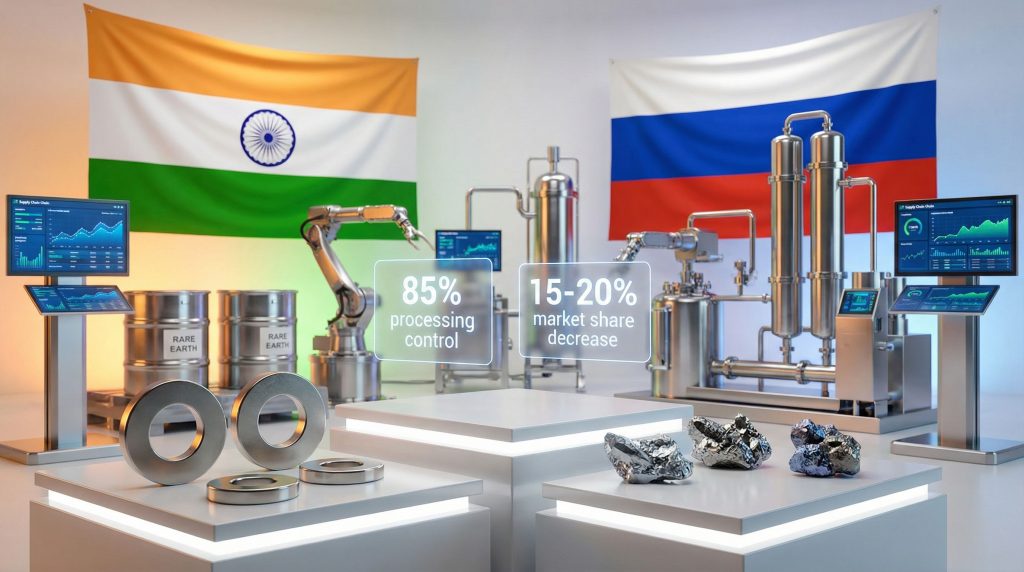
The India Russia rare earth partnership represents a calculated response to China's commanding 85% control over global rare earth refining operations. This bilateral framework, formalised through a memorandum of understanding between TEXMiN Foundation and GIREDMET on February 24, 2026, establishes comprehensive cooperation spanning the complete mining value chain from exploration through advanced materials development.
The strategic timing reflects broader geopolitical realignments as nations recognise that energy transition goals cannot be achieved while remaining dependent on single-source supply chains. Sukumar Mishra, Director of IIT (ISM) Dhanbad and Chairman of the Hub Governing Board for TEXMiN Foundation, emphasised that critical minerals and rare earth technologies serve as foundational elements for India's energy transition, electronics manufacturing, and strategic sectors.
Consequently, this partnership emerges within the context of India's National Critical Mineral Mission, which targets substantial reduction in import dependency through domestic capability development. The initiative demonstrates how bilateral cooperation can address systemic vulnerabilities while building technological expertise that supports long-term strategic autonomy, aligning with broader mining industry innovation trends.
When big ASX news breaks, our subscribers know first
Advanced Metallurgical Capabilities and Technology Integration
The collaboration focuses on developing sophisticated rare earth metallurgy processes, with particular emphasis on high-coercivity permanent magnet production using neodymium-iron-boron (Nd-Fe-B) compositions. These materials represent critical components for renewable energy infrastructure, particularly wind turbines that require magnets capable of maintaining performance under extreme operational conditions.
Hydrometallurgical Processing Excellence
The partnership prioritises environmentally conscious separation techniques through advanced hydrometallurgical processes, representing a significant departure from traditional pyrometallurgical approaches that generate substantial environmental impacts. This technological direction addresses increasing regulatory pressure for sustainable mining practices while improving processing efficiency.
Key development areas encompass:
• Advanced separation chemistry for rare earth element purification
• High-purity metal and alloy production for aerospace applications
• Refractory metal powder manufacturing for defence sectors
• Electronic and optical materials for semiconductor industries
Konstantin Ivanovskikh, Deputy Director of GIREDMET, articulated the strategic rationale by explaining how combining GIREDMET's metallurgical expertise with TEXMiN's translational research ecosystem would accelerate development and pilot-scale validation across the rare metal value chain. Moreover, this collaboration incorporates strategic antimony financing principles to ensure sustainable funding mechanisms.
Digital Twin Integration and Smart Processing
The partnership incorporates cutting-edge Industry 4.0 technologies through digital twin-enabled processing plants that integrate artificial intelligence, machine learning, and advanced sensor systems. This approach represents a fundamental shift toward precision processing that optimises extraction efficiency while minimising environmental impact through real-time optimisation algorithms.
Digital integration enables continuous monitoring of separation processes, predictive maintenance scheduling, and automated quality control systems that ensure consistent output specifications. These capabilities become particularly critical when producing materials for defence and aerospace applications where quality tolerances allow minimal variation, reflecting the broader trend toward data-driven mining operations.
Circular Economy Integration and Resource Recovery
Battery Recycling and Critical Metal Recovery
The collaboration emphasises sustainable resource utilisation through comprehensive hydrometallurgical recycling of lithium-ion batteries to recover lithium, nickel, and cobalt. This circular economy approach addresses dual challenges of resource scarcity and environmental sustainability while creating additional revenue streams from waste materials, building on recent developments in battery recycling breakthrough technologies.
Current global lithium-ion battery recycling rates remain substantially below optimal levels, creating significant opportunities for technological innovation in recovery processes. The partnership's focus on developing efficient recycling infrastructure positions both nations to capture value from the growing volume of end-of-life batteries generated by expanding electric vehicle adoption.
Legacy Resource Utilisation
Recovery of critical minerals from legacy mine dumps and low-grade ores represents an innovative approach to expanding available resource bases without traditional exploration investments. This strategy recognises that historical mining operations often left substantial mineral values in waste materials due to technological limitations or economic constraints that no longer apply.
The partnership's emphasis on extracting value from previously discarded materials demonstrates strategic thinking that maximises resource utilisation while addressing environmental remediation objectives. Legacy mine dumps frequently contain concentrated rare earth elements that can be economically recovered using modern separation technologies.
Technology Readiness Acceleration and Commercialisation Pathways
Technology Translation Research Park Framework
The collaboration operates within the Technology Translation Research Park (TTRP) framework, designed to accelerate the transition from laboratory research to industrial-scale production. This institutional structure addresses the common challenge of bridging the gap between academic research and commercial application, often referred to as the "valley of death" in technology development.
Dheeraj Kumar, Deputy Director of IIT (ISM) Dhanbad and Project Director of TEXMiN, explained that the framework aims to accelerate deployment of sustainable, industry-ready solutions aligned with the Atmanirbhar Bharat initiative. This approach emphasises raising technologies to higher Technology Readiness Levels (TRL 6-9) through systematic validation and demonstration processes.
Commercial Development Timeline and Investment Requirements
The partnership's commercial development strategy encompasses multiple phases designed to validate technologies before large-scale implementation:
Technology Development and Investment Framework
| Development Phase | Investment Scale | Technical Objectives | Market Validation |
|---|---|---|---|
| Pilot Validation | $50-100 million | Technology demonstration | Process optimisation |
| Commercial Demo | $200-500 million | Small-scale production | Market acceptance testing |
| Industrial Scale | $1-3 billion | Full production capacity | Global market penetration |
Note: Investment figures represent industry estimates and require verification from official sources.
Strategic Market Positioning and Competitive Dynamics
Global Market Disruption Scenarios
The partnership's potential impact on global rare earth markets depends on successful technology transfer and commercial implementation. Market analysts consider multiple scenarios for how increased processing capacity outside China might affect established supply chains:
Successful Implementation Scenario:
India develops substantial domestic rare earth processing capabilities within five years, potentially reducing China's market dominance in specific segments by 15-20%. This outcome requires successful technology transfer, adequate capital investment, and effective commercial implementation.
Limited Technical Progress:
The collaboration achieves modest capability improvements whilst China maintains its dominant position with minor market share adjustments. This scenario reflects the substantial technical challenges inherent in rare earth processing and the time required for capability development.
Geopolitical Disruption:
International sanctions or technology transfer restrictions could limit collaboration effectiveness, potentially redirecting efforts toward alternative partnerships with other nations seeking supply chain diversification.
Integration with India's Self-Reliance Strategy
Atmanirbhar Bharat Critical Mineral Objectives
The partnership directly supports India's National Critical Mineral Mission by establishing domestic processing capabilities essential for strategic sectors. The initiative targets substantial reduction in import dependency for critical minerals, with rare earth elements representing a priority focus area due to their importance across multiple industrial sectors.
Strategic objectives encompass:
• Development of domestic magnet production capabilities
• Reduced dependence on Chinese rare earth imports
• Enhanced supply security for defence and renewable energy sectors
• Technology readiness advancement for commercial deployment
The collaboration includes provisions for expert exchanges, joint doctoral supervision, specialised training programmes, and advisory support to governments, public sector undertakings, and industry stakeholders. This comprehensive approach recognises that sustainable capability development requires human capital development alongside technological advancement.
The next major ASX story will hit our subscribers first
Risk Assessment and Implementation Challenges
Technical Implementation Barriers
Rare earth element separation involves complex chemistry requiring specialised expertise that remains concentrated in relatively few global locations. The partnership must address technical challenges including:
Process Complexity:
Rare earth separation chemistry demands precise control of multiple variables including pH, temperature, reagent concentrations, and processing times. Minor variations can significantly impact product quality and recovery rates.
Quality Control Standards:
Defence and aerospace applications require materials meeting stringent specifications with minimal tolerance for impurities or compositional variations. Developing quality control systems capable of consistently meeting these standards represents a substantial technical challenge.
Environmental Compliance:
Rare earth processing generates various waste streams requiring careful management to meet environmental regulations. The partnership's emphasis on sustainable processing must balance environmental objectives with commercial viability.
Capital Requirements and Infrastructure Development
Establishing competitive rare earth processing capabilities requires substantial capital investment in specialised equipment, environmental controls, and supporting infrastructure. The partnership must secure adequate financing whilst managing construction timelines and technical risk factors.
Processing facility development also requires access to skilled technical personnel capable of operating complex separation equipment and maintaining consistent product quality. Both nations must invest in training programmes to develop the human capital necessary for successful operation.
Geopolitical Implications and International Response
Comparative Global Initiatives
The India Russia rare earth partnership represents one of several international efforts to diversify rare earth supply chains beyond Chinese dominance. Other notable initiatives include partnerships focused on mining development across various regions, as highlighted by recent agreements between mining companies and government bodies.
United States-Australia Partnership:
Focuses primarily on mining and basic processing capabilities with emphasis on defence applications and ally supply chain security.
European Union Critical Raw Materials Act:
Emphasises recycling infrastructure development and alternative source identification whilst building strategic reserves for critical applications.
Japan-Vietnam Collaboration:
Targets specialised high-technology applications with focus on advanced electronics and precision manufacturing sectors.
The India-Russia partnership distinguishes itself through comprehensive value chain integration combined with circular economy principles and digital technology incorporation, potentially establishing a model for South-South cooperation in critical mineral development.
International Market Response
Successful implementation could encourage similar partnerships between other developing nations seeking to reduce dependence on established supply chains. This trend toward multipolar critical mineral processing represents a fundamental shift away from concentrated supply structures that characterised the industry for decades.
China's response to increased competition may include technological advancement, cost reduction efforts, or strategic partnerships designed to maintain market position. The interaction between established suppliers and emerging competitors will likely shape global pricing dynamics and technology development priorities.
Long-Term Strategic Outcomes and Market Evolution
2030 Vision and Capability Development
Successful partnership implementation could position India as a significant contributor to global rare earth processing, potentially controlling 10-15% of non-Chinese processing capacity by 2030. This outcome would create more balanced global supply chains whilst providing both partner nations with enhanced strategic autonomy in critical materials.
The collaboration's emphasis on sustainable processing and circular economy integration may establish new industry standards for environmental performance whilst demonstrating commercial viability of next-generation processing technologies.
Technology Transfer and Innovation Ecosystem
Representatives from TEXMiN and IIT (ISM) Dhanbad are scheduled to participate in the International Congress on Rare Metals, Materials and Related Technologies (RAREMET-2026) in Moscow from May 20-22, 2026, demonstrating early engagement with international scientific communities.
This participation reflects the partnership's commitment to knowledge sharing and collaborative innovation that extends beyond bilateral cooperation to contribute to global technological advancement in critical mineral processing. Furthermore, such international cooperation demonstrates how critical minerals partnerships are evolving beyond traditional diplomatic frameworks.
Market Psychology and Investment Dynamics
Investor Sentiment and Risk Perception
The partnership's success depends significantly on sustained capital commitment through multiple development phases spanning several years. Investor confidence requires demonstration of technical progress, regulatory support, and market demand validation throughout the development process.
Market psychology around critical mineral investments has shifted substantially as supply chain vulnerabilities became apparent during recent geopolitical tensions. This evolution creates more favourable conditions for alternative processing development whilst increasing scrutiny of project execution capabilities.
Commercial Viability Factors
Long-term commercial success requires achieving cost competitiveness with established processing operations whilst meeting quality specifications demanded by high-value applications. The partnership's focus on advanced processing technologies and circular economy integration may provide competitive advantages that justify premium pricing for certain applications.
In addition, market development depends on broader adoption of renewable energy technologies and electric vehicles that drive demand for rare earth-intensive components. The partnership's timing aligns with accelerating energy transition trends that support growing market demand for processed rare earth materials.
The India Russia rare earth partnership represents a strategic initiative that could fundamentally alter global critical mineral supply chain dynamics through comprehensive technology development, sustainable processing innovation, and strategic market positioning. However, success requires effective execution across technical, commercial, and geopolitical dimensions whilst navigating complex implementation challenges and risk factors that characterise advanced materials development.
Disclaimer: This analysis includes forward-looking assessments and market projections that involve inherent uncertainties. Investment and market development timelines represent estimates based on available information and should not be considered definitive predictions. Readers should conduct independent research and consult relevant experts before making investment or strategic decisions related to critical mineral markets.
Want to Stay Ahead of Critical Minerals Market Movements?
Discovery Alert's proprietary Discovery IQ model delivers real-time notifications on significant ASX mineral discoveries, including critical minerals essential for renewable energy infrastructure. Subscribers receive instant alerts on actionable opportunities across over 30 commodities, ensuring they're positioned ahead of market movements that could reshape global supply chains. Begin your 14-day free trial today and gain the market-leading advantage you need in this rapidly evolving sector.