May 24, 2026
Understanding Industrial-Scale Uranium Enrichment Infrastructure
The nuclear fuel cycle represents one of the most technically sophisticated manufacturing processes in modern industry, requiring precise coordination between multiple enrichment stages to achieve specific uranium-235 concentrations. Advanced enrichment facilities must balance production capacity, regulatory compliance, and technological innovation while meeting stringent safety protocols. Understanding these operational dynamics provides crucial insight into America's evolving nuclear fuel independence strategy and the technical achievements driving domestic enrichment capabilities forward. Furthermore, the Urenco USA enrichment milestones demonstrate significant progress in establishing domestic nuclear fuel supply chains.
When big ASX news breaks, our subscribers know first
What Makes Urenco USA's December 2025 Milestones Strategically Critical?
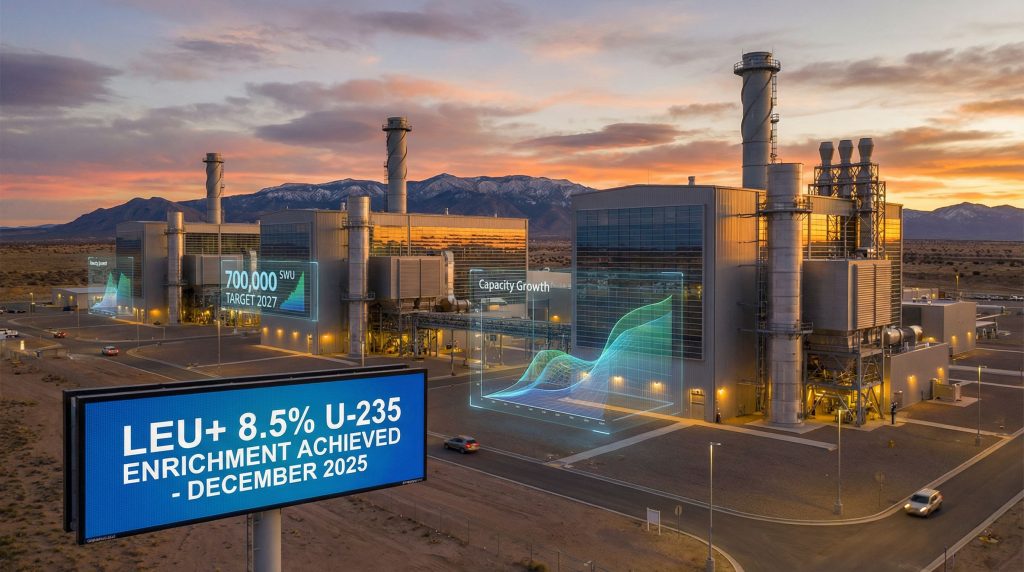
The National Enrichment Facility in New Mexico achieved a significant technical breakthrough on December 11, 2025, completing its first production run of uranium enriched to 8.5 percent U-235. This milestone represents the first time any commercial uranium enrichment facility in the United States has produced enrichment levels above the traditional 5 percent threshold, establishing domestic capability within the Low-Enriched Uranium Plus (LEU+) specification range of 5-10 percent U-235.
The Nuclear Regulatory Commission's authorization in September 2025 enabled enrichment operations up to 10 percent U-235 across all facility cascades, following comprehensive operational readiness reviews and enhanced safety system implementations. This regulatory approval preceded the actual production achievement by approximately ten weeks, demonstrating the systematic approach required for higher enrichment capabilities. Moreover, these developments occur against the backdrop of russian uranium import ban impact on the domestic supply chain.
LEU+ Production Capabilities and Technical Specifications
The 8.5 percent U-235 enrichment level achieved at Urenco USA represents a 70-185 percent increase above conventional reactor-grade LEU specifications of 3-5 percent U-235. This intermediate enrichment category bridges standard light water reactor fuel requirements and high-assay low-enriched uranium (HALEU) specifications used in advanced reactor designs.
The facility's third centrifuge cascade commenced standard LEU production on December 16, 2025, ahead of projected timelines. All three new cascades installed during 2025 achieved operational status before scheduled completion dates, indicating effective project management and technical execution capabilities. Additionally, these developments help address ongoing uranium market volatility affecting global supply dynamics.
Cascade Infrastructure Expansion Metrics
Urenco USA's current operational capacity stands at 4.9 million separative work units (SWU) annually, with expansion targets reaching 5.6+ million SWU by 2027. Separative work units measure the separation effort required during uranium enrichment, calculated based on feedstock concentrations, enriched product specifications, and depleted tails compositions.
The facility's goal includes installing 700,000 additional SWU capacity by 2027, representing substantial enhancement to domestic enrichment infrastructure. This capacity expansion follows a modular deployment strategy, enabling incremental additions without requiring facility shutdown or production interruption. However, advances in US uranium production tech also complement these enrichment capabilities.
Why Does LEU+ Technology Matter for America's Nuclear Renaissance?
Extended fuel cycle capabilities represent the primary advantage of LEU+ deployment across America's existing nuclear reactor fleet. Higher enrichment concentrations enable 24-36 month operating cycles compared to standard 18-24 month cycles with conventional LEU fuel, reducing shutdown frequency and associated maintenance scheduling costs.
Commercial quantities of LEU+ are anticipated for delivery by mid-2026, establishing a timeline for utility integration programs and reactor licence modifications. The availability of domestically produced LEU+ may accelerate deployment of accident-tolerant fuel designs for advanced reactor applications, reducing dependency on foreign enrichment sources for next-generation nuclear technologies. Furthermore, these developments come at a time when uranium spot price trends continue to fluctuate significantly.
Advanced Reactor Fuel Requirements and Compatibility
LEU+ serves dual functions within the nuclear fuel supply chain, providing enhanced performance for existing light water reactors while creating feedstock pathways for HALEU production. HALEU enrichment ranges from 10-20 percent U-235, required for various small modular reactor designs and microreactor applications targeting remote deployment scenarios.
The 8.5 percent enrichment achievement demonstrates technical capability approaching HALEU specifications, establishing domestic infrastructure for advanced reactor fuel supply chains. This capability positions American enrichment facilities to support emerging reactor technologies without relying on international suppliers for specialised fuel products.
Performance Characteristics and Operational Benefits
| Fuel Parameter | Standard LEU (3-5%) | LEU+ (8.5%) | Performance Enhancement |
|---|---|---|---|
| Operating Cycle Length | 18-24 months | 24-36 months | 33-100% extension |
| Burnup Potential | 45-55 GWd/tU | 60-75 GWd/tU | 33-36% improvement |
| Refueling Frequency | Annual/Biennial | Biennial/Triennial | Reduced maintenance cycles |
| Reactivity Control | Standard margins | Enhanced margins | Improved load-following |
How Do Urenco USA's Capacity Metrics Compare Globally?
The National Enrichment Facility's current capacity of 4.9 million SWU annually represents approximately 33 percent of total U.S. enrichment demand, establishing substantial but not monopolistic domestic market share. This capacity level requires complementary supply sources to fulfil remaining national requirements while providing strategic supply security benefits.
Urenco USA's workforce exceeds 500 employees, representing the largest uranium enrichment facility employment base in the United States. Expansion plans include additional hiring to support capacity increases and advanced enrichment operations requiring specialised technical expertise. Consequently, these developments help mitigate US uranium market disruptions affecting supply chain stability.
International Enrichment Infrastructure Context
Global uranium enrichment capacity operates through several major facilities employing gas centrifuge technology, laser enrichment systems, and legacy electromagnetic separation methods. Gas centrifuge efficiency measurements typically focus on energy consumption per SWU produced, though specific comparative data varies significantly based on facility age, technology generation, and operational parameters.
Urenco USA's 6th-generation European centrifuge technology incorporates advanced rotor designs and magnetic bearing systems, providing enhanced separation efficiency compared to earlier centrifuge generations. The modular cascade architecture enables incremental capacity expansion without requiring complete facility reconstruction or extended operational shutdown periods. Additionally, Urenco's enhanced capability programme demonstrates the company's commitment to expanding domestic uranium production capabilities.
Market Positioning and Supply Security Analysis
The facility's role within U.S. government efforts to eliminate Russian uranium dependency positions domestic enrichment capability within strategic supply security frameworks rather than purely commercial market contexts. This geopolitical dimension influences capacity planning, investment priorities, and operational scheduling decisions.
| Capacity Metric | Current (2025) | Target (2027) | Strategic Context |
|---|---|---|---|
| Annual SWU Capacity | 4.9 million | 5.6+ million | 33% domestic demand |
| Enrichment Range | 3-8.5% U-235 | 3-10% U-235 | LEU + LEU+ capability |
| Cascade Count | 3 new (2025) | Additional units | Modular expansion |
| Employment Level | 500+ workers | Expanding | Largest U.S. facility |
What Regulatory Framework Enables Higher Enrichment Operations?
Nuclear Regulatory Commission authorisation for 10 percent U-235 enrichment across all facility cascades required comprehensive safety system modifications and enhanced operational procedures. The September 2025 approval followed detailed technical reviews, operational readiness assessments, and non-proliferation compliance evaluations.
Higher enrichment capabilities necessitate enhanced material accountability systems, tracking uranium inventory compositions throughout the enrichment process. Physical security measures for facilities producing above 5 percent U-235 require additional protective systems and access controls compared to standard LEU production operations.
Safety Protocol Evolution and Compliance Requirements
The transition from standard LEU to LEU+ production involves modified cascade operations, altered gas handling procedures, and enhanced quality control systems ensuring precise U-235 concentrations in final products. Regulatory oversight includes periodic inspections, performance assessments, and compliance audits verifying adherence to approved operational parameters.
Material handling protocols for LEU+ require specialised procedures addressing higher enrichment levels while maintaining nuclear security standards. These protocols encompass storage systems, transportation containers, and inventory management processes designed for intermediate enrichment products.
How Does Cascade Technology Drive Production Efficiency?
Centrifuge cascade architecture enables continuous uranium enrichment through sequential separation stages, with each cascade containing multiple individual centrifuge units operating in coordinated configurations. The 6th-generation European technology deployed at Urenco USA incorporates advanced rotor materials, magnetic bearing systems, and enhanced separation efficiency compared to previous centrifuge generations.
Production scheduling optimisation coordinates enrichment campaigns across multiple cascades, balancing feedstock utilisation, product specifications, and tails management. Campaign planning involves determining optimal enrichment sequences, cascade allocation strategies, and quality control checkpoints throughout the production process.
Technical Specifications and Performance Parameters
Individual centrifuge units within each cascade operate at precisely controlled rotational speeds, creating centrifugal forces enabling uranium isotope separation based on molecular weight differences. The separation process concentrates U-235 isotopes in product streams while depleting U-235 concentrations in tails materials.
Energy efficiency metrics for modern gas centrifuge operations typically measure electricity consumption per SWU produced, though specific performance data varies based on operational parameters, maintenance schedules, and cascade configurations. Advanced magnetic bearing systems reduce friction losses and extend operational lifespans compared to mechanical bearing alternatives.
Quality Control and Material Accountability Systems
Enrichment operations require continuous monitoring of uranium isotope concentrations throughout the cascade system, ensuring product specifications meet customer requirements and regulatory limits. Analytical systems measure U-235 percentages at multiple process points, enabling real-time adjustments to maintain target enrichment levels.
Material balance accounting tracks uranium inventories from natural feedstock through enriched product and depleted tails streams. These accountability systems provide essential data for regulatory reporting, customer verification, and operational optimisation decisions.
The next major ASX story will hit our subscribers first
What Economic Impact Does Domestic Enrichment Create?
The National Enrichment Facility represents multi-billion dollar infrastructure investment in advanced nuclear fuel cycle capabilities, creating substantial direct employment and supply chain multiplier effects throughout New Mexico's nuclear industry cluster. The facility's 500+ employee workforce includes specialised technical positions requiring advanced nuclear engineering, chemistry, and physics expertise.
Regional economic development benefits extend beyond direct facility employment, supporting local suppliers, contractors, and service providers involved in enrichment operations. The skilled workforce requirements drive educational partnerships with regional universities and technical training programmes developing nuclear industry capabilities.
Investment Economics and Long-Term Contracting
Uranium enrichment facilities require substantial capital investment in centrifuge technology, infrastructure systems, and regulatory compliance programmes. These investment costs are typically recovered through long-term supply contracts with utility customers, providing stable revenue streams supporting facility operations and expansion programmes.
Supply security premiums reflect the strategic value of domestic enrichment capability compared to import dependency risks. Utilities may accept higher pricing for domestically produced enriched uranium to reduce supply chain vulnerabilities and geopolitical risks associated with foreign suppliers.
How Do Technical Specifications Enable Advanced Applications?
LEU+ fuel assemblies incorporating 8.5 percent U-235 enrichment provide enhanced performance characteristics for existing light water reactor operations, including extended fuel cycles, improved burnup potential, and enhanced reactivity control margins. These performance improvements translate to reduced operational costs through decreased refueling frequency and associated maintenance scheduling.
| Technical Parameter | Standard LEU (4.5%) | LEU+ (8.5%) | Improvement Factor |
|---|---|---|---|
| Theoretical Burnup | 45,000 MWd/tU | 65,000 MWd/tU | 44% increase |
| Cycle Length | 500-600 days | 650-800 days | 30-33% extension |
| Excess Reactivity | Standard margins | Enhanced margins | Improved control |
| Reload Fraction | 1/3 annual | 1/4 biennial | Reduced complexity |
Advanced Reactor Integration Opportunities
Small modular reactor designs frequently specify LEU+ fuel compositions to optimise performance characteristics and reduce facility complexity. The availability of domestic LEU+ supply enables SMR deployment programmes without dependency on international enrichment sources, supporting accelerated advanced reactor commercialisation timelines.
Microreactor applications targeting remote installations may utilise LEU+ fuel to extend operational periods between refueling operations. These applications prioritise fuel cycle length over enrichment costs, making higher enrichment levels economically attractive for specialised deployment scenarios.
What Timeline Governs Commercial LEU+ Deployment?
Commercial LEU+ production at Urenco USA is scheduled to commence by mid-2026, approximately six months following the initial production run achievement in December 2025. This timeline provides adequate period for customer qualification programmes, regulatory approvals for reactor licence amendments, and fuel fabrication facility preparations for LEU+ feedstock processing.
Utility qualification programmes involve testing LEU+ fuel assemblies under controlled reactor conditions, analysing performance characteristics, and obtaining regulatory approval for routine commercial utilisation. These qualification processes typically require 12-18 months for completion, depending on reactor design specifications and regulatory review timelines.
Production Ramp-Up and Customer Integration
The facility's target of 700,000 additional SWU capacity by 2027 supports expanded LEU+ production capability beyond initial commercial quantities. This capacity expansion enables multiple utility customers to integrate LEU+ fuel into their reactor operations while maintaining adequate supply availability for existing LEU requirements.
Supply chain coordination involves fuel fabrication facilities preparing equipment and procedures for LEU+ feedstock processing, ensuring compatibility with existing fuel assembly manufacturing processes. These preparations may require modified handling procedures, enhanced quality control systems, and specialised shipping containers for higher enrichment materials.
How Does This Achievement Impact US Energy Security Strategy?
Domestic LEU+ production capability reduces American nuclear industry dependence on foreign uranium suppliers, particularly following recent restrictions on Russian uranium imports. The establishment of higher enrichment capability within the United States provides strategic supply security benefits while supporting advanced reactor deployment programmes requiring specialised fuel compositions.
Import substitution benefits extend beyond immediate supply security considerations, creating domestic technical expertise and manufacturing capabilities essential for long-term nuclear industry competitiveness. The skilled workforce and technical infrastructure developed for LEU+ production provides foundation for potential HALEU production capability supporting advanced reactor deployment.
Future Expansion Potential and Strategic Positioning
Additional cascade installations beyond 2027 could further expand domestic enrichment capacity, potentially reaching 20 percent U-235 enrichment levels required for certain advanced reactor designs. This expansion potential positions American enrichment facilities to serve both domestic and allied nation requirements for specialised nuclear fuel products.
Technology leadership in uranium enrichment provides competitive advantages in international nuclear fuel markets while supporting U.S. nuclear export policy objectives. Advanced enrichment capabilities demonstrate American technical competence and industrial capacity within the global nuclear fuel cycle industry.
What Challenges Must Be Addressed for Continued Success?
Skilled workforce development represents a critical challenge for expanded enrichment operations, requiring specialised training programmes in nuclear engineering, chemistry, physics, and operational procedures specific to higher enrichment processes. Educational partnerships with universities and technical schools must develop curriculum addressing advanced enrichment technologies and safety protocols.
Supply chain optimisation involves managing uranium feedstock procurement, coordinating production scheduling across multiple cascades, and developing disposal or recycling pathways for depleted uranium tails materials. These supply chain considerations become more complex with higher enrichment operations requiring enhanced material accountability and security measures.
Regulatory and Market Dynamics
International competition from established enrichment suppliers requires maintaining cost competitiveness while meeting stringent safety and security requirements. Market dynamics include fluctuating uranium prices, changing customer demand patterns, and evolving regulatory requirements affecting operational costs and investment planning.
Customer demand fluctuations present capacity utilisation challenges, requiring flexible production scheduling and inventory management strategies. Long-term supply contracts provide revenue stability while maintaining operational flexibility to respond to changing market conditions and customer requirements.
"The establishment of LEU+ production capability at Urenco USA represents a watershed moment for American nuclear fuel independence, demonstrating both technical capability and strategic foresight in reducing foreign dependency whilst supporting advanced reactor deployment programmes."
Technical Note: Uranium enrichment percentages refer to U-235 isotope concentrations, with natural uranium containing approximately 0.7 percent U-235. Reactor fuel typically requires 3-5 percent U-235, while advanced reactor designs may specify higher enrichment levels up to 20 percent U-235 for specialised applications.
Investment Disclaimer: This analysis discusses uranium enrichment technology developments and does not constitute investment advice. Nuclear industry investments involve substantial technical, regulatory, and market risks that require professional financial consultation. Past performance of nuclear fuel cycle facilities does not guarantee future operational or financial success.
Considering Small-Cap Uranium Investment Opportunities?
Discovery Alert's proprietary Discovery IQ model delivers real-time alerts on significant uranium and mineral discoveries across the ASX, instantly empowering subscribers to identify actionable opportunities ahead of the broader market. Begin your 30-day free trial today and secure your market-leading advantage in uranium and mining investments.