May 24, 2026
Infrastructure Evolution Drives Industrial Concrete Production Demand
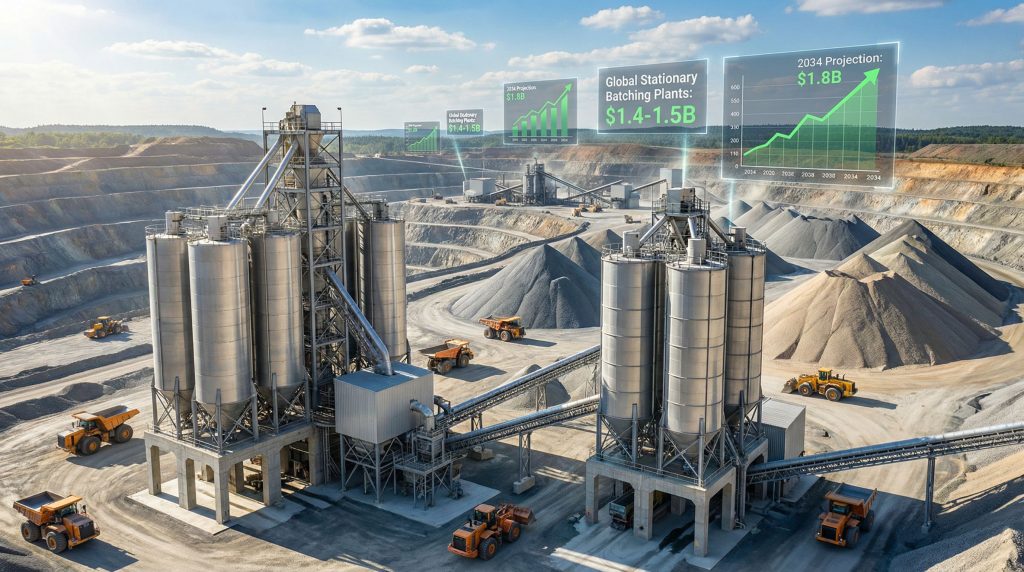
Global mineral extraction has transformed from simple resource harvesting into sophisticated industrial ecosystems requiring extensive permanent infrastructure. This evolution fundamentally reshapes how mining companies approach concrete production, moving beyond traditional ready-mix suppliers toward integrated on-site manufacturing systems. The global demand for stationary concrete batching plants in the mining sector continues expanding as operations require concrete for processing facilities, heavy equipment foundations, haul road networks, and containment structures, creating sustained requirements for reliable, high-capacity production capabilities.
The shift toward permanent concrete infrastructure reflects broader industry evolution trends in mining project economics and operational complexity. Unlike temporary construction projects, mineral extraction sites operate across multi-decade horizons, justifying capital investments in dedicated production systems. This extended operational timeline creates unique market dynamics where initial equipment investments are amortized over thousands of production cycles.
When big ASX news breaks, our subscribers know first
Economic Fundamentals of Permanent Concrete Infrastructure in Mining
Mining project lifecycles typically span 20 to 40 years depending on reserve characteristics and commodity market conditions, according to International Council on Mining and Metals documentation. This extended operational horizon fundamentally changes the economics of concrete supply, making permanent installations economically attractive compared to external supplier dependency.
Capital efficiency analysis reveals several key factors:
- Long-term operational stability reduces per-unit production costs over extended periods
- On-site production eliminates transportation premiums that can represent 30-50% of delivered concrete costs in remote locations
- Investment amortisation across decades of operation improves project returns
- Operational control reduces supply chain disruptions and scheduling constraints
The cost comparison framework between on-site production and external suppliers becomes particularly compelling in remote mining locations. Transportation costs scale dramatically with distance, fuel surcharges, and accessibility constraints. Mining operations in isolated regions often face logistics premiums that make permanent batching installations economically justified within the first operational years.
Production volume requirements in modern mining operations typically demand:
- Processing facility concrete: 30-120 cubic metres per hour during construction phases
- Haul road infrastructure: Continuous production capability for paved road systems
- Equipment foundations: High-specification concrete for crushing and milling equipment
- Tailings management: Large-volume concrete for containment and spillway systems
Technical Infrastructure Applications
Mining concrete applications extend far beyond basic structural requirements. Furthermore, processing facilities demand chemical-resistant concrete specifications due to exposure from ore processing chemicals and environmental conditions. Equipment foundations must withstand dynamic loads from heavy machinery operating continuously across decades.
Primary infrastructure categories include:
- Processing plant foundations: Permanent concrete structures supporting ore crushers, mills, and separation equipment
- Transportation networks: Concrete-paved haul roads reducing vehicle operating costs and extending equipment lifespan
- Storage and containment: Tailings dams, water management systems, and chemical storage facilities
- Support facilities: Maintenance workshops, equipment storage, and administrative buildings
The technical complexity of these applications requires consistent concrete quality and reliable production scheduling. In addition, automated batching systems achieve material accuracy within ±2% for aggregates and ±1% for moisture compensation, critical for mining applications where specification consistency impacts long-term structural performance.
Operational Advantages of Stationary Systems in Mining Environments
Remote mining locations present unique operational challenges that stationary concrete batching plants address through integrated design and permanent installation benefits. However, mining sites often operate in isolated regions where external concrete suppliers face logistical constraints, cost premiums, and reliability concerns.
Logistical integration provides several operational benefits:
- Direct connection with on-site aggregate crushing operations
- Elimination of external supplier dependency and scheduling constraints
- Enhanced project timeline control through dedicated production capacity
- Reduced vulnerability to supply chain disruptions
Mining operations with co-located mineral processing often generate crushed aggregate as operational byproducts or waste management solutions streams. Integrating concrete batching with existing aggregate processing represents logical operational synergy, reducing material costs while utilising otherwise waste materials.
Environmental Durability Requirements
Mining environments impose severe durability requirements on stationary concrete batching equipment. High dust concentrations from mining operations require sealed bearing systems and comprehensive air filtration. Temperature extremes in arctic mining operations or high-altitude locations demand specialised equipment protection and heating systems.
Technical specifications for harsh environments include:
- Corrosion-resistant materials and protective coatings for sulphide mining regions
- Enhanced environmental protection for electrical control systems
- Robust dust containment systems meeting environmental compliance standards
- Sealed hydraulic and pneumatic systems protecting against contamination
Automated control systems reduce manual intervention requirements, addressing labour availability challenges in remote locations while improving operational consistency. Digital monitoring enables real-time tracking of production metrics, material consumption, and equipment performance, supporting data-driven operations efficiency objectives.
Regional Development Patterns and Growth Dynamics
Disclaimer: Market size figures referenced in industry reports vary significantly and should be considered estimates rather than definitive market valuations. Specific regional growth projections represent analyst opinions and may not reflect actual market performance.
Regional mining development creates distinct patterns of infrastructure investment and concrete production demand. Areas with significant mineral resources experience sustained construction activity related to extraction facilities, processing operations, and transportation infrastructure. Consequently, this development cycle creates predictable demand for permanent concrete production systems.
Asia-Pacific mining infrastructure expansion reflects several trends:
- Rapid industrialisation driving mineral extraction project development
- Government infrastructure investments supporting resource sector growth
- Integration of mining operations with broader transportation and energy networks
- Modernisation of existing operations requiring upgraded concrete infrastructure
The region's mining investment patterns demonstrate sustained growth in copper, iron ore, and rare earth extraction operations. For instance, countries with established mining sectors continue expanding capacity while emerging producers develop initial extraction capabilities.
Africa and Latin America resource development characteristics include:
- Greenfield mining projects requiring complete infrastructure development
- Remote locations making on-site concrete production economically attractive
- Integration with regional infrastructure development supporting mining operations
- Foreign investment driving modern mining technology adoption
| Regional Development Factors | Infrastructure Impact | Concrete Demand Characteristics |
|---|---|---|
| Established mining regions | Capacity expansion and modernisation | High-volume, continuous production requirements |
| Emerging mining areas | Greenfield development | Large initial infrastructure investment |
| Remote locations | Complete infrastructure buildout | On-site production economic advantages |
| Integrated operations | Processing and transportation networks | Sustained concrete consumption patterns |
Investment Patterns and Market Dynamics
Mining companies increasingly evaluate concrete production as strategic infrastructure rather than construction services. This perspective shift recognises concrete supply reliability as critical for operational continuity and project risk management.
Investment decisions typically consider total cost of ownership across extended operational periods rather than initial capital expenditure alone. However, permanent batching installations demonstrate favourable economics when evaluated against decades of external supplier dependency and transportation cost exposure. According to market research, the global demand for stationary concrete batching plants in the mining sector is projected to reach significant market valuations by 2033.
Technology Integration and Automation Advances
Digital technology integration represents a fundamental shift in concrete batching plant capabilities, particularly valuable for mining applications requiring consistent quality and reliable production scheduling. Modern stationary plants incorporate Internet of Things (IoT) sensors, automated material handling, and real-time production optimisation.
Advanced control systems provide:
- Real-time production monitoring and quality control
- Material usage optimisation reducing waste and costs
- Predictive maintenance scheduling minimising downtime
- Integration with mining operation scheduling systems
Energy efficiency improvements in modern batching equipment reduce operational costs per cubic metre produced while supporting mining companies' sustainability objectives. Furthermore, enhanced mixing technology optimises cement utilisation and reduces material waste through precise batching accuracy.
Sustainability and Environmental Compliance
Environmental regulations increasingly influence equipment selection in mining operations, particularly in regions with stringent dust control and emissions standards. The sustainability transformation in mining requires stationary batching plants designed specifically for mining applications with comprehensive environmental protection systems.
Environmental compliance features include:
- Baghouse filtration systems achieving 99.5%+ dust collection efficiency
- Noise attenuation meeting local regulatory requirements
- Wastewater management systems for concrete plant washout and cleaning
- Recycling capabilities for unused concrete and aggregate materials
These environmental protection systems address regulatory requirements while supporting mining companies' environmental stewardship commitments. In addition, dust control technology becomes particularly critical in mining operations near populated areas or environmentally sensitive locations.
Digital monitoring capabilities enable:
- Automated environmental compliance reporting
- Real-time emissions monitoring and control
- Production optimisation reducing environmental impact
- Integration with mine-wide environmental management systems
Investment Analysis and Financial Considerations
Mining companies evaluate stationary concrete batching plant investments through comprehensive total cost of ownership analysis extending across entire project lifecycles. This approach considers capital expenditure, operational costs, and risk mitigation benefits compared to external supplier dependency.
Capital expenditure factors include:
- Initial equipment purchase and transportation to remote locations
- Site preparation and foundation requirements for permanent installation
- Integration costs with existing mining infrastructure and utilities
- Startup and commissioning expenses including operator training
Operational expenditure analysis encompasses:
- Energy consumption and utility costs in remote locations
- Maintenance and spare parts availability for specialised equipment
- Labour requirements and ongoing training needs
- Material sourcing and inventory management costs
Risk Mitigation Through Permanent Infrastructure
Stationary installations provide risk mitigation benefits that external supplier dependency cannot match. Supply chain disruptions, quality variations, and cost volatility represent significant operational risks for mining companies operating on tight production schedules.
Risk mitigation advantages include:
- Production capacity immune to external supplier capacity constraints
- Quality control eliminating specification variations from multiple suppliers
- Cost predictability through fixed operational parameters
- Schedule reliability supporting critical path mining operations
The break-even analysis for permanent installations typically occurs within 3-5 years of operation, depending on concrete consumption volumes and transportation cost premiums in remote locations. However, mining operations with high concrete consumption demonstrate faster payback periods.
How Do Financing Options Support Plant Investment?
Mining companies exploring permanent concrete production systems can leverage various capital raising methods to finance these strategic investments. Equipment financing options often include:
- Direct purchase with internal capital allocation
- Lease-to-own arrangements reducing initial capital requirements
- Project financing tied to specific mining development phases
- Vendor financing programmes from equipment manufacturers
The next major ASX story will hit our subscribers first
Future Market Development and Strategic Outlook
Disclaimer: Future market projections represent analytical opinions based on current trends and should not be considered guaranteed outcomes. Mining industry development faces numerous variables including commodity prices, regulatory changes, and technological disruption.
The convergence of mining industry modernisation, infrastructure investment, and technological advancement creates sustained demand drivers for stationary concrete batching plants. As mineral extraction becomes increasingly industrialised, concrete production systems evolve from construction support to strategic operational infrastructure.
Industry consolidation and standardisation trends suggest:
- Development of mining-specific batching plant configurations
- Standardised maintenance and spare parts systems for remote operations
- Integration between concrete production and mine planning software systems
- Automated production scheduling based on construction timelines and resource allocation
Circular economy principles increasingly influence mining operations, driving demand for concrete production systems supporting recycling, waste reduction, and resource optimisation. Furthermore, future equipment designs will likely incorporate enhanced recycling capabilities and integration with mining waste management systems.
Technology development directions include:
- Artificial intelligence optimisation of concrete mix designs for specific mining applications
- Automated quality control systems reducing manual intervention requirements
- Integration with mine-wide digital management platforms
- Enhanced environmental monitoring and compliance reporting capabilities
Long-term Growth Drivers
Global mineral demand continues expanding driven by renewable energy infrastructure, electric vehicle production, and emerging technology requirements. This sustained demand growth necessitates new mine development and capacity expansion at existing operations.
Key growth factors supporting market expansion:
- Expanding global mineral demand requiring new mine development
- Infrastructure modernisation at existing mining operations
- Regulatory requirements supporting environmental compliance and operational safety
- Technology advancement improving production efficiency and cost competitiveness
The transformation of mining from resource extraction to integrated industrial operations positions stationary concrete batching plants as essential infrastructure components. This strategic role ensures continued market development across global resource development regions, supporting both new mining project development and capacity expansion at established operations.
Mining companies increasingly recognise concrete supply reliability as fundamental to operational success, making permanent batching installations strategic investments rather than optional equipment. Consequently, this perspective ensures sustained demand growth aligned with global mining industry expansion and modernisation trends. The global demand for stationary concrete batching plants in the mining sector reflects this fundamental shift toward integrated operational infrastructure. According to industry analysis, the market continues demonstrating robust growth trajectories across all major mining regions.
Ready to Capitalise on Mining Infrastructure Investment Opportunities?
Discovery Alert's proprietary Discovery IQ model delivers real-time alerts on significant ASX mineral discoveries, instantly empowering subscribers to identify actionable opportunities ahead of the broader market as mining companies expand their operational infrastructure and production capabilities. Begin your 14-day free trial today and secure your market-leading advantage in the evolving mining sector.