June 10, 2026
The Industrial Raw Material at the Heart of Europe's Sanctions Debate
Raw material supply chains rarely attract the attention of foreign ministers, parliamentary coalitions, or prime ministers. Yet when an industrial oxide compound produced on Ireland's Shannon Estuary becomes the subject of urgent diplomatic meetings, cross-border legislative motions, and national government investigations, something structurally significant is unfolding. The story of Irish alumina exports to Russia is not simply a trade dispute. It is a window into the deepest contradictions of European sanctions architecture, and the difficulty of drawing a clean line between lawful commerce and geopolitical complicity.
When big ASX news breaks, our subscribers know first
Understanding Alumina: The Invisible Step Between Rock and Metal
To grasp why this debate carries such weight, it helps to understand where alumina sits in the aluminium production process. Bauxite ore, mined predominantly in Guinea, Australia, and Brazil, contains aluminium oxide bound up with other minerals. Refining that ore through the Bayer process produces alumina, a white powder that is then smelted using enormous quantities of electricity to produce primary aluminium metal.
This intermediate stage is often overlooked in public discussion of aluminium supply chains, yet it is arguably the most strategically sensitive point. Understanding bauxite supply fundamentals is essential here: smelters cannot function without a continuous alumina feed. Unlike electricity or labour, alumina cannot be easily substituted at short notice. A smelter that loses access to reliable alumina supply faces partial or total curtailment within weeks.
Alumina is not simply an industrial input. It is a structural dependency that connects upstream mining to downstream manufacturing, making control over refinery output one of the most consequential leverage points in global metals markets.
Russia operates some of the world's largest and most energy-efficient aluminium smelters, particularly in Siberia where cheap hydropower enables competitive production costs. However, Russia's domestic alumina refining capacity is insufficient to supply these smelters fully. The country's smelters at Krasnoyarsk and Sayanogorsk, both operated by Rusal, have historically relied on imported alumina feedstock to maintain output levels.
Aughinish Alumina: Scale, Ownership, and Strategic Position
Located on the Shannon Estuary in County Limerick, Aughinish Alumina is one of Europe's largest alumina refineries by output capacity. It processes bauxite into alumina at industrial scale and has been a significant employer in the regional economy for decades.
The facility is owned by Rusal, the Russian aluminium conglomerate with ownership links to businessman Oleg Deripaska. This ownership structure has attracted scrutiny since Russia's invasion of Ukraine in February 2022, raising questions about whether output from a European industrial facility should continue flowing into Russian smelting operations during an active armed conflict. Furthermore, the involvement of aluminium industry leaders such as Rusal in geopolitically sensitive supply chains has only deepened the complexity of this debate.
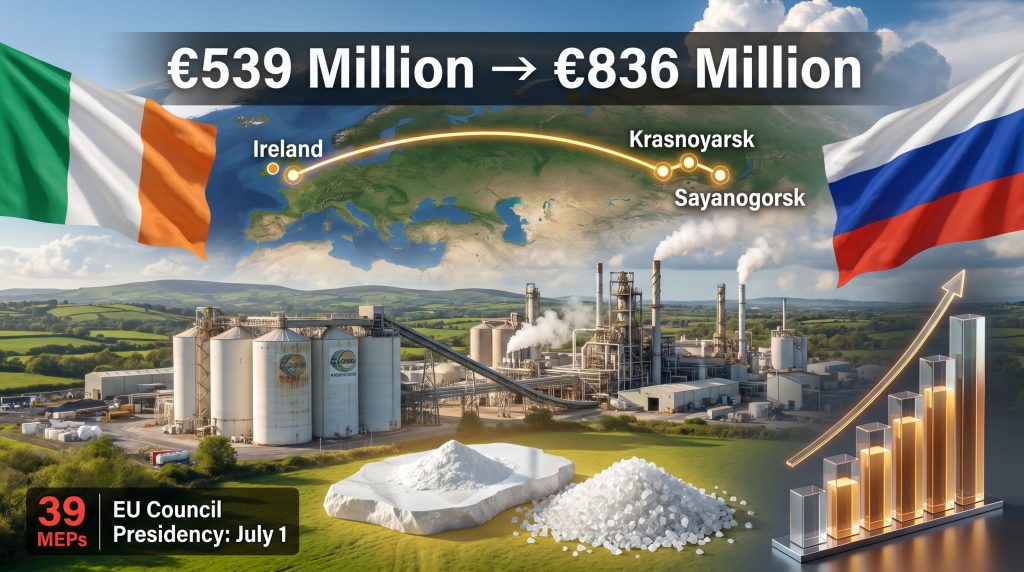
Investigative reporting has indicated that approximately half of Aughinish's annual output in 2024 was directed to the Krasnoyarsk and Sayanogorsk smelters in Siberia. This is not a marginal or incidental trade flow. It represents a material portion of one of Europe's most significant alumina refineries feeding into the industrial base of a country under broad EU sanctions.
The Export Value Trajectory: From €539 Million to €836 Million
The scale of Irish alumina exports to Russia has grown substantially since Russia's full-scale invasion of Ukraine in 2022. The following figures illustrate the trade's trajectory:
| Year | Estimated Irish Exports to Russia | Key Context |
|---|---|---|
| 2021 | €539 million | Pre-conflict baseline |
| 2023 | Significant increase begins | Post-invasion trade rerouting accelerates |
| 2024 | Approx. 50% of Aughinish output | Krasnoyarsk and Sayanogorsk identified as recipients |
| 2025 | €836 million | Peak controversy period |
The near-doubling of export value between 2021 and 2025 is not an anomaly driven by price fluctuations alone. It reflects a deliberate structural shift in trade flows, partly enabled by the disruption of other alumina supply routes to Russia following Western sanctions on related entities and the broader reconfiguration of global commodity markets after 2022.
This matters for a specific reason: global alumina markets have been structurally tight since 2022. Disruptions at major refineries in Jamaica and Australia, combined with Guinea's growing geopolitical risk profile, have tightened available supply for buyers outside China. Russia's smelters, facing restricted access to some traditional suppliers, have consequently leaned more heavily on the Aughinish relationship. The Kyiv Independent's reporting has been instrumental in revealing just how significantly these export volumes exceeded what the Irish government initially acknowledged.
Is the Trade Legal? The Critical Distinction Between Lawful and Acceptable
Here is the point that makes this debate so politically combustible. Under existing EU sanctions frameworks, alumina is not a restricted export to Russia. The trade is fully compliant with current law. No regulation, directive, or sanctions schedule prohibits Aughinish Alumina from shipping its output to Rusal's Siberian smelters.
Yet legal permissibility and political acceptability have progressively diverged since 2022, creating a growing tension that is now driving formal legislative action at the European Parliament level. The broader question of commodity sanctions impacts across global markets illustrates how difficult it is to draw clean boundaries around industrial inputs.
The reasons alumina has not been added to EU sanctions lists are partly evidentiary and partly economic:
- Evidentiary challenge: EU officials have noted the difficulty of conclusively tracing a supply chain from an Irish alumina refinery through a Siberian smelter to a specific military-adjacent end product. The chain of custody for industrial aluminium is diffuse and spans multiple jurisdictions.
- Economic consequences: Adding alumina to sanctions schedules would have immediate and significant economic effects on an EU member state, particularly on employment and industrial output in County Limerick.
- Precedent risk: Sanctioning an industrial input rather than a finished product or direct military supplier sets a complex precedent that could affect other EU industries with Russian-linked ownership structures.
The absence of alumina from EU sanctions schedules means the exports remain fully legally compliant. However, legal permissibility and political acceptability have increasingly diverged, a tension now driving formal legislative pressure at the European Parliament level.
Supply Chain Traceability: The Military End-Use Question
The controversy has been deepened by investigative journalism exploring whether aluminium produced from imported alumina feedstock at Russian smelters has found its way into supply chains serving sanctioned manufacturers or defence-related production. The Guardian's investigation into Aughinish Alumina's supply chain linkages suggests the connections are more direct than previously acknowledged.
This is where the evidentiary complexity becomes acute. Aluminium is a fungible industrial metal used across thousands of applications, from automotive components to aerospace structures to consumer electronics. Establishing that a specific tonne of aluminium produced at Krasnoyarsk originated from Aughinish alumina, and subsequently entered a weapons-relevant supply chain, requires a level of supply chain documentation that rarely exists in practice.
Irish Prime Minister Micheál Martin has acknowledged the concern, pledging a government investigation into the matter while noting that Ireland does not wish to be associated with exports that could potentially contribute to weapons or explosive materials production. His position reflects the core tension: genuine concern about ultimate end-use, combined with the legal and constitutional reality that Ireland cannot unilaterally sanction trade that EU law permits.
The next major ASX story will hit our subscribers first
The Political Pressure Building in Brussels
The pressure on this issue has been escalating at the EU institutional level across multiple fronts simultaneously:
- 39 MEPs have formally called on the European Commission to introduce a prohibition on alumina exports to Russia, representing a meaningful legislative constituency.
- EU foreign policy chief Kaja Kallas is expected to raise the alumina exports issue directly during a visit to Dublin, signalling that the matter has reached the highest levels of EU foreign policy attention.
- Ireland assumes the rotating EU Council Presidency on July 1, placing it in a structurally influential position over EU legislative and regulatory priorities at precisely the moment its own industrial exports are under scrutiny.
- Finnish MEP Mika Aaltonen has warned publicly that the alumina exports controversy could overshadow Ireland's EU presidency, adding a reputational dimension to what was initially a trade policy question.
The timing is politically awkward for Dublin in a structural sense. The Council Presidency places Ireland in a chair-holding role across EU legislative negotiations, making it difficult to be simultaneously defending an export trade that nearly four dozen elected EU representatives want banned. In addition, understanding metals geopolitics more broadly helps contextualise why Brussels is treating this as more than a bilateral Irish trade matter.
Political Pressure Snapshot
- 39 MEPs have formally called on the European Commission to prohibit alumina exports to Russia.
- Ireland assumes the rotating EU Council Presidency on July 1, amplifying external scrutiny.
- EU foreign policy chief Kaja Kallas is expected to raise the issue directly during her Dublin visit.
Scenario Analysis: Four Pathways Forward
The resolution of this issue is not binary. Several distinct policy pathways exist, each with different consequences for the refinery, for Ireland's economy, and for the broader EU sanctions architecture:
| Scenario | Likelihood | Economic Impact on Aughinish | Geopolitical Signal |
|---|---|---|---|
| Status quo maintained | Moderate | Neutral | Weak |
| EU-level export ban on alumina | Growing | High disruption risk | Strong |
| Irish domestic legislative action | Low (legal constraints) | Significant | Moderate |
| Voluntary industry redirection | Low | Variable | Symbolic |
Scenario 1: Status Quo. Alumina remains off sanctions lists, the trade continues, and political pressure dissipates without legislative resolution. This is plausible but increasingly difficult to sustain given the MEP coalition and Kallas's engagement.
Scenario 2: EU-Level Export Restriction. The European Commission, responding to parliamentary pressure, introduces targeted export controls on alumina to Russia. This would directly impact Aughinish's operational model and likely require restructuring of Rusal's Irish asset strategy.
Scenario 3: Irish Domestic Action. Ireland moves unilaterally ahead of EU consensus. This faces significant legal obstacles under EU single market architecture, making it the least likely formal outcome. Ireland cannot independently sanction trade that falls within EU competence without risking legal challenge.
Scenario 4: Voluntary Redirection. Rusal, responding to reputational pressure or anticipating regulatory change, redirects Aughinish output to non-Russian buyers. Given the current tightness of global alumina markets, alternative buyers would be readily available, however this outcome depends entirely on commercial incentives aligning with political optics.
The Global Alumina Market Context That Makes This Harder to Resolve
Resolving the Irish alumina exports to Russia question is complicated by broader structural dynamics in global alumina supply. Several factors are relevant:
- Guinea's dominance in bauxite supply, combined with political instability in the region, has made alumina refiners increasingly cautious about long-term feedstock security.
- China's growing alumina self-sufficiency has reduced its historical role as a swing buyer, tightening available supply for non-Chinese smelters seeking alternative sources.
- Australian refineries, historically major global alumina exporters, have faced operational pressures that have periodically reduced export availability.
- Trade rerouting through non-sanctioned jurisdictions remains a structural enforcement challenge. Even if Irish alumina were sanctioned, the opacity of global commodity trading means rerouted supply through intermediary countries cannot be easily detected or blocked.
These dynamics mean that Russian smelters are unlikely to easily replace Aughinish alumina with domestic production or readily available alternative imports. This paradoxically increases the strategic leverage that any potential export restriction would carry. For context, Europe supply chain risks extend well beyond alumina alone, suggesting that the Aughinish situation may be a preview of wider regulatory challenges ahead.
The Economic Stakes for Ireland: Employment and Regional Dependency
Any analysis of this debate that ignores the domestic Irish economic dimension is incomplete. Aughinish Alumina represents one of the most significant industrial employers in County Limerick. The refinery's operational footprint extends across direct employment, contractor relationships, and the broader regional supply chain.
Sanctions or export controls that effectively prevented the refinery from shipping to its primary buyer under current ownership would create immediate economic dislocation. The question of what happens to a major European industrial asset owned by a Russian entity in a post-sanction scenario is one that other EU nations have also confronted, without arriving at clean or replicable solutions.
The precedent set by how EU member states have handled Rusal-linked assets in their own jurisdictions provides limited guidance, as each case has involved different ownership structures, national industrial policies, and degrees of strategic exposure.
Frequently Asked Questions: Irish Alumina Exports to Russia
Is it illegal to export alumina from Ireland to Russia?
No. Under current EU sanctions frameworks, alumina is not a restricted export to Russia. The trade is legally compliant, though it has attracted significant political criticism.
Who owns Aughinish Alumina?
The County Limerick refinery is owned by Rusal, the Russian aluminium producer with ownership links to businessman Oleg Deripaska.
How much of Aughinish's output goes to Russia?
Investigative reporting indicates that approximately half of the refinery's annual output in 2024 was directed to two Russian smelters, Krasnoyarsk and Sayanogorsk, located in Siberia.
Why haven't EU sanctions been extended to cover alumina?
EU officials have cited the difficulty of conclusively establishing a direct link between Irish alumina exports and Russian military production chains. Extending sanctions also carries significant economic consequences for an EU member state hosting one of Europe's largest refineries.
What role does Ireland's EU presidency play in this debate?
Ireland assumes the rotating EU Council Presidency on July 1, placing it in a structurally influential position over EU legislative and regulatory priorities at a moment when its own industrial trade is under public and parliamentary scrutiny.
What are MEPs calling for?
A coalition of 39 Members of the European Parliament has formally requested that the European Commission introduce a ban on alumina exports to Russia.
Key Takeaways
The Irish alumina exports to Russia debate reflects tensions that are unlikely to resolve quickly or cleanly. Several structural conclusions stand out:
- The trade is legal but politically untenable for an EU member state on the cusp of its Council Presidency, creating a reputational exposure that transcends the legal question.
- The €539 million to €836 million trajectory between 2021 and 2025 confirms a structural shift in trade flows, not a temporary market anomaly.
- The 39-MEP coalition represents a meaningful and growing legislative constituency that is pushing the issue toward formal Commission-level consideration.
- The supply chain traceability problem connecting alumina to potential military end-uses remains the central evidentiary and legal challenge for those seeking to extend sanctions.
- Ireland's limited unilateral legal capacity under EU architecture means any durable resolution almost certainly requires coordinated action at the European level rather than domestic legislative intervention.
This article contains forward-looking analysis and policy scenario assessments. Readers should note that trade policy, sanctions frameworks, and geopolitical developments can change rapidly. Nothing in this article constitutes legal, financial, or investment advice.
Want to Stay Ahead of the Commodity Discoveries Shaping Global Supply Chains?
The geopolitical pressures reshaping alumina and aluminium markets are a reminder of how swiftly commodity supply dynamics can shift — and how significant the investment implications can be when they do. Discovery Alert's proprietary Discovery IQ model delivers real-time notifications on significant ASX mineral discoveries, translating complex commodity data into actionable opportunities the moment they emerge, so begin your 14-day free trial today and see why historic discoveries have generated extraordinary returns for investors who acted early.